Home 2014

PRODUCT SHOWCASE: Kurt Hydraulics Introduces 6W Couplings With High-Pressure Hoses For The Wind Energy Industry

0

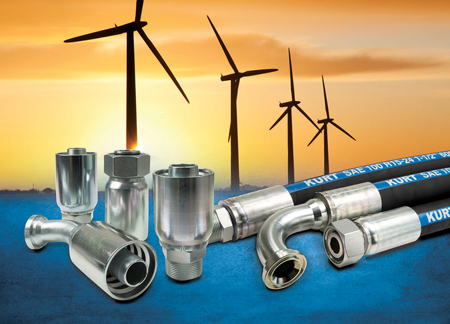
Kurt Hydraulics’ line of 6W Couplings combined with high pressure braided hose are ideally suited for applications that require high pressure capabilities and temperature ranges from -40°F to 250°F for the wind industry. The couplings are a one-piece, bite-the-wire crimp coupling with non-skive design to eliminate cover skiving before assembly to the hose.

The Kurt 6W Couplings make assembly simple, quick and enhance the hydraulic hose assembly to maintain more integrity which is crucial in many applications. The couplings eliminate leaks and in-field failures caused by shock and vibration and are ideally suited in wind energy hydraulic systems.

Kurt 6W Couplings are available in 85 different types and popular sizes of 1¼”, 1½, 2” and are designed to work with SAE R13 and 4SH hydraulic hose—also available from Kurt. The 6W couplings can withstand ultra high pressure of up to 6000 psi, and are suited for operations ranging in temperatures from -40° F to 250°F.

All Kurt couplings meet or exceed SAE specifications and are quality manufactured in accordance with ISO 9002/QS 9000 quality processes and systems. They are finished with RoHS compliant trivalent Chromum-6 Free process, a highly durable finish which exceeds the industry SAE standard by 4X hours of salt spray.

For more information, visit www.kurthydraulics.com.

PRODUCT SHOWCASE: Flex Element Design Couplings Add Electrical Insulation To Mechanical Components

0

Motion system designers have a new option to arrest electrical current. In addition to their primary function, Zero-Max CD® couplings are designed with composite flex elements that are non-conductive.

The flex element designed into Zero-Max CD couplings provides electrical insulation while protecting mechanical components from system overloads. CD Couplings do not pass electrical current through the coupling.

In addition to protecting from stray electrical current, CD couplings protect generators in a system from transferring lower reaction loads to the generator bearings. The coupling’s composite discs withstand all types of environmental elements, including temperature extremes from -40 to +70°C, and also moisture and chemicals.

Additional operating features include: zero backlash; excellent for reversing loads; smooth operation at high speeds; and compact size with a clamping system that fits most applications. CD couplings have very long life cycles and require less replacement over time. They provide exceptional cost-effectiveness and reduced waste.

CD couplings are available in many models and sizes, including custom designs for unusually large and challenging applications such as wind turbines. Standard models and sizes include single and double flex models with clamp style hubs with or without keyways. The torque capacities range from 40Nm to 1436Nm and beyond with speed ratings from 4400 RPM to 17,000 RPM.

All CD couplings are environmentally friendly and are manufactured of RoHS compliant materials.

For more information on products and services call (800) 533-1731, or visit www.zero-max.com.

Greensmith On Track To Integrate Four New Battery Types In 2014

0

Greensmith, a leader in grid-scale energy storage technologies has announced it is on track to successfully integrate an additional four new battery types in 2014, bringing the company’s total since inception to 12 using its battery-agnostic technology platform, now in its fourth generation. With over 23 MW of energy storage capacity to be deployed in 2014, Greensmith continues its rapid growth by serving an expanding list of strategic customers and channel partners looking to take full advantage of the company’s proven technologies and application expertise, including frequency regulation, grid stability/deferral, renewable integration, and commercial/industrial functionality.

Refined over many years of development, innovation, and real-world deployment experience, Greensmith’s software platform enables the rapid economic integration of both current and future battery technologies, always selected and configured according to the objectives and requirements of the target application. Although the company continues to develop and deliver turn-key energy storage systems at scale, a number of customers and partners are choosing to license Greensmith’s software and integration technology a-la-carte.

“From the very start, Greensmith believed that the potential for energy storage lay beyond ‘batteries-in-a-box,’ and that robust layers of software, integration and optimization were critical to capturing its full value”, said John Jung, Greensmith CEO. “It was also clear that a variety of battery alternatives, suitable for different application needs, would be available over time and therefore need to be easily integrated into a single, resilient technology architecture. So we built and advanced our battery-agnostic technology through multiple cycles of product development and delivery. We’re quite pleased to be on pace to successfully integrate our 12th battery type by the end of 2014— and while it’s become fashionable to proclaim battery-agnosticism in the marketplace, it’s quite another thing to have actually executed and delivered the goods.”


NEC Acquires Grid Energy Storage And Commercial Systems Business Of A123 Systems From Wanxiang

0

NEC Corporation has announced the acquisition of the A123 Energy Solutions business unit of A123 Systems, LLC. This acquisition, for approximately $100 million, strengthens the energy storage capability of NEC’s smart energy business, a core segment of its Mid-term Management Plan’s commitment to social infrastructure. A123 Energy Solutions will be integrated into the NEC Group of companies and operated globally as a key element of its business. An agreement on the terms of the deal has been finalized and a new company “NEC Energy Solutions” is slated to begin operation in June under the direction of NEC. A123’s existing cell manufacturing and sales, research and development, and automotive operations will remain the core focus of A123 Systems, LLC.

With this acquisition, NEC will become the world’s leading supplier of lithium-ion grid energy storage systems. A123 Energy Solutions has deployed over 110MW of its Grid Storage Solutions (GSS™) worldwide with the vast majority of these systems already in revenue service. The company will continue to supply systems using A123 Systems’ Nanophosphate® lithium-ion cells and support all existing installations. NEC Energy Solutions, with access to NEC Corporation’s world-class information communications technology (ICT) and A123 Energy Solutions’ system integrations expertise, is now better prepared to address the increasing global need for energy storage. In addition, NEC’s high quality, cost-effective lithium-ion technology adds to the ever-growing portfolio of energy storage technologies available for future use in A123 Energy Solutions’ GSS platform. At the same time, NEC will leverage A123 Energy Solutions’ experience in commercial batteries in order to serve NEC’s telecommunication carrier, enterprise and government customer base, thereby helping to drive the global expansion of NEC’s smart energy business.

ACCIONA Debuts Medium-Wind Site Turbine In Las Vegas

0

ACCIONA Windpower has upgraded its AW125/3000 wind turbine, with a new version specially designed for medium-wind sites (IEC IIb). This new design was highlighted at the WINDPOWER 2014.

The upgraded design of the AW125/3000 allows for siting at locations with higher average wind conditions and lower turbulence intensity.

The AW125/3000 combines a 125-meter rotor with a three megawatt wind turbine generator and is available on multiple tower heights ranging from 87.5 meters to 140 meters.  With the 87.5m tower, the AW125/3000 IEC IIb wind turbine—which has 61.2-meter blades—is uniquely positioned to deliver maximum Annual Energy Production while staying within a 150-meter tip-height threshold in sites with aviation permitting constraints.  

The first Design Assessment for the AW125/3000 IEC IIb is expected by the end of 2014 and deliveries are available in early 2015.

GE’s Wind PowerUp Reaches 1,000 Installations

0

GE recently announced that its Wind PowerUp platform has secured more than 1,000 units under contract to date. PowerUp is a customized software-enabled platform that allows wind farm operators to increase annual energy production (AEP) on their turbines by up to 5 percent, taking into account environmental conditions. A 5 percent increase in energy output translates to up to a 20 percent increase in profit per turbine.

“The industry’s response to Wind PowerUp has been exciting to see over the past seven months,” said Anne McEntee, president and CEO of GE’s renewable energy business. “We have been working with our customers to develop customized solutions ideal for their fleet and working with them in new ways that helps them win.”

PowerUp adjust performance dials, including speed, torque, pitch, aerodynamics, and turbine controls with the goal of maximizing the power output of a wind farm.

Sage Oil Vac Receives 2014 President’s “E” Award

0

The U.S. Department of Commerce has awarded Sage Oil Vac, Inc. of Amarillo, Texas the 2014 President’s “E” Award in recognition for the company’s achievements in making significant contributions to the increase of U.S. exports.

Sage Oil Vac has demonstrated a sustained commitment to U.S. export expansion. The “E” Award Committee has recognized Sage’s innovation in the development of services for the wind turbine industry, as well as the company’s customization of products for export markets. Companies receiving this award have contributed to national export expansions efforts that support the U.S. economy and create American jobs.

 The President’s “E” Award was created by President John F. Kennedy in 1961, and more than 2,500 firms have been recognized through the “E” Awards since the program’s inception. The “E” Award program is managed by the U.S. Commercial Service, which nominates the recipients. Through 108 domestic offices and locations in more than 70 countries, ITA offers programs and services focused on export promotion.

 The primary criterion for the President’s “E” Award for Exports is four years of successive export growth, usually accompanied by a rising percentage of export sales within total sales. The application should demonstrate export expansion that is measurable, innovative, sustainable, and has broad impact.

Prairie Wind Completes Section Of Transmission Line

0

Kansans are a step closer to benefitting from a more robust electric transmission system with a portion of the Prairie Wind Transmission line now in service. About 78 miles of the 108-mile, double circuit 345 kV transmission line is complete and moving electricity between Wichita and Medicine Lodge. The line was energized Wednesday. The remainder of the Prairie Wind project, which will take the line from Medicine Lodge south to the Kansas/Oklahoma border, is scheduled to be complete by the end of 2014.

The Prairie Wind line is part of a broader project commonly referred to as the Y-Plan. The Y-Plan will alleviate congestion in the region’s transmission grid.

“Construction of the line has brought good paying jobs to the communities near the line, giving local economies a boost,” said Kelly Harrison, president of Prairie Wind Transmission and vice president, transmission of Westar Energy. “This line is like an electricity super highway Portion of Prairie Wind Transmission line energized that will strengthen the state’s transmission system for decades, providing Kansas communities with more reliable electricity, enabling development of wind energy and giving Kansans access to lower cost electricity.”

Under this plan, OG&E will continue the Prairie Wind line from the Kansas/Oklahoma border to Woodward, Okla. ITC Great Plains is constructing a line from Medicine Lodge to a Clark County, Kan. substation and then to Spearville, Kan. All of the transmission line projects under the Y-Plan are scheduled to be complete by the end of this year.

Through careful project planning and management, the estimated cost of the Prairie Wind line was lowered last fall to $170 million, about 25 percent less than original estimates of $225 million. Prairie Wind is a joint venture formed by Westar Energy and Electric Transmission America — a joint venture of an American Electric Power subsidiary and MidAmerican Transmission — to build and own new electric

Lucintel Forecasts Global Wind O&M Market To Reach $14 Billion By 2018

0

The global wind operation and maintenance market is set to expand with stable demand potential in the near future. The wind operation service market accounted for more than 20 percent and the wind maintenance service market accounted for more than 75 percent of the global wind operation and maintenance marketing 2012. The three main components of wind turbines, gearbox, generator, and wind blades account for more than 50 percent of repair and replacement servicing needs. According to market forecasts, the global wind operation and maintenance market is expected to reach $14,014 million by 2018.

Lucintel, a leading global management consulting and market research firm, has conducted a competitive analysis on this market and presents its findings in "Growth Opportunities in Global Wind Operation and Maintenance Market 2013-2018: Trend, Forecast, and Opportunity Analysis.” This study provides a concise overview of the global wind operation and maintenance market in terms of value and projected annual growth.

Lucintel discusses the various challenges and opportunities faced by the wind O&M market. Efficient and timely operation and maintenance servicing has a positive impact — both on reducing repair costs and improved performance output of large machines. In this market, it is very critical to have ready inventory of spare parts or a strong supply chain that can respond to the repair needs when they occur.

Lucintel's study encompasses the major drivers. Mostly, aging wind turbines cause unexpected failure of components, such as gearboxes, generators, and rotor blades, which is a major driver for wind operation and maintenance costs. So, improving turbine reliability is a priority for the manufacturers.

This report highlights different aspects of the wind operation and maintenance market. Due diligence has been given to the current market scenario. Europe is the leader in this market with the highest market share, followed by APAC.

The global wind operation and maintenance market is expected to grow significantly in near future. The top players need to formulate effective marketing strategies to take advantage of the opportunities, resulting in improved revenue and profitability.

Lawmakers Praised For Introducing Rural Wind Energy Development Act

0

Representatives Earl Blumenauer (OR-03) and Tom Cole (OK-04) introduced the Rural Wind Energy Development Act to provide an investment tax credit to ranchers, farmers, and small businesses to offset the up-front costs of owning a distributed wind turbine.  This modest expansion of current law will keep small business energy jobs growing across the United States.

Distributed wind projects are present in all 50 states, providing clean, homegrown, affordable power and economic development across the United States.  These systems are commonly, but not always, installed on residential, agricultural, commercial, industrial, and community sites and can range in size from a few-hundred-watt, off-grid turbine at a remote cabin or a 5-kW turbine at a home to a multi-MW turbine at a manufacturing facility.

“I applaud Representatives Blumenauer and Cole for their leadership at this critical time for our industry,” said Jennifer Jenkins, Executive Director of the Distributed Wind Energy Association. “This industry is bigger than just one job or one type of turbine. We have an entire supply chain here in the U.S. providing parts for a wide range of distributed wind systems, while employing Americans and providing American-produced electricity. This legislation will provide stability and certainty for the entire distributed wind market and allow this American success story to go on.”

The Congressmen issued the following statements earlier today:

“Community wind energy not only creates American-produced electricity, but American jobs as well,” said Blumenauer. “Approximately 90% of distributed wind turbines sold in the U.S. are made here, according to domestic manufacturing content, creating non-exportable, family wage jobs.”

“I am pleased to once again work with my friend and colleague in furthering the success of the same credit we worked to create in 2008,” said Cole. “Not only does the credit play an important role in encouraging and developing an all-of-the-above energy approach for our nation, but it also ensures that America continues to be a leader in innovation. By modestly increasing this credit, we can continue to encourage economic development, especially in our rural communities.”

The existing investment credits, which may be taken in lieu of the federal Production Tax Credit for large-scale wind projects, have worked very well, but are too limiting. This bill strikes the existing 100 kilowatt nameplate limitation for small wind systems, and expands the maximum wind turbine size to 20 megawatts, in line with the Federal Energy Regulatory Commission definition of distributed wind power.

This will provide stability and certainty for the distributed wind market and unlock the necessary investment to grow our global leadership role in distributed wind power, while helping Americans take advantage of clean, renewable, affordable power.

EPA Proposes Carbon Reduction Guidelines

0

The U.S. Environmental Protection Agency has released its Clean Power Plan proposal, which for the first time cuts carbon pollution from existing power plants, the single largest source of carbon pollution in the United States. The proposal will protect public health, move the United States toward a cleaner environment and fight climate change while supplying Americans with reliable and affordable power.
Power plants account for roughly one-third of all domestic greenhouse gas emissions in the United States. While there are limits in place for the level of arsenic, mercury, sulfur dioxide, nitrogen oxides, and particle pollution that power plants can emit, there are currently no national limits on carbon pollution levels.

With the Clean Power Plan, EPA is proposing guidelines that build on trends already underway in states and the power sector to cut carbon pollution from existing power plants, making them more efficient and less polluting.

By 2030, steps EPA is taking will:

· Cut carbon emission from the power sector by 30 percent nationwide below 2005 levels, which is equal to the emissions from powering more than half the homes in the United States for one year;

· Cut particle pollution, nitrogen oxides, and sulfur dioxide by more than 25 percent as a co-benefit;

· Avoid up to 6,600 premature deaths, up to 150,000 asthma attacks in children, and up to 490,000 missed work or school days—providing up to $93 billion in climate and public health benefits; and

· Shrink electricity bills roughly 8 percent by increasing energy efficiency and reducing demand in the electricity system.

The Clean Power Plan will be implemented through a state-federal partnership under which states identify a path forward using either current or new electricity production and pollution control policies to meet the goals of the proposed program. The proposal provides guidelines for states to develop plans to meet state-specific goals to reduce carbon pollution and gives them the flexibility to design a program that makes the most sense for their unique situation. States can choose the right mix of generation using diverse fuels, energy efficiency and demand-side management to meet the goals and their own needs. It allows them to work alone to develop individual plans or to work together with other states to develop multi-state plans.

Also included in the proposal is a flexible timeline for states to follow for submitting plans to the agency—with plans due in June 2016, with the option to use a two-step process for submitting final plans if more time is needed. States that have already invested in energy efficiency programs will be able to build on these programs during the compliance period to help make progress toward meeting their goal.


IEA: $48 Trillion Needed To Meet Global Energy Needs To 2035

0

Meeting the world's growing need for energy will require more than $48 trillion in investment over the period to 2035, according to a special report on investment released by the International Energy Agency (IEA) as part of the World Energy Outlook series. Current annual investment in energy supply of $1.6 trillion needs to rise steadily over the coming decades towards $2 trillion. Annual spending on energy efficiency, measured against a 2012 baseline, needs to rise from $130 billion today to more than $550 billion by 2035.

"The reliability and sustainability of our future energy system depends on investment," said IEA Executive Director Maria van der Hoeven. "But this won't materialize unless there are credible policy frameworks in place as well as stable access to long-term sources of finance. Neither of these conditions should be taken for granted. There is a real risk of shortfalls, with knock-on effects on regional or global energy security, as well as the risk that investments are misdirected because environmental impacts are not properly reflected in prices."

Newly compiled data show how annual investment in new fuel and electricity supply has more than doubled in real terms since 2000, with investment in renewable source of energy quadrupling over the same period, thanks to supportive government policies. Investment in renewables in the European Union has been higher than investment in natural gas production in the United States. Renewables, together with biofuels and nuclear power, now account for around 15 percent of annual investment flows, with a similar share also going to the power transmission and distribution network. But a large majority of today's investment spending, well over $1 trillion, is related to fossil fuels, whether extracting them, transporting them to consumers, refining crude oil into oil products, or building coal and gas-fired power plants.

Investment decisions are increasingly being shaped by government policy measures and incentives. While many governments have retained direct influence over energy sector investment, some stepped away from this role when opening energy markets to competition:  many of these have now stepped back in, typically to promote the deployment of low-carbon sources of electricity. In the electricity sector, administrative signals or regulated rates of return have become, by far, the most important drivers for investment: the share of investment in competitive parts of electricity markets has fallen from about one-third of the global total ten years ago to around 10 percent today.

Of the cumulative global investment bill to 2035 of $48 trillion in the report's main scenario, around $40 trillion is in energy supply and the remainder in energy efficiency. Of the investment in energy supply, $23 trillion is in fossil fuel extraction, transport and oil refining; almost $10 trillion is in power generation, of which low-carbon technologies – renewables ($6 trillion) and nuclear ($1 trillion) – make up the lion's share; and a further $7 trillion in transmission and distribution. More than half of the energy-supply investment is needed just to keep production at today's levels, that is, to compensate for declining oil and gas fields and to replace power plants and other equipment that reach the end of their productive life. The $8 trillion of investment in energy efficiency is concentrated in the main consuming markets, the European Union, North America and China: 90 percent is spent in the transport and buildings sectors.


Maryland Energy Association Releases Report On Offshore Wind Area

0

The Maryland Energy Administration (MEA) recently announced the release of a report detailing a high-resolution geophysical and oceanographic survey of the entire Maryland Wind Energy Area. The survey was the first by any state to map the seafloor geology of a complete Wind Energy Area. This information is critical to optimizing the siting, design and layout of an offshore wind project.

MEA contracted with Coastal Planning & Engineering to pilot the Scarlett Isabella along lines set 150 feet apart, over 1,500 nautical miles. The team gathered data characterizing the depth, seafloor conditions and seabed geology, as well as looking for submerged cultural resources such as shipwrecks.

This report outlines the physical environment of the Wind Energy Area, including the composition of geological layers, the location and nature of hazards, and distribution of cultural resources.  The project trained students at University of Maryland Eastern Shore to serve as federally certified Protected Species Observers on the mission, ensuring that marine mammals and other protected species were not impacted, while providing students with skills in high demand. Teams of scientists from University of Maryland Baltimore County deployed LIDAR, weather balloons and other tools to gather valuable data for refining power production and climate models of the Wind Energy Area.

Vestas Lands 148 MW Order From First Wind

0

Vestas has received an order for 48 V112-3.0 MW turbines for the 148-MW Oakfield project in the state of Maine. The order is a call-off on the master supply agreement announced in December 2013 for multiple U.S. projects—the potential of which totals 718 MW. With today’s order, Vestas has secured 298 MW under this MSA.  

The V112-3.0 MW turbines—for which Vestas has already received almost 6 GW of orders—will be supplied for this project. The project will also include a 10-year Active Output Management 5000 service agreement. AOM 5000 is an energy-based availability guarantee that ensures the turbines are operational when the wind is blowing. This service option includes the VestasOnline® surveillance system that remotely controls and monitors the turbines and minimizes lost production by predicting when maintenance may be required.

"We're pleased to continue the construction of the Oakfield Wind project and look forward to installing Vestas’ V112-3.0 MW turbines there," said First Wind CEO Paul Gaynor. "The Vestas turbines at our Bull Hill project in Maine and the Palouse project in Washington State have performed well and we expect the Oakfield project to enjoy similar success."

“This order underlines the strong partnership between Vestas and First Wind, one of the leading wind developers in the U.S.” said Chris Brown, President of Vestas’ sales and service division in the United States and Canada. “This is the fourth project Vestas and First Wind are carrying out together and the second in Maine. The first project in Maine has achieved 99 per cent availability since it was commissioned in 2012, a testament to the performance of our technology and service capabilities that customers expect from Vestas.”

Deliveries for the Oakfield project will take place in the second quarter of 2015, with commissioning expected by the fourth quarter of 2015. Vestas’ factories in Colorado are expected to be involved in the manufacturing for this project. To meet customer demand, Vestas is adding more workers at three of its Colorado factories—the blade factory in Windsor as well as the blade and nacelle factories in Brighton. Vestas is recruiting now and expects to add hundreds of production workers in the first half of 2014 in Windsor and Brighton, primarily at the two blade factories. Interested candidates can apply at ElwoodWindJobs.com.

Source: Vestas

DWEA Awarded Grant To Streamline Distributed Wind Supply Chain

0

The U.S. Department of Commerce’s National Institute of Science and Technology (NIST) announced that the Distributed Wind Energy Association was awarded a 2-year grant to form a consortium of distributed wind energy equipment manufacturers, suppliers, customers, and university researchers and develop a roadmap to identify common manufacturing gaps, prioritize actions to close these gaps, and foster rapid transfer of solutions.

“Our vision is to leverage industry-academic dialogue to develop strategies to aid distributed wind industry growth and advance innovative manufacturing techniques by increasing production volumes and reducing lifecycle costs while maintaining high quality,”  said Jennifer Jenkins, Executive Director of DWEA.  “As both developing and industrialized nations seek to address climate and economic challenges, the U.S. distributed wind industry stands poised to provide cost-effective solutions and claim its share of a projected $2 trillion global market.”

“In order for the U.S. distributed wind industry to remain leaders in this important space, it is critical that we increase collaboration and improve product offerings through the advancement of technology while driving down component costs,” said Troy Patton of Northern Power Systems. “This new Consortium will allow us to share ideas and forge ahead as global leaders in the growing market of distributed wind.”

“I’m thrilled to be leading such an important effort to improve competitiveness and drive down costs of wind projects installed behind the meter,” said Heather Rhoads-Weaver of eFormative Options. “This project will bring together all the critical stakeholders in our industry to help U.S. distributed wind turbine and component manufacturers–and members of the entire value chain–maintain their edge in a growing global market.”

NIST has developed in interactive map showing initial SMART Wind project partners, which DWEA will update as the Consortium develops.

Source: Distributed Wind Energy Association

ICUEE—The Demo Expo Takes Number Two Spot In Top-Trade-Shows List

0

ICUEE—The Demo Expo was recently named the number two spot in the recently-announced Top U.S. Trade Shows list from the Trade Show News Network (TSNN).

TSNN annually ranks shows by exhibit space net square footage. For 2013, ICUEE won for its record-breaking size of more than 1.17 million net square feet, second only to the 2013 CES show. TSNN is a leading online information resource for the exhibitions and events industry.

The next ICUEE, International Construction and Utility Equipment Exposition, will be held September 29-October 1, 2015 at the Kentucky Exposition Center in Louisville, Kentucky.

The biennial show features extensive test-drive opportunities where attendees can operate the equipment themselves in job-like conditions.

“Attendees say this is where they prepare for the future and exhibitors cite the high quality of attendees,” stated Sara Truesdale Mooney, ICUEE show director and AEM senior director, exhibitions and strategy.

“We’re planning for more equipment demos and interactive product demonstrations than ever before and targeted industry best-practices education. ICUEE 2015 will provide the products and knowledge attendees need to stay competitive.”

ICUEE perennially ranks among the top five in trade-show-industry exhibition rankings. AEM, the Association of Equipment Manufacturers, is show owner and producer and focuses on creating a high-quality show experience. AEM shows are industry-run in which participants have a voice in show planning, industry partnerships enhance value, costs are carefully monitored, and revenues go back into industry services.

ICUEE targets utilities and utility contractors in the following sectors: electric, telecommunications, wastewater, water, natural gas, cable, and rail. For more information on attending or exhibiting, visit www.icuee.com.

TPI Buys Out JV Interest In Turkey

0

TPI Composites has announced that it has acquired the remaining twenty-five percent interest in its joint venture wind blade operation in Izmir, Turkey.

TPI launched the business in 2012 with a local partner ALKE ÎNŞAAT and has grown the operation into the largest wind blade manufacturer in the region.

TPI has invested more than $35M to fully capitalize the Turkey operation, including a complete upgrade to its 355,000 square-foot building.

“We are very pleased to have signed long-term agreements for our initial capacity in Turkey with leading customers in the region,” said Steve Lockard, president & CEO of TPI Composites.  “It is a great thrill to see our world-class operation take shape and ramp to its full capacity.”


PRODUCT SHOWCASE: Free Web Tool Facilitates Cable Transit Design And Installation

0

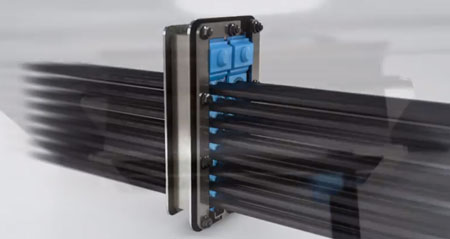
Roxtec recently announced the release of its Roxtec Transit Designer 2.0—a free, web-based tool that simplifies both product selection according to needs and requirements and the process of designing, purchasing, and installing cable and pipe transits.

Giuseppe Principato is an instrument designer in Italy  and one of thousands of designers and engineers in more than 80 countries who have already discovered the benefits of the new design software. He works with tasks such as developing material requisitions for bulk materials as well as with preparing cable routing, cable entries, wiring, installation details, and job specifications.

“I use the Roxtec Transit Designer every time a multi-cable transit is accepted or requested by our customer,” he said. “It is easy to use and understand, and it helps me save time. You can customize cable transits and easily change the arrangement of the transit whenever you need.”

Simple enough that designers just enter cable schedule, sealing requirements, and installation preferences—the tool generates documents such as bill of materials and CAD drawings. They can share their work with project teams anywhere in the world. And the chat function offers them instant access to the Roxtec expertise.

To start using the Roxtec Transit Designer, designers and engineers are invited to register at https://transitdesigner.roxtec.com/us/start.

Greensmith On Track To Integrate Four New Battery Types In 2014

0

Greensmith, a leader in grid-scale energy storage technologies has announced it is on track to successfully integrate an additional four new battery types in 2014, bringing the company’s total since inception to 12 using its battery-agnostic technology platform, now in its fourth generation. With over 23 MW of energy storage capacity to be deployed in 2014, Greensmith continues its rapid growth by serving an expanding list of strategic customers and channel partners looking to take full advantage of the company’s proven technologies and application expertise, including frequency regulation, grid stability/deferral, renewable integration, and commercial/industrial functionality.

Refined over many years of development, innovation, and real-world deployment experience, Greensmith’s software platform enables the rapid economic integration of both current and future battery technologies, always selected and configured according to the objectives and requirements of the target application. Although the company continues to develop and deliver turn-key energy storage systems at scale, a number of customers and partners are choosing to license Greensmith’s software and integration technology a-la-carte.

“From the very start, Greensmith believed that the potential for energy storage lay beyond ‘batteries-in-a-box,’ and that robust layers of software, integration and optimization were critical to capturing its full value”, said John Jung, Greensmith CEO. “It was also clear that a variety of battery alternatives, suitable for different application needs, would be available over time and therefore need to be easily integrated into a single, resilient technology architecture. So we built and advanced our battery-agnostic technology through multiple cycles of product development and delivery. We’re quite pleased to be on pace to successfully integrate our 12th battery type by the end of 2014— and while it’s become fashionable to proclaim battery-agnosticism in the marketplace, it’s quite another thing to have actually executed and delivered the goods.”
 

NEC Acquires Grid Energy Storage And Commercial Systems Business Of A123 Systems From Wanxiang

0

NEC Corporation has announced the acquisition of the A123 Energy Solutions business unit of A123 Systems, LLC. This acquisition, for approximately $100 million, strengthens the energy storage capability of NEC’s smart energy business, a core segment of its Mid-term Management Plan’s commitment to social infrastructure. A123 Energy Solutions will be integrated into the NEC Group of companies and operated globally as a key element of its business. An agreement on the terms of the deal has been finalized and a new company “NEC Energy Solutions” is slated to begin operation in June under the direction of NEC. A123’s existing cell manufacturing and sales, research and development, and automotive operations will remain the core focus of A123 Systems, LLC.

With this acquisition, NEC will become the world’s leading supplier of lithium-ion grid energy storage systems. A123 Energy Solutions has deployed over 110MW of its Grid Storage Solutions (GSS™) worldwide with the vast majority of these systems already in revenue service. The company will continue to supply systems using A123 Systems’ Nanophosphate® lithium-ion cells and support all existing installations. NEC Energy Solutions, with access to NEC Corporation’s world-class information communications technology (ICT) and A123 Energy Solutions’ system integrations expertise, is now better prepared to address the increasing global need for energy storage. In addition, NEC’s high quality, cost-effective lithium-ion technology adds to the ever-growing portfolio of energy storage technologies available for future use in A123 Energy Solutions’ GSS platform. At the same time, NEC will leverage A123 Energy Solutions’ experience in commercial batteries in order to serve NEC’s telecommunication carrier, enterprise and government customer base, thereby helping to drive the global expansion of NEC’s smart energy business