





Home 2014

TPI Composites And Acciona Windpower Sign Long-Term Supply Agreement

0

Blade manufacturer opens its second plant in China, re-opens Mexico plant in order to serve global wind market


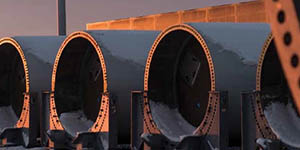
TPI Composites, a leading global wind blade manufacturer, has announced that it has signed a multi-year supply agreement with Acciona Windpower SA to provide wind blades from TPI’s new factory in Dafeng, China.  Acciona intends to export these blades for projects around the world including North America. TPI will also manufacture high-precision molds and assembly systems to produce Acciona’s blades at TPI’s recently announced advanced composite tooling facility in Taicang.

“TPI is excited to continue to support new customers on a global basis, and this agreement with Acciona validates the strength and value of TPI’s dedicated supplier model,” said Steve Lockard, president & CEO of TPI Composites. “The Acciona Group is one of the largest developers and owners of wind power projects in the world, and we are looking forward to supporting its expanding wind turbine business globally.  Acciona’s strength and success is demonstrated in its recent 300MW order in the U.S.”

Jose Luis Blanco, CEO of Acciona Windpower SA, added, “We are very pleased to be partnering with TPI for the supply of AW116/125 wind blades for worldwide use.  Acciona’s track record of reliability and TPI’s experience as an independent wind blade manufacturing partner will serve our needs well for years to come.”

TPI has been operating in China (Taicang, Jiangsu) since 2008 and is expanding its facilities with the addition of its Dafeng, Jiangsu facility. The location allows TPI to serve multiple customers and cost-effectively deliver products to the Chinese and export markets.  TPI has manufactured tens of thousands of high-quality wind blades over a decade in Asia, Europe, and North America. 

In December, TPI announced its decision to reopen its plant in Ciudad Juarez, Mexico to provide cost-effective, world-class blades to the North American wind market.   The Juarez factory was formerly operated as a joint venture between TPI and Mitsubishi Power Systems under the name of VienTek, but is beginning operations now to serve multiple customers as a 100 percent TPI-owned facility.

 “TPI is very pleased to be reopening our Mexico operation to continue to drive down the cost of wind energy and to gain market share in the U.S. and Mexico,” Lockard said in December regarding the re-opening.  “It will allow us to grow our business with current customers and to support new customers in the region.”

Wayne Monie, TPI’s chief operating officer, added, “We launched VienTek in 2002 and operated successfully for more than 10 years, providing many thousands of highly reliable blades to the U.S. market.  The skills and the blade manufacturing knowledge of the roughly 600 former employees that we are rehiring will be fully utilized during the restart.”

TPI currently operates regional wind blade factories in the U.S., China, and Turkey.  Lockard commented, “Our Newton, Iowa operation will continue to effectively serve primarily the mid-western U.S. market while the Mexico plant’s location is ideally situated to deliver blades by truck and rail to the western U.S. and Mexico markets.”
TÜV Rheinland Combines Nine Global Inverter Testing Labs Into Streamlined Network

0

With an increasing importance of inverters as energy and data hubs, TÜV Rheinland has formed a unique worldwide network of testing laboratories for various power-level inverters, Inverter Services Network (ISN), by uniting its nine facilities located in Australia, Germany, Greater China (Shanghai and Taiwan), Hungary, India, Italy, Japan, and the United States. Integrating these geographically diverse labs in one cohesive service structure will result in a fast, cost-effective and streamlined service.

The company’s ISN network will share subject knowledge, local grid code requirements, testing resources and lab accreditations. More than 25 experts with extensive knowledge in inverter technology will deliver comprehensive support for their colleagues in 65 countries providing services on site and at manufacturer facilities. Operation efficiencies, enhanced communication, and reduced need for international travel are all expected to reduce costs for customers. 

TÜV Rheinland has been performing inverter testing around the world for a number of years. The facility in Pleasanton, Calif., opened in 2013 and tests small- to mid-sized inverters and converters according to all relevant US and international safety, grid, and performance standards, and sets up and witnesses large, utility-scale inverters on location at customer facilities. TÜV Rheinland provides necessary listing reports and issues the appropriate U.S. (NRTL) and international certifications for inverters to be used in any location.

Compact Optical Design Drives Economical Ice Sensing Solution

0

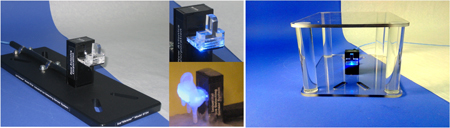
New Avionics Corporation has introduced a new compact ice sensor for use on wind power turbine nacelles and meteorological towers.

New Ice*Meister™Model 9734-SYSTEM is demonstrably the smallest, lightest, most-sensitive ice detector anywhere. Its low cost, simple operation, simple installation, minimal host requirements, and simple maintenance adds value to every size wind power turbine, onshore, offshore, remote, parking lots, etc.

The entire 9734 assembly with its mounting plate weighs only one pound. This makes it easy to carry and install. The sensor is a self-contained compact unit that works on 8-36 VDC, consumes only 2 watts, and conveniently embeds all its electronics inside its own housing.

In operation, the 9734 is a digital/optical, go/no-go ice sensor. It monitors the optical characteristics of whatever substance is in contact with the probe. Anytime it “sees” that liquid rain has turned to solid ice, the unit alerts its host system by closing its output relay contacts and energizing its indicator LED.

When the ice has disappeared, the device’s output relay contacts open, and its indicator LED is de-energized.

The ice sensor’s blue indicator LED is locally visible inside its clear plastic probe, which makes it easy to test and observe the sensor at arm’s length. Sensitivity is simple to adjust in the field. The only maintenance recommended is to clean the optical probe occasionally with isopropyl alcohol and a soft cotton swab.

The sensor is entirely optical. Other than the electrical contacts of its single-pole, single-throw output relay, the 9734 has no moving parts whatever. The housing measures a mere 2½ inches x 1¼ inch x 1 inch, and the probe extends an inch out from the housing. The 9734 is encased in a solid, waterproof housing, and  is robust against harmful elements—including UV.

The 9734 provides its own mounting plate that bolts to the top of any nacelle, and comes standard with 6 feet of lightweight blue cable. Custom-length cables are available as a factory option. Other options include a protective polycarbonate cage and a de-ice heater.

For more information, call (954) 568-1991 or visit www.newavionics.com.

Professional Leak Detection Kit for Oil-Based Fluid Systems

0

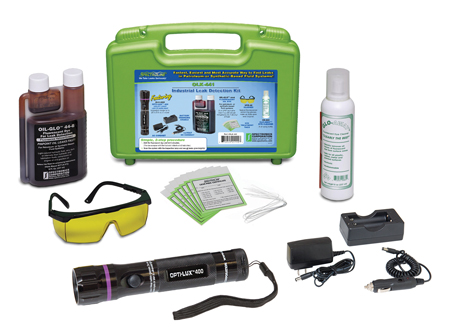
Spectronics Corporation has unveiled the OLK-441 Leak Detection Kit, which finds leaks quickly and efficiently in petroleum- or synthetic-based fluid systems. The kit can be used with hydraulic systems, compressors, engines, gearboxes and fuel systems.

Central to the kit is the OPTI-LUX™ 400 — an advanced, LED leak detection flashlight that emits less visible light so industrial fluid leaks are easy to spot. The unit features a high-output violet light LED that causes fluorescent dyes to glow far more brilliantly and with greater contrast than with standard blue light inspection lamps, revealing the exact source of every leak. Its power is comparable to high-intensity 150-watt lamps and it has an inspection range of up to 25 feet (7.6 m) or more.

The kit also includes an 8 ounce bottle of patented OIL-GLO™ 44 concentrated fluorescent dye, an 8 ounce spray bottle of GLO-AWAY™ dye cleaner, an AC/DC charger, dye treatment tags, and fluorescence-enhancing glasses. The components are conveniently packed in a rugged carrying case.

For more information about the Spectroline® OLK-441 Leak Detection Kit, call 1-800-274-8888. Outside the United States and Canada, call 516-333-4840. Website at www.spectroline.com.

Cape Wind Wins Legal Battle

0

Cape Wind today again defeated the efforts of its opponents to block the country’s first offshore wind farm. In a significant decision, the U.S. Court of Appeals for the District of Columbia Circuit upheld the FAA’s approval of the Cape Wind project, rejecting every argument that had been advanced by the project’s opponents.

“The Alliance to Protect Nantucket Sound, the Town of Barnstable and their financial backer-coal billionaire Bill Koch– have failed yet again in their continuing campaign to use the courts to delay the financing of Cape Wind,” Cape Wind Communications Director Mark Rodgers said. “The court’s definitive decision is an important legal victory that brings America that much closer to launching its offshore wind industry, a keystone in America’s renewable energy future,” Rodgers continued.

This decision takes on even greater importance because this was the same court that had previously provided project opponents their sole and temporary relief, opponents have lost all 12 legal decisions in other courts.

On October 28, 2011 this Court had remanded the FAA’s third Determination of No Hazard back to the FAA to better explain the rationale for its decision. On February 9, 2012, the FAA issued a Public Notice of its reinstated project review, indicating its conclusion that “None of the turbines would have an adverse effect on the use of air navigation facilities or navigable airspace.” On August 15, 2012 the FAA issued its 4th DNH which project opponents challenged, the Alliance to Protect Nantucket Sound pronounced confidence their challenge would be successful – this is the case decided today in favor of the FAA and Cape Wind.

Siemens Lands Largest Single Turbine Order To Date

0

OEM will supply 1,050 MW to MidAmerican Energy for Iowa projects


Siemens has received an order from MidAmerican Energy for the supply of 448 wind turbines. With a total capacity of 1,050 MW, this represents not only the largest order for onshore wind turbines for Siemens, but also the largest single order for onshore wind power awarded globally to date. The wind turbines, each with a nominal rating of 2.3 MW and a rotor diameter of 108 meters, are to be installed in five different projects in Iowa. Siemens will also be responsible for service and maintenance of the wind turbines.

Iowa is one of the leading U.S. states in wind energy generation. In 2012, around 24 percent of total power generation in the state was provided by wind power. Siemens has already installed 1.2 GW of wind power capacity for MidAmerican Energy to date. Including this new order, these wind projects will provide around 660,000 American households with eco-friendly power when they are completed in 2015.

The nacelles and hubs for the wind turbines of this major order will be assembled at the Siemens plant in Hutchinson, Kansas, and the rotor blades will be produced by Siemens in Fort Madison, Iowa.

“Siemens not only leads the way for offshore wind power worldwide, we are also a very successful player in the onshore wind industry,” said Markus Tacke, CEO of the Wind Power Division of Siemens Energy.  “In Europe and Africa alone, we successfully installed more than 1 gigawatt in the last fiscal year. This new order from MidAmerican Energy once again highlights that we are one of the leading suppliers in the U.S. wind power market.”

GE, Mitsubishi Reach Settlement In Patent Litigation

0

Turbine OEMs keep patents, agree to cross-licensing of intellectual property


General Electric Co. and Mitsubishi Heavy Industries, Ltd. have mutually agreed to end longstanding legal battles surrounding wind turbine intellectual property, according to a statement from Mitsubishi Heavy Industries.

The two wind turbine manufacturers “have reached amicable settlement of all legal actions taken by both parties in the United States relating to alleged infringements of their patents on wind turbines,” the statement read. “As a result, all litigation under way relating to wind turbines has been dropped.”

The settlement involves a cross-licensing agreement in which each company grants use of its intellectual property to the other, while maintaining ownership of their respective patents. Both parties agreed not to disclose further details of the settlement, according to the statement.

The patent dispute dates back more than five years to February 2008, when GE petitioned the United States International Trade Commission (ITC) to investigate its claims that Mitsubishi Heavy Industries was importing wind turbines and components into the U.S. that infringed on three patents held by GE.

The patents in contention involved sustained operation of wind turbines without regard to changing wind speed and low voltage conditions, as well as severing a turbine’s connection to the electrical grid in the event of power fluctuations.

The ITC ruled in favor of Mitsubishi in early 2010. However, GE’s appeal to the U.S. Court of Appeals for the Federal Circuit led to a split decision handed down in February 2012. The appellate court upheld the ITC’s decision on one case, while overturning a second case—sending it back to the ITC for further review. The court ruled the third case as moot due to the fact that the patent had since expired.

Litigation continued, with GE filing a claim surrounding the alleged infringement in federal district court in Texas in 2009. The case was stayed. In 2012, GE secured a $170 million jury award against Mitsubishi in another lawsuit concerning a different set of wind turbine patents. Prior to that verdict, Mitsubishi brought an antitrust suit against GE in May 2010, claiming that GE had obtained patents fraudulently. The antitrust case was placed on hold pending the outcome of the patent litigation and prior to the December settlement.

DNV GL Unveils Post-Merger Branding

0

The merger of DNV and GL in September led to the creation of DNV GL, a world leading ship and offshore classification society, a leading independent service provider in the oil and gas sector, a powerhouse in energy and renewables, and one of the world’s top three certification bodies.

“Businesses are facing increasing technological, regulatory, social and operational challenges, in a world that is becoming ever more complex,” DNV GL Group president and CEO Henrik O. Madsen said. “While at the same time, stakeholders are demanding greater accountability and transparency. To be confident they are making the right choices, both businesses and governments need an independent partner they can trust to empower their decisions,” says Group CEO Madsen.

DNV GL is making a significant and continuous investment in strategic research and development. Innovative projects are taking technology and standards to new, advanced levels in collaboration with our customers.

“It was from this broader view that our new brand strategy of our expansive, expert services and customer enablement was created. The new visual identity with the three extended lines was created to symbolize our working context of sea, land and sky,” DNV GL Group Chief Communications Officer Stefan Nerpin said.

Created from two highly respected companies whose parallel histories span almost 150 years, Nerpin is confident that the new DNV GL will “offer the businesses we serve much-needed benefits in terms of technical insight, risk management and knowledge transfer,” he says, adding, “With our combined capabilities, more than 16,000 professionals are bridging technological and operational expertise to the greater goal of creating a safer and more sustainable society. DNV GL is able to offer this broader view across more than 100 countries, sharing our expertise and bringing best practices to our customers around the world.”

The post-merger integration is progressing well and Group CEO Henrik O. Madsen says the new global entity is in “a good position to take on the first full year of operations as one company with a new brand; DNV GL. We want to build upon the knowledge and expertise throughout the group by creating new networks and learning from each other. Our goal is to make sure that we are always finding innovative solutions that create value and growth for our customers, ensuring that the world we leave behind is a better one than the one we find today,” he concludes.

For more information, visit them online at www.dnvgl.com.

UBS to acquire 50 percent of 161 MW Spinning Spur II project in Texas

0

EDF Renewable Energy and UBS International Infrastructure Fund announced in December that they have signed a definitive agreement under which UBS International Infrastructure Fund will acquire a 50 percent equity interest from EDF Renewable Energy in the 161 MW Spinning Spur II wind farm project, subject to completion of construction and customary conditions precedent.

Spinning Spur II, located in Oldham County Texas, commenced construction in June 2013, with an expected COD (Commercial Operation Date) on or about July 1, 2014. The project will be one of the first to take advantage of the new CREZ (transmission lines connecting the wind generating capacity of the Texas Panhandle to high electricity demand areas in the state.

DONG Energy acquires 580 MW Race Bank offshore project from Centrica

0

DONG Energy has acquired a 100 percent ownership interest in the UK offshore wind development project Race Bank, from Centrica. The project has a total consented capacity of up to 580 MW and is located in the Greater Wash area approximately 27 km off the east coast of England.

The purchase price (enterprise value) for the project is GBP 50 million (approximately DKK 450 million). The Race Bank project has received all major consents from UK authorities for the construction and operation of the wind farm.

USDA Providing $250 million to Rural Electric co-ops for Energy Efficiency Loan Program

0

The U.S. Department of Agriculture (USDA) will take new steps to save consumers money on their energy bills in partnership with rural electric cooperatives. It plans to provide rural electric cooperatives up to $250 million to lend to business and residential customers for energy efficiency improvements and renewable energy systems.

The program will help build a cleaner and more sustainable domestic energy sector for future generations by reducing barriers to investment in energy efficiency and potentially cutting energy bills for families and businesses in the process. Although energy efficiency measures can reduce home energy use considerably, many consumers and businesses do not invest in them because they lack the capital or financing to do so.

Funding will be provided to rural electric cooperatives and utilities which will then re-lend the money to help homeowners or businesses make energy efficiency improvements. In addition to energy audits, the loans may be used for upgrades to heating, lighting, and insulation, as well as conversions to more efficient or renewable energy sources.

First Wind and Burlington Electric sign 10-year PPA for Maine’s Hancock Wind Project

0

First Wind has reached an agreement with Burlington Electric Department (BED) to sell the utility power generated from the planned Hancock Wind project near Ellsworth, Maine. First Wind will sell 25 percent of the power and renewable energy certificates (RECs) generated at the 51 megawatt (MW) wind farm for the next 10 years under a fixed-price agreement to the Vermont utility.

NREL taking Applications for National Executive Energy Academy through January 31

0

The Energy Department’s National Renewable Energy Laboratory (NREL) is accepting applications for its 2014 Executive Energy Leadership Academy. NREL’s Executive Energy Leadership Academy, also known as Energy Execs, is a program for non-technical decision-makers throughout the country to learn about renewable energy and energy efficiency technologies, analytical tools and financing. Leaders in government, communities, non-profits and the private sector are eligible.

There are two Energy Execs learning opportunities — the Leadership Program and the Leadership Institute. Both programs are designed to provide executive decision-makers with information and tools to guide their organizations and communities in energy-related planning.

Apply online at www.nrel.gov/energyexecs/or via fax or mail. The application deadline is January 31, 2014.

Clean Energy Jobs Top One Million, Index Shows

0

Ecotech Institute’s Clean Jobs Index, a tool to compare states’ use and development of clean energy, found more than one million job postings in the clean energy sector from July 1, 2013, through September 30, 2013. This shows a 54 percent increase in needed clean energy employees, evidence that the sector is rapidly growing and in need of experts. 

Ecotech Institute launched the Clean Jobs Index in January 2013 to provide objective job information about the clean tech industry. The Clean Jobs Index defines a clean tech job as one where workers make their business more environmentally friendly, use fewer natural resources, or produce goods or provide services that benefit the environment.

To learn more about the Clean Jobs Index, please visit www.ecotechinstitute.com/cleanjobsindex. To learn more about Ecotech Institute, go to www.ecotechinstitute.com.

ENERCON Installs Prototype E-115 Turbine In Northern Germany

0

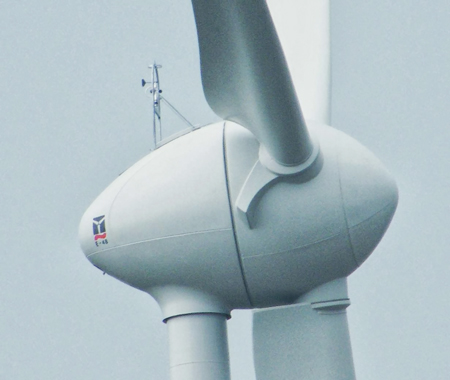
ENERCON recently installed a prototype of its IEC class IIa wind turbine in northern Germany and launched operations according to schedule.

The prototype is perched on a precast concrete tower at a hub height of 135 meters, but is also available with towers ranging from 92 to 149 meters (hub height). Thanks to its performance-optimized blade design and a rotor diameter of 115 meters, the E-115 generates high yield even in the partial load range making the new series a profitable choice also for inland sites with slightly less wind.

This new turbine type aligns with ENERCON’s current MW-class models. Up until now, the top selling product was the E-101/3 MW machine with a rotor diameter of 101 meters.

“The demand for this category of wind turbine is high. And customers now have another turbine to choose from featuring technical innovations such as the divided rotor blade concept for optimized logistics,” said ENERCON Sales Director Stefan Lütkemeyer.

At a typical inland site with average wind speeds of 6.5 m/s at 149 meter hub height, the E-115 can generate an annual output of roughly 9.3 million kilowatt hours—an increase of 14 percent compared to the E-101. Expected availability for the E-115 is the middle of this year.

Ampair To Acquire Westwind

0

Ampair, the Dorset (UK)-based wind turbine manufacturer, is pleased to announce that it is in exclusive negotiations to acquire Westwind, the Belfast-based wind turbine manufacturer. Ampair, with over 40-years’ experience, is the UK’s oldest manufacturer of wind turbines.  Westwind relocated from Australia to the UK several years ago and now offers the widest range of MCS certified turbines of any manufacturer.

Ampair’s managing director David Sharman said “this acquisition immediately enables us to offer a wind turbine solution from 100W through to 20kW, which is a unique position and which will be to the benefit of our worldwide client base. Ampair’s smaller turbines and Westwind’s larger MCS-certified turbines neatly span the full range.”

RTS Signs On To Become UK Service Provider For Vensys

0

German turbine manufacturer Vensys and UK engineering services supplier RTS International have announced their UK framework agreement.

RTS has been chosen to become the UK Service Provider for Vensys. RTS will undertake the project management of the erection process as well as the on-going service requirements for Vensys turbines at onshore locations throughout the UK.

“We are delighted to be partnering with Vensys to deliver our installation and maintenance services across the UK,” Vensys managing director Chris Palmer said. “We installed the very first UK Vensys 1.5MW turbine in Kings Lynn at the start of October and this announcement today marks the start of what we expect to be a very successful and long-term partnership.”

GE’s 2.5-120 Turbine Now Operating Commercially at German site

0

Two months after the completion of installation, the first GE 2.5-120 wind turbine has been put into commercial operation in Schnaittenbach, a town in Bavaria, Germany. The 2.5-120 produces approximately 8,000-megawatt hours a year, which is equivalent to the required average energy needs of about 2,000 German households. The investor and operator of this project is Max Bögl Wiesner GmbH.

By choosing GE’s new 2.5-120 turbine, Max Bögl Wiesner GmbH made a decision for today’s most efficient inland wind turbine worldwide. GE’s goal was to facilitate the generation of wind energy in densely wooded regions with low wind intensity such as the Oberpfalz (Upper Palatinate area). The 2.5-120 meets these requirements and additionally contributes to the successful implementation of the “Energiewende” on a regional level.

The turbine’s advanced controls, paired with the 120-meter rotor and a specially engineered hybrid tower with a hub height of 139 meters, allow for a more efficient energy output. The 2.5-120 is GE’s first brilliant wind turbine to utilize the power of the Industrial Internet. The Industrial Internet uses data analysis to connect machines and equip them with intelligence, helping to position each one for enhanced performance. The 2.5-120 analyzes tens of thousands of data points every second to drive higher output and improve services productivity, ultimately helping to manage wind’s variability.

Siemens, DONG Energy Reach Deal on 582 MW German North Sea Offshore Projects

0

Siemens recently announced it will supply 97 wind turbines, each with a rating of six megawatts and a rotor diameter of 154 meters, to the Danish energy provider DONG Energy. The total capacity for the Gode Wind 1 and Gode Wind 2 projects is 582 MW, enough to supply around 600,000 German households with eco-friendly power.

The Gode Wind 1 (252 MW) and Gode Wind 2 (330 MW) wind power plants will be erected off the North Sea island of Juist, around 45 kilometers from the German coast in water depth of up to 34 meters. This will mark the first time that Siemens will be supplying its new 6 MW wind turbines for offshore in Germany. Siemens will also service the wind turbines for a period of five years. Construction is planned to begin in the first half of 2015, with commissioning scheduled for the second half of 2016.

“Offshore wind energy is a vital contributing factor to the success of the energy transition in Germany,” stated Markus Tacke, Siemens wind power division CEO. “Only at sea can wind projects of a performance category equivalent to major power plants be erected in Germany. Offshore wind energy will also act as a stabilization factor in the German energy mix. Offshore wind power plants produce electricity on more than 340 days per year, thanks to stable wind conditions at sea.”

Siemens is at the front of the market for offshore wind power plants, for grid connection and for offshore wind service. To date, the company has installed wind turbines with a total capacity of 3.9 gigawatts (GW) at sea worldwide. Siemens currently has orders for offshore projects with a capacity of around 5 GW in the books.

“Despite the fact that offshore wind energy is quite a new technology, we are making great advances. In the coming ten years we intend to reduce costs by up to 40 percent,” declared Mr. Tacke. “To accomplish this, it is essential that we have clearly defined and reliable framework conditions for the expansion of offshore wind power in Germany.”

Vestas and Enel Green Power Ink Deal for 350 MW, Plan for Order of Additional 636 MW

0

Vestas will supply 75 V100-2.0 MW turbines for the 150 MW Origin wind power plant in Oklahoma. Vestas and EGP-NA also have signed an agreement for up to an additional 836 MW worth of 2 MW turbines of which 200 MW is firm. Deliveries for Origin are expected to occur midyear, followed by commissioning by the end of December.

“We’re thankful to work again with a major global company like Enel which has a proven track record of building successful wind-energy projects in this country,” said Chris Brown, President of Vestas’ sales and service division in the United States and Canada.

Vestas’ factories in Colorado will be involved in manufacturing blades, nacelles and towers for the 350 MW order. To meet customer demand, Vestas is adding more workers at three of its Colorado factories—the blade factory in Windsor as well as the blade and nacelle factories in Brighton. Vestas is recruiting now and expects to add hundreds of production workers in the first half of 2014 in Windsor and Brighton, primarily at the two blade factories. Interested candidates can apply at ElwoodWindJobs.com.

The Origin project will include a three-year Active Output Management (AOM) 5000 service agreement. AOM 5000 is an energy-based availability guarantee that ensures the turbines are operational when the wind is blowing. This service option includes the VestasOnline surveillance system that remotely controls and monitors the turbines and predicts potential wear-and-tear issues. This allows Vestas to plan maintenance so the turbines operate with the minimum amount of lost production.

Vestas has previously supplied wind turbines to Enel for three U.S. projects, most recently the 200 MW Caney River wind power plant in Kansas that was commissioned in 2011.

EGP-NA, part of Enel Green Power, is a leading owner and operator of renewable energy plants in North America with projects operating or under development in 21 U.S. states and two Canadian provinces.