Home 2013

Nordex to Close Arkansas Assembly Plant

0

Nordex SE has announced that the company will cease nacelle production at its Jonesboro, Arkansas, facility after it completes the orders in its current pipeline. The decision was driven by the wind industry’s global overcapacity and the continued uncertainty and instability of the U.S. market. The decision will not impact the current year’s business performance, as exceptional expenses were already accounted for in 2012 as previously reported.

“This was an extremely difficult decision for Nordex. We are reacting to the weakened demand from the U.S. market, brought on by the unpredictable extensions of the Production Tax Credit (PTC), and the resulting low utilization rate of our U.S. assembly plant,” Nordex SE CEO Dr. Jürgen Zeschky said. “We see great potential in the U.S. and Latin American markets and are committed to serving those markets and increasing our installed base. With this decision we also increase our flexibility to react to US demand for our turbines out of one single plant in Rostock, Germany. We will be maintaining the extensive expertise in sales, engineering, service, project management, training and support which we have built at our Chicago and Jonesboro locations to continue the growth we have achieved through these challenging times.”

“This is a sad day for all of us at Nordex USA,” Ralf Sigrist, president & CEO of Nordex USA, Inc. said. “We will lose valued colleagues, who have done their very best for us, but the decision was inevitable considering the underutilization of our plant.”

In the future, nacelles for the North and Latin American markets will be supplied from Nordex’ factory in Rostock, Germany, using the global supply chain and logistics support based there. Service activities for all existing U.S. wind farms are not affected by the closure of the U.S. production. The training academy, the central parts storage and the repair facility in Jonesboro will remain in operation to support service and operations in the Americas. Around 40 employees will be affected with layoffs beginning in October.

The restructuring of the company in the United States is in line with Nordex’ strategy to position its operations to maximize capacity utilization.

For more information, visit www.nordex-online.com.

Xcel Energy Plans Significant Increase in Wind Purchases

0

Xcel Energy’s Southwestern Public Service Company is seeking approval in New Mexico to purchase almost 700MW of additional wind energy through three purchase agreements, deals that will save Texas-New Mexico customers more than $590 million in fuel costs over 20 years.

The wind purchases will come from three facilities to be located in Oklahoma, Texas and New Mexico:

• 199MW from NextEra Energy Resources/Mammoth Plains Wind Energy Center, located in Dewey and Blaine counties, Okla.
• 249MW from NextEra Energy Resources/Palo Duro Wind Energy Center, located in Hansford and Ochiltree counties, Texas.
• 250MW from Infinity Wind Resources/Roosevelt Wind Ranch in Roosevelt County, N.M., between the towns of Dora and Elida.

The price per MWh of energy generated at these wind facilities will be less than the per-MWh price of most of the company’s natural gas-fueled generation, according to Riley Hill, president and CEO of Southwestern Public Service Company, an Xcel Energy company. Over the 20-year terms of these agreements, Xcel Energy expects to save $590.4 million in fuel costs, Hill said.

“We started shopping for more wind energy in March after seeing some very good prices on the market,” Hill said. “We are making these acquisitions purely on economics and the savings we can deliver to our customers.”

Hill pointed out that the favorable pricing is partly the result of a federal production tax credit that Congress extended for one year, applicable to facilities that begin construction before the end of 2013.

Xcel Energy currently has close to 1,500MW of wind energy capacity connected to its Texas-New Mexico transmission and distribution network, which spans the Panhandle and South Plains regions of Texas, six eastern and southeastern counties in New Mexico and portions of Oklahoma and Kansas. Xcel Energy purchases more than 600MW through long-term contracts.

The three additional contracts will more than double the company’s contract wind resources, and will push the total Texas-New Mexico wind capacity beyond 2,200MW.

The company solicited additional wind resources through a request for proposals process that opened in March. This process generated more than 75 proposals that included the winning bidders. The deals are for energy only, and do not include the purchase of renewable energy certificates (RECs).

For more information, visit www.xcelenergy.com.

DNV KEMA: Accuracy of Wind Farm Energy Assessments Improving

0

DNV KEMA Energy & Sustainability, a global energy consulting firm and authority in testing, inspection and certification, said a study it conducted found that performance predictions for large-scale North American wind energy projects placed in service between 2010 and 2012 were substantially more accurate than for wind farms placed in service between 2001 and 2009.

The firm recently published the 2013 update to its study “Actual versus Predicted Wind Power Project Performance.” The study indicates that wind energy projects entering service since 2010 have produced an average of 97 percent of the energy predicted, an improvement of six percentage points over wind farms that went on line between 2001 and 2009. According to DNV KEMA, “Additional improvement is anticipated when data is available from projects for which energy estimates include recent changes in energy assessment techniques.”

“To minimize the cost of energy from wind energy projects, investors need to have confidence in the energy production estimates made before the projects are built,” said Robert Poore, a senior advisor at DNV KEMA. “While DNV KEMA energy assessments have historically been more accurate than the industry average, we found that in the last three years improved methodologies for assessing project energy production have lowered the average variance between pre-construction energy estimates and actual plant performance for the entire industry. As confidence is gained in the improved methods, we expect to see less discounting of pre-construction estimates when investors evaluate wind projects. In the long run, this should help reduce the cost of energy from wind.”

According to the study, robust wind assessment campaigns, more comprehensive curtailment risk analysis and further research into wake and flow modeling are key elements in further reducing uncertainty in wind project energy assessments. “Our work with clients has demonstrated that an enhanced energy assessment program is one of the best investments a developer can make. When we plan and execute a better than average site measurement program, including the use of remote sensing, the reduced uncertainty in the energy assessment frequently results in more favorable financing terms, higher project value and higher confidence when bidding for power purchase agreements,” Poore said.

For more information, visit www.dnvkema.com.

Siemens Wind Power Division Selects CEO

0

Markus Tacke has been appointed CEO of Siemens Energy Sector’s Wind Power division. The forty-eight year old Tacke was scheduled to take the helm August 1. He succeeds Felix Ferlemann who, at 53, left the company by mutual agreement to pursue new career challenges.

Tacke studied mechanical engineering at the Technische Universität Darmstadt, where he completed his doctoral degree. He also earned a Master of Engineering degree from Cornell University in Ithaca, New York. Before joining Siemens AG in 1998, Tacke had been active for the construction firm Wayss & Freytag AG at their unit for commissioning of large-scale machinery. At Siemens, he has been serving as CEO of the Industrial Power Business Unit at the Energy Sector’s Oil & Gas Division since October 2009. Before that, he had been responsible for the worldwide business of Siemens in industrial steam turbines. Tacke is married and has four children.

“Felix Ferlemann provided essential stimuli, and we thank him for his commitment,” notes Michael Süß, member of the managing board of Siemens AG and CEO of Siemens’ Energy Sector. Ferlemann had been active at Siemens Wind Power since October 2011. Holder of a doctorate in mechanical engineering, he had previously been in charge of automotive chassis systems at Benteler-Automobiltechnik GmbH.

For more information, visit www.siemens.com/wind.

Avanti Achieves GWO Certificate

0

With a new certification from Lloyd’s, Avanti Wind Systems now meets the demands from the Global Wind Organisation to train and educate operators to work in wind turbines and other workplaces in similar heights.

Both the training personnel and the facilities at Avanti Wind Systems, headquartered in Hillerød, Denmark, are now certified after GWO standards to basic safety training for onshore and offshore activities covering “Working at Heights.” This is the first step for Avanti to follow the GWO standards for safe work in wind turbines. Other GWO-certifications are expected to follow later this year.

The object of Global Wind Organisation is to support an injury-free work environment for construction and operating of wind farms on- and offshore. To support this, GWO has developed a standard for basic safety training to provide personal working at wind farms with sufficient knowledge to obtain this target.

GWO is working together with most of the wind turbine manufacturers and larger wind farm owners in Europe and the U.S.

Safe work in wind turbines has always had first and top priority at Avanti Wind System. Therefore, Avanti follows the highest standards in the field irrespective of the country where Avanti Wind Systems is working. With this GWO certification, Avanti Wind Systems states that the company also will train and educate anyone working in wind turbines in the same high standards.

For more information, visit www.avanti-online.com.

Nordex Performs Extended Quality Testing

0

Turbine system performance, safety and service life are frequently determined solely by means of calculations, computer simulations or years of field testing. At its Rostock, Germany production site, Nordex is now employing additional test rigs to check numerous core components of the Generation Gamma and Generation Delta wind turbines under laboratory conditions as well. The Company scrutinizes the entire turbine systems right from the development phase at the Nordex technical center “Technikum,” the floor area of which has now been extended to 3,900 m2, plus the rotor blade testing facility with a floor area of an additional 2,400 m2.

Last year, Nordex invested 4,600,750 million in extensions to the modern “Technikum,” developing new testing facilities and now putting them into operation step-by-step. With these new test rigs, Nordex is testing the system functions under extreme climatic and mechanical conditions including in the form of long-term endurance tests. This way, the company is able to ensure that its developments satisfy strict quality criteria and that it is able to release a high-quality product for series production. A further goal is to increase the pace of development.

“In addition to larger rotors, a greater installed capacity and growing tower heights, real-life conditions at wind turbine sites, which can be quite harsh in some places, are increasingly playing a role in the development of our systems,” Nordex SE CEO Dr. Jürgen Zeschky said. “Our turbines must operate perfectly in extreme cold or heat, in icy or very humid conditions and under different grid conditions.”

Nordex uses a project validation plan to make sure that no critical components are neglected during testing and that everything proceeds in-sync with current development projects. This plan defines the components which must be tested, the target result, the type of test required and the testing interval.

15 different testing facilities, including an azimuth and motor/vibration test rig, have been installed for complete and thorough testing of the core components fitted to Nordex. In addition, various tests are performed on the blade adjustment system using three different pitch testing systems. The advantage of this is that Nordex is now able to perform advance tests of the turbine software, the pitch converter under load and the entire system comprising switching cabinets, drives and cable loops under normal and also extreme temperatures.

The most important new addition is the climate chamber, which has been expanded and is now more efficient. With a capacity of almost 150 m3 and a range from -40°F to +140°F, it submits the turbine systems to extreme climatic endurance testing. In addition, a relative ambient humidity of 95 percent can be simulated. A further five test benches are devoted solely to tests on slip rings. One of these is also fitted with a climate chamber with a capacity of 2m3.

A grid simulator with variable voltages and frequencies at the configuration limits is also available for testing the system capabilities even under difficult grid conditions. In addition, it is possible to generate dynamic grid errors and harmonics. To guarantee the best possible quality of electricity, Nordex also simulates the grid errors of a wind farm in a medium-voltage grid in the field. The fault ride-through capabilities for bridging any drops in voltage are checked on a continuous basis. This also aids the development of grid codes and helps to ensure that the necessary certificates are gained.

The testing system for the Company’s internally produced rotor blades with a length of up to 65 meters has been in operation since 2010 and allows static and dynamic stress tests to be performed. In addition, Nordex started up a cable loop test bench last year.

All tests form part of the standard inspection of the core components of the Generation Gamma and Generation Delta wind turbines. In addition to performing its own tests, Nordex imposes on its suppliers a duty to perform vibration, EMC and lightning protection testing on the components which they deliver. In this connection, Nordex has stipulated in its internal quality requirements that internally developed or externally sourced components must function perfectly in the entire range of different ambient conditions. The findings gained are continuously incorporated in the innovation process, with the results directly plugged into the turbine development process in order to additionally enhance their quality.

For more information, visit www.nordex-online.com.

Sky Harvest to Acquire Vertical Axis Wind Turbine Technology and Manufacturing Facilities

0

Sky Harvest Windpower Corp. announced that it has entered into an agreement to acquire a vertical axis wind turbine manufacturing and sales business from a private Canadian company in consideration of the issuance of 650,000 shares of its common stock, cash payments totaling $65,000, and the grant of an option to the vendor to acquire up to 550,000 shares of its common stock at a price of $0.10 for a period of five years. This grant is pursuant to the company’s previously announced 2011 stock option plan. In addition, Sky Harvest has agreed to pay the vendor a royalty of $200 for every vertical axis wind turbine that it sells for a period of ten years. The vendor will also receive 500,000 voting shares of the subsidiary company that holds the turbine assets if that company’s shares trade publicly on a recognized stock exchange or quotation system. As part of the agreement, Sky Harvest has acquired the intellectual property rights relating to the turbine design, and leasehold interests in both manufacturing facilities and equipment.

Sky Harvest has received written expressions of interest for the purchase of over 13,000 vertical axis turbines from parties in four different countries. The sale of such number of turbines would generate revenue of approximately $250 million. Sky Harvest has also entered into discussions with additional parties with compatible technology regarding the potential joint venture development of additional wind turbine products.

Unlike most wind turbines which have blades that rotate around a horizontal axis, a vertical axis wind turbine has blades that spin vertically around a horizontal mast. They are primarily used in remote areas to provide electricity to communication towers, mines, and communities that typically rely on diesel or propane for power generation, which results in reduced costs to the user, as well as a smaller environmental impact through the reduced use of fossil fuels and no risk of on-site diesel spills. These turbines are also suitable for rural areas of developing countries where grid infrastructure is minimal or non-existent. They can also be mounted near the upper portion of commercial smoke stacks and are powered by the updraft. The principal advantages of a vertical axis wind turbine include low noise levels, minimal vibrations due to low RPM, the ability to utilize wind from any direction, ease of installation and maintenance, durability, and very low impact to wildlife. In addition, the Sky Harvest turbine is self-starting and begins to move at wind speeds as low as two meters per second and commence generating power at wind speeds of three meters per second. The additional advantages of the Sky Harvest turbine when compared to its competitors are its ability to withstand temperatures well below freezing and to operate without a driveshaft or gearbox.

“We are excited about the potential market for our vertical axis wind turbine given that there are many areas of the world where horizontal turbines are not feasible due to a lack of infrastructure or public resistance to large-scale projects,” Sky Harvest’s President, William Iny, said. “The initial interest that we have received from prospective customers is overwhelming and not only reflects the features of our turbine, but also the potential market for this type of product. Our board believes that this manufacture-ready segment of our growing business will bring additional value to our shareholders. Through the development of highly engineered vertical turbines, our goal is to become the pre-eminent, reliable supplier to the telecommunications and remote community power generation sectors.”

For more information, visit www.skyharvestwind.com or call 877-700-7021.

EU Offshore Wind Grows, but Warning Signs Evident

0

277 new offshore wind turbines, totaling 1,045MW, were fully grid-connected in Europe during the first six months of 2013. This is double compared to the same period in 2012 when 523.2MW were installed. In addition, 268 foundations were installed and 254 turbines erected, all during the first 181 days of the year. “Offshore wind power installations were significantly higher than in the first six months of last year,” said Justin Wilkes, director of policy at the European Wind Energy Association. “But financing of new projects has slowed down with only one project reaching financial close so far this year. This, together with a lack of orders being placed for offshore wind turbines, substructures and components, reflects the regulatory uncertainty in key offshore markets including Germany and the UK. It highlights the significant challenges faced by the offshore wind sector.

“Offshore wind is a new industry that creates jobs, reduces fossil fuel imports and in which Europe is a world leader with huge export opportunities. The installation rate shows what the European offshore wind industry is now capable of. But to attract investment to the sector governments need to provide a stable regulatory framework and the EU should set a binding renewable target for 2030,” Wilkes said.

Total offshore capacity in Europe is now at 6,040MW in 58 wind farms across ten countries—up from 4,336MW in June 2012.

21 offshore wind farms are under construction or in preparation, with a total capacity of 5,694MW.

The 277 wind turbines fully grid-connected in  the first half of 2013 were in seven wind farms: Thornton Bank (BE), Gunfleet Sands 3 (UK), Lincs (UK), London Array (UK), Teesside (UK), Anholt (DK), BARD offshore 1 (DE).

For more information, visit www.ewea.org.

Vestas Secures Service Contract Renewals for 130MW GDF SUEZ Fleet

0

Vestas has secured 10-year advanced service contract renewals with GDF SUEZ Energia Italia, which heads the Italian-based energy business of the GDF SUEZ Group, for six wind power plants in Italy with a total capacity of 130 MW—comprising 31 units of V90-2.0 MW and 80 units of V52-850 kW wind turbines.

The service contract extensions include a 10-year service agreement with Vestas’ Active Output Management (AOM) 5000 service scope, a complete service package to ensure minimised lost production, including everything necessary to maximise output but with further aligned incentives. AOM 5000 offers an energy based availability guarantee that aligns service and maintenance execution with low wind periods.

Under the agreement, GDF SUEZ Energia Italia will also benefit, for the entire fleet, from the Vestas Weather & Power Forecast—a high-quality, site specific, continuous weather and production forecasting system. It enables the optimization of maintenance schedules by identifying low wind periods during which service is to be performed. It also improves customers’ business by delivering precise power forecasting, and it fulfils the grid requirements established.

“We decided to renew our 111 Vestas wind turbines’ service and maintenance agreement for another ten years on the basis of our long-lasting business relationship with Vestas and its ability to meet a number of specific requests—not least, maximizing our wind power plants’ value by increasing the turbines’ reliability and availability, reducing down time and improving lifetime performance of our wind turbines in the country,” said Pascal Renaud, generation director for GDF SUEZ Energia Italia.

“We are very proud that GDF SUEZ Energia Italia has chosen to sign 10-year advanced service renewal contracts for their entire Vestas installed fleet in Italy. The GDF SUEZ Group is one of the largest and most experienced utilities in the world that demands excellence within its organisation and from Vestas. Vestas is therefore very pleased to have been chosen by the customer on the basis of the confidence built over years and our ability to listen and act on their requests,” said Nicolas Wolff, general manager of Vestas France. “We are pleased with the trust GDF SUEZ shows in our organization as this is a huge recognition of our service performances.”

The six wind power plants produce approximately 250,000 MWh per year, which is enough to meet the residential electricity consumption of about 220,000 people in Italy and save the environment from almost 100,000 tons of CO2 emissions on an annual basis. Installed between 2006 and 2010, the power plants are located in the regions of Campania, Molise and Sicily.

For more information, visit www.vestas.com.

Repower Completes 325MW Offshore Installation

0

Suzlon Group subsidiary REpower Systems SE have installed the last of the 48 total REpower 6M turbines in the Belgian offshore wind farm Thornton Bank. The customer for this project is the Belgian offshore project development company C-Power, which was set up by four Belgian investors and counts REpower customers RWE Innogy and EDF EN amongst its shareholders.

“We are very proud to have installed the largest fleet of 6 megawatt turbines worldwide,” Andreas Nauen, CEO of REpower Systems SE, said. “Thornton Bank confirms the long-term potential of the market. We offer our customers the best technology combined with industry leading experience in building projects in complex and challenging environments.”

The 2013 construction phase covers all 18 REpower 6M turbines. Each of the turbines has a rated power of 6.15 megawatts. REpower completed Phase III successfully and on time: that proofs the company’s well-developed logistics concept and the good cooperation between the teams during the installation of the turbines. After the completion of all three construction phases, the wind farm has a total output of 325 megawatts —enough to supply 600,000 people or a city the size of Glasgow with electricity. In terms of investment volume, the contract marks the largest financing for a completed project to date in the offshore wind industry overall. Companies from Belgium, Germany, France, the Netherlands, Denmark and Sweden are involved in Thornton Bank, making the wind farm a showcase project for the European offshore wind industry.

For more information, visit www.repower.de

PRODUCT SHOWCASE: Slatercom Offers FAA-certified D1RW Obstruction Lighting System

0

Slatercom-WCD, located in Salem, Oregon, has announced the availability of the industry-standard Dialight D1RW Series- LED Medium Intensity FAA certified obstruction lighting system, designed to utilize existing xenon flash head cables. Existing xenon medium intensity lighting systems typically use either a five- or six-conductor flash head cable and are noted for being quite troublesome and expensive to repair. The new Dialight LED lighting system comes ready to install without changing the existing flash head cable thus saving considerable time replacing flash head cable. Systems are in stock for immediate delivery. The complete system is covered by a five-year warranty.

FAA rules require all obstruction lighting systems to be monitored and logged daily—either visually or electronically. Slatercom lighting systems are typically provided with alarm monitoring capability that can be connected into remote monitoring equipment. In remote locations such as wind farms, visually monitoring and logging of obstructions (as required by the FAA) is not convenient or even practical.  Slatercom-WCD offers several options for monitoring including the Slatercom Cellular Alert System, RMS Live Monitoring, WEB600 IP based monitoring system and the SAT4 satellite based system. These systems can provide cell phone, text or e-mail notification of lighting system problems and prevent heavy FAA fines for non-compliance. In addition, an automatic log of lighting system status done a daily basis can be downloaded to comply with FAA rules. These logs are typically kept on the server for at least one year.

Most wind farm met towers are installed prior to construction of the wind farm to facilitate data collection for wind farm design. These sites typically are located in areas that lack commercial power. Slatercom offers extremely efficient (less than 100 watts/ day) FAA “A” series lighting systems for these applications. The Slatercom Solar Harvester solar system utilized in these systems provide the seven-day autonomy as required by the FAA for solar powered systems. The solar systems are engineered site specific, guaranteeing a properly-sized system for the installation location. 

Interior wind turbine lighting is often provided by the manufacturer using florescent or incandescent lighting fixtures. Slatercom is one of the largest Dialight  LED “White Lighting” distributor. Slatercom stocks a large selection of linear (florescent replacement) fixtures, down lights, wall packs and many versions of high bay lighting fixtures. These long life, energy efficient fixtures can provide decades of trouble free performance. 

For more information, visit www.slatercom.com, call 503-581-5550 or e-mail info@slatercom.com.

PRODUCT SHOWCASE: Keen Tucson Brings Protection, Functionality to Jobsites This Fall

0

Founded on the idea of creating multi-purpose hybrid footwear that combines form and function, KEEN understands that life extends from work to play and everywhere in between. The KEEN Utility line was a natural extension of that idea, bringing versatile and progressive work footwear that stands on its own to men and women everywhere.

This fall, KEEN Utility takes this idea of hybrid footwear to the next level with the introduction of the Tucson. The outdoor-inspired silhouette is reminiscent of a much-loved hiking boot while blending all the innovative work boot performance features KEEN Utility has developed and incorporated into the entire collection.

“Each season we strive to innovate both within our product line as well as the industrial footwear industry,” said Mark Reilly, Division Director for KEEN Utility. “The love for outdoor adventure and active lifestyles runs deep in the KEEN DNA. The Tucson allows us to blend that outdoor look and comfort with the functionality of top-notch protective footwear.”

Hitting select retailers this month, the KEEN Utility Tucson work boot features an outdoor-inspired silhouette with all the technical features required for a hard day on the job site. Crafted with a waterproof, nubuck leather upper the boot features a sleek, low profile midsole and open mesh inserts to increase air circulation. A KEEN.Dry waterproof, breathable membrane lets moisture out but never in and a hydrophobic/hydropholic two-zone comfort technology lining helps to keep feet cool and dry.

The Tucson features KEEN Utility’s signature asymmetrical steel toes that are contoured to the natural shape of the left and right foot, providing ASTM-rated protection with a roomy toe box for maximum comfort without sacrificing safety. The oil- and slip-resistant non-marking rubber outsole exceeds ASTM Mark II non-slip testing standards, proving the Tucson is one boot ready for whatever the workday puts in its path. Available in mid and low heights with steel and soft toes.

For more information, or to find a KEEN Utility retailer near you, visit www.keenfootwear.com.

PRODUCT SHOWCASE: Sandvik Introduces CoroMill Plura End Mill Tool for Composites Manufacturing

0

The CoroMill® Plura compression end mill for composites from Sandvik Coromant targets manufacturers machining carbon-fiber reinforced polymers (CFRP). Unlike conventional end milling cutters, the CoroMill Plura tool combines positive and negative helix design to “compress” the top and bottom of the component edge. This minimizes any potential for delamination, a common defect when machining CFRP and several other types of engineering composites using higher helix cutters.

The new Plura end mill has been designed for edge milling applications on workpieces with a minimum thickness of 6mm. It features optimized micro geometry that offers six effective cutting edges for achieving a surface finish (Ra) of well below 0.0001 in. (4 µm), in combination with high material removal rates. Users should keep the split-line in the middle of the material for best results. It is also important to remember that when the tool cuts fibers going against the grain on the top or bottom surface there is potential for more splintering than when the tool cuts along the fiber direction.

Conventional up-milling strategies are recommended as these typically deliver less vibration. Among the cutting data users can expect to see is cutting speeds of 656-1,312 ft./min. (200-400 m/min), and feed rates of 0.001-0.002 in./tooth (0.03-0.06 mm/tooth) for roughing or 0.008-0.0015 in./tooth (0.02–0.04 mm/tooth) for finishing.

The CoroMill® Plura compression end mill for composites makes use of GC1630 grade for extended life, and comes in diameters ranging from 0.24-0.63 in. (6.0-16.0 mm), and lengths (total) from 2.99-3.94 in. (76 to 100 mm).

For more information, visit www.sandvik.coromant.com.

PRODUCT SHOWCASE: STAUFF Introduces PPC-04-plus Compact Mobile Hydraulic Tester

0

STAUFF introduces the PPC-04-plus, the latest generation of hand-held hydraulic testers. The STAUFF PPC-04-plus features robust construction and an oil-resistant rubber coating to withstand impacts, vibration, dust and moisture (protection class up to IP67) and is designed for use in particularly harsh conditions. This compact mobile tester measures pressure, temperature, flow rate, frequency and speed in mobile and industrial hydraulic systems.

The STAUFF PPC-04-plus is available with either two analog sensor inputs or a CAN interface (PPC-04-plus-CAN) for connecting up to three digital sensors.

Even in low-light situations, measured values can still be read quickly and reliably from the multi-line, backlit LCD graphic display.

Using the USB port and the included software, measurement values can be easily read and transferred to the PC, where they can be displayed, analyzed and further processed.

The STAUFF PPC-04-plus joins the family of portable hydraulic testers, which includes the larger STAUFF PPC-Pad, which features a large-format (3.5” x 4.5”) LCD screen and up to six analog inputs, and the smaller PPC-06/08-plus series, which features a digital readout LCD screen.

 For complete product information, e-mail diagtronics@stauffusa.com, or call 201-444-7800.

PRODUCT SHOWCASE: TWR Lighting Offers “All-In-One” Obstruction Lighting Solution

0

TWR Lighting, Inc./Orga Aviation offers the L450 LED “All-In-One Solution” The new L450 product range of red and red/white, medium intensity LED obstacle lights incorporate the most advanced optical engineering design and LED technology enabling the development of the most cost effective solutions for the medium intensity obstruction light market. The new L450 products are focused on minimizing the visual impact that obstacle lights can have on the surrounding environment, while at the same time further reducing power consumption. The L450’s “All-In-One Solution” concept, follows the designs successfully adopted over the past 10 years in the L350 product with the light having a built in power module, controller and GPS synchronizer.

Also available is the L450 RED LED/Infrared LED “All-In-One Solution”.  This new L450-864-IR-G product incorporates both red led and infrared led technology into a single medium intensity obstacle light. Using the most advanced optical engineering design for both an FAA L864 LED and Infrared LED technology enables this fixture to provide the most reliable nighttime marking of structures where military and civilian aviation night vision goggle (NVG) technology is required.

In addition to LED lighting for Wind Turbines TWR Lighting, Inc. offers a complete line of LED lighting systems including the LEDBEACON3 24VDC Beacon and PV solar power systems for use on meteorological towers 60-100 meters in height. These systems were designed specifically for remote solar applications and offer the lowest power consumption thus minimizing both the capital costs and cost of ownership.

In 2001 TWR Lighting Inc. partnered with Orga Aviation and introduced the first lighting systems to the U.S. designed specifically for the wind turbine market. The company has manufactured and distributed FAA/ICAO-approved obstruction lighting since 1981, and operates out of a recently expanded 50,000-plus sq.-ft. headquarters in Houston, Texas.

For more information, visit www.twrlighting.com.

PRODUCT SHOWCASE: Capital Safety Adds PROTECTA PRO Welder’s Harness and Extends Sealed-Blok SRL Offering

0

Capital Safety, home of the DBI-SALA® and PROTECTA® brands of fall protection equipment, recently expanded its already successful product lines—the PROTECTA® PRO™ Welder’s Harness, and the DBI-SALA® Sealed-Bok™ SRL.

The PROTECTA® PRO™ Welders Harness is uniquely engineered to endure harsh welding environments. Featuring Modacrylic over Kevlar and Polyester webbing that is both heat resistant and flame retardant, the Welders Harness resists heat bursts and weld splatter. Specifically, the webbing can withstand char temperatures up to 700 degrees Fahrenheit, absorbing heat and lasting longer than the standard harness. With a lightweight design that dramatically improves comfort and a 420-pound user capacity, the Welders Harness is an affordable, economical option for workers who weld at height.

The DBI-SALA® Sealed-Blok™ family recently expended its product offering with the addition of a 175-foot SRL. The Sealed-Blok™ series now includes SRLs ranging from 15 feet to 175 feet. Featuring heavy-duty, durable aluminum housing and stainless steel end-plates, the 175-foot Sealed-Blok™ SRL delivers superior sealed performance, resisting water, contaminants and even corrosion. Dynamic components are safely sealed inside the IP68-rated housing, making this SRL ideal for the toughest working environments, including offshore platform access in the oil and gas and wind energy industries. With a built-in carrying handle, certified as a secondary anchor point, the Sealed-Blok™ SRL is certified for “dropped objects” protection.

Both products comply with current OSHA and ANSI industry standards.

For more information, visit www.capitalsafety.com, or call 800-328-6146.

Deepcwind Offshore Turbine Connects to Grid

0

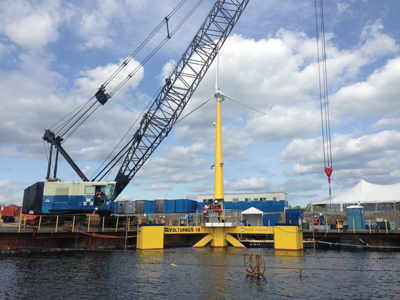
VolturnUS 1:8, a 65-foot-tall offshore wind turbine prototype, connected to the Central Maine Power Company on June 13, making it the first grid-connected offshore wind turbine in North America.
The turbine is 1:8th the scale of a 6MW, 423-foot rotor diameter design. It is sited off the coast of Castine, Maine.

“Today will constitute a historic moment for offshore wind in the Americas,” Habib Dagher, director of the Advanced Structure and Composites Center at the University of Maine and leader of the DeepCwind Consortium said during a ceremony marking the occasion. Dagher was joined at the event by Peter Vigue, president and CEO of Cianbro Corp.; Jake Ward, UMaine vice president for innovation and economic development; and William Brennan, president of Maine Maritime Academy.

The VolturnUS technology is the culmination of more than five years of collaborative research and development conducted by the University of Maine-led DeepCwind Consortium. The DeepCwind research program is a unique public-private partnership funded by the Department of Energy, the National Science Foundation-Partners for Innovation, Maine Technology Institute, the state of Maine, the University of Maine and more than 30 industry partners.

Jose Zayas, director of the U.S. Department of Energy’s Wind and Water Power Technologies Office who was in Brewer, Maine for the turbine’s May 31 launch, says the Castine offshore wind project represents “a critical investment to ensure America leads in this fast-growing industry, to bring tremendous untapped energy resources to market and create new jobs across the country.”

Data acquired during the 2013 deployments off Castine will be used to optimize the design of UMaine’s patent-pending VolturnUS system. The program goal is to reduce the cost of offshore wind to compete with other forms of electricity generation without subsidies.The UMaine Advanced Structures and Composites Center has partnered with industry leaders to invest in a 12MW, $96-million pilot farm. The deployments this summer will de-risk UMaine’s VolturnUS technology in preparation for connecting the first full-scale unit to the grid in 2016.

Maine has 156GW of offshore wind capacity within 50 miles of its shores and a plan to deploy 5GW of offshore wind by 2030. The 5GW plan could potentially attract $20 billion of private investment to the state, creating thousands of jobs.

For more information, visit composites.umaine.edu and www.deepcwind.org.

RES Americas to Construct Phase Two of the Lower Snake River Wind Project

0

Renewable Energy Systems Americas Inc. (RES Americas), a leader in the construction of wind and solar projects in North America, is pleased to announce it has been selected as the balance of plant (BOP) constructor for phase two of the Lower Snake River wind farm. Portland General Electric (PGE) announced this week that it has entered into an asset purchase agreement to acquire the development rights to the wind project from Puget Sound Energy Inc. (PSE), and that RES America Construction Inc. will serve as general contractor.

Phase two of the Lower Snake River wind farm, which is located near Dayton, Wash., northeast of Walla Walla, is expected to employ up to 300 construction workers, and once operational, create about 18 full-time jobs. The 267MW project will utilize 116 wind turbines manufactured by Siemens Energy Inc., each with a nameplate generating capacity of 2.3 MW.  When complete in 2015, the project will provide enough clean, renewable energy to power 84,000 homes.

“RES Americas enjoyed working with Puget Sound Energy to finalize development of phase two of the Lower Snake River wind farm, and we look forward to constructing it for Portland General Electric,” RES  Chief Operating Officer Andrew Fowler said.  “The acquisition of this project is a significant addition to PGE’s renewable energy portfolio, and will ensure that PGE’s customers receive even more power from clean, renewable resources.”

RES Americas was the original developer of the Lower Snake River wind farm, and in 2009 sold the development assets to PSE, at which time PSE assumed the role of owner and developer of the project.  RES Americas also performed the BOP construction on the 343 MW Lower Snake River Wind Project – Phase I, which was completed in 2012. PSE owns and operates that project.

PGE’s acquisition of phase two of the project from PSE is the result of a request for proposals for renewable resources that PGE issued last fall.  PGE found that of the 64 bids representing 39 distinct generating projects that were submitted in response, phase two of the Lower Snake River wind farm was the best-performing proposal.

Combined with PGE’s existing owned and contracted renewable power generating resources, PGE’s acquisition of phase two of the Lower Snake River wind farm will allow PGE to comply with state standards requiring the utility to supply 15 percent of the power it delivers to customers from qualifying renewable sources beginning in 2015.

For more information, please visit www.res-americas.com.

Winergy Donates 20-Ton Gearbox to Ecotech Institute

0

Ecotech Institute recently received a large gearbox for its Wind Energy Technology program, giving students the chance to learn on equipment that many will eventually use in their career. Winergy, a subsidiary of Siemens, donated the 20-ton Eickhoff gearbox, which is a major component in a wind turbine that gears up the rotational speed of the drivetrain and generator rotor. The donation gives Wind Turbine Technician students additional equipment to learn first-hand how to do borescope inspections, bolt fastening and troubleshoot gearboxes.

“We are so thankful for this generous donation. Within the wind industry, it is commonly understood that proper maintenance, as well as predictive analysis of oil and vibrations, can extend the life of the gearbox,” said Shawn Lamb, program director of wind energy technology at Ecotech Institute. “It’s important for our students to learn these maintenance skills, because the longevity of this component can make or break a wind farm’s business model and profit structure.”

For more information, visit www.ecotechinstitute.com/wind-energy-technology-schools.cfm or www.winergy-group.com.

INTERTEK Completes London Array Cable Management Support

0

Intertek has successfully completed a long-standing cable package engineering and support contract at London Array, the world’s largest offshore wind farm.

Now in full operation, London Array is set to provide renewable energy to over half a million British homes each year, and, as part of this extensive project, Intertek provided valuable construction, cable engineering and installation support.

The activity began in 2001 and has seen Intertek Energy & Water Consultancy Services (formerly Metoc) carry significant cable routing and feasibility studies during the evolution of the project. These vital studies helped aid the installation of the four export cables, each over 50 km in length, to the on and offshore substations, saving vital time and helping the project to meet scheduled completion deadlines.

Throughout the lifecycle of the brief, Intertek provided dedicated on-site cable engineering expertise and resource to the project, thereby enabling the developer and all associated project partners, to help reduce risks and maintain schedule.

“Having worked closely with the project development team at London Array since its inception, we’re proud to have played a role in helping bring the initiative online—especially given the sheer size and scale of the project,” said Frank Beiboer, managing director, Intertek Energy & Water Consultancy Services. “Through the provision of specialist expertise and dedicated internal personnel, it’s fantastic to be able to celebrate and share this important industry milestone and measure of success.”

Richard Rigg, London Array Project Director, added, “Intertek carried out a number of significant cable routing studies during the development of the London Array Offshore Wind Farm. More recently, Intertek has provided expertise in the form of personnel to manage elements of the installation and commissioning of the four export cables and technical advice in preparation for the transfer of the cables to an Offshore Transmission Owner.”

“While a project of this scale will inevitably experience a variety of challenges, Intertek has consistently produced high quality work that hashelped to keep the project on track and has contributed to London Array becoming a real success story for UK energy.”

For more information, visit www.intertek.com.