Home July 2014

July 2014

Wind Industry Celebrates Global Wind Day

Global Wind Day is a worldwide event that occurs annually on June 15th. It is a day for discovering wind, its power and the possibilities it holds to change our world.

In more than 75 countries around the world, wind farms are in operation, generating energy from a clean and renewable source.

Thousands of individuals are involved in the production of energy from the wind, but for many people, wind energy is a mystery. Global Wind Day is the day when you can visit wind farms, meet experts, attend events, take actions to support wind energy and find out everything you want to know about wind energy.

To mark the 6th Annual Global Wind Day on June 15th, the Canadian Wind Energy Association launched a redesigned annual Power of Wind Contest.

Students entering or in post-secondary education are eligible to submit multimedia or written entries on the theme of why wind energy is important to Canada’s future energy mix.

Last year’s Power of Wind Contest attracted over 500 thoughtful and creative blogs on how students can be part of a renewable energy future. This year, there will be four bursary prizes of $1,000 each awarded for the best blogs, the most creative submissions and the best use of multimedia.

Participants can submit their blog entries until September 15th, 2014. The winners will be announced at CanWEA’s Annual Awards Banquet in Montreal on October 29, 2014. Visit friendsofwind.ca for more information.

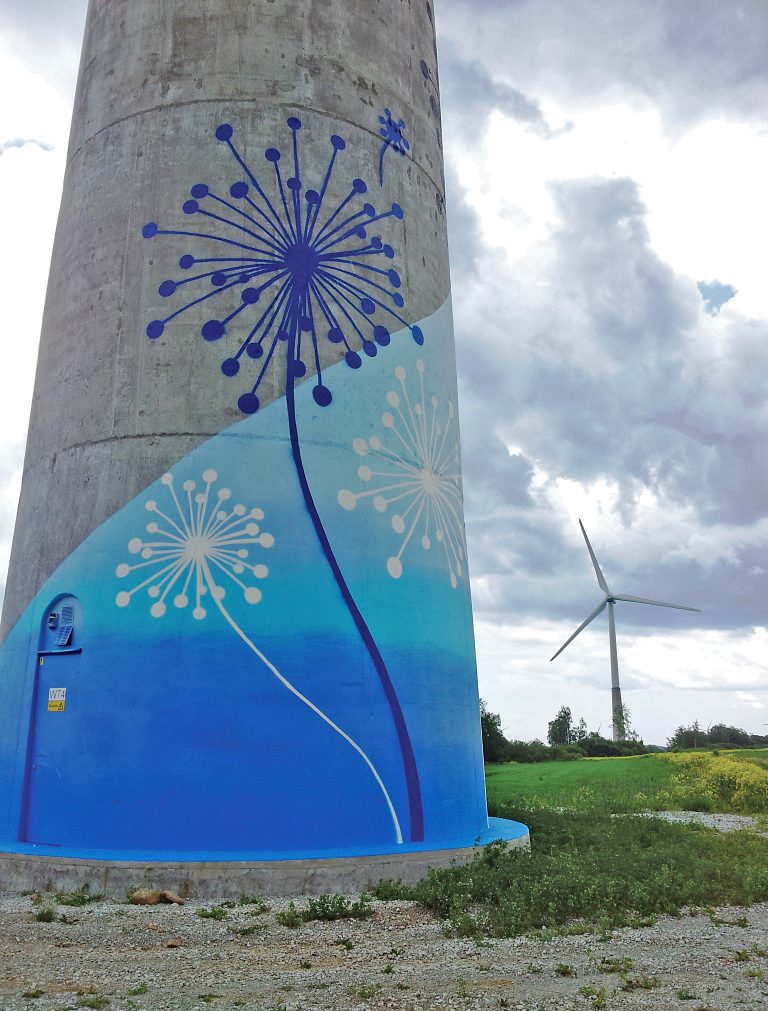
The Estonian Wind Power Association turned one of country’s wind turbines into art for this year’s Global Wind Day. The idea to decorate the turbine with dandelions was selected among 46 brilliant ideas sent for the competition “Art on Wind Turbine.”

The artwork was painted on one of the tower’s in Viru-Nigula wind farm in the East of Estonia and is well seen by people driving past the wind farm on Narva highway. The dandelions ready to let fly their seeds are symbolizing the flow of energy and wind.

In Ireland, where the Irish Wind Energy Association recently reported wind energy accounted for an average of 23 percent of electricity generation (from December 2013 to May 2014), wind farms hosted an array of events to celebrate wind energy. Some communities held public wind farm open-days so that families can learn about wind energy and see the turbines in operation themselves; others are inviting schools for fun, games and facts on wind.

The European Wind Energy Association and the Global Wind Energy Council coordinate the Global Wind Day through a network of partners. The day started as a European one in 2007 and went Global in 2009. On June 15, hundreds of public events are organized all over the world.

Editor’s Desk

0

What do you want to be when you grow up?

Adults ask kids this all the time, not really expecting an intelligent, well-thought-out answer. We could give the excuse that we’re giving them an opportunity to exercise their creative imaginations. Or maybe we plan on having a good laugh at a silly response.

Personally, I think it’s just one of those trite, awkward questions we ask of a child when we’ve just met them or don’t know them very well.  It’s small talk for toddlers. Second only to “How old are you?”

Even if you don’t have a reason for asking, and no matter what response you get, you know from the start that it’s an exercise in futility. You can’t expect someone to map out a 40-year career plan on the spot at that young stage of life.

If that was a reasonable expectation, I wouldn’t even know what wind energy is. My name would be Lion-O and I would spend my days defending Cat’s Lair against the evil Mutants of Plun-Darr.

Funny thing is, the question doesn’t go away. It simply gets re-phrased with increasing degrees of meaning and urgency as you pass through the stages of life.

When you’re a teen, it’s: “Have you thought much about your future?”

You may end up going to college, where, upon graduating, you surprise yourself by asking: “What am I going to do now?!”

When you get married and start a family, the question becomes a statement: “I’ll be whatever I have to be.”

From that point on, you might find yourself asking others the same silly question that you’ve never even been able to answer. Toddlers… teens… grads … dads.

One day, you’ll retire … from whatever your occupation was. This is the “grown-up” moment you’ve been striving for your whole life. You sit back and take an assessment …

“Have I become what I wanted to be when I grew up?”

I never thought I would end up in the wind industry. It wasn’t even on the radar. But in this industry I found something that I can get behind — something that doesn’t solely consume 40 hours out of my week.

If you’re receiving this magazine, chances are you are part of the wind energy workforce. If you find yourself disillusioned by the politics and uncertainty, or that you’ve lost what it was that drew you to the industry, assess your motives. If they’re different than what they were originally, rediscover that purpose, or you’ll constantly be asking yourself a different question:
“What have I become?”

Thanks for reading
 

Wind Energy Poised to Lead the Way in Carbon Reduction

The first week in June was a busy one in the renewable energy world, and perhaps even more so among the media that covers energy and policy. That was when the U.S. Environmental Protection Agency (EPA) released its first-ever proposed rule limiting carbon pollution from existing power plants.

In short, the release of the proposed rule was good news for wind energy because the resource is well-positioned to be a leading solution to cutting carbon.

Already Making an Impact
Having dramatically cut the cost of its product (i.e., clean energy), the wind energy industry is already helping every state make progress in cutting their carbon emissions. Already, 11 states have achieved emission reductions of 10 percent or more because of wind and another three states are just below 10 percent.

Just prior to the release of the proposed EPA rule, AWEA released a white paper showing wind energy already helps nearly every state make progress toward carbon reductions and is an affordable and reliable compliance option for further reductions. The white paper found that the 167.7 million megawatt-hours of wind energy produced in the U.S. in 2013 reduced CO2 emissions by 126.8 million tons, the equivalent of reducing power sector emissions by more than 5 percent, or taking 20 million cars off the road.

Achieving 20 percent wind energy, a benchmark outlined in the U.S. Department of Energy’s impending Wind Vision document and in a prior 2008 DOE report, would yield emission reductions of 25 percent.

Wind energy can help states make even more significant reductions, in accordance with the proposed rule — and it can do that while saving consumers money and driving local economic development in the process.

Over the last few years, wind energy has experienced record growth and a major reduction in costs. Wind energy has driven up to $25 billion in private investment in a single year, while the reductions in carbon dioxide emissions and deployed megawatts are rapidly heading upwards.

The cost of wind energy has dropped 43 percent in four years, thanks partly to 560 factories making wind energy components across 44 states. Utilities and other power providers have increasingly been signing contracts for wind energy because they can get long-term, fixed-price deals that help hedge their portfolio against the price volatility of fuel-based sources.

Adopt and Adapt
Thus, American wind power is well positioned to be at the center of efforts to achieve the benchmarks under the proposed EPA rule.

“We hope that this rule makes clear that we have a chance right now to make long-term decisions to lock in affordable power with clean, renewable energy for decades to come,” said Paul Gaynor, CEO of wind energy company First Wind. “Renewable power isn’t only clean, it’s competitively priced.  Our customers are already saving millions of dollars by buying wind and solar electricity, and stand to save millions in the years to come.  Renewable energy isn’t subject to the price fluctuation that fossil-fuel power is, meaning that the cost savings will last for years to come.”

Notably, stakeholders from various segments of the energy industry are showing openness to the proposed rule. Duke Energy CEO Jim Rogers offered an almost shrugging can-do analysis of the EPA proposal. “I think we’ll find a way to adopt and adapt to the EPA regulations,” he said, speaking at the Annual Conference for Energy Storage in Washington, D.C.

Rogers also expressed concern over rushing to natural gas as the sole solution to meeting the carbon targets set by the new EPA rule. “The gas industry has a history of volatility,” noted Rogers, urging utilities to diversify their resource mix with such options as renewables.

As many utilities across the country know, renewable energy sources like wind power act as a hedge against fossil-fuel price volatility, insulating customers from spikes on their power bill during supply squeezes. In three separate cases during the winter months, wind stepped in to stabilize prices and fill in supply gaps when the cold drove electric demand skyward.

“As one of the biggest, fastest, and cheapest ways to reduce carbon pollution, wind energy can play a central role in state plans to achieve the reduction targets appropriately set by the EPA,” said AWEA CEO Tom Kiernan, responding to the release of the proposed rule. “Reducing carbon pollution through the deployment of wind energy can be done in a manner that keeps electricity affordable and reliable, creates jobs, and supports local economic development.”

(202) 383-2500 www.awea.org info@awea.org
AmericanWindEnergyAssociation @AWEA american-wind-energy-association
www.aweablog.org


U.S. offshore wind development area doubles

0

As part of the Obama administration’s Climate Action Plan, Secretary of the Interior Sally Jewell and Bureau of Ocean Energy Management (BOEM) Acting Director Walter Cruickshank today joined Massachusetts Governor Deval Patrick to announce more than 742,000 acres offshore Massachusetts will be available for commercial wind energy leasing. The proposed area is the largest in federal waters and will nearly double the federal offshore acreage available for commercial-scale wind energy projects.

The Massachusetts Wind Energy Area is located approximately 12 miles offshore Massachusetts – from its northern boundary, the area extends 33 nautical miles southward and has an east/west extent of approximately 47 nautical miles. BOEM proposes to auction the Wind Energy Area as four leases.

“Massachusetts is leading the way toward building a clean and sustainable energy future that creates jobs, cuts carbon pollution and develops domestic clean energy resources,” Jewell said. “Thanks to Governor Patrick’s vision and leadership, the competitive lease sale in Massachusetts will reflect the extensive and productive input from a number of important stakeholders. This includes interests such as commercial fishing, shipping, cultural, historical, environmental, and local communities to minimize conflicts and bring clarity and certainty to potential wind energy developers.”

“Today’s announcement is a momentous occasion and the culmination of years of cooperation and hard work between the Commonwealth and federal officials,” Patrick said. “Through our investments and proactive planning, Massachusetts is poised to lead the charge in offshore wind energy development, with the economic and environmental benefits that come with it.”

The announcement builds on Interior’s work to stand up a sustainable offshore wind program through its wind energy initiative for the Atlantic Coast. To date, BOEM has awarded five commercial wind energy leases off the Atlantic coast: two non-competitive leases (Cape Wind in Nantucket Sound off Massachusetts and an area off Delaware) and three competitive leases (two offshore Massachusetts-Rhode Island and another offshore Virginia). To date, competitive lease sales have generated about $5.4 million in high bids for about 277,550 acres in federal waters. BOEM is expected to hold additional competitive auctions for Wind Energy Areas offshore Maryland and New Jersey later this year.

“The Commonwealth of Massachusetts has been working hand in hand with BOEM to foster responsible commercial wind development in federal waters off Massachusetts,” said BOEM Acting Director Cruickshank. “Members of the Massachusetts Renewable Energy Task Force have been great partners in our planning process for the Wind Energy Area and the Proposed Sale Notice.”

To help inform BOEM’s decision-making, the Commonwealth established two working groups, a Fisheries Working Group on Offshore Renewable Energy to discuss issues and compatibility between commercial fishing activities and offshore commercial wind energy development, and a Habitat Working Group on Offshore Renewable Energy to discuss available ecosystem data and information within the area under consideration in order to identify any gaps.

The Commonwealth has additionally collected and presented spatial information and data for the Wind Energy Area regarding marine mammals, birds, ocean floor, geology, commercial ship traffic, and recreational boating to inform BOEM’s offshore wind planning process. In addition to BOEM’s stakeholder outreach, the Commonwealth has conducted dozens of public meetings and stakeholder sessions to discuss the Federal offshore wind leasing process.

Since taking office in 2007, Governor Patrick’s Administration has worked to position Massachusetts as a hub for the emerging U.S. offshore wind industry. These efforts also include the construction of the Marine Commerce Terminal in New Bedford, the first facility in the nation designed to support the construction, assembly, and deployment of offshore wind projects.

The Proposed Sale Notice announced today triggers a 60-day public comment period ending on August 18, 2014. Comments received or postmarked by that date will be made available to the public and considered before the publication of the Final Sale Notice, which will announce the time and date of the lease sale.

The end of the comment period also serves as the deadline for any participating companies to submit their qualification packages. To be eligible to participate in the lease sale, each bidder must have been notified by BOEM that it is legally, technically and financially qualified by the time the Final Sale Notice is published. For more information on qualification requirements, please see The Proposed Sale Notice. Companies planning to submit a qualification package are strongly encouraged to submit as early as possible during the comment period to ensure adequate time for processing.

BOEM will host a public seminar during the comment period to describe the auction format, explain the auction rules, and demonstrate the auction process through meaningful examples. The time and place of the seminar will be announced by BOEM and related information will be published on BOEM’s website.

In addition to the Proposed Sale Notice, BOEM is publishing in the Federal Register a Notice of the Availability (NOA) of a Revised Environmental Assessment and a Finding of No Significant Impact (FONSI). The FONSI states that BOEM has determined that no reasonably foreseeable significant impacts are expected to occur as a result of issuing wind energy leases and the approval of Site Assessment Plans in the Massachusetts Wind Energy Area. Before a decision regarding the construction of any proposed wind power facility, BOEM will conduct a comprehensive site-specific National Environmental Policy Act review, which will include additional opportunities for public comment.  

— Source: U.S. Department of the Interior.

Energy department partners with advocacy groups

0

In order to provide the highest quality information to support decision-making regarding wind energy, the Energy Department in June launched a collaborative partnership between its new WINDExchange initiative and six supporting Regional Resource Centers.

The new WINDExchange initiative and website will serve as a digital portal providing fact-based informational resources about the costs and benefits of wind power, technical assistance and guidance for simplifying the deployment process, and public access to educational resources. Upholding the Energy Department’s commitment to making high-quality information available to advance clean energy technologies, WINDExchange provides key resources and tools through its website such as: wind resource maps; e-newsletters published twice a month; webinars; podcasts; databases; economic development studies; fact sheets; the Wind for Schools Portal; and a Small Wind Guidebook.

Six new Regional Resource Centers (RRCs) will serve their regions as wind energy information centers, supporting WINDExchange’s efforts and working collaboratively with local organizations to engage diverse stakeholder groups. Their geographically-based focus will enable the RRCs to better understand and target the specific priorities and challenges relevant to their regions. Leaders from the RRCs are meeting this week at the National Wind Technology Center in Colorado to kick off this year’s engagement activities in each region and discuss the new WINDExchange resources available to support their work.

The new RRCs include:

• Northwest Wind Resource and Action Center, operated by Renewable Northwest
• Four corners Wind Resource Center, operated by Utah Clean Energy in partnershipwith Interwest Energy Alliance and Northern Arizona University
• America’s Islanded Grids Resource Center, operated by Renewable Energy Alaska Project and Island Institute
• Midwest Wind Resource Center, operated by Windustry
• Northeast Wind Resource Group, operated by Clean Energy Group and Sustainable Energy Advantage
• Southeast Wind Energy Resource Center, operated by Southeastern Coastal Wind Coalition.

— Source: U.S. Department of Energy

Silicon Valley Power and Oklahoma Municipal Power Authority win 2014 Public Power Wind Awards

0

The U.S. Department of Energy, together with the American Public Power Association (APPA), have recognized the Oklahoma Municipal Power Authority (OMPA) and Silicon Valley Power (SVP) of Santa Clara, California, as the winners of the 2014 Public Power Wind Awards.

The awards, presented at the APPA National Conference in Denver, Colorado, recognize publicly owned utilities that demonstrate outstanding leadership in advancing wind power in the U.S.

Silicon Valley Power received the award in the public power utility category for its 30-year, sustained commitment to acquiring, developing, and integrating wind energy in Santa Clara. The utility built a 20 MW wind farm that has provided affordable power to Santa Clara customers for over 25 years. Silicon Valley Power provides its customers with renewable energy at the lowest average rate in the state of California, and maintains a 13.8 percent wind energy mix.

OMPA received the award for steadily building its renewable energy portfolio in an effort to support its members’ green power initiatives. It was the first commercial power company to offer wind power to municipal customers in Oklahoma and, in 2011, OMPA purchased more than 49 MW of wind generating capacity, bringing their wind energy generation to 14 percent of their total annual power production.

— Source: U.S. Dept. of Energy
 

Report: Global installed wind energy capacity to more than double by 2020

0

Despite an overall slump in installations in 2013, the global cumulative wind power capacity will more than double from 319.6 GW at the end of 2013 to 678.5 GW by 2020, says research and consulting firm GlobalData.

The company’s latest report states that China, the largest single wind power market responsible for 45 percent of total global annual capacity additions in 2013, is expected to have a cumulative wind capacity of 239.7 GW by 2020.

China overtook the U.S. as the leading market for installations in 2010, when it added a massive 18.9 GW of wind capacity.

“China doubled its cumulative wind capacity every year from 2006 to 2009 and has continued to grow significantly since then,” said GlobalData alternative energy analyst Harshavardhan Reddy Nagatham. “Supportive government policies, such as an attractive concessional program and the availability of low-cost financing from banks, have been fundamental to China’s success.

“While China will continue to be the largest global wind power market through to 2020, growth for theforecast period will be slow due to a large installation base.”

The report also states that the U.S. will remain the second largest global wind power market in terms of cumulative installed capacity, increasing from 68.9 GW in 2014 to 104.1 GW in 2020. U.S. growth will largely be driven by renewable energy targets in several states, such as Alaska’s aim to reach 50 percent renewable power generation and Texas’ mandate to achieve 10 GW of renewable capacity, both by 2025.

Nagatham concludes: “The slump in 2013 was largely a product of a decrease in installations in the U.S. and Spain. While there are likely to be further slight falls in annual capacity additions in 2015 and 2016, overall industry growth will not be affected as global annual capacity additions are expected to exceed 60 GW by 2020.”

The full report, “Wind Power, Update 2014 — Global Market Size, Average Price, Competitive Landscape, and Key Country Analysis to 2020” is available for purchase at store.globaldata.com.
— Source: GlobalData

Staying at the Top of Their Game

0

The wind energy industry is the tip of the spear when it comes to fulfilling the societal needs for renewable energy. Wind energy has been a key factor in the United States and European Union’s plans for lower carbon emissions, and will continue to increase in prominence as the latest developments in technology continue to drive the cost of electricity down.

According to Ecotech Institute’s Clean Job Index, a database on clean jobs and other sustainability factors that affect the United States, jobs in wind energy are expected to grow 22 percent between 2010 and 2020. Figure 1

“Wind is proving to be a cost competitive energy source on its own. With the growth potential we are forecasting, it would be difficult to be anything but upwardly mobile in a career in wind energy,” said Walter Christmas, a wind energy technology instructor at Ecotech Institute.

But this growth, paired with the ever-changing list of trends and challenges in wind energy, requires an expertly trained high-tech workforce. Technical colleges, like Ecotech Institute, are tasked with staying on the cutting edge of technology while preparing students to enter a workforce that desperately needs them.  

“When we see our graduates get job offers before they even graduate, that is a good indicator the industry is growing,” said Auston VanSlyke, a wind energy technology instructor at Ecotech Institute.

Growth and Trends
Many wind energy sites have come online this year.  This is the type of growth that leads to increased hiring both in operations and maintenance positions, as well as management for facilities. The wind energy industry has also seen a move toward more specialist positions related to sub-systems and component diagnosis and repair.

“These are high-level technician jobs working closely with system engineers to monitor components such as gearboxes, generators, frequency converters, vibrations and oil analysis,” VanSlyke said.  

The industry has also seen growth in offshore wind turbines, with the Department of Energy announcing another round of funding to three offshore pilot projects. The complexity of offshore wind will accordingly add complexity to the technology, commissioning, operation, and maintenance of these multi-megawatt power plants. Figure 2

In an industry that is constantly and rapidly changing, keeping up with the latest technological advancements is one of the biggest challenges professionals working in wind energy face. Implementing new methods and systems means learning new solutions for troubleshooting. When it comes down to it, downtime equals money, and the more you understand why a turbine faults, the better your bottom line will be.

Christmas cited the Voith hydrodynamic variable-speed gearbox used by DeWind, the double-fed induction generator and frequency converters, and the electric (variable frequency drive) pitch systems as just a few examples of the latest technology to gain prominence in wind energy.

But the rate of change is ultimately a good thing, as the industry tirelessly works to find new innovations in wind energy technology. In the coming years, Christmas expects improving gearbox reliability will become a focus — a development that would reduce downtime during major component replacements.

And the need for these innovations matters not only to engineers, but also to every professional within the industry. Figure 3

“As talented as the industry’s engineers are, often the simplest and most effective solutions stem from ideas created by technicians. It makes sense that the people who work closest to the machines should generate some creative solutions,” Christmas said.

Preparing Students for the Workforce
Identifying the skills needed for wind energy technicians is an on-going process. The industry often looks to resources like the National Renewable Energy Lab’s National Skills Assessment of the U.S. Wind Industry and The American Wind Energy Association (AWEA) Operations and Maintenance (O&M) Recommended Practices, to pinpoint what abilities and knowledge are needed.

Even when an aspiring wind technician leaves a college like Ecotech Institute, this is only the beginning of their training. They will then be trained on the turbine specific technology by the OEM or an on-the-job trainer.  This learning cycle can last many years before a true level of technical competency is achieved on these highly automated wind power plants.  

Advancements in technology are still outpacing even the best field technicians’ ability to keep up. Often, wind energy companies need to hire training firms to keep their employees abreast of the latest faults and how to troubleshoot them. Figure 4

To prepare individuals to enter this work environment, education programs for wind energy must focus on state-of-the-art technologies in its trainings and labs. Ecotech Institute makes it a priority to expose students to skillsets such as supervisory control and data acquisition (SCADA), PLC programing, advanced pitch systems, advanced converter theory, communications, power electronics, power equality, torque and tensioning tools, and the latest in climb and rescue techniques.

But most importantly, aspiring wind energy technicians must learn how to learn. To the uninitiated, the first day of on-the-job training can be overwhelming. Upon entering the workforce, these individuals must learn to absorb and digest the processes and technology being taught by their on-the-job trainers. In an industry defined by innovation and change, the most crucial skill someone can learn is the ability to adapt.  
 

www.ecotechinstitute.com /EcotechInstitute @Ecotech_Inst
EcotechInstitute


As job growth lags in rural America, some communities see wind energy development as a possible answer

0

To many in rural communities, clean energy means a clean slate. Here it’s no secret that environmental considerations take a back seat to the enthusiasm surrounding new opportunities for employment. Even the potential for lower electricity rates can’t bump “job creation” from the headlines.

Statistics support the sentiment. Nationally the wind industry drives a domestic manufacturing supply chain of more than 560 facilities across 43 states and supports more than 50,000 jobs. States such as Kansas boast over 4,000 good-paying positions tied to wind energy. Taxable values on personal property have increased by as much as 15 percent per year in places like Huron County, Michigan, allowing local governments to hire new workers and improve job-creating infrastructure.

But the picture isn’t rosy everywhere. Though the economy has added jobs each month since March of 2010, the vast majority of this improvement has taken place in metropolitan counties. When it comes to job creation, our rural areas are being left behind.

Seven years after the early days of the Great Recession rural counties are struggling to keep pace with their urban counterparts. Right now there are 348,000 fewer jobs in rural counties than there were in 2007. There are 440,000 fewer jobs in counties with small towns today than in 2007. Meanwhile, urban counties have gained 765,000 jobs over the same period.

If these job totals are any indication, a full 73 of Nebraska’s 93 counties have yet to recover from the Great Recession. One of these is Burt County, home to the Center for Rural Affairs.

The median income for a household in Burt County is $33,954. The average salary for a female in our county totals $20,644. Almost 9 percent of the local population lives below the poverty line.

Burt County is also home to a proposed community wind project that has spent the past five years trying and failing to secure a power purchase agreement from the Nebraska Public Power District, the state’s largest utility.

An 80 MW wind facility takes one year to build. During this time 376 new construction jobs will be added. In Nebraska, the average salary for these jobs is $46,037, leading to total earnings of $17.3 million. This translates to $28.68 million in local spending into the local community economy, creating countless jobs along the way.

It’s estimated that this facility will be in operation for a 20-year period. This leads to 14 additional jobs, with an average wage of $47,143 per year. This encourages $1.07 million in spending into the local economy. A total of $1.84 million is made in earnings due to the direct jobs created and associated earnings, plus the indirect economic benefits from the local spending taking place.  

Burt County isn’t a unique example. Hundreds of rural counties throughout the Central United States could benefit dramatically from a commitment by their local utility to invest in an energy source that keeps money in the community and the transmission infrastructure required to move this energy from where it’s produced to where it’s needed most.

The wind industry has grown dramatically over the past seven years. Prices have fallen by 43 percent in the past four, and continue to trend downward. Six states meet more than 15 percent of their energy needs using wind. Independent system operators such as the Southwest Power Pool have set new generation records, exceeding 30 percent. Utilities are setting new records as well, such as Xcel energy which managed to use wind for over 60 percent of its needs at this time last year.

Industry growth may be impressive, we still have a long way to go. It’s important that we not rest on our laurels. Small towns throughout America are struggling to offer the kind of good paying, middle classes jobs that are needed to keep our social fabric strong. Wind energy offers a solution that capitalizes on the renewable natural resources found right in our own back yards.

An investment in wind energy is an investment in our community, and in the future of rural America.

www.cfra.org /ruralaffairs @cfra


CASE STUDY: KVCC Wind Turbine Technician Academy

0

Introduction
According to data from the American Wind Energy Association, wind energy supplied more than 4 percent of the United States’ electricity in 2013. On the state level, in 2013, wind energy had double-digit percentage shares in nine states. In Iowa and South Dakota, wind energy provided more than 25 percent of those states’ electricity.

The U.S. wind industry installed 214 MW during the first quarter of this year, eclipsing total new capacity installed in the first three quarters of 2013. The U.S. now has a cumulative installed wind capacity of 61,327 MW. Currently, more than 13,000 MW of wind projects are under construction — an industry record. Figure 1

Despite a significant drop in new installed capacity in 2013, wind energy is continuing to expand its share of the U.S. energy generation mix.

Need and Opportunity
In 2008, shortly before the exponential growth of the U.S. wind energy industry, installed capacity was 25,065 MW. Kalamazoo Valley Community College saw an opportunity to address the long-term need for highly qualified wind energy technicians. Administrators and personnel recognized and understood the need for technicians who could perform services and make repairs as well as contribute to the industry’s need for improved efficiencies and availability. In 2009, KVCC enrolled students and launched its Wind Turbine Technician Academy (WTTA) with the intent of changing the paradigm for educating the wind workforce.
 
The Program
Kalamazoo Valley’s Wind Turbine Technician Academy attracts students who want to be the best in their field. Applications are required to assure students understand the working conditions, the complexity of the job and embrace the requirements associated with wind farm locations. Students who are accepted into the course are climb-tested, undergo background checks and take a skills assessment. Figure 2

Many students are attracted to the field as a proactive opportunity to support clean energy production and by the unique opportunity to work on highly advanced technology.  Students come from around the world and alumni can be found at work for nearly all of the major wind industry employers. Workforce placement rates have remained between 95 – 97 percent for certified alumni.

This program has an elite reputation of being a responsive program driven by industry demands. That fact is largely due to its competency-based programming which aligns to skill standards created by employers. This month, the tenth WTTA class begins its study in the 24-week course. Students attend the program Monday through Friday, eight hours a day, to gain proficiency in specific competencies and in performing actual work demonstrating their ability to apply what they learn.

Kalamazoo Valley Community College holds the recognition of earning both the American Wind Energy Association (AWEA) Seal of Approval, as well as certification by the Bildungszentrum für Erneuerbare Energien (BZEE), Renewable Energy Education Center. As a BZEE partner school, graduates have the opportunity to earn a certification as a Service Technician for Wind Turbine Engineering. Certification requires students to pass both written and practical examinations, as well as participate in in-the-field service to satisfy internship requirements.

Hands-On Training
The training lab is located in Kalamazoo, Michigan. This is a hands-on program. The first three weeks of the course is devoted to certified safety training. The program has earned the respect of wind farm owners such as Michigan-based Crystal Flash Renewables and Heritage Sustainable Energy, who support the program through educational affiliations. These partnerships afford students the opportunity to gain hands-on experience by performing real work on real working turbines — under the guidance of their professional instructional team. This experiential learning fulfills the certification requirements of the BZEE and produces experienced, well-tested graduates who are immediately prepared to perform the job functions required by their future employers. Figure 3

 “As an owner/operator of utility wind facilities, we place tremendous faith in not only the skill, but also the dedication of the technicians,” said Rick Wilson, Vice President of Operations at Heritage Sustainable Energy, located in Traverse City, Michigan. “They are responsible for millions of dollars of equipment and assuring that it is available when the wind blows 24/7/365. The Kalamazoo Valley program instills this sense of responsibility in the students and heightens their level of enthusiasm to execute their job with the utmost efficiency.”

Growing Demand
With the push in this country to generate 20 percent of our energy with wind by 2030, the demand for highly trained technicians will only increase. (Technicians starting pay ranges from $16.50 to 24.00 per hour.  Overtime is common.)  The work requires technicians to be willing and able to travel at the direction of their company. The work follows service contracts that cover predicted maintenance as well as unplanned service. Industry estimates call for one wind turbine technician is needed for every ten turbines.

The need for technicians will continue to increase regardless of the market associated with policy debates and inconsistency.  The existing fleet will continue to require support.  Figure 4

“Our training curriculum is at the leading edge of best practices in the industry,” said Tom Sutton, Director of Wind Energy and Technical Training at Kalamazoo Valley, “We listened carefully to employers and have built a course driven by their training standards. Our reputation for excellence as a competency-based training institution is evidenced by wind energy leaders knowing our graduates personally and attributing their proficiency to the training they received while in the program. By showing it can be done, the industry has made renewed commitments to competency-based training for technicians entering the industry.”

Student Profile/Testimonials
The Kalamazoo Valley WTTA graduated its first class of technicians in 2010.  Including the class of 2014 who graduated on June 20, 134 alumni have successfully entered the field of generating renewable energy. Students come from all over the world and they go all over to find jobs. It is truly a global program.

Nick Moss, 23, a recent graduate from the Kalamazoo Valley program, already has a job lined up in Woodward, Oklahoma. A 2014 graduate of the program, Nick feels prepared to begin his career and continue advancing with it.  Figure 5

“My last job was a dead-end,” said Moss. “I already had a good mechanical background from working on a farm.” Working at height didn’t intimidate him, but was instead one of the things that drew him in.

“This is a fast-growing industry — I am looking forward to traveling around the country,” he said.

Conclusion
The Kalamazoo Valley Community College Wind Turbine Technician Academy provides a fast track to high demand/high paying jobs. Wind Turbine Technicians are employed by turbine manufacturers and firms that provide operational and maintenance services as well as construction companies. Kalamazoo Valley offers this course as a non-credit full time program allowing men and women the chance to be job ready in less than six months.

“Our hands-on training capability, having trainees in real operating wind turbines, continues to make us attractive to the wind industry employers who see the field experience, combined with strong fundamentals education, as the best way to develop world class technicians,” Sutton said.

The Wind Turbine Technician Academy is offered twice a year. The next academy begins on July 7, 2014.
 

(269) 488-4400 www.kvcc.edu


Hiring Help: The view from a wind energy recruiter’s desk

An urgent phone call …
“Good morning Patricia. We have an immediate need to fill a position over here! Please give this your personal attention.”  

“Ready? Here goes … Must have BS in electrical Engineering, MSEE degree preferred. MBA couldn’t hurt. Ten years experience as a senior manager with a utility, with all applicable skills and knowledge, i.e., MS Project, SCADA, Arc Flash, IEC Substation, medium-large generation and transmission. A skilled negotiator and public speaker, eager to sell his home and move his family 800 or 1,000 miles. Completely familiar with all federal, state and local ordinances, right? Speaks some Latvian? Couldn’t hurt. There is some travel involved but never more than 30-40 percent.

“Oh, almost forgot. We won’t consider anybody without, say, 7-10 years experience in wind energy.”

The conversation continues …
“I see our agreement mentions a fee … What? Whoa! That’s going to be a tough sell, but HR hasn’t had any luck with this one. Let’s give it shot. Oh, salary? Well, we expect to have a nice salary package in the neighborhood of $75K or $80K. Can you have us six or seven candidates this week? By the way, we’re also calling four other recruiters.”  

Exaggerated? Yes. But only slightly!  

On occasion, candidate issues can be nightmarish as well. The candidate may be secretly weighing two or more other offers or prospects or be susceptible to counter offers by his/her present employer. The “ideal” candidate on paper may be surprisingly and devastatingly ghastly in an interview. He or she may accept a job which requires a relo and then refuse the relocation. Spouses can be fully entrenched in rewarding careers of their own and are understandably resistant to the inevitable relocation.

These examples reflect a few of the challenges to both companies and recruiters that accompany present and expected growth in wind energy.  

Overall, North Fork Renewables Group, the rare recruitment firm working exclusively in renewables (primarily wind and solar), sees an extremely busy and rewarding future in wind energy recruiting, because wind, despite on-again, off-again governmental support, continues to grow dramatically.  

What are key issues in attracting top wind candidates? What does it take to effectively and consistently succeed in their recruitment?

Employers who wish to attract and retain experienced qualified candidates can succeed when they make the decision to work closely with recruiters.  

The hiring company needs to give the recruiter extensive background information about company and what company is trying to achieve. What is the evolving “story” of the company?  Ideally the candidate will be a fit with the direction of the company as well as the job opening. Why is the position open? Was the position recently created? Why have past attempts to fill the position failed?  Were the positions responsibilities not being met by a former employee?  

Why would the candidate want to work for the company? Positions are difficult to sell to a candidate if the hiring manager can’t describe why the company is a great place to work. Rumors to the contrary must be dealt with. If candidates have heard terrible things about the company, those issues must be addressed. Experienced recruiters wrest from hiring authorities enough information to sell the company to the candidate.

Who is involved in the hiring? It is vital for the recruiter and candidate to know who will be conducting the interviews. The hiring process can be derailed suddenly and irreparably by a final interview with the one person who had different ideas from the start. A thorough recruitment can prevent a candidate from stepping into an elevator shaft late in the interview process.  

The fact is that vast numbers of job seekers very much want to work in renewables. This is a huge plus for renewable energy industries. Experienced workers who have left wind or solar in the past are attempting to return. We regularly hear from individuals employed in oil or gas who hope to cross over to wind with full knowledge of a likely reduction in salary. It is heartwarming as well that colleges and universities increasingly offer renewable energy related degrees. Overall, the view from a wind energy recruiter’s desk is encouraging.

(631) 765-8550 Ext. 101 www.northforkrg.com info@northforkRG.com


Sierra Club ads target Representatives for jeopardizing wind jobs by inaction on PTC

0

The Sierra Club has launched a national ad campaign, urging Congress to reauthorize a critical incentive for domestic wind energy investments. The effort, which includes substantial online and television ad buys, focuses on members of Congress with wind manufacturing jobs in their districts and states that are at risk if the wind production tax credit is not renewed.

The first wave of ads targets twenty House members who have been silent as the wind production tax credit has expired, and involves a television ad targeting Congressman Tim Walberg (MI-07) and extensive online ad buys in 20 other districts. The ad targeting Walberg will aired more than 5,000 times throughout June on broadcast and cable channels in Michigan’s 7th district. Geo-targeted online ads calling out 20 other Representatives launched this week and will run at least through June on local and national news sites. These members represent districts and states with a growing wind industry who have not taken a position in support of extending the federal production tax credit for renewable energy. In most cases, they have taken no position at all.

The wind production tax credit expired at the end of last year, in part because of new opposition from groups reportedly linked to fossil fuel interests.

“The Wind Production Tax credit is arguably one of the best bets we’ve made on clean, domestic energy,” said Dave Hamilton, Director of Clean Energy for Sierra Club’s Beyond Coal campaign. “It encourages huge investments, creates good American jobs, helps our country become more energy independent, and cuts air and water pollution. But many in Congress are failing to act, leaving thousands of American workers and communities across the country blowing in the wind.”

The wind industry employs more than 80,000 American workers and produces enough clean energy to power 15 million homes. It saves more than 30 billion gallons of fresh water each year compared with other energy sources. According to the American Wind Energy Association, if growth remains steady, the industry will produce 20 percent of America’s electricity by 2030.

“For wind in America’s heartland, the sky’s the limit,” explained Mary Anne Hitt, Director of Sierra Club’s Beyond Coal campaign. “Wind energy has created tens of thousands of good-paying, family-sustaining jobs, and has the potential to create tens of thousands more — all while generating enough clean energy to more than meet our nation’s electricity needs.”

In April, the Senate Finance Committee approved a package of extenders that included the wind tax credit. Movement has since stalled in the Senate, and The House Ways and Means Committee failed to include an extension of the wind tax credit in a similar package in May.

Forthcoming online, television, and print ads are planned as the Sierra Club continues to pressure members of Congress to act to protect clean energy jobs in their own communities.

— Source: The Sierra Club

Clean energy sector adds 5,600 jobs in the first quarter

0

Congressional inaction on key clean energy tax policies, coupled with attacks on state renewable energy programs, led to a dramatic decline in clean energy job announcements in the first quarter of this year, according to the latest report from the nonpartisan business group Environmental Entrepreneurs (E2).

About 5,600 clean energy and clean transportation jobs were announced in the first three months of this year, down from 12,000 such jobs reported in the comparable period in 2013.

A major geothermal project in Idaho accounted for the most clean energy jobs announced on the state level in the first quarter. Idaho was followed by more traditional clean energy leaders. The remaining states in the Top 10 were: Texas, California, Missouri, New York, Kansas, Arizona, Hawaii, New Mexico and Louisiana..  For the complete report and state-by-state details on all clean energy jobs announced in Q1 and in previous quarters, see here.

Despite adding thousands of new jobs to the economy, the dramatic drop in clean energy and clean transportation job announcements in the quarter is a clear reflection of mixed signals American businesses  are getting from Capitol Hill and state capitals when it comes to policies such as the federal Production Tax Credit (PTC) and various state-level renewable energy standards (RES), according to E2.

“Congress pulled the plug on smart clean energy tax policies at the end of last year, while in the states, lawmakers are getting bullied by special interests that don’t want our country to produce more clean, renewable energy,” said E2 executive director Bob Keefe. “Guess who’s suffering as a result? American workers and businesses.”

Keefe added:  “Given the muddied policy environment on clean energy, low overall jobs numbers were expected. Fortunately, it’s not too late for lawmakers to steer clean energy and clean transportation job growth back on track.

“If we want to keep creating good-paying clean energy jobs in America, our elected officials need to do their jobs first. They need to support these smart policies that will help our economy while also helping our environment,” Keefe said.

Among the notable clean energy projects announced in the first three months of 2014:

• Aguacaliente’s 25 MW, $150 million geothermal plant is expected to bring 800 jobs to Walker Ranch, Idaho;

• NJR Clean Energy Ventures’ wind farm in Carroll County, Iowa, could create more than 80 jobs; and

• The 22 MW Barilla solar project in Pecos County, Texas, is expected to create about 350 jobs.

Among industry sectors in the first quarter, there was a noticeable shift in the types of jobs announced in the solar industry in particular. Whereas larger, utility-scale projects were drivers of job growth in previous quarters, the most recent report shows residential solar is gaining ground and putting people to work. Other major sectors like building efficiency and wind also saw declines.
— Source: E2

New EPA Standards Will Result in More Jobs, Less Carbon

0

New Environmental Protection Agency standards that for the first time will cut carbon pollution from power plants are an economic catalyst that will drive innovation and investments in renewable energy and energy efficiency and will trigger economic growth throughout the United States, according to the nonpartisan business group Environmental Entrepreneurs (E2).

By sending a clear market signal to businesses that America is on the path to a clean energy future, these common-sense standards will create hundreds of thousands of good, high-paying jobs that will help make our nation’s workforce more competitive.

“Here’s what these standards mean for America: More jobs, less carbon pollution,” said E2 executive director Bob Keefe.
— Source: E2

Conversation with Rob O’Brian

What can you tell our readers about the Joplin region? How would you describe its climate/suitability for the wind energy industry?

There are three words we use that are best representative of the Joplin region: Central, Connected, and Capable.

  • Central: The Joplin region’s strong central U.S. location is right in the heart of growing wind energy markets.
  • Connected: Efficient, cost-effective highway and rail transportation routes provide easy connection to major wind project areas. Eight OEM turbine manufacturers are located within 600 miles of Joplin.
  • Capable: The Joplin region is home to a large, hard-working labor force has the capabilities to meet the highest level of customer demands.

Could you talk briefly about the level of wind energy industry involvement already present or planned for the Joplin region?

Existing Joplin region companies are already engaged in the wind industry and offer unique supply chain opportunities in fiberglass nacelles and hubs, turbine gearbox bearings, fabricated metal structures and components, electronics and cabling, energy storage systems and oversize, overweight transportation.

How would you describe the general opinion toward renewable energy — wind specifically — in the Joplin region?

Industries and individuals alike are embracing alternative energy sources and look for continual improvement in cost, storage options and ease of attainment.

Could you mention some of the educational opportunites that may exist as they relate to wind energy and other relatable industries?

The rest of the workforce in the Joplin region is enhanced with training facilities focused on technology. These facilities include: The Kansas Technology Center at Pittsburg State University, the Missouri Alternative and Renewable Energy Technology Center at Crowder College, the Missouri Advanced Power Systems Research at Missouri Southern State University.

Joplin Regional Partnership: The seven-county Joplin region is located near the geographic and population centers of the United States. The City of Joplin is the hub of a Metropolitan Statistical Area of 179,000 people and a regional market area of nearly 500,000. The area’s market reach, productive workforce and high quality of living make the Joplin Region an ideal location for manufacturing, warehousing, & distribution.

Workforce: The JRP region has workforce of more than 200,000. Based on a recent labor market survey by the Docking Institute, the available workforce pool is nearly 94,000 people. Of this available workforce, more than 50% have some level of college or technical school education and 94% are high-school graduates.

Wages in the region are very competitive. Wages are approximately 80-85% of U.S. averages, depending on employment sector. Area employers give high-ratings to the productivity and loyalty of their workforce. While it is not unusual for companies to draw employees from as far as 60 minutes away, the average commute time is only 17 minutes, reflecting the efficient highway system and overall lack of traffic congestion in the region.

(417) 624-4150 www.joplinregionalpartnership.com /joplinchamber
@joplinchamber


Pattern Energy reaches full commercial operation of Chile’s largest wind project

0

Expanding its commercial operations into Chile, Pattern Energy Group Inc. has announced that the 115 MW El Arrayán Wind project has completed construction and is fully operational. The El Arrayán Wind power project is the largest wind project in Chile and all of South America.

The project marks Pattern Energy’s first wind project outside North America, and expands the company’s portfolio to eight operating wind projects across three countries. The completion of the project expands Pattern’s owned operating capacity by 36 MW (representing its proportional interest in the project) to 1,042 MW.

“With the completion of El Arrayán Wind we are expanding our portfolio of world-class wind power projects with stable long-term cash flows in attractive markets,” said Mike Garland, CEO of Pattern Energy. “We were drawn to Chile for its robust and stable economy, its electricity pricing in U.S. dollars and its aggressive policy to expand renewables given their limited domestic energy resources. The project is one of the best wind sites in all of Chile. We have delivered El Arrayán on time, increasing our total operations to eight operating wind facilities with three more projects totaling 393 MW in construction, all of which are on track to be completed this year.”

El Arrayán Wind is located approximately 400 km north of Santiago on the coast of Chile, in a location with strong coastal winds. The El Arrayán project will generate clean, renewable power equal to the needs of approximately 200,000 Chilean homes each year. The facility is utilizing 50 Siemens 2.3 MW wind turbines, which Pattern Energy is also using at other wind projects in Canada and the United States.

Pattern Energy is the operator of El Arrayán Wind and is a joint venture owner with a net ownership interest of 31.5 percent in the project. Its joint venture partners include AEI El Arrayán Chile SpA, a subsidiary of AEI, and Antofagasta Minerals SA (AMSA) with net ownership interests of 38.5 percent and 30 percent of the project, respectively. In addition, AMSA is the controlling party of the off-taker Minera Los Pelambres, which will acquire approximately 70 percent of the project’s expected electricity generation through a long-term fixed-for-floating hedge. The project will sell its remaining output into the Chilean spot market at the prevailing market price at the time of sale.

Arrayán connects to the Sistema Interconectado Central’s 220kV transmission system. The project is located on approximately 15,320 acres of coastal land on a long-term lease with a single landowner.

Approximately 200 jobs were created during construction, as well as up to 15 ongoing permanent positions. The project was constructed by Skanska Chile SA, a subsidiary of Skanska AB and one of the leading wind-focused construction firms in Chile.

Compared to generation from a coal-fired power plant, the electricity produced annually by El Arrayán Wind will offset more than 300,000 metric tons of carbon dioxide, the equivalent to the annual carbon footprint of an estimated 70,000 Chileans, and will conserve enough water to meet the needs of more than 11,000 Chileans.

— Source: Pattern Energy

Gamesa to build and supply a 54 MW wind project in the Philippines

0

Gamesa has reinforced its presence in the Philippines thanks to a new turnkey contract for the construction, supply and installation of a 54 MW wind farm for Alternergy. This marks the third contract closed by Gamesa in this market, having signed orders totalling 144 MW in recent months.

Gamesa will install 27 of its G90-2.0 MW turbines in the Pililla wind farm, located on the Philippine island of Luzón. The company will also provide the operations and maintenance (O&M) services at the facility for five years. Under the terms of the agreement, Gamesa will also build the infrastructure needed to install and operate the facility, including a substation. The civil and electrical works will be executed by Gamesa together with the local Philippine consortium CASA which is formed by Cendaur, Ati Consulting, Santa Clara and Airnergy. The wind farm is scheduled for completion during 2015.

This new contract cements Gamesa’s presence in Asia, where it is already active in several markets (China, India, Japan, Sri Lanka, Vietnam, Taiwan and South Korea) in its capacity as both technology provider and wind farm developer. As of March 2014, the company had installed a total of 5,016 MW of its turbines in Asia, while it maintains a further 1,900 MW.

— Source: Gamesa

Reducing Offshore Costs Through Integrated Design

0

Chapter One-Executive Summary
Energy security and CO2 reduction are vital for a sustainable energy future, but anyone following energy issues in the media will be aware that prices are top of many peoples’ agendas. As the third element of the so-called “energy trilemma” faced by policy-makers, the cost of energy to homes and businesses is a major political issue. In particular, the political debates in countries such as Germany and the UK have a strong focus on the perceived cost implications of policies designed to promote new, clean energy sources such as offshore wind.

But making use of the wide-open spaces and fabulously rich wind resource of the sea has the potential to provide huge volumes of clean, domestically produced energy while simultaneously spurring economic growth and creating new jobs in the manufacture, installation and operation of wind turbines.

Compared to its land-based cousin, offshore wind is a new energy technology. This relative immaturity as well as the technical challenge of offshore wind means that it is currently around 50 percent more expensive to produce a unit of energy offshore than it is onshore. But the stronger, more consistent wind at sea means that there are real opportunities to narrow the gap and there are several government and industry-sponsored programs aimed at doing just that in the UK, Germany and Denmark — all leading countries in the creation of offshore wind sectors.

Adding to this important work, DNV GL plans to launch a cost reduction manifesto, to uncover opportunities for lowering the cost of offshore wind — and put them to work in the real world.

As the first stage of this process, project FORCE brought together a world-leading wind turbine design team tasked with completing a detailed engineering study, revealing the magnitude of the potential savings from a “joined-up” approach to the design of large offshore wind turbines and their jacket support structures.

Project Force:
Cost Efficiency Through Integration

“Joined-up” or integrated design of wind turbines and their support structures is one of the most potent ways to save cost in offshore wind. Recognizing this fact, DNV GL brought together 25 expert engineers from cost modeling, offshore load calculations, blade design, controller design, drivetrain design and support structure design disciplines to get under the skin of cost-reduction. The FORCE team worked to integrate recent advances in offshore wind technology and demonstrate reductions of at least 10 percent to the cost of electricity generated by offshore wind.

The result of the work is four technologies for cost reduction — the “killer apps.” All four of the killer apps proposed are classed as “near market,” that is, they are expected to be deployable commercially within five years.

Collaboration Is The Key
Strikingly, none of these measures can be deployed by a single supply-chain player1. Indeed, in some cases issues of intellectual property protection, confidentiality and conflicts of interest mean that there may be resistance to innovation, even though the collective benefit of reducing cost — something which is vital for the future of the industry — is very large. A resolution to this apparent dilemma must clearly be found to enable the cost savings needed for a healthy and sustainable offshore wind industry.  At the heart of the challenge is the way the costs and benefits of integration fall on the companies which make and install the various components of an offshore wind farm. Currently there is a misalignment of design-risk and cost-reward between the contracting parties, which is blocking innovation. The remedy to this is a swift transition towards a collaborative and integrated approach to the design, engineering and procurement of offshore wind projects.

The idea that cooperation between offshore wind supply-chain players is crucial to realizing cost reduction is not new. Collaborative contracting practices such as “alliancing” were encouraged in the UK’s Oil and Gas sector in the 1990s2 and are discussed at length in both The Crown Estate’s Offshore Wind Cost Reduction Pathways Study and the UK Government’s Cost Reduction Task Force Report3. Benefits including better alignment of incentives, risk sharing and cost reduction are all identified but few concrete actions have yet been delivered. Table 1

Reflecting the diversity of possible solutions to the collaboration dilemma, DNV GL presents the leading options for bringing engineers together to make cost reduction happen. On balance, we favor a Joint Industry Project (JIP) on integrated practices across design, engineering and procurement. This offers the greatest potential to unlock the cost-reducing power of an integrated and collaborative approach to offshore wind. Ultimately, whichever path our offshore wind industry takes, we believe that healthy levels of collaboration are as important as healthy levels of competition. Whilst we have made significant progress on the latter over the last few years, it is now time that we start acting like a mature industry — embracing both collaboration and integration.

Chapter Two-Project Force
Crossing From Excellent To Outstanding: The Integration Of Design

Producing energy at the lowest cost possible is the goal that drives wind energy design. From the blades of the turbine through to the foundation at the base of the support structure, the cost of all of the components is assiduously minimized by experienced and talented engineers. However, until recently, the tools required to fully understand the interactions between the various components and sub-systems had not been brought together on a single design and analysis platform.

For example, the turbine manufacturer designs a turbine optimized to deliver the lowest life cycle cost possible before releasing technical information to enable the separate design of the support structure. The trouble with this approach is that the design of each element has subtle but significant implications for the design of the other. It may be possible to design a turbine with more advanced features that is, perhaps, slightly more expensive but reduces the loading of the support structure enough to save cost in the steel fabrication and result in a net overall saving.

By performing this kind of optimization exercise on the turbine/support structure system as a whole, any unintended conservatism resulting from isolated design of components can be eliminated — and cost saved.

Revealing The Potential:The Force Approach
Building on three decades of experience and careful modeling of wind energy technology, DNV GL has built up a suite of cost models. These models, which are all validated with real-world data, can be used in concert to optimize the design of each element of an offshore wind turbine as a single system from the seabed to the rotor tip without the need for lengthy and possibly incomplete design iterations.

By bringing together experts from all aspects of wind energy design and testing, using a full-system cost model to measure the outlays and benefits of their ideas, project FORCE has been able to identify and quantify cost savings for offshore wind that would otherwise have been missed.

Killer apps for cost reduction
The outputs of project FORCE center on four killer apps for cost reduction. The apps are technologies or practices that are ready (or nearly ready) to be deployed commercially and have the potential between them to reduce the cost of energy from large offshore wind by at least 10 percent.

Integrated Design
Producing energy at the lowest cost possible is the goal that drives wind energy design. From the blades of the turbine through to the foundation at the base of the support structure, the cost of all of the components is assiduously minimized by experienced and talented engineers. However, until recently, the tools required to fully understand the interactions between the various components and sub-systems had not been brought together on a single design and analysis platform.

Currently, wind turbines are being procured by developers under separate contracts to the support structures; this is a barrier to the integrated design approach and generally results in non-optimal designs, especially for the support structures. Integrated loads analysis not only saves cost, it also allows the identification and quantification of the cost savings from our three other killer apps.

Enhanced control
Offshore wind structures are not static, passive structures that simply have to withstand their environment. They are fundamentally dynamic and by means of active control technology are able to respond intelligently to applied environmental loads. project FORCE deployed DNV GL’s world-beating capability in the technology and design of wind turbine control systems, developing an innovative approach to improving pitch control.

The power output from an individual turbine can be increased or decreased by altering the angle of the blades to the wind, known as the pitch. In the same way that the sails of a boat can be trimmed to respond to changes in the wind to keep the boat upright and sailing smoothly, the control system of a wind turbine changes the pitch of the blades in real-time. At the most basic level, the blades can change pitch in unison to try and smooth the power to the drive train and keep it from exceeding the turbine’s rated capacity. More subtly, the blades can change pitch individually in order to actively reduce the loads experienced by the turbine and its support structure, allowing a leaner, more optimized design and a lower overall cost of the combined system.

While 1P individual pitch control — where each blade adjusts its pitch once per revolution (approximately eight seconds) — is widely used for state-of-the-art offshore turbines, project FORCE undertook cost modeling and dynamic simulations to understand the implications of doubling the frequency of adjustments to twice per revolution. So-called 2P pitch control can, in particular, reduce the twisting loads on the support structure and allows net cost savings to be made in the fabrication and installation of lighter components. In addition to improving the rate at which the blades’ pitch can respond to changes in wind conditions, FORCE has also investigated the use of forward-looking LiDAR4 to increase the ability of the wind turbine control system to anticipate changes and thereby respond faster.

Refined blades
The modern wind turbine was born on dry land and has had to adapt to its environment. Sharing the landscape with communities means that there are certain constraints which define the envelope within which onshore wind turbine designers can operate. One of these constraints is the level of noise that the turbine blades make — which in turn limits the speed at which the blades can rotate. The design implications of this constraint are hard-wired into many aspects of onshore turbine design, such as the aerodynamic shape or planform of the blades.

When engineers began to adapt onshore designs to the hostile and remote offshore environment, using onshore turbines as their basis meant that many norms and standards came with them, including some that dictated the speed at which the rotor tips move through the air to ensure noise levels were capped. But, miles from land, with no one around to hear the sound the blades make, it is quite possible to relax the constraint on rotational speed, altering the planform or shape of the blades to maximize energy output and reduce loads without such concern for noise.

When the project FORCE team looked closely at the design implications for the overall cost of energy of allowing a faster, slender blade, some interesting findings emerged. Although tinkering with the blade in this way does not fundamentally increase the amount of energy that can be captured, it does have some significant spin-off benefits for other parts of the system. For example, a faster moving rotor imparts its energy to the turbine with less torque — which means that drive train components can be potentially lighter and cheaper. It also means that, because slender blades are inherently more flexible, they are able to naturally deflect in response to changes in wind speed, reducing the potential for fatigue of the turbine and its support structures — again allowing cost savings to be made.

Frequency relaxation
All structures have natural or “resonant” frequencies and respond much more vigorously to excitation at these frequencies than at others. Alarming demonstrations of resonance include the destruction of bridges in response to wind-induced vibrations or buildings becoming unstable due to fitness classes working out to a particular track.5 Wind turbine structures are no different: Designers consider whether their structure will have a resonant frequency similar to the excitations or load variations likely to be experienced by the structure. Fortunately, it is relatively easy to predict since the major loading variations are associated with the rotation of the turbine blades. Designers of offshore support structures therefore take care to ensure that the structural resonant frequencies are constrained to be sufficiently far from the rotational frequency of the rotor — or its multiples.

This “design frequency constraint” is a highly effective way of minimizing the amplitude of vibration and hence severity of fatigue loading of the support structure. However, it also comes with a significant cost. Jacket designs which have lower resonant frequencies tend to have profiles with narrower footprints and be made of thicker steel cross-members — and are more massive. More steel means more cost and, when the jacket and tower can account for almost half of the capital cost of a wind turbine installation, even small savings could be significant. By carefully modeling the impact of a relaxation of the design frequency constraint, allowing a stiffer jacket with a higher resonant frequency somewhat closer to a multiple of the rotor rational frequency, the project FORCE team has found that the resulting structure with a wider footprint can result in up to 25 percent saving in steel costs. Clearly, the potential for net costs savings are very significant indeed.

Chapter Three-Making It Happen
The Offshore Wind Prisoner’s Dilemma: A Game Of Trust

First conceived by mathematicians working on game theory in the 1950s, the “prisoner’s dilemma” is a concept that explains why cooperation is not always easy to achieve. It neatly shows that, depending on the pay-offs of different outcomes, the most likely result of a “game” of two “players” (prisoners in the original version) is non-cooperation — even when it is in both players’ interest to work together6.

Designing, building and installing offshore wind turbines may not be a classic application of the prisoner’s dilemma, but as a metaphor it certainly seems apt. We can think of the various parties in the offshore wind supply chain as the players in the game, and the mutually attractive outcome of lower cost offshore wind as the result of cooperation through the killer apps described in Chapter Two.

To make use of the insight afforded by this simple game theory example, we can take a look at which of the project FORCE technologies are likely to require collaboration between parties that may not occur spontaneously. The illustration overleaf, shows that the cost (and risk) of implementing the killer apps does not always fall on the same party as the benefits that accrue.

The key to unlocking these benefits is the Integrated Design app: the joined-up design of the turbine and support structure. The cost savings are real and achievable with today’s technology: the only barrier is commercial.

Addressing The Barriers
There are several options open to the offshore wind sector that can potentially solve the dilemma. Here, we assess the options and score each of them for feasibility (how easily the approach can be implemented); timeliness (whether the approach can realize savings rapidly enough to impact the current generation of offshore wind farms); and impact (the potential of the approach to unlock project FORCE savings). The scoring is based on a traffic light system in which green means that the assessment of the feasibility, timeliness or impact is very promising, while amber indicates a note of caution and red indicates real problems.

Option 1:
Market Forces (Figure 1)
Perhaps the most obvious approach is to “leave it to the market.” This strategy is consistent with the political push for cost reduction through competition being encouraged in some leading markets, most notably the UK and Denmark. But what would it actually look like — and is it a remedy to the collaboration challenge we have identified?

In fact, competition between turbine manufacturers is already leading to turbines that are marketed on their whole-system levelized cost of energy (LCoE). But to deliver the savings of the killer apps, the turbine designer must be able to directly influence the foundation design — which is not currently the case. And, while there may be an incentive for the turbine supplier to also take on the contract for the foundation, a contract barrier between the supplier and the foundation designer is likely to remain — meaning that the kind of intimate collaboration required to unlock the benefit of the killer apps is not readily possible.

Option 2:
Buyer-Led Enforcement (Figure 2)

Another strategy might be for the buyers of offshore wind turbines — the project developers — to make integrated design a condition of contact awards. For instance, when designing procurement exercises a developer could request tenders for an integrated turbine and support structure package. Scoring review criteria could be amended to favor truly integrated designs. More radically, project developers could only request integrated package tenders.

Option 3
Government-Led Information Sharing (Figure 3)

Given the “common good” nature of cost reduction, there could be a role for government to play in removing barriers to integrated design. This could be through regulation, which requires more integrated design practices or the publication of recommended practice documents. Alternatively, government could take a more active role, perhaps commanding the central collection and distribution of information.

Option 4
“Jip” On Integration Of Design, Engineering And Procurement (Figure 4)

A Joint Industry Project (JIP) could offer the framework needed to unlock the benefit of integrated design. Such a project would need to address contracting structures in order to better align risks and rewards, including perhaps a more complete exploration of alliancing options7. But, crucially, it would also need to define best practice guidelines for actually implementing an integrated approach to design and engineering much earlier in the project life cycle. By providing a widely accepted industry benchmark, the collaborative and integrated approach to design and engineering would, over time, become enshrined in industry practice. This would offer benefits beyond the turbine-support structure elements examined by project FORCE. Electrical infrastructure and installation practices are just two additional areas that would likely yield cost compression as a result of this approach. The guidelines could be road-tested in detail using a recently completed project as a baseline to evaluate the true cost saving impact of the improved industry practice – thus building confidence in the approach.

DNV GL has plenty of first-hand experience of how Joint Industry Projects can be an effective instrument in helping to maturing technology and industry, including in offshore wind. Participation of stakeholders from across the industry (including regulatory bodies) will provide the breadth of perspectives needed for the JIP to establish consensus and allow the early application of knowledge gained with confidence.

Joint Industry Projects Work
DNV GL is a strong advocate of well-targeted and executed Joint Industry Projects and we have already shown that this collaborative approach can work in the offshore wind industry. Our leading role in the recently completed CableRisk project illustrates this.

Problems with subsea cables have affected many offshore wind farms and damage to cables has been identified as a major insurance risk for the offshore wind industry. Cable-related problems are costly and most often arise from inadequate risk identification, lack of planning, sub-standard design and deficiencies in how procedures are applied. To date, cabling failures have cost millions of euros in delays and numerous legal disputes. In order to address these problems, a guideline was developed by the JIP known as ‘CableRisk’, established in August 2012 by DNV GL and 15 partner organizations, including those listed below.

CableRisk resulted in a subsea power cable guideline: a comprehensive technical guide that covers all project phases of subsea cable projects. It applies to the entire length of the cable and its surroundings including assessment of project conditions, planning and execution of works as well as asset management. Important sections of the 145-page document cover design of the physical interfaces at offshore units and in the landfall area.

Cable Risk Partners
• Bohlen & Doyen
• Boskalis Offshore
• DONG Energy
• Electrabel GDF Suez
• Iberdrola
• Inch Cape (EDPR, Repsol)
• JDR Cable Systems
• Norddeutsche Seekabelwerke
• Offshore Marine Management
• SIEM Offshore Contractors
• Tekmar Energy
• Tideway Offshore Solutions
• Van Oord Offshore Wind Projects
• VSMC

Where Now?
Of the options outlined above, while ambitious, a JIP offers the greatest potential to unlocking the cost-reducing power of an integrated and collaborative approach to design, engineering and procurement in offshore wind. DNV GL welcomes discussions with any interested parties who are keen to explore this.

Ultimately, whichever path our offshore wind industry takes, we believe that healthy levels of collaboration are as important as healthy levels of competition. Whilst we have made significant progress on the latter over the last few years, it is now time that we start acting like a mature industry — embracing both collaboration and integration.


Authors
James Dobbins,
Senior Engineer, Turbine Engineering
James’ main area of expertise is wind turbine mechanical systems. During his seven years at DNV GL, he has been involved in eight complete wind turbine design projects for machines with power rating from 1MW to 7MW and has managed two of these projects.
James.dobbin@dnvgl.com

David Quarton,
Senior Technical Advisor, Turbine Engineering
David has over 25 years’ experience in the wind energy industry. He led the development of the first international design standard for offshore wind turbines and is a Fellow of the Institution of Mechanical Engineers. He has also participated in the Steering Committee of the European Wind Energy Technology Platform.
David.quarton@dnvgl.com

Paul Reynolds,
Senior Consultant, Offshore Wind, Strategy & Policy
Paul Reynolds is a senior offshore wind consultant at DNV GL. Previously he was Offshore Wind Development Manager at RenewableUK where he co-authored the Cost Reduction Taskforce report.
Paul.reynolds@dnvgl.com

Joe Phillips,
Head of Strategy & Policy
Joe is a Chartered Engineer and Head of Strategy & Policy at DNV GL. His international team provides targeted support to governments and companies. He has worked in renewable energy, primarily in offshore wind, for over 10 years in engineering, project management and strategic roles. He is the lead author on a number of industry reports including “Wind In Our Sails — the coming of Europe’s offshore wind energy industry”.
Joseph.phillips@dnvgl.com
 

Copyright Information:
This article was reprinted with permission from the copyright holder. Content and illustrations are Copyright © Garrad Hassan & Partners Ltd or its licensors. ALL RIGHTS RESERVED, and all moral rights are asserted and reserved.

Disclaimer and Conditions:
This disclaimer and conditions (together “Conditions”) take effect between you and Garrad Hassan & Partners Limited registered in England & Wales with company number 1878456 (“Garrad Hassan”) if you view, access or otherwise receive a copy of this report or any part of it. This report is provided for illustrative purposes only and we make and give no representations, warranties or undertakings as to the content of any part of this report (including, without limitation, any as to quality, accuracy, completeness or reliability) and material is provided without responsibility on the part of Garrad Hassan or any of its affiliates (being any entity controlled by or under the same control, direct or indirect, as Garrad Hassan, together with Garrad Hassan being individually or collectively, (“DNV GL”) or their officers, employees and agents. DNV GL and its officers, employees and agents neither assume nor accept any responsibility or liability (including for negligence) in relation to any content, and no action should be taken or omitted to be taken in reliance upon any content. This report has been produced from information relating to dates and periods referred to in this report. The report does not imply that any information is not subject to change. Garrad Hassan is not responsible for the accuracy of the data supplied to it. None of the foregoing terms of this paragraph shall be taken to exclude liability for fraud or for negligence causing death or personal injury.

** Footnotes
1. Current wind turbine Original Equipment Manufacturers (OEMs) do not offer full Engineer-Procure-Construct-Install (EPCI) contract packages.
2. Tuft, V., 1995. CRINE – COST REDUCTION INITIATIVE FOR THE NEW ERA.
3. DECC, 2012. Offshore Wind Cost Reduction Task Force Report; The Crown Estate, 2013. Offshore Wind Cost Reduction Pathways Study, Available at: http://www.thecrownestate.co.uk/media/305094/offshore-wind-cost-reduction-pathways-study.pdf [Accessed February 28, 2014]
4. LIght Detection And Ranging – similar in concept to RADAR but using light rather that radio waves.
5. http://news.blogs.cnn.com/2011/07/19/scientist-tae-bo-workout-sent-skyscraper-shaking/
6. http://www.open.edu/openlearn/history-the-arts/culture/philosophy/the-prisoners-dilemma-detail
7. Whereas traditional contracting structures are predicated on the idea of competition between suppliers, “alliancing” refers to the cultivation of long-term collaborative partnerships between two or more suppliers across the supply chain and their clients. Alliancing arrangements can come in many variants; for instance, they can be project-specific, or apply more strategically to a number of projects. They can range from ‘pure’ collaborative structures to looser, more informal involvement at the project design stage.

Properly assessing and understanding turbine electrical components is critical to tech safety

0

Understanding the function of the electrical conductors, insulators and electrical protection devices will help you understand the dangers and importance of safe work habits while maintaining wind turbines.

We recently took a bit of time to discuss some of the components in an electrical circuit. The components that we focused on earlier were switches and loads — or the components that do work for us.  There are a few more components that comprise parts of the electrical systems that are items that we deal with daily when working at the wind farm. The other items that we would like to cover are the conductors, insulators and protective devices. For some of you, this will be basic knowledge. For others, it may be information that makes the difference between life and death.

There are many different sizes of conductors on a wind turbine. Of course, the primary purpose of most all of today’s turbines is to produce electricity. This electricity is transferred from the generator via electrical conductors. The conductors are sized according to the amount of electrical current that they are expected to carry, and with a safety factor. Smaller conductors carry smaller amounts of current, while larger conductors carry more current. On most of these conductors — with the exception of overhead line cables — we have insulation. The insulation is rated according to the voltage of the electrical power being transmitted. The basic function of the insulation is to keep the current that is traveling through the conductor from leaving the conductor in an unplanned path. When the insulation fails, current can pass through it to another conductive surface or item.

It is necessary for the current to stay in the conductor to prevent short circuits and other electrical failures. Note that the turbine and tower are made of metal. These are conductors.  Never place yourself in such a way that you become energized and then grounded to the tower, completing a circuit.
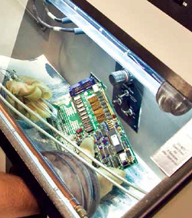

So current determines the conductor size and voltage that determines the thickness, size or value of the insulation. That said, “air” is an important insulator in our industry. We use it for our overhead cables that pass between high voltage poles.  

As a wind turbine technician, or Windsmith, it is common for you to look for damaged conductors in a wind turbine’s control or power circuits. Usually the conductors fail due to heat damage. This heat is usually due to current passing through a loose connection, causing resistance. This damage is indicated by heat discoloration, melted rubber insulation, or both. These types of failures can be found by visual inspection, smell or thermal inspection.   

It is also common to look for damaged insulation in a wind turbine. Areas of concern for damaged insulation can be areas that rub and wear on an item due to the turbine’s movements. A common area is related to the cable droop from the nacelle to the down-tower conductors. These type of impending failures are normally located visually if the damage is not caused by heat. Note that the higher the voltage, the more critical it is that the insulation jacket has no damage (including small nicks). This is especially important when we start working with voltages over 1000v.  If the insulation fails on the conductor, usually you will have a fault due to a short-to-ground or cross circuit. This can be a spectacular failure if it occurs in a power circuit. If it happens in a control circuit, it may be difficult to find, especially if the problem causes an intermittent fault.

There is still one more item in the electrical circuits that we have not touched on. Those items are the electrical safety devices. Typical safety devices used in a wind turbine electrical system are fuses and circuit breakers. In a wind turbine, a typical configuration is includes one safety device per circuit, per load. This means that usually items such as a pump motor will have its own fuse or circuit breaker; a yaw motor will have its own protection device, etc. The protection devices typically detect too much current due to thermal or magnetic sensing and open the circuit it is designed to protect.  Note that this protection is there only to protect the circuit from burning due to too much current.  The electrical safety device is NOT there to protect you. It’s there to protect the electrical circuit from catching fire from too much current.

You may wonder if there is any electrical protection for you? The answer is almost a resounding “no.” Pretty much the only electrical safety items in the electrical systems designed to protect you personally would be the electrical cabinets to keep you out, and ground fault interrupters in electrical outlets for your use of electrical tools. The rest of the electrical protection devices are there to protect the electrical conductors from catching fire.

Hopefully this article will help drive some discussion within your service group and will prevent unsafe work practices.  As always work as safe as possible and work to prevent surprises.

Comparing Maintenance Options: OEMs and ISPs

0

The clock starts ticking the moment a wind turbine stops working. Wind turbine efficiency is evaluated in terms of minutes (of production up/downtime) and dollars (spent on after-sales services as a result of system failure). As far as the bottom line is concerned, individual equipment failures and their root causes are moot points.

To maximize efficiency, the ideal wind farm would have in-house resources and know-how to conduct all necessary tests and repairs to restore turbines to full working order. To supplement these capabilities, the wind farm manager works hand-in-hand with OEMs of their turbine equipment to ensure fast turnaround and affordable replacement parts.

Economic realities make this scenwario unrealistic for most wind farms. The manpower and financial resources associated with running a wind farm and operations and maintenance team are often cost-prohibitive. Figure 1

Regarding OEMs, it’s important to remember that they are in the business of making and selling large quantities of the same products. If your defective part is under warranty, ordering a replacement from the OEM is typically a no-brainer. But when component failure occurs off-warranty and you need immediate, cost-effective solutions, you should consider a third-party independent service provider.

From a cost standpoint, purchasing replacement parts at full price from the OEM can be expensive and unnecessary. Wind farms can save millions every year by repairing — rather than replacing — defective components and by purchasing surplus and refurbished inventory.

As a rule of thumb, customers can expect to spend 40–70 percent less on repaired and surplus parts as opposed to new and/or replacement parts. For example, wind farm managers know that a particular replacement pitch system part costs around $5,000 from the OEM. However, when the component is outsourced to an ISP, it can be upgraded with newer technology — resulting in a part that runs cooler and lasts longer — for about 20–30 percent of the OEM replacement cost.

From a value and efficiency standpoint, ISPs are inherently geared toward providing high-quality customer service and technical solutions. In contrast to the OEM’s business model, standardized product design and sales don’t move their financial needle. Rather, these service-centric ISPs invest in engineering staff and advanced diagnostic equipment to help clients resolve production challenges, and their ROI is grounded in their success doing so. For this reason, parts repaired by ISPs often exceed the performance expectations and expected lifetime of new parts from the OEM. Figure 2

Of course, not all ISPs are created equal. Finding a single contractor that can handle a wide range of preventative and corrective repair services (e.g. electronics, hydraulics, precision mechanical, etc.) isn’t easy. Even worse, poor craftsmanship and low-quality parts are major issues in certain corners of the aftermarket/repair industry.

While these concerns can discourage some companies from contracting ISPs, sniffing out disreputable repair shops and counterfeit parts isn’t rocket science. Here’s how you can do it in five minutes or less:
Use Google to your advantage. Run search queries for the company and scan for red flags on the one hand, and articles that establish their reputation as domain experts on the other. Do complaints or scam reports appear in the top search results? What about interviews or feature articles in various news/industrial publications? Do they have a LinkedIn company profile page, and are their employees listed? Can you find pictures of their facilities and testing equipment?

Then, take a critical look at the information on their website. How long have they been in business? If you plug their address into Google Maps / Street View, does everything appear to check out (i.e. approximate square footage and exterior photographs)? Do they provide case studies and press releases that detail specific examples and applications of repair work performed?

Last but not least, what is the length of their typical warranty on services provided? If the ISP has confidence in their craftsmanship, they ought to offer superior warranties. Twelve-month warranties, for instance, offer assurances that the ISP can indeed make the part stronger than the original. Figure 3

In addition to offering cost-cutting repair services and a wide inventory of refurbished parts, some ISPs deliver even greater value by looking beyond a single component repair job toward the greater picture: efficiency. To really make an impact on a wind farm’s efficiency, it’s not enough to simply replace the part. ISPs can substantially increase wind farm efficiency as a whole by digging into the customer’s O&M processes and equipment and finding ways to root out unscheduled downtime and expenses.

OEMs, by contrast, offer the bare minimum — at a premium price point — when it comes to dedicated, value-added customer service and engineering services. Understanding how an individual wind farm uses their equipment — and then determining (and eliminating) the root cause for failure — are capital expenditures that most OEMs often won’t invest in.

PSI Repair Services has been a trusted ISP to the wind energy market since 2008. We offer wind turbine component repair and upgrade services for GE, Vestas, Siemens and Clipper turbines. We cover the critical electronic, hydraulic and precision mechanical components that drive turbine pitch and yaw systems and down-tower electronics. Components we service include printed circuit boards, pitch drive systems (such as H-bridges and hub converters), IGBTs, PLCs, controls, AEBIs, proportional valves, pitch and yaw motors, encoders, slip rings, VRCC units, hydraulic pumps, servo motors, transducers and much more. Most of our services come with a 12-month warranty. Figure 4

PSI has been in the repair business for almost 50 years, with customers belonging to the automotive, aerospace, defense and military, food and beverage, healthcare, public transportation, and semiconductor industries. Our 60,000 square-foot facility in Livonia, Michigan is equipped with the most advanced diagnostic equipment in the industry.

Just recently, PSI Repair Services surpassed the 13,000 mark for components repaired/serviced for the wind industry. At an average repair price of $1,500, and a conservative 50 percent savings from the cost-of-new, PSI has saved the wind industry in the neighborhood of $10,000,000.

Customer savings aren’t merely a result of paying less for repairs, however. PSI’s Engineering Services Department can accurately diagnose performance issues and offer permanent cost-saving solutions by recommending and taking preventive and corrective repair actions. These actions include: removing and replacing stressed parts; improving legacy design with newer, more reliable technology; remanufacturing un-salvageable or obsolete components; as well as manufacturing custom-designed products.

(800) 325-4774 www.psi-repair.com/repair-services/wind-turbine-parts-repair