







Home July 2019

July 2019

NRG Systems sells Bat Deterrent System to Hawaii wind farm

NRG Systems, Inc. has announced the first commercial sale of its Bat Deterrent System to Kawailoa Wind, Hawaii’s largest wind farm. Located on the island of Oahu, Kawailoa Wind will outfit each of its 30 turbines with a Bat Deterrent System. The adoption of NRG’s pioneering technology is part of Kawailoa Wind’s ongoing efforts to help conserve the Hawaiian hoary bat, which has been on the United States’ list of endangered species since 1970.

“DESRI has a history of adopting innovative technologies and ideas to mitigate the impacts of renewable energy development,” said Bryan Martin, chief executive officer of D. E. Shaw Renewable Investments (DESRI), which owns and operates Kawailoa Wind. “We are excited to partner with NRG Systems at Kawailoa Wind as part of those efforts.”
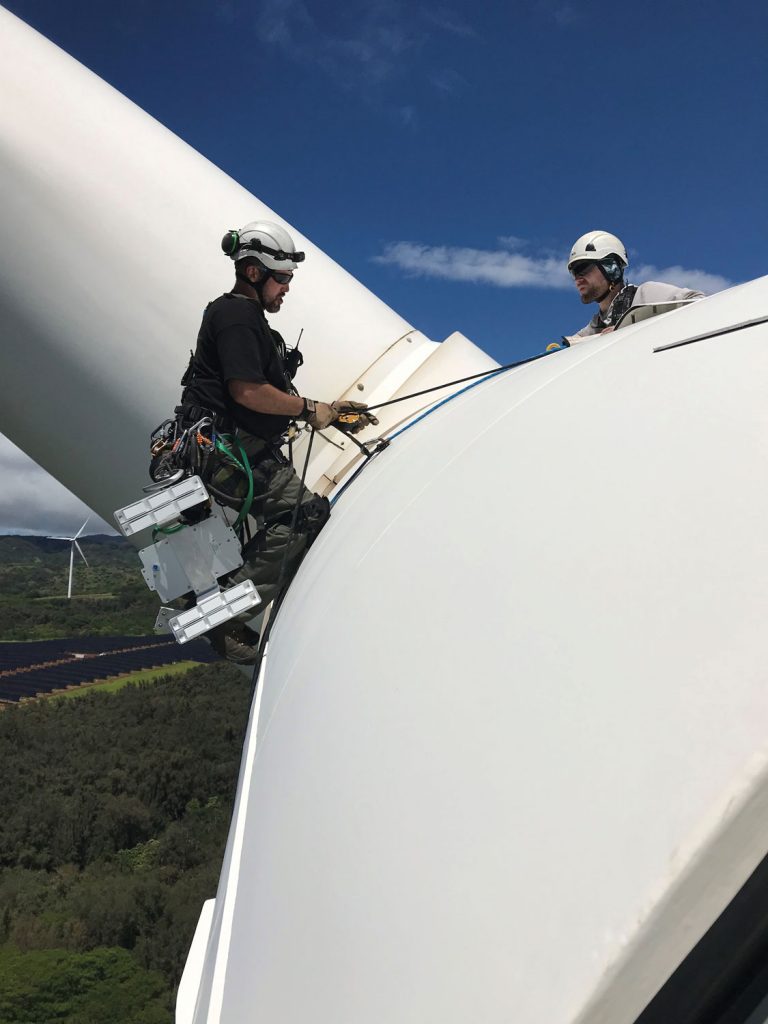
Kawailoa Wind is installing NRG Systems’ Bat Deterrent System on its 30 turbines. (Courtesy: NRG Systems)

Bat fatalities have been documented in association with wind-farm operations in Hawaii — an occurrence that has been seen at wind farms across the globe. Because of this, conservation of these animals has become one of the most pressing issues facing the renewable energy industry today.

“Wind energy is crucial to providing renewable energy in Hawaii,” said Brita Woeck, environmental compliance officer for Kawailoa Wind. “Kawailoa Wind is invested in finding solutions so that clean energy generation and bat conservation can co-exist.”

Kawailoa Wind is curtailing, or turning off turbines in low wind speeds at night, when bats are most active, to minimize Hawaiian hoary bat fatalities. NRG’s Bat Deterrent Systems are expected to be used in addition to curtailment.

More infonrgsystems.com

Vaisala expands weather radar offering to include X-band

Vaisala, a global leader in weather, environmental, and industrial measurement, recently announced the development of an advanced X-band Weather Radar. The smaller size and lower cost of an X-band radar will make it an ideal instrument to enhance the weather detection capabilities of a specific location. In difficult terrain, it fills the gaps to reliably detect snow, rain, and other weather activity. Adding X-band radars to an existing network will also improve the accuracy of precipitation measurement, providing better data for flood warnings or hydro-electric power plants, for example. In airport environments, the radar allows for detection of wind shear, wake vortices, convective weather, even birds.

The new X-band Weather Radar provides accurate measurements for a limited area, filling in a gap in a national radar network or delivering precise information for an airport. Severe weather in mountainous areas and gaps under sparse weather radar networks will be visible when X-band radars are added to the radar networks. Airport safety and efficiency will be improved with accurate detection and nowcasting of hazardous conditions.

An X-band Weather Radar antenna. (Courtesy: Vaisala)

“X-band radar will enhance a weather detection arsenal, making it even more reliable and accurate,” said Pekka Utela, director of Weather Radars for Vaisala. “By developing a smaller system allowing simple site selection, as well as providing maximum weather detection sensitivity with automatic and continuous calibration, the new X-band radar will answer the challenges decision-makers face in severe weather situations.”

The intelligence the X-band radar collects will provide significantly improved situational awareness. When integrated with other measurement systems, such as Vaisala C-band Weather Radar or wind Lidar, users will get the most comprehensive, real-time data available. At airports, accurate wind shear detection, complemented by Lidars, helps optimize take-off and landing sequences, as well as enhancing the safety of flight operations.

More infovaisala.com/weather-radars