











The wind-energy industry, a cornerstone of the global energy transition, faces a dual challenge: scaling production to meet growing demand while ensuring maximum efficiency and long-term durability of its assets. At the heart of this challenge are turbine blades — composite structures that are growing increasingly large and complex. In this context, artificial intelligence (AI) emerges as a transformative technology, quietly optimizing manufacturing processes and pointing toward a future of higher productivity and reliability.
Far from being an abstract concept, AI is already a tool with measurable impact on the factory floor of wind components. Its algorithms are redefining efficiency and quality standards, with concrete applications ranging from material-use optimization to real-time inspection to the development of intelligent curing processes.

The Present: Gains in Production Efficiency and Quality
The application of AI in wind-blade manufacturing is already delivering tangible results. The Israeli company, Plataine, for example, has implemented its optimization solution at major global manufacturers, including TPI Composites. By automating and optimizing cutting plans for the hundreds of fiberglass parts that make up a single blade, the technology achieved material savings of 3 percent to 4 percent — a significant gain in large-scale production [1].
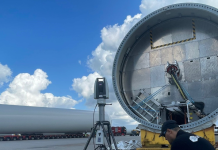
Another critical advance is taking place in quality inspection. Traditionally, a manual and offline process, defect detection is being transformed. The Indian company, Assert AI, with its ORBIT system, and the Canadian company, Virtek, with its IRIS AI camera, use computer vision to inspect blades during the manufacturing process [2, 3]. These systems detect defects such as wrinkles, air bubbles, and foreign object debris (FOD) in real time, enabling immediate corrections, reducing waste, and eliminating the need for production stops for inspection. Control of the curing process — one of the most critical stages in composite manufacturing — is also becoming more intelligent. TPI Composites, in collaboration with the University of Texas at Dallas, is developing a “digital twin” to optimize blade curing. Using physics-informed machine learning algorithms and real-time sensor data, the system adjusts temperatures across multiple mold zones to ensure optimal curing, resulting in greater consistency and productivity [4]. In a previous project with the WindSTAR research center, TPI had already achieved 95 percent predictive accuracy with its digital twin of the infusion process, with computation speeds 100 times faster than traditional simulations [5].
While much of the attention in wind-turbine manufacturing has centered on the blades, other critical components are now entering the spotlight of AI-driven innovation. The nacelle cover — the protective housing for the turbine’s generator, gearbox, and control systems — presents its own manufacturing challenges. Though less discussed than the aerodynamic marvels of blades, the integrity of the nacelle cover is paramount to a turbine’s long-term reliability. A defect in this composite shell can lead to water ingress, corrosion, and failure of the equipment it protects.
The manufacturing of these large composite structures is a demanding process. Spanning several meters, each cover must be produced with tight tolerances to ensure a proper fit during final assembly, where even minor misalignments can cause costly delays. The process involves molding large fiberglass sections, ensuring correct resin infusion, and managing the internal components installed within the housing. For large wind farms requiring hundreds of identical units, ensuring repeatability and quality control is a significant technical challenge.
In response, a new trend is emerging: Component manufacturers are developing their own AI solutions in-house. This strategy allows them to create systems tailored to their specific production lines, thereby avoiding the high costs and long integration times associated with external vendors. By using their own process knowledge, these companies are building effective AI tools to address their most pressing quality and efficiency problems.

One example is a phased AI implementation at a nacelle cover facility. The first phase, already operational, focuses on administrative and traceability processes. An image recognition system integrated into the factory’s workflow management platform automatically verifies the purchase order number for a project matches the serial number and date on the component’s label. This automated check reduces human error and improves traceability, ensuring the digital record for each part is accurate from the start.
While this first step provides a solid foundation, the next phase represents a major step forward in quality control — a development seen as a significant advance for nacelle manufacturing. This system will use computer vision to conduct a full quality inspection inside the nacelle cover.
By training the AI on an image database from thousands of existing quality reports, the system will learn to identify and verify the presence and correct placement of every component, from brackets and wiring harnesses to insulation panels. Such a system allows for a level of inspection that is difficult to achieve with manual checks alone, especially in a high-volume production environment. It is a notable application, as no similar AI-based quality control system has been deployed in the serial production of nacelle covers to date.
The use of AI in nacelle cover manufacturing contrasts with the high-profile innovations being deployed for blade inspection, most notably by GE Vernova. While both use computer vision to improve quality, they target different components with distinct challenges, showing the technology’s versatility.
GE Vernova’s approach to blade quality addresses the structural demands of modern turbine blades. As Veronica Barner, the company’s renewables director at its Advanced Research Center, has noted, even an anomaly of a couple of millimeters can compromise a blade’s longevity. Finding such small deviations in a structure the size of a football field is like “trying to find a needle in a haystack” [10].
To solve this, GE Vernova has deployed robotic “crawlers” inside its blade factories. These compact robots, about the size of a two-foot model car, can navigate the entire interior of a blade, a task impossible for human inspectors who can only access about half of the internal surface. In about 30 minutes, the crawlers capture a complete high-definition visual record of the blade’s inner surfaces. This feed is then analyzed by a computer vision system trained on tens of thousands of annotated images to flag potential anomalies.
The system logs its findings in a digital tool, allowing technicians to review and address any issues before the blade is shipped. Each blade that passes this vetting process receives a digital quality certificate, ensuring a consistent standard across GE Vernova’s manufacturing network. The technology is already in use for the company’s 154-meter rotors, including those for the SunZia wind project in New Mexico [10]. The distinction between these two AI applications is important. The GE Vernova solution addresses the structural challenge of ensuring the integrity of a massive, load-bearing surface by detecting minute material and surface flaws. The in-house AI system for nacelle covers, on the other hand, solves a different problem: assembly verification. Its main goal is not to detect microscopic material defects in the shell, but to confirm that the components within it are installed correctly. This means every part is present, in the right place, and properly secured, preventing issues such as loose components or incorrect wiring during assembly.
This comparison shows there is no single solution for AI in wind manufacturing. The most effective applications are those designed for a component’s specific challenges. While the crawler robots are a powerful answer for blade inspection, the development of custom AI for nacelle covers demonstrates a more targeted, process-oriented approach to quality control. Both are vital for the industry’s future. As the wind energy sector continues to scale — with larger turbines, offshore exposure, and tighter project timelines — AI is becoming a key tool to deliver the quality and efficiency that the global energy transition demands.

The Future: Intelligent Blades and Autonomous Manufacturing
While current applications focus on optimizing existing processes, the next frontier for AI in the wind industry lies in creating more resilient components and in autonomous manufacturing and maintenance processes.
One of the most promising advances is the development of self-healing composites. Researchers at North Carolina State University have created a material that self-repairs more than 1,000 times. Its application in wind turbine blades — explicitly mentioned in the study — could extend the service life of these structures to centuries, dramatically reducing maintenance costs and turbine downtime [6]. Maintenance itself is another area undergoing rapid transformation. BladeRobots, a spin-off from Vestas, has developed an autonomous robot for repairing blade leading edges, a task that is currently dangerous and time-consuming. In partnership with Kawasaki, the robot is transported to the blade by an unmanned helicopter, the K-RACER, which automates the entire process and increases both safety and efficiency [7].
These innovations point to a paradigm shift in which real-time process control and automation, focused on consistency, become more important than sheer production speed. Digitalization — once an aspiration — becomes a reality, with each blade carrying a complete digital record of its manufacturing history, ensuring traceability and confidence throughout its entire service life [8].
The market reflects this trend. The AI-in-energy sector is expected to grow from $8.9 billion in 2024 to nearly $59 billion by 2030 [9]. For the wind-energy industry, the adoption of artificial intelligence is no longer optional, but an essential component to ensure the scale, quality, and sustainability required to lead the global-energy transition.
References
- Plataine. (2020). Case Study: TPI Composites Optimizes Wind Blade Manufacturing. https://www.plataine.com/wp-content/uploads/2018/03/Plataine-TPI-Composites-Case-Study.pdf.
- Assert AI. (2026, February 3). Wind Turbine Blade Manufacturing in 2026: Why Offline QC is a Risk. https://www.assertai.com/as-the-wind-blade-market-doubles-can-2026-manufacturers-still-afford-offline-qc/.
- Virtek Vision. (n.d.). Wind Blade Manufacturing. https://virtekvision.com/pages/industry-wind.
- CompositesWorld. (2024, August 16). TPI, University of Texas participate in wind blade cure optimization project. https://www.compositesworld.com/news/tpi-university-of-texas-participate-in-wind-blade-cure-optimization-project.
- CompositesWorld. (2023, January 20). TPI, WindSTAR create digital twin for wind blade manufacturing. https://www.compositesworld.com/news/tpi-windstar-create-digital-twin-for-wind-blade-manufacturing-.
- NC State University. (2026, January 14). Self-Healing Composite Can Make Airplane, Automobile and Spacecraft Components Last for Centuries. https://news.ncsu.edu/2026/01/healing-composite-lasts-centuries/.
- Kawasaki Heavy Industries. (2026, January 6). Kawasaki and BladeRobots partner on blade robot. https://renews.biz/106208/kawasaki-and-bladerobots-partner-on-blade-robot/.
- Composite Integration. (2026, January 16). How Might Wind Blade Manufacturing Evolve in 2026?. https://www.composite-integration.co.uk/how-might-wind-blade-manufacturing-evolve-in-2026/.
- MarketsandMarkets. (2025, April 25). Artificial Intelligence in Energy Market worth $58.66 billion by 2030. https://www.marketsandmarkets.com/PressReleases/ai-in-energy.asp.
- GE Vernova. (2024, May 21). Blade Runners: GE Vernova Is Deploying AI-Enabled Machines to Boost Wind Turbine Blade Quality. https://www.gevernova.com/news/articles/blade-runners-ge-vernova-deploying-ai-enabled-machines-boost-wind-turbine-blade-quality