



As part of the development of the Estonian Liivi offshore wind farm project, the Fraunhofer Institute for Wind Energy Systems IWES has conducted a site condition monitoring campaign in Liivi Bay, commissioned by Enefit.
The Fraunhofer IWES Stage 3+ wind Lidar buoy, a floating Lidar system, was installed together with co-deployed oceanographic sensors to collect a year of measurements, e.g., wind profiles, turbulence intensity (TI), wave, and current parameters. It was the first commercial campaign to obtain advanced TI measurements from Fraunhofer IWES’s high-frequency deterministic motion compensation method. The campaign also involved a land-based Lidar measurement and wind modelling.
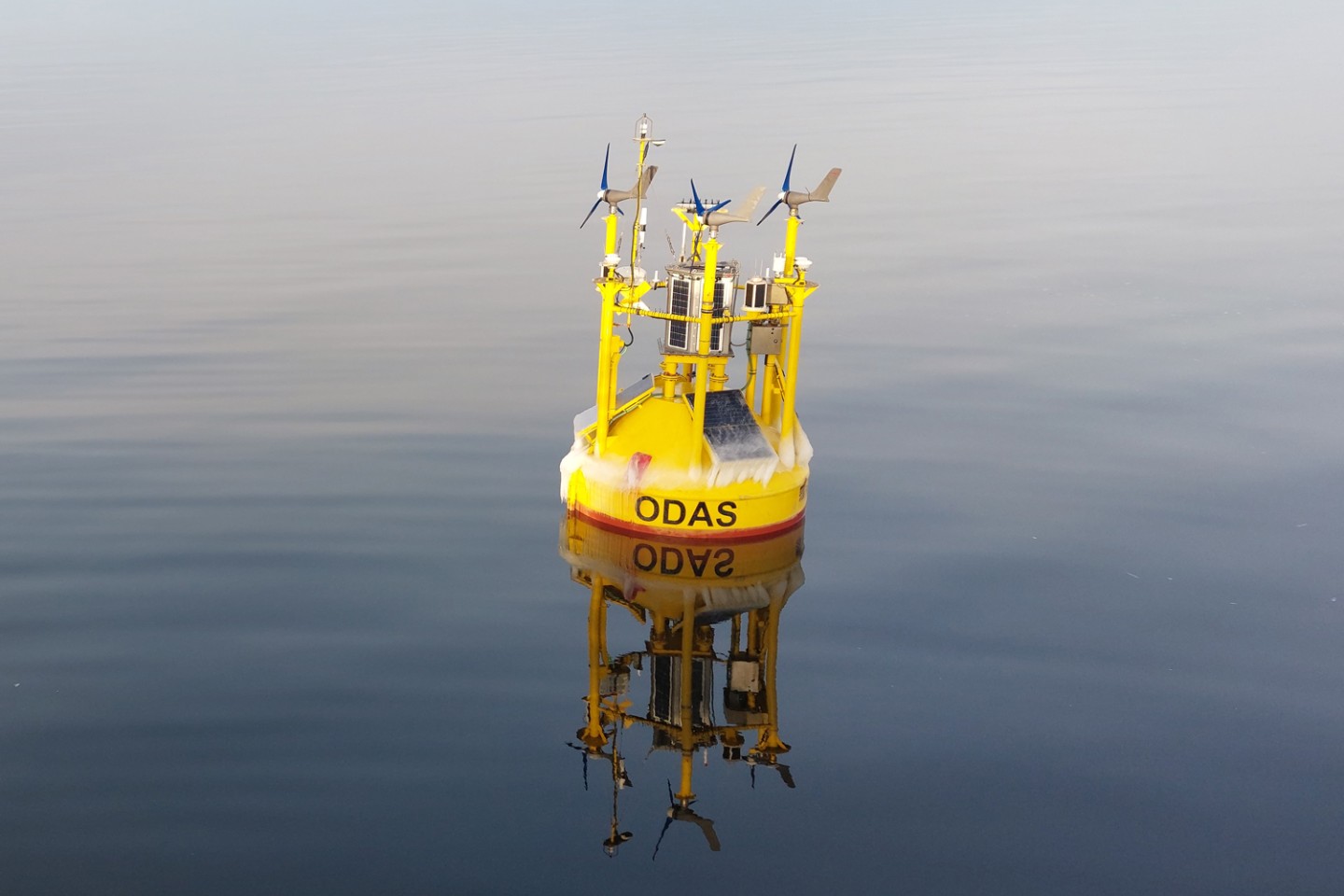
A site condition monitoring campaign is essential before building a wind farm, providing the sitespecific resource and environmental data needed to design the project safely, efficiently, and with best bankability. The campaign in Liivi Bay was conducted from October 2024 to December 2025. Floating Lidar systems like the Fraunhofer IWES wind Lidar buoy have been widely adopted by the wind industry as an efficient survey tool. They allow accurate resource measurements at sea, with traceable and minimized measurement uncertainty, to provide optimum energy yield assessment.
During the sea ice season, the Fraunhofer IWES wind Lidar buoy was temporarily removed from site. This was planned to prevent sea ice damage. The parallel onshore Lidar campaign deployed on Kihnu Island provided a precise wind measurement reference for that period. A horizontal transfer modeling using an offshore-calibrated atmospheric flow model addressed the data gap caused by the buoy’s absence and completed the datasets.
“Liivi Bay represents a strategically important location for the development of offshore in the Baltic region,” said Johann-Gustav Lend, Baltics Business Development Manager at Enefit. “The insights gained from this measurement campaign will support Enefit in advancing offshore wind capacity that enhances regional energy security and accelerates the transition to a cleaner, more efficient energy system.”
In parallel with its recent scientific advancements and publications, Fraunhofer IWES has delivered turbulence intensity (TI) measurements based on its high-frequency deterministic motion compensation method. Enefit and the Liivi Project are the first commercial partners to benefit from this cutting-edge methodology for floating Lidar systems.
“The Fraunhofer IWES project team was delighted to deliver the technically important turbulence intensity measurements based on our own step-up into high-frequency line-of-sight motion compensation, bringing the benefit of applied research to the industry as per Fraunhofer’s mission,” said Loïs Legendre, Project Manager Wind Measurement at Fraunhofer IWES.
Also involved in the project were the Riigilaevastik (Estonian State Fleet) and their vessel crews providing effective operational support throughout the campaign, as well as Luode Consulting who conducted the oceanographic measurements.
“For the Estonian State Fleet, active participation in scientific research and monitoring activities in national waters is highly important, including making state fleet resources available to support such work,” said Andres Laasma, Director General of the Estonian State Fleet.
More info: www.iwes.fraunhofer.de/en