


The U.S. wind industry stands ready to help keep a lid on rising power bills — if the industry is allowed to operate with less federal interference. By introducing new obstacles to an already-lengthy permitting process, the current administration has repeatedly attempted to throttle one of America’s best bets to build more power capacity at scale and at speed.
From directives requiring the Secretary of the Interior to sign off on all DOI authorizations, to the Pentagon mitigation agreements — and the resulting FAA determinations required for wind projects — coming to a complete standstill, federal agencies have not just threatened but effectively ground wind development to a halt across the board over the past year and a half.
Because all wind projects require some level of federal involvement, these actions — just two examples among many — have jeopardized not just wind projects on state lands but also private land. For offshore wind, agencies have gone further — targeting already authorized, under-construction projects by suspending or attempting to revoke existing authorizations.
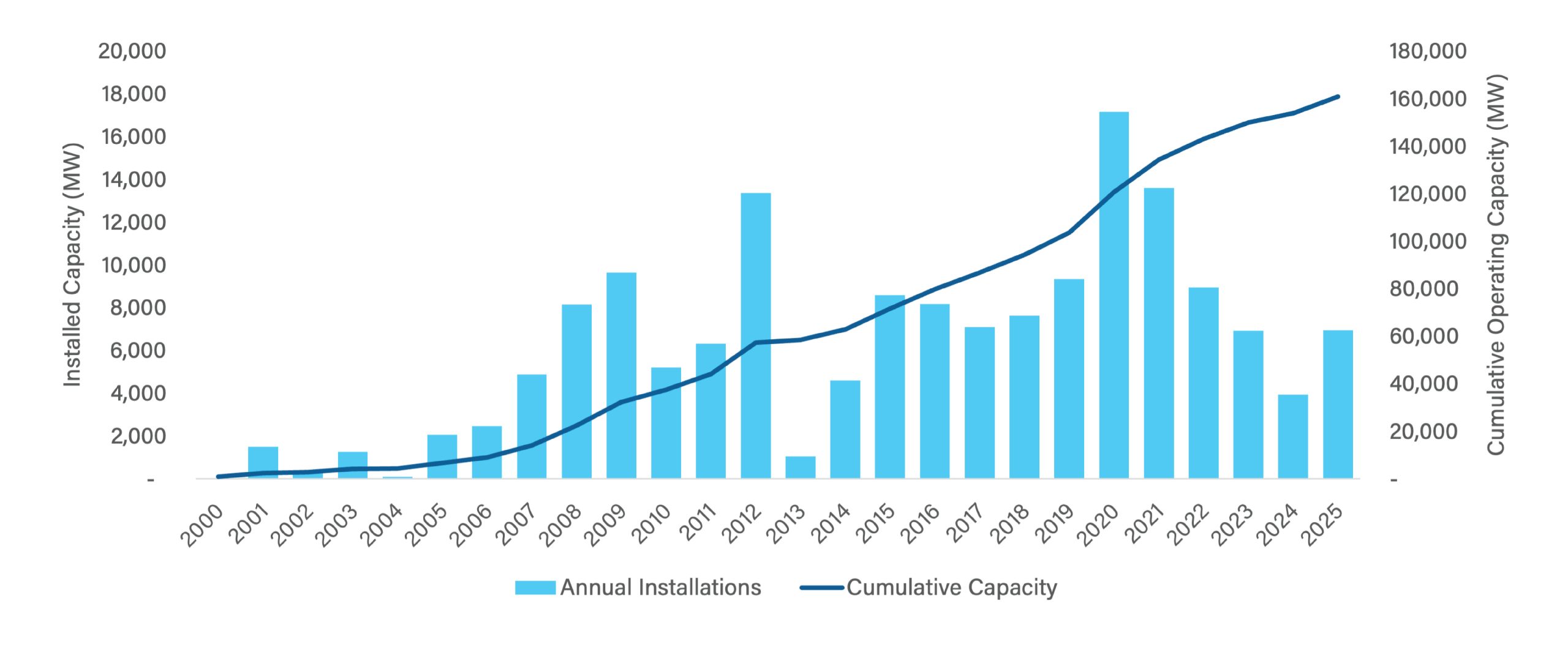
At a time when the U.S. needs to add power capacity to the grid, not get in the way of it, this federal interference has inflicted real harm, both to the wind industry and to the country’s wallets. The offshore wind pipeline dropped 23 percent year-over-year, with no new projects commissioned, and the land-based wind industry saw just 7 GW of new projects in 2025, a noticeable recovery from the 10-year low seen in 2024, but still the third-smallest year for deployments in a decade. (See Figure 1)
Despite these headwinds for new projects, existing U.S. wind projects continue to play a critical role in the country’s electricity mix. With 160 GW of capacity installed, onshore and offshore wind generate more than 10 percent of U.S. electricity. Offshore wind capacity could increase as much as 20 times in 2026, providing essential grid reliability for the U.S. Northeast.
Rising Prices
U.S. wholesale power prices surged 41 percent to average $43/MWh in 2025, amid extreme weather events and higher natural gas prices. Wind is one of the cheapest options for new power available, as well as one of the fastest technologies to commission after construction is allowed to begin. Once in operation, wind projects do not require the same costly and variably priced inputs that thermal generation needs.
Regions with higher concentrations of wind generation felt the wholesale price increase the least: Southwest Power Pool (SPP), home to nearly one-third of the country’s land-based wind capacity, maintained the lowest average wholesale prices at $27/MWh, according to data published by the grid operator. Similarly, the Electric Reliability Council of Texas (ERCOT), saw an annual hourly wholesale price increase of 21 percent, half the national average. Texas has long been the national leader in land-based wind deployments, with 44 GW installed.
As energy prices increasingly become a kitchen table issue, wind power is not only delivering relief to the areas where it is installed, but also contributing to the country’s GDP, providing well-paying jobs, and supporting rural communities:
- Investing in America: ACP’s Annual Clean Power Market Report (out April 28, 2026) pegs 2025 investment in new wind projects at $14 billion — capital that shows up as steel in the ground, manufacturing orders, and paychecks. Texas alone accounted for $3.4 billion of that spending, a reminder that today’s clean-power build is as much an economic-development story as it is an electrons story.
The U.S. land-based wind industry contributed more than $40 billion to the U.S. economy in 2025, through construction and operations & maintenance activity. This is more than the annual GDP of 90 countries.
- Supporting rural communities: For counties and towns that host projects, the benefits often show up in tangible community investment. Wind projects contribute roughly $1.4 billion each year in state and local tax revenue — money that can help fund schools, first responders, and other essential public services.
Landowners, meanwhile, receive an estimated $1.3 billion annually in land lease payments, providing steadier income streams and helping families hold onto working land.
- The jobs behind the megawatts: ACP estimates the U.S. wind industry directly employs more than 100,000 Americans, while its broader economic activity supports an additional 280,000 jobs nationwide. These are high-paying jobs that families can rely on, and that communities are built around. Workers directly employed in the wind industry earn $78,942 on average, higher than the mean wage of all private industries and government workers ($67,920) [1].
- The ripple effects are measurable: Each job in clean power supports additional employment across the economy, providing about 2.8 jobs in land-based wind and 2.4 in offshore wind.
A Red-and-Blue Build-Out
Despite the attacks from the current administration, wind power should be a bipartisan issue as its benefits — to electric bills, to landowners, to rural municipal budgets — largely flow toward parts of the country represented by Republicans. The top 10 congressional districts for operational wind capacity are all represented by Republicans.
As electricity demand continues to grow, the wind industry delivers affordable, reliable energy while driving investment, supporting American jobs, and strengthening communities across the country.
The federal government should get out of the way and let America build the power projects it needs to thrive.
Join ACP and other industry leaders at CLEANPOWER – ACP’s largest event of the year where it will be charting the U.S. energy future with top companies, experts, policymakers, and leaders across all types of energy.
The conference is packed with cutting-edge discussions about wind, dealmaking, networking, and fun. CLEANPOWER 2026 will be at the George R. Brown Convention Center in Houston, Texas, June 1-4.
References
- Bureau of Labor Statistics, Occupational Employment and Wage Statistics, May 2024.