


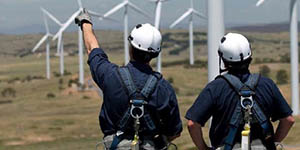
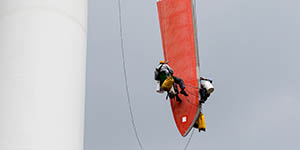
The converter and control systems contained within every wind turbine are essentially the brain and the heart of the asset, converting variable-frequency electricity into grid-compatible power, all while maintaining the speed, blade pitch, and yaw to capture the maximum amount of energy while ensuring the safety of the turbine.
It’s a complicated bit of engineering, one that KK Group has been performing for the wind industry for decades.
“We deliver the converter and the controls to the big wind turbine OEMs,” said Kim Wichmann-Hansen, president of KK Group’s U.S. division. “We deliver to Siemens Gamesa, to Vestas, and to GE. In addition to the converter and the controls, we also deliver cooling solutions, as well as both structural condition monitoring and drive train condition monitoring, and the service business around that.”
Growing the Base
With a U.S. presence, Wichmann-Hansen emphasized that, from a U.S. perspective, the diversification in the U.S. for KK Group is hinged around growing the asset operator base.
“In the U.S., there are around 80,000 turbines,” he said. “We are probably in half of those turbines, if not more. We are delivering structural vibration monitoring to all GE turbines. We do the same for Siemens Gamesa and for Nordex turbines, as well as for Vestas. We are delivering all converter and control systems to the entire fleet, so you can see how we get into many individual turbines. That’s the business we run in the U.S., where we help both the OEMs, but also the asset operators, maintain those fleet of turbines with service offerings, condition monitoring offerings, and various retrofits. We also in turn now are in the UPS business, with battery driven back up power solutions that keep essential safety and communications systems online in the case of grid outages.”
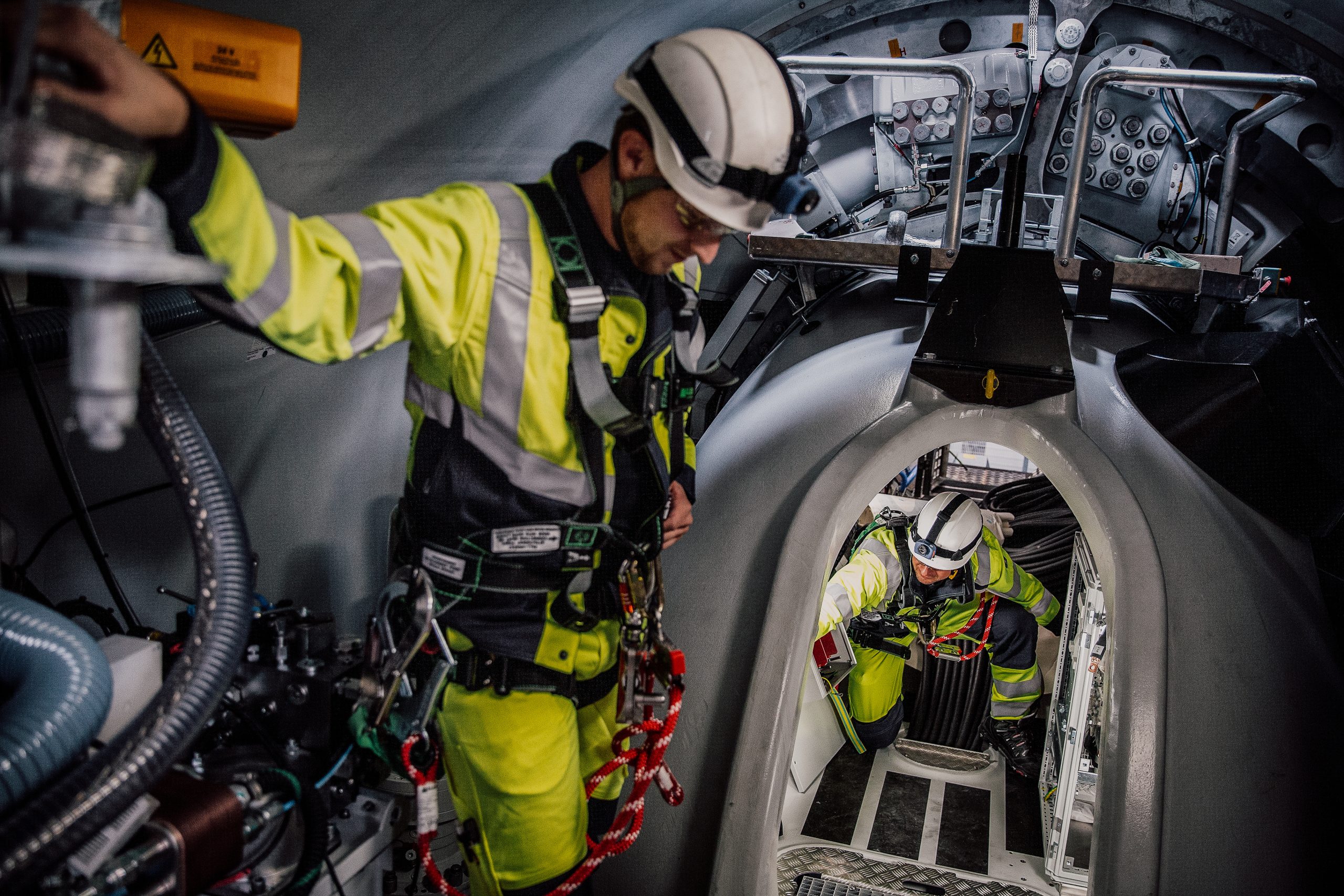
Even with the additional diversification of KK Group’s portfolio, the converter and control systems the company offers the sector are still the largest piece of its business, according to Wichmann-Hansen.
“The converter as a unit is the single biggest piece that we deliver,” he said. “What is relevant is, if you want to grow with the industry, you have to decide if you scale with units or whether you scale with megawatts. The industry has developed in a way where turbines get bigger and bigger, so for the same megawatts, you actually produce fewer units. An industry that scales only with units can be a little bit stagnant. One of the benefits of the converter is that it scales with megawatts.”
This means that, even though there may be fewer converters, the converter is still a big component in the turbines, according to Wichmann-Hansen.
“That’s one of the things we focus on, as well as taking over the complexity from our customers,” he said. “The converters and control systems in a modern turbine are much more integrated. It’s not only the reliability of the turbine and how cheap it is, it’s also how it can perform on the grid. One of the things we are excelling with in the U.S. is with older turbines. The converter determines how the grid sees the turbine. We are able to make older turbines grid compliant to modern grid requirements. That keeps your old fleet alive, because wind becomes more and more dominant on the grid.”
Repowering Older Converters
If an older turbine does not support the grid, it becomes an “Achilles’ Heel” for the industry, according to Wichmann-Hansen.
“We are able to repower older converters to make them grid code compliant and generally compliant to today’s industry,” he said. “We take old technology and improve it with today’s knowledge.”
KK Group definitely backs up its expertise with solid numbers. The company is a $1.2 billion global company with production facilities all over the world, including the U.S., according to Wichmann-Hansen.
“In the U.S., we have two locations — one in Houston, which is our headquarters, and in Kansas, where we have our warehouse and order management facilities,” he said. “We have sales areas also dotted around the country. Our monitoring and service business is the fastest growing part of our company, especially here in the U.S.”
Taking Care of Complexity
Through its history, KK Group has had to tackle the element of complexity as it delivers quality products and services to its customers, according to Wichmann-Hansen.
“It’s finding out that, as turbines became more and more competitive with the cost of energy, we had to also look at efficiency,” he said. “To avoid just competing on cost and price, we also compete on efficiency. That’s one of the reasons why we integrated cooling into our company, because cooling makes our electronics more efficient. If you look at the industry probably five or 10 years ago, there were many individual suppliers to the industry. To some extent in the U.S., there’s still a very fragmented supply chain landscape. One of the things KK does with its ownership from A.P. Moller Holding, parent company of among others, Maersk, is to take a longer perspective while trying to consolidate in the industry. Not consolidating from a perspective of just wanting to accumulate everything, but from a perspective of being more robust and being able to meet your customers in hindsight, so to speak.”
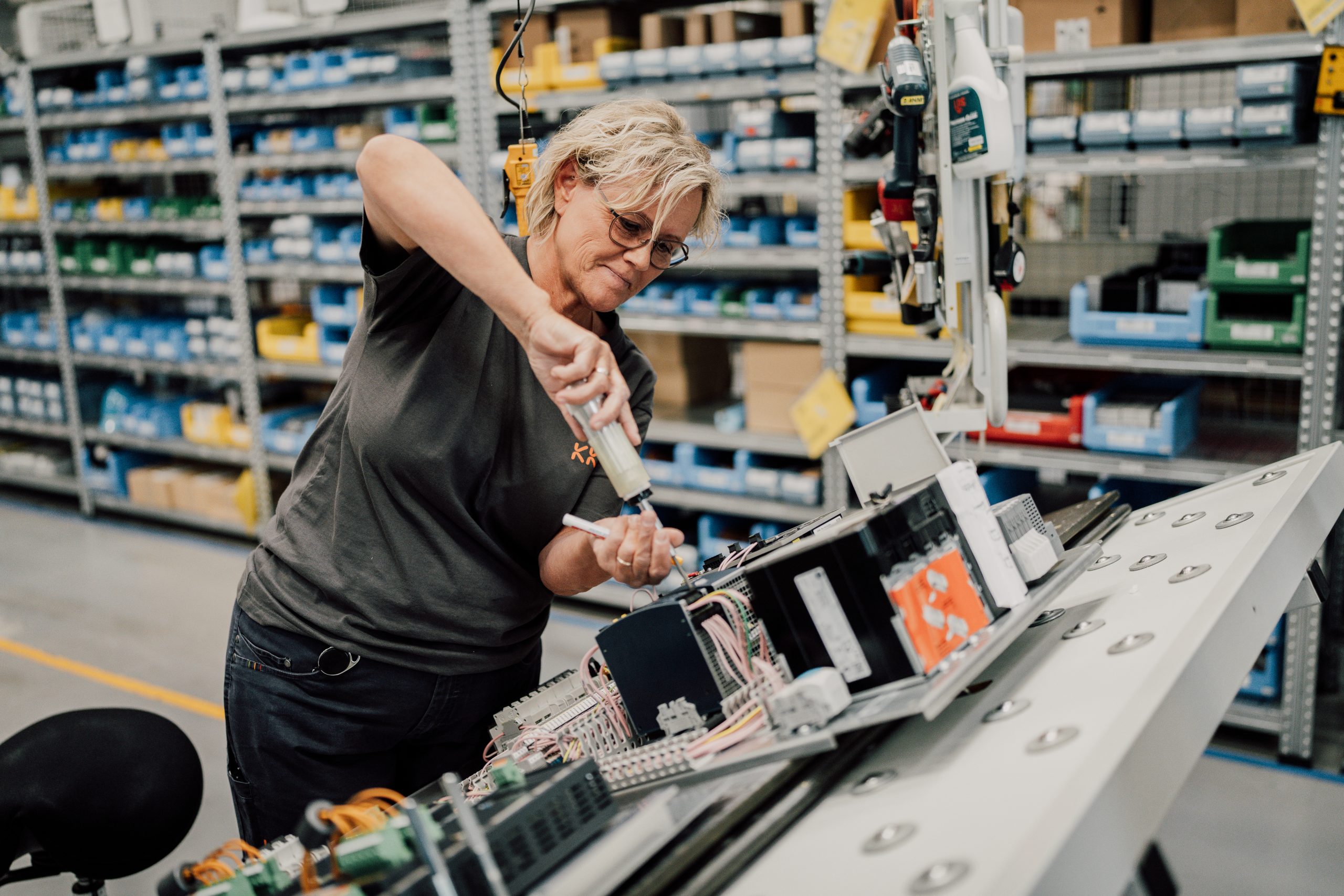
To that end, Wichmann-Hansen said he is acutely aware that KK Group is an important part of the wind industry.
“We want the wind industry to continue to grow, and as the industry grows and customers grow and turbines grow, that means complexity grows,” he said. “One of the key cornerstones in our approach is what we offer back to the customer is that we remove the complexity. We take that complexity over. That can be taking over supply chains. It can be taking over products that have interfaces that the customer does not need to deal with. We take that over and offer back more system solutions. We offer integrated service solutions, because what is produced in the wind industry must be able to operate in the field for the next 25 to 30 years.”
Staying Solvent
That crucial growth while dealing with the complexity of the industry helps ensure KK Group doesn’t have many individual small suppliers that have gone out of business with every down-cycle, according to Wichmann-Hansen.
“Wind, like any other industry, has up cycles and down cycles, so by making us so robust that we can keep serving an industry even in a down cycle period is one way we have grown within the industry, taking responsibility and diversifying the business,” he said. “We not only serve the wind OEMs with the team, but we also serve the asset operators and other industries. Within our cooling area, we also serve industrial customers. We don’t just focus on the OEMs. Our goal in the wind industry is to make our company more resilient and more robust, so we can actually serve them as the best supplier in the industry.”
To help achieve those goals, KK Group creates a unique relationship with its customers when the company is approached with a challenge, according to Wichmann-Hansen.
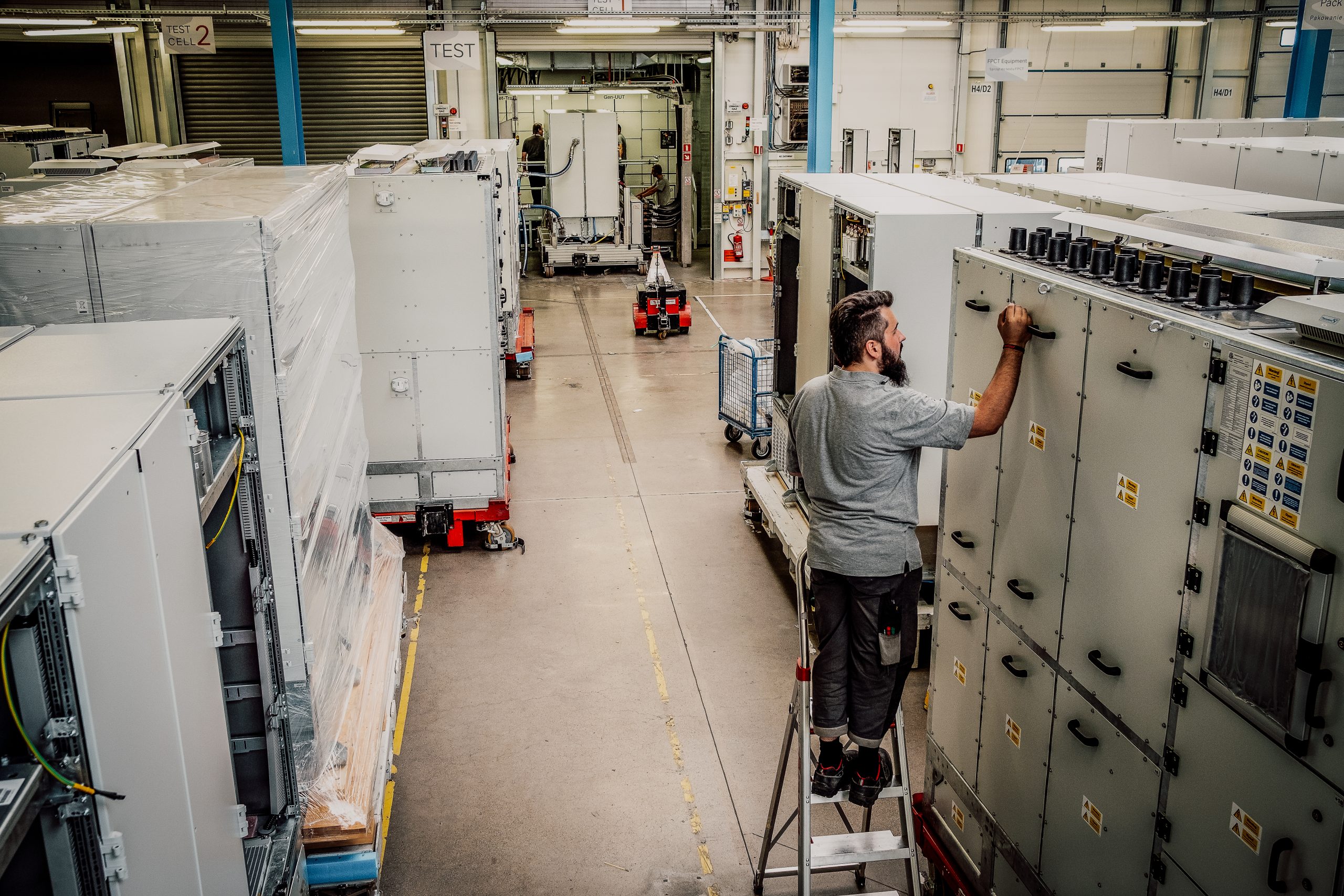
“If it’s an OEM that wishes to have us build their technology, then there are ways the customer can approach us,” he said. “For example, they may already have a technology solution that they want us to build for them; it’s called built-to-print. They basically tell you, ‘Here’s the drawings; here’s the design. Could you please set up a supply chain, a production location, and an engineering source so we can produce that?’ Then we would engage with them and use our knowledge to move that from build-to-print, to build-to-spec, and introduce our own intellectual property gradually.
A part of the consolidation in the industry is that we can also offer better products for customers when they are being consolidated into KK Group. We very much look to serve the customer with value added offerings, not just the cheapest possible production. In the industry, we have to have a tight grip of cost, but we do that through value adding and a curve where you move it from build-to-print and build-to-spec into our own designs, so that we can potentially grow volume into it. Then we package it with a service offering — if the customer wants that.”
A Single Turbine Start
KK Group currently supports a large global swath of the wind-energy business, so it’s humbling and a little surprising to know the company began with a single turbine, according to Wichmann-Hansen. In 1978, a small, local carpenter owned a farm where he was tired of paying too much for the electricity he was using, so he constructed his own turbine. That one turbine eventually produced so much energy that it had to be connected to the grid. From this, KK Electronics was born, which would later become KK Group.
“When Siemens acquired Bonus Energy and became Siemens Wind Power, that’s when we really changed into being a wind-focused company,” he said. “One of the things that is a little bit special about our company is we have been brought up in an industry where there’s only a few customers, when you deliver to the OEMs. That makes you very focused on your customer. If you lose the customer, you cannot just replace them.”
An Eye on the Future
With a laser focus on wind energy and its future, Wichmann-Hansen said KK Group will continue to service wind and its importance to a global energy future.
“As wind continues to grow — whether it’s in the U.S. or outside the U.S. — it is still the fastest growing and cheapest source of energy,” he said. “That propels other related industries, like battery energy storage, because it’s not all 100 percent positive around wind, in the sense that wind is intermittent. You can only produce energy when the wind blows, and, therefore, you need to wrap some industries around wind to make it really robust.”
But with that diversification, KK Group will also keep innovating its converter and control systems in order to keep an aging wind fleet efficient and productive, according to Wichmann-Hansen.
“If we take the U.S. as an example — like I said earlier, it’s the largest installed base outside China with 80,000 turbines, and KK Group is in half of them,” he said. “For some of them, the age of that fleet is tripling. Turbines older than 15 years are now growing three times in numbers over the next couple of years, and that installed base is quite big in the U.S., and we keep adding to that install base. We keep adding to it, and that keeps it living longer and longer now. The average life of a turbine is maybe around 40 years in the latest industrial analysis. Being able to repower these turbines has quite an important element to it. That will definitely be part of KK Group’s next 10 years and beyond.”
More info www.kkgroup.com