



Lightning is one of the most expensive — and underestimated — threats facing the wind industry today. As turbines grow taller, their vulnerability to lightning strikes is only increasing. The average tip height of these structures has surged from less than 100 meters in 2000 to 164 meters in 2022, tripling the capacity per turbine. But with this growth comes a new risk: The towering blades are now more susceptible to lightning strikes [1] as they rise taller and cover larger swept areas than ever before.
The average wind turbine in the United States is struck at least once a year, and wind farms in the worst locations can average more than 10 strikes per turbine annually. The industry loses more than $100 million each year to lightning-related turbine repairs, according to recent estimates. Damages range from minor blade punctures to full structural failures, driving costly downtime, expensive maintenance, and, in some cases, full blade replacement.

Why Traditional Systems Struggle
Wind-turbine blades are equipped with lightning protection systems (LPS) designed to safely conduct lightning strikes to ground. The typical LPS consists of surface-mounted receptors connected to down-conductors embedded inside the blades. When working as intended, the receptors provide a preferential location to form an upward lightning leader — the initial channel of ionized air that initiates and determines the path of a lightning strike. When that upward leader connects to a downward leader from a charged storm cloud, a continuous path to the cloud is formed, and the full charge of the strike is safely transferred.
In real-world lightning events, the LPS doesn’t always function as intended. Instead of leaders forming solely at the lightning receptors, they often emerge directly from the down-conductor inside the blade — and at multiple points along its length. These internal leaders can pierce through the blade shell and gradually degrade its insulation. Occasionally, one of these internal leaders “wins the race” to the cloud, connecting before the leader from the receptor. When that happens, the resulting lightning strike can punch a hole through the shell, leading to delamination, structural damage, or — though rarely — complete blade failure.
Current LPS designs do offer protection, but not consistently and not without risk. No lightning protection method is 100 percent effective.

A Different Way to Think About Protection
Arctura, for example, is rethinking the way turbines deal with lightning — not just accepting it as inevitable damage. The company has developed technology that works to safely guide lightning’s path, instead of trying to fight it. After years of research and development, Arctura has created a coating designed to enhance the performance of LPS and significantly reduce the frequency of blade damage caused by lightning. Arctura is bringing this innovation to market in partnership with Mankiewicz Coating Solutions, LLC.
Protecting a blade with better insulation at the extreme electric fields presented before a lightning strike can be a fool’s errand. A better approach is to guide lightning to the receptors where it can be safely dealt with. That’s the idea behind the ArcGuide® coating technology developed by Arctura and found only in the Alexit® BladeRep® Topcoat ALP 20 by Mankiewicz. In the microseconds preceding a strike to a wind turbine, there are multiple upward lightning leaders forming inside and outside the blade and along its surface all reaching up toward the sky. Which one will win this rapid race to connect with the charged cloud is not clear, yet the outcome makes all the difference between a safe strike or a damaged blade. ALP 20 gives the receptors a competitive edge by encouraging the formation of upward leaders there, helping them win the race.

How the Coating Works
At the core of ALP 20 is a proprietary formulation of small conductive particles suspended in a durable polyurethane-based coating. Years of empirical high voltage testing have resulted in an optimized set of coating characteristics found to be highly effective. The conductive particles in the topcoat create localized zones of stronger electric field strength that promote the early ionization of the air adjacent to the particles and above the surface. As the electric field builds, these patches of ionized air coalesce to form a continuous leader in the form of a surface flashover. When applied around receptors, this enables the upward leaders there to form faster, extend farther, and outcompete the undesired leaders forming inside the blade in the race to connect with the cloud.
Laboratory testing shows the difference: Blades coated with ALP 20 generate leaders that grow over four times faster than untreated blades. The faster a leader grows, the better its odds of connecting first and preventing damage.
Importantly, ALP 20 is not a conductive coating. Unlike a continuous conductive paint, all the electric energy travels through a highly conductive channel of ionized air above the surface. Because of this, the coating is not sacrificial and is not damaged by lightning strikes. High current laboratory testing confirms no degradation of the coating, even after multiple 200kA “full threat” strikes.
That means one application can protect a blade for its full-service life — eliminating the need for regular inspections, repairs, or reapplication.

Proven in the Lab — and in the Field
Over four years, funded in part by the U.S. Department of Energy, the technology was subjected to rigorous testing protocols aligned with IEC 61400-24, the international standard for wind-turbine lightning protection.
In comparative testing that went beyond IEC standards and used aged wind-turbine blades, uncoated blades performed poorly — suffering numerous shell punctures during simulated lightning strikes. When the same blades were coated with ALP 20, punctures were significantly reduced under identical test conditions.
Annual drone inspections of ALP 20 installations on wind farms since 2022 show no degradation after multiple seasons of operation.
Lightning is highly unpredictable, and accurately forecasting the path of a strike is extremely challenging. This makes it equally difficult to assess the effectiveness of lightning protection technologies with high confidence. While laboratory tests can simulate where lightning leaders may attach, they have limitations — particularly in missing any impact of blade rotation. Despite these constraints, after conducting hundreds of simulated strikes, enough data was gathered to project a 73 percent reduction in damaging lightning events during real-world operation.
With just a single application of the coating [2], the potential for operational cost savings is significant.
Easy Application, Long-Term Payoff
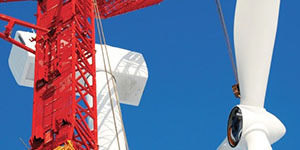
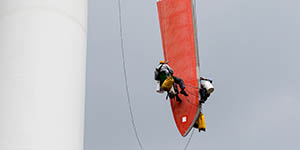
A major advantage of ALP 20 is its easy installation. The flexible two-coat system can be applied by rope access teams or bucket truck crews during routine maintenance. Its application process is identical to that of BladeRep® Topcoat 12 — a widely used aftermarket coating applied to thousands of blades — and involves the following steps:
1. Prep: Sand the area around the receptor and clean thoroughly.
2. Paint: Mask off an area around the receptor and apply the first coat with a roller, wait 45 minutes, and then apply the second coat.
3. Cure: Allow a minimum four-hour cure time (conditions depending).
The system comes pre-packaged as a 1kg two-component kit in a single container with optional thinning for specific environmental conditions. One container is sufficient for the typical application on a single blade. Because the coating isn’t consumed during a strike, operators can expect ALP 20 to provide many years of worry-free lightning protection.
Redefining Lightning Protection
Reacting to the threat of lightning shouldn’t just be a matter of damage control — it should be about reducing downtime and optimizing performance. By incorporating the innovative ArcGuide® technology, ALP 20 enhances the electric field in the air above the surface around the receptors shifting the odds of strike attachment dramatically in favor of the existing LPS, making today’s turbines safer, more resilient, and cheaper to maintain.
As turbines continue to grow taller — and lightning events grow more frequent with climate change — LPS enhancements like ALP 20 could become a standard feature for both new builds and retrofit upgrades across the wind-energy landscape. Safeguarding the future of clean power means not just resisting nature’s power — but working with it. It’s a principle that dates back to Benjamin Franklin, whose invention of the lightning rod in 1752 marked a turning point in how structures are protected by guiding lightning safely to ground. Just as Franklin’s insight transformed building safety, innovations like ALP 20 offer a modern solution for wind turbines — harnessing that same philosophy to protect today’s infrastructure for tomorrow’s energy needs.
References
- Said, Ryan, et al., “A Multiyear CONUS-Wide Analysis of Lightning Strikes to Wind Turbines,” Wind Energy, 2025.
- Szlatenyi, Christopher, et al., “A New Coating for Reducing Wind Turbine Blade Lightning Damage,” International Conference On Lightning and Static Electricity 2022, 2022.