








As our fleet of wind turbines continue to age, understanding the structural integrity of its foundations becomes increasingly important. With millions of fatigue cycles annually, the punishment foundations must withstand is immense. When constructed properly and maintained within engineering specifications, the foundations are up to the task. However, when subjected to neglect, the minor deficiencies will almost certainly compound, exposing significant economic liabilities and perhaps safety concerns for those working above.

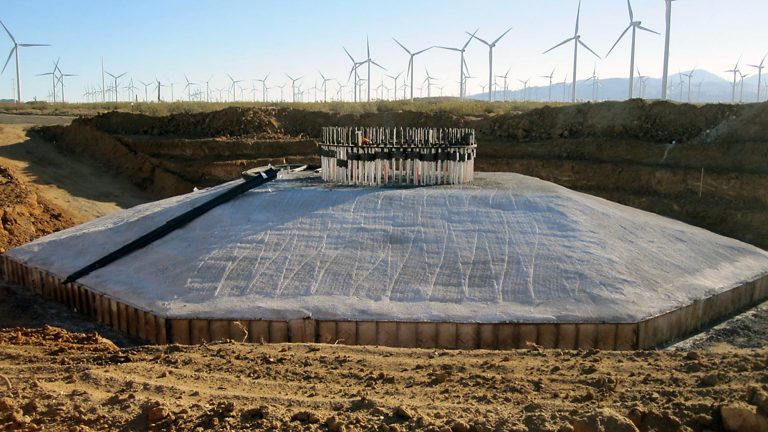
In order to better care for a foundation, it’s important to better understand them. First off, foundations are not a dead, static mass. They’re precisely engineered structures designed to properly dissipate the tremendous forces coming from above. The anchor bolts, grout, concrete, and reinforcing steel have very relevant jobs to this happening properly. Though several different designs exist, the majority of U.S. wind turbines are built on “spread” footings. Differing designs rely on certain components more than others, but the general principle stays the same: to keep your turbines anchored to the earth.
Foundation Components
Anchor Bolts: The anchor bolts are generally held in tension, which is effectively pulling the turbine to the foundations. As an example: A turbine has 160 anchor bolts times 100,000 pounds of specified post tension each equals 16 million pounds of collective “pull.” The design engineer, based on complex calculations, determined this turbine needs 16 million pounds pulling it down to the foundation.
Grout: The grout is the buffer of the 16 million pounds of pull (plus weight of turbine) between the base flange and the pedestal concrete. The grout is the first line of defense from the forces above. It evenly distributes the loads from above to the foundation concrete.
Concrete: The concrete is the ballast or weight keeping the turbine from overturning. Simply put, it’s a giant weight.
Reinforcing Steel: This keeps the concrete as one cohesive mass and distributes the loads evenly. It is important to know that in the past 15 years, design standards have changed (twice), increasing the amount of reinforcing steel within the foundations.

Inspection and Maintenance Procedures
To mitigate the potential for major foundation problems, a foundation maintenance and inspection procedure should be implemented: AWEA’s Operations and Maintenance Best Practices has detailed procedural recommendations. A proper foundation inspection and maintenance program doesn’t need to be overbearing, cumbersome, or expensive. The best programs are based on common sense, with an escalation of service, based upon preliminary findings. Foundations require much less maintenance than the rest of the structure but should be systematically inspected and tested for abnormalities. For starters, it’s extremely important to know if the anchor bolts are holding their specified tension.
There are many reasons why an anchor bolt could be holding improper tension:
- Design data.
- Construction techniques.
- Material/construction deficiencies.
- Concrete shrinkage.
- Anchor bolt relaxation.
- Seating losses.
- Corrosion.
- Turbine abnormalities.
- Incorrect equipment.
- Improper calibration.
- Neglect.
- Weather/seismic events.

Besides ensuring proper anchor bolt tension, each foundation should be visually inspected yearly for the first several years after construction. A visual inspection could simply be documenting hardware condition (corrosion?), concrete cracking or spalling, interior water, and any other abnormalities. Whatever conditions are discovered during the first inspection, they need to be recorded as the benchmark, with future inspections referencing the known problems. Remember the fatigue cycles? If your foundations are not in proper shape, you will be point-loading the grout, concrete, and steel near the failing areas, greatly jeopardizing the total number of fatigue cycles your foundation can withstand. Not all foundations are perfect, and some small failures may be inevitable, but the larger more expensive issues can often be greatly reduced, if not prevented entirely.
Subterranean Inspections
If significant cracking is visible at ground level, re-powering is being considered, or your foundations were designed before 2007, inspecting the interface between the pedestal and spread footing can save a catastrophic event. Exposing and inspecting the critical interface between the pedestal and spread footing during operating conditions is becoming common practice when one or more of these conditions exist. If the pedestal is found to be moving independently of the spread footing, you have a big problem that needs to be fixed before a catastrophe ensues.
Corrosion Cause and Effect
Hardware corrosion is often an indicator to the health of the foundation. If the hardware is excessively corroded, there is a higher likelihood of larger foundation concerns. Ultimately, there are two problems that corrosion will lead to: The first is the degradation of hardware (particularly washer and lower nut), resulting in post tension loss in the anchor bolts. Fractions of millimeters of lost washer/nut thickness will directly result in tension losses to the anchor bolt.

The other major issue stemming from corrosion is improperly functioning hardware. In many cases this problem continues to elude operators who don’t know what to look for. We’ve come across stuck nuts in every state we’ve worked, in every type of atmospheric environment. Stuck hardware can generally be overcome, but it takes the conscious wherewithal to identify and then rectify the problem. You need to use the right equipment to properly identify stuck hardware. If the tensioning system doesn’t allow for full visibility of the anchoring nut during tensioning, how do you know what you’re doing? Secondly, you need enough torque in the tooling to free corroded hardware. Anything less than a large wrench often won’t work. It’s important not to assume hardware that looks visually OK is functioning properly. Frequently, an uncovered anchor bolt may look fine but is severely stuck. Unless a high quality never-seize was applied under the nut during construction, the hardware is more than likely stuck. Proper testing will identify such issues. Corrosion is one of the largest threats to a foundation’s long-term structural longevity. It is a compounding issue that can lead to significant problems with the rest of the structure over time.
Conclusion
A foundation will tell you how it’s doing. It’s your job to pay attention. A simple maintenance plan with periodic tension testing and annual visual inspections will go a long way in preserving a foundation’s integrity. If small problems are found, fix them before they become large problems. It seems common sense, yet as our industry ages, it’s increasingly clear that every component can be replaced except the foundation. With extended lifespans and re-powering now commonplace, it is valuable to know your foundations can handle the job long into the future.