





Mammoet is playing a key role in the lifting and movement of next generation wind-turbine components for two offshore wind farm projects.
In 2023, it was selected by Buss Ports to marshal foundations for two of the largest offshore wind projects in Europe — Nordseecluster A (Germany) and Thor (Denmark).
Nordseecluster (A & B) and Thor are joint offshore wind projects of RWE (51 percent) and Norges Bank Investment Management (49 percent). These offshore wind projects will play a crucial role in their countries’ green energy targets. Combined, they will achieve a total planned capacity of up to 2.6 GW.

Mammoet’s scope was to manage the phased load-in, temporary storage, and load-out of 116 XL monopile foundations for both wind farms at Buss Terminal Eemshaven in the Netherlands.
With different specifications of monopiles being shipped to the port in different numbers, the load-ins had to be carefully planned so that marshalling equipment was configured in advance and space at the port could be managed effectively.
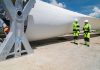
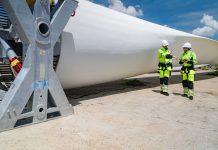
The monopiles for Nordseecluster A weighed about 1,500 tons and measured on average 85 meters in length; the foundations for Thor stretched approximately 100 meters and weighed about 1,500 tons.
Monopiles are normally transported in a longitudinal configuration. However, to deliver more units per voyage they were loaded in a transverse orientation and protruded slightly over the side of the vessel.
To support this, Mammoet needed to unload these structures sideways. This methodology also allowed the load-out method from China to be reversed. Due to the low ground bearing capacity of the quay, an unusually long linkspan ramp was used. Typically, linkspans measure five meters — this ramp stretched about 12 meters before touching down on the quay.
It also would have meant there would only be enough time to offload one monopile in the first tidal window. An alternative solution had to be found.
“To overcome this, we placed wooden mats on the deck of the vessel to gain the height we needed,” said Wouter Santen, project manager at Mammoet.
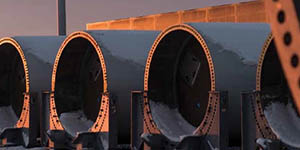
For the final load-outs, the monopiles were driven back to the quayside and lowered into concrete cradles, ready to be lifted onto the delivery vessel using its on-board crane.
By overcoming the tidal constraints and the limited ground-bearing capacity of the quay, it made it possible for up to 10 monopiles to be delivered at a time instead of eight or nine.
Over the duration of this year-long project, several trips from China were spared as a result. With each voyage taking about 60 days of sailing, the time and cost savings were significant.
More info www.mammoet.com