








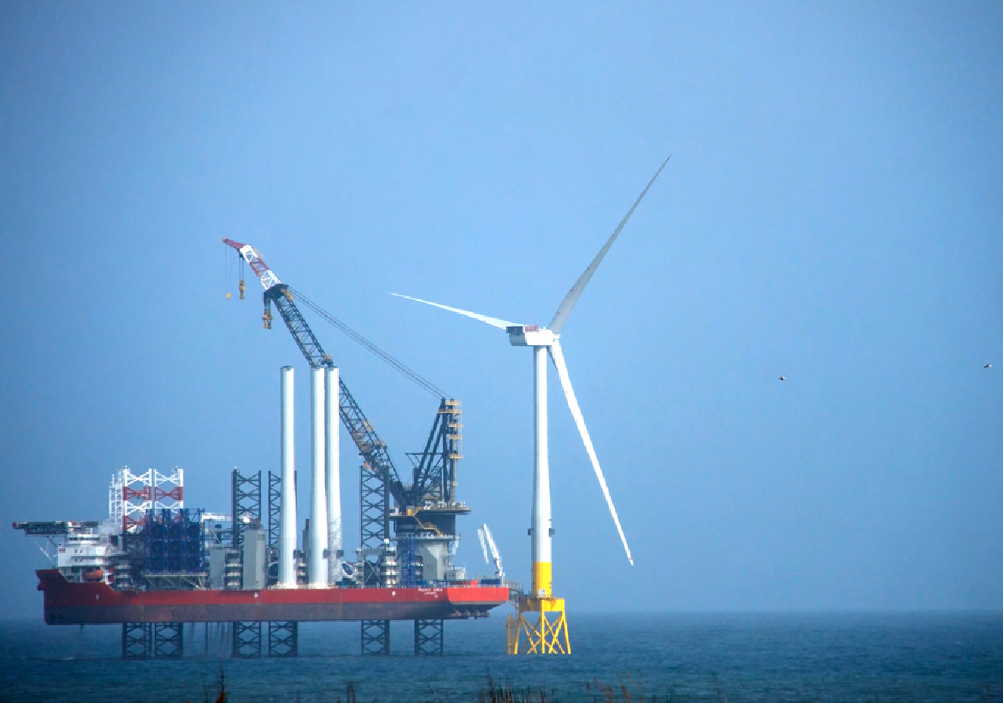
A recent study by the Kuehne Climate Center shows that the existing and forthcoming global fleets of wind-turbine installation vessels (WTIVs) and heavy lift vessels (HLVs) could install an additional 320 GW of offshore wind by 2030, driving global installed capacity up to 400 GW, if broader market conditions align.
China’s fleet can most likely achieve about 225 GW through the smart coordination of demand and supply of installation services alone. The rest of the world market, led by European operators, would, in addition to smart coordination, require annual fleet investments in the range of 2.5 billion to 4 billion euros over the next three years to achieve 175 GW installed capacity by 2030. Without these investments, the rest of the world’s vessel fleet could at best achieve about 140 GW installed capacity by 2030, bringing global possible installations down to 365 GW.
While these gigawatt numbers may seem high from today’s perspective of a volatile offshore wind market, renewable energy scenarios suggest that 2,500 GW of offshore wind will be needed by 2050 to meet climate targets. Under the “Double Down, Triple Up” renewables pledge from the end of 2023, aspirations were for 500 GW of offshore wind by 2030. Given the need to scale renewables such as offshore wind at an unprecedented pace, the findings highlight the entire supply chain’s capacity should be regularly assessed, and that future output targets need to be backed by supply chain development targets. Stefanie Sohm from the Kuehne Climate Center, who led the study, sees especially the logistics systems to support sector growth as an often-overlooked component.
“Wind installation vessels are large assets and can have long lead times,” she said. “Mobilizing the right investments early on requires market visibility and coherent supply chain development plans across the industry.”
The study also illustrates how a qualitative mismatch between market supply and demand constrains the overall installations that can be achieved: Tasking the vessel fleet with the installation of the same overall amount of gigawatts but composed of different plausible turbine sizes results in different amounts of gigawatts installed. Thomas Poulsen from Panticon, who contributed to the research, notes that “Efficient vessel deployment strategies within a project should be an obvious objective for keeping costs down. Looking further ahead, the potential efficiency gains from smart coordination of vessel allocation across projects and regions have not yet received the attention it deserves.” The authors therefore suggest the creation of an independent, multi-regional coordination platform for offshore wind projects that can enhance forecasting and vessel allocation for faster results at lower collective cost.
Since installation vessels are only one of many critical players in offshore wind, possible achievements obviously also depend on the capacities of the rest of the supply chain, and importantly, the broader market conditions and political ambition.
The study “Logistics’ role in scaling offshore wind to climate targets – a scenario study on installation vessel requirements” is available for download on KCC’s website. It includes a general overview of offshore wind logistics and an assessment of the existing and forthcoming wind-turbine installation vessel and heavy-lift vessel fleets for PR China and the rest of the world. Using different turbine evolution scenarios, the study includes a detailed analysis up to 2030 and a high-level outlook to 2050.
More info: www.kuehne-stiftung.org