








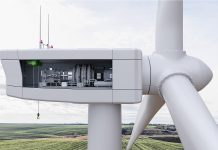

RUD recently developed neXera, an electric hoist that comes with variable lifting speeds of 24 to 80 m/min for loads of up to 800 kg. Compared to conventional devices, RUD neXera is about four times faster at lifting and lowering over a typical service cycle. This is made possible primarily by the patented X-Drive chain drive. Wind-turbine operators benefit from less downtime for maintenance and longer operating times per turbine. The hoist offers higher safety for service personnel and is easy to maintain thanks to its modular design.
“RUD neXera is completely new and unique; there has never been such a fast and safe hoist for wind turbines on the market before,” said Matthias Müller, technical manager in Drive Development at RUD Drives GmbH, based in Wermsdorf (Saxony). “We developed our innovation specifically for lifting applications with lifting heights of up to 200 meterss and more. These hub heights are now a reality in the wind power industry, but classic hoists are designed for a hub height of 160 metres. With RUD neXera, we are closing this gap in the market.”
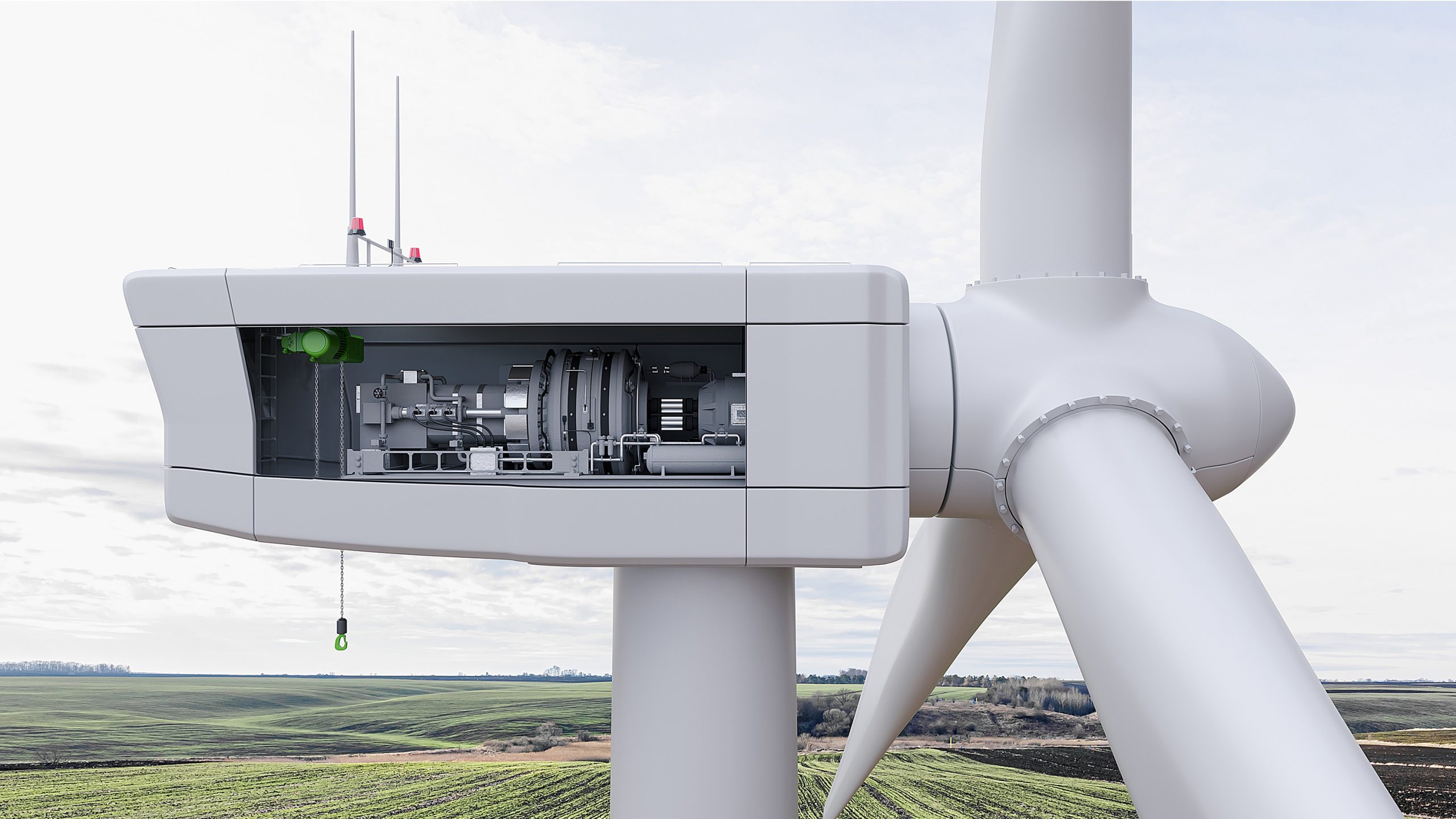
As an innovative hoist for wind turbines, RUD neXera is suitable for all turbine types with a hub height of up to 200m, both onshore and offshore.
THE X-Drive chain drive, a RUD innovation, enables high chain speeds of up to 80 m/min. The result: shorter waiting times when lifting and lowering, and therefore shorter service times on wind turbines. This leads to lower service costs and less downtime for the turbine. The fast chain drive also scores points with low chain wear, which leads to lower operating costs and greater safety. Another safety plus: with the X-Drive, the chain pocket wheel prevents the chain from becoming unclamped or sheared off.
When maintaining wind turbines, tools, replacement materials, and lubricants have to be transported up into the turbine. RUD neXera takes care of this job; RUD neXera 800, for example, can transport up to 800 kg of payload to a height of 200 meters in about eight minutes.
“It’s a real advantage to be able to travel at high speeds and get from top to bottom as quickly as possible – and vice versa,” said Annekatrin Strunz, Sales Area Manager Windpower at RUD.
“With conventional hoists, lifting the necessary tools and auxiliary materials for maintenance work on wind turbines takes an average of two hours. RUD neXera, on the other hand, takes around half an hour,” Müller said.
RUD neXera not only scores with high lifting speeds, but also with increased operational and work safety. The newly developed hoist has a built-in incremental encoder that allows the highest and lowest desired hook positions to be set precisely. The sensor records the revolutions of the drive shaft precisely and ensures high positioning and repeat accuracy. The encoder cannot be manipulated during operation and, unlike the push button switches or tilt elements in conventional hoists, its trigger elements cannot be mechanically destroyed.
“These are all developments designed to reduce the risk of accidents during wind turbine maintenance,” Müller said.
In addition, RUD neXera can be equipped with a load eye instead of a load hook.
“With the load eye and matching shackles, the load is held securely in place. This is a real safety advantage for the operating and service personnel on the ground,” Müller said.
The hoist from RUD has a modular design, which enables servicing of the hoist and replacement of assemblies. Electricians have easy access to the control system on RUD neXera, enabling them to rectify faults more quickly. All control elements are housed in a separate box. The entire control system can be replaced separately, as can the pendant control. Unlike conventional hoists, the hoist’s operating data (e.g. for the annual inspection and the test log) can be recorded and stored as a variable in the frequency converter in a way that cannot be manipulated.
As of January 1, 2025, there were a total of 30,243 wind turbines in Germany with a total installed capacity of 69,475 MW, as reported by strom-report.de. The majority of wind energy generation comes from onshore turbines. These, as well as offshore turbines at sea, require regular maintenance.
“There is a high demand for efficient, safe and fast lifting equipment for wind turbines,” Müller said. “This is where RUD neXera comes in, taking wind turbine maintenance to a new level.”
More info www.nexera.rud.com