









Wind-turbine blades are among the most critical and costly components in a turbine. Each blade is a complex composite structure designed to withstand extreme loads, environmental stress, and decades of operation, yet even minor defects can escalate into catastrophic failures if left undetected. This is where condition monitoring systems (CMS) come into play, transforming maintenance strategies from reactive to predictive and safeguarding the long-term performance of wind assets. By providing continuous insights into the structural health of the blade, owners and operators are able to prioritize work more efficiently and accurately quantify the risk present in their entire fleet.
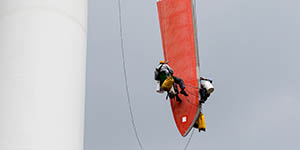
As nameplate capacities increase and blades get longer and heavier at unprecedented rates, the criticality of small structural defects is amplified. Traditional inspection methods, such as visual drone-based checks or scheduled up-tower climbs, often fail to catch early-stage defects such as delamination or, even worse, internal damage such as spar web separation. These issues can be hard to detect with traditional inspection methods and propagate silently, leading to costly repairs, extended downtime, or even a need for complete blade replacement.

From Reactive to Predictive Maintenance
The value of CMS lies in its ability to shift maintenance strategies from time-based to condition-based. Instead of climbing towers for scheduled inspections, operators can prioritize interventions based on actual blade health. This predictive approach reduces unnecessary climbs, minimizes downtime, and optimizes resource allocation so that teams can balance proactive repairs with regular maintenance strategies.
Moreover, early detection of structural defects prevents small issues from becoming major failures. For example, identifying a pitch misalignment early can improve aerodynamic efficiency and reduce loads on the drivetrain, extending the life of the entire turbine.
In the wind industry, where margins are tight and availability is paramount, CMS solutions deliver measurable ROI to the customer. By reducing unplanned outages and extending blade life, operators can maximize energy production and get to what generation is all about: lowering the levelized cost of energy for the customers. As wind farms scale and turbines grow larger, the importance of continuous blade monitoring will only increase. Wind turbine blades are too valuable to leave unchecked.

CMS investment
Investing in a robust CMS is not just about maintenance; it’s about ensuring reliability, safety, and profitability in the evolving landscape of renewable energy.
Weidmuller’s BLADEcontrol system is a structural health monitoring solution engineered specifically for composite wind-turbine blades. At its core, the system uses a dual-axis accelerometer mounted inside each blade, as well as a drivetrain accelerometer. This configuration enables BLADEcontrol to capture subtle variations in vibration response while filtering out noise from the gearbox and rotor bearings. The result is highly precise measurements that allow operators to pinpoint the root cause of anomalies across their fleet. Additionally, Weidmuller is uniquely positioned in the industry as a manufacturer of power supplies, terminal blocks, and other connectivity hardware leading to an affordable solution built with in-house components. The BLADEcontrol system’s return on investment is less than three years by alerting the operator to structural damage while it is still non-urgent, and avoiding the costs of unnecessary climbs.
Whether installed by wind turbine OEMs during manufacturing or retrofitted up-tower on operational turbines, BLADEcontrol integrates seamlessly into existing workflows. All insights are delivered through the intuitive WebVis (Web-based Visualization) dashboard, giving engineers, site managers, and technicians real-time visibility into their fleet’s blade health and insightful data that can be used for decision-making.

Next-Generation CMS
The next generation of wind-turbine blade-based CMS will have an even more advanced repertoire of detectable damages because, instead of relying on a single measurement technology, it will employ multi-modal sensors that can detect vibrations in ultra-low- and high-frequency applications. One specific example of this is Weidmuller’s BLADEcontrol NXT, which not only uses tri-axial accelerometers but has an additional acoustic sensor positioned inside the blade. This allows for dual-source vibration analysis as well as specific location triangulation, giving technicians and engineers more actionable insights to their fleet.