








From a distance, a wind turbine looks like one enormous machine, but in reality, that machine is made up of thousands of different parts that must constantly perform in harmony to create electricity.
Many different companies may be responsible for maintaining those pieces, but companies like Weidmuller transform traditional maintenance through insightful operational data, while leaning into 175 years of experience to add even more services to its wind-energy portfolio.
“We are in several areas of the wind industry,” said Pete Tecos, director of new energy solutions at Weidmuller. “First and foremost is, we’re trying to develop safe, secure, resilient solutions for the electrical cabinets and the interconnectivity of the systems within the wind turbines. This goes across our core portfolio of terminal blocks, power supplies, electronic load monitoring, surge protection, heavy duty connectors, all the way to programmable automation controllers, and industrial I/O.”
In addition to the core connectivity and electrical cabinets, Weidmuller has developed customized LED tower lighting systems, according to Tecos. These are highly engineered systems specific to turbine models that can be installed easily, and the lighting is tailored for each particular tower.
“However, where we bring unique value to the wind industry, is with our emphasis on condition monitoring systems, and that’s in a couple of different areas,” he said.

BLADEcontrol Condition Monitoring
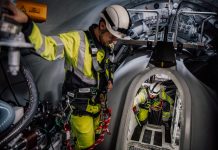
One of those areas is for the root connections of the wind-turbine blade, according to Tecos, BOLTcontrol is a system that monitors the bolts that connect the blade to the hub. But Weidmuller’s premier condition monitoring product is BLADEcontrol, the company’s condition monitoring system for blade health.
“It is capable of detecting cracks, debonding, delamination, and other damages at very early stages when blades can be repaired cost-effectively utilizing condition-based maintenance, rather than time-based maintenance,” he said. “Data-driven decision making is really critical for the industry as it exists today. In addition to damage detection and blade degradation, BLADEcontrol is also excellent at detecting ice buildup on blades, which is essential for those wind-farm installations in cold regions. Buildup of ice can be detrimental to a blade and even the entire wind turbine. Our system can detect the buildup of ice, and if it gets to a critical mass, BLADEcontrol can send an alarm to the turbine controller to shut down so that the ice can be abated, and then issue a restart request once it’s diminished to a point that’s deemed safe.”
Guiding Principles
With 175 years of history under its belt, Weidmuller is a company that has centered itself around innovation and connectivity in the industrial environment, according to Tecos, but under the guiding principles of sustainability and responsibility.
“Some of the key elements of that philosophy involve customer-centric innovation,” he said. “Weidmuller positions itself as a partner in industrial connectivity and supporting our customers through digital transformation with intelligent products, solutions, and services. Like many of our customers, we emphasize continuous innovation in order to meet the evolving technological challenges of the future. That’s first. The second is some of our key corporate values, which would include service, competence, and reliability since 1850. Very few companies can make that statement.”
That means high-quality products with a strong price-to-performance ratio, where creativity and innovation is present in all of Weidmuller’s business units, which includes the company’s organizations and its qualified and committed employees who complement its products and solutions with outstanding logistics capabilities, according to Tecos.
“Our third key element is sustainability and responsibility,” he said. “I’d say Weidmuller is deeply committed to ethical and sustainable business practices, and we align with a variety of international standards, like the German Supply Chain Act, the UN Global Compact, and other Declaration of Human Rights standards that foster responsible corporate citizenship. We’ve implemented a code of conduct and principles for human rights and decent work environments, which applies globally across all business units, and subsidiaries and partners of Weidmuller.”
The company’s last key element would involve global and local engagement, according to Tecos.
“We are a family-owned company with global scale,” he said. “While we have a presence in over 80 countries, we value both global reach as well as local responsibility, and we balance them accordingly, striving to create a meaningful connection, whether it is power, signal, data, or the human relationship. That’s really what we’re driving toward.”

Expanding in the Wind Sector
Although Weidmuller has made a name for itself by manufacturing terminal blocks, power supplies, controllers, I/O and more, it’s with its condition monitoring products where Tecos said the company is really making a name for itself within wind energy.
“I think one of the excellent examples of how Weidmuller has tracked the evolving wind industry is rooted in our focus on blade condition monitoring,” he said. “If you look at what’s happened in the wind industry over the past two decades, in an effort to bring down the levelized cost of electricity to make wind energy the viable competitive energy source that it is today, the industry has had to increase the power output of the turbines.”
One of the ways to do that is to make turbines — and their blades — larger, according to Tecos.
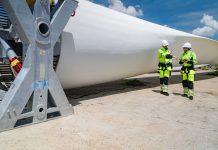
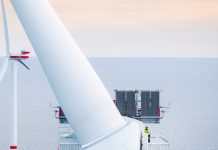
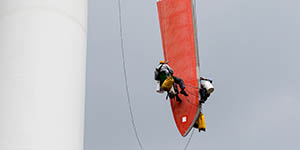
“We see blade lengths have more than doubled in that 20-year timeframe,” he said. “We see rotors reaching farther and farther up into the sky, where they could be subjected to stronger jet streams and sometimes more turbulent air. This makes the blades one of the more costly and higher risk components of the wind turbine. Yet the manufacturing process of blades has remained virtually unchanged in that timeframe. It’s primarily a manual process, which makes it inherently susceptible to error and defects.”
Because of the turbines’ exponential growth, condition monitoring — once thought of as an accessory — has become a necessity, according to Tecos.
“Data-driven operations and maintenance directly mitigate the risk of unplanned downtime, or even catastrophic failures,” he said. “It’s a tool that’s going to be required by both OEMs and operators to make sure that fleets can operate at their optimal capacities and performance.”

Working with Customers
Finding the proper product for a customer can be a process, but it’s a necessary one to ensure the best fit, according to Tecos.
“The first steps often include setting up a workshop with the customer, so we can ascertain the following things: No. 1, do we thoroughly understand the problem our customer is trying to solve? Are we also taking into account or into consideration the needs of the end customer? We like to take it full scale — from not only our customer, but the end customer,” he said. “We can then assess: Do we have a solution or solutions? There could be multiple ways we could approach it, but which solution is most viable both technically and commercially? Can it be deployed within the necessary timing requirements? Is it scalable or even translatable? By scalable, obviously, is it applicable not just to a single turbine, but across a fleet or across a platform of turbines? Translatable means: Could we take this solution and apply it in a different industry or to a different type of asset, but using the basic same philosophies of the solution that we applied to a wind turbine? Then finally, does it drive unique value to our customer and the industries that we mutually serve? That’s really the salient point.”
175 Years of Business
Weidmuller has its roots in textiles, beginning in Germany in the 1850s. In 1948, the company took what it had learned in stamping and metal fabrication and used that knowledge to pivot into the electrical connectivity industry, where Weidmuller created, developed, and invented the first insulated terminal block, according to Tecos.
“The terminal block has basically been synonymous with Weidmuller since that time,” he said. “It’s the core product for which we are known, although in the ensuing 80 years or so since its development, we have created a portfolio that spans more than 54,000 SKUs, from terminal blocks to full industrial automation solutions.”
Since 1850, Weidmuller has existed as a privately held, family-owned company, a monumental achievement that few — if any — companies can duplicate, according to Tecos.
“We can cite so many examples of companies and empires being built that are subsequently sold off by future generations — that is not the case here,” he said. “Since 1850, the family is committed to this company, committed to the employees, and most importantly, committed to the customers and the industries that we are privileged to serve. I think that’s one of the proudest achievements of the company.”

50 Years in the U.S.
As part of that 175-year history, Weidmuller is also celebrating 50 years in the U.S. with its Richmond, Virginia, location, according to Tecos. On June 11, Weidmuller’s supervisory and executive boards came to Richmond to celebrate this milestone along with state and local economic officials, customers, distributors, and more. The celebration also served to commemorate the grand opening of the company’s engineering and production facility, which broke ground in May of 2023.
A half century serving North American companies, as well as Weidmuller’s near two century existence, makes it essential that the company keeps an eye on an ever-changing future for the wind sector.
To that end, Tecos said he expects to see a convergence of IT and OT so the wind turbine can be viewed holistically. This will enable operators and OEMs to streamline operations and minimize inefficiencies, while maximizing productivity and profitability.
“The goal is to acquire, aggregate, and analyze data regardless of asset brand, age, or control type so that AI and machine learning tools can transform that operational data and leverage it to elevate performance and improve designs,” he said. “Also, I just can’t imagine there’s not going to be a transformation regarding the adoption of automation for the production of blades and other major elements of the wind turbine that are currently tied to manual processes.”
And with Weidmuller’s recent expansion at its Richmond facility, the company is ready to face much of what’s next on the wind-energy horizon, according to Tecos.
“We have just expanded our operations by 24,000 square feet; this is dedicated to engineering as well as manufacturing, and a good portion of that manufacturing capacity is going to be allocated to clean-energy initiatives, certainly combiner boxes for PV, but we’re also looking at the possibility of making BLADEcontrol stateside as well,” he said. “That’s pretty exciting. And we’re looking forward to implementing that.”
More info www.weidmuller.com