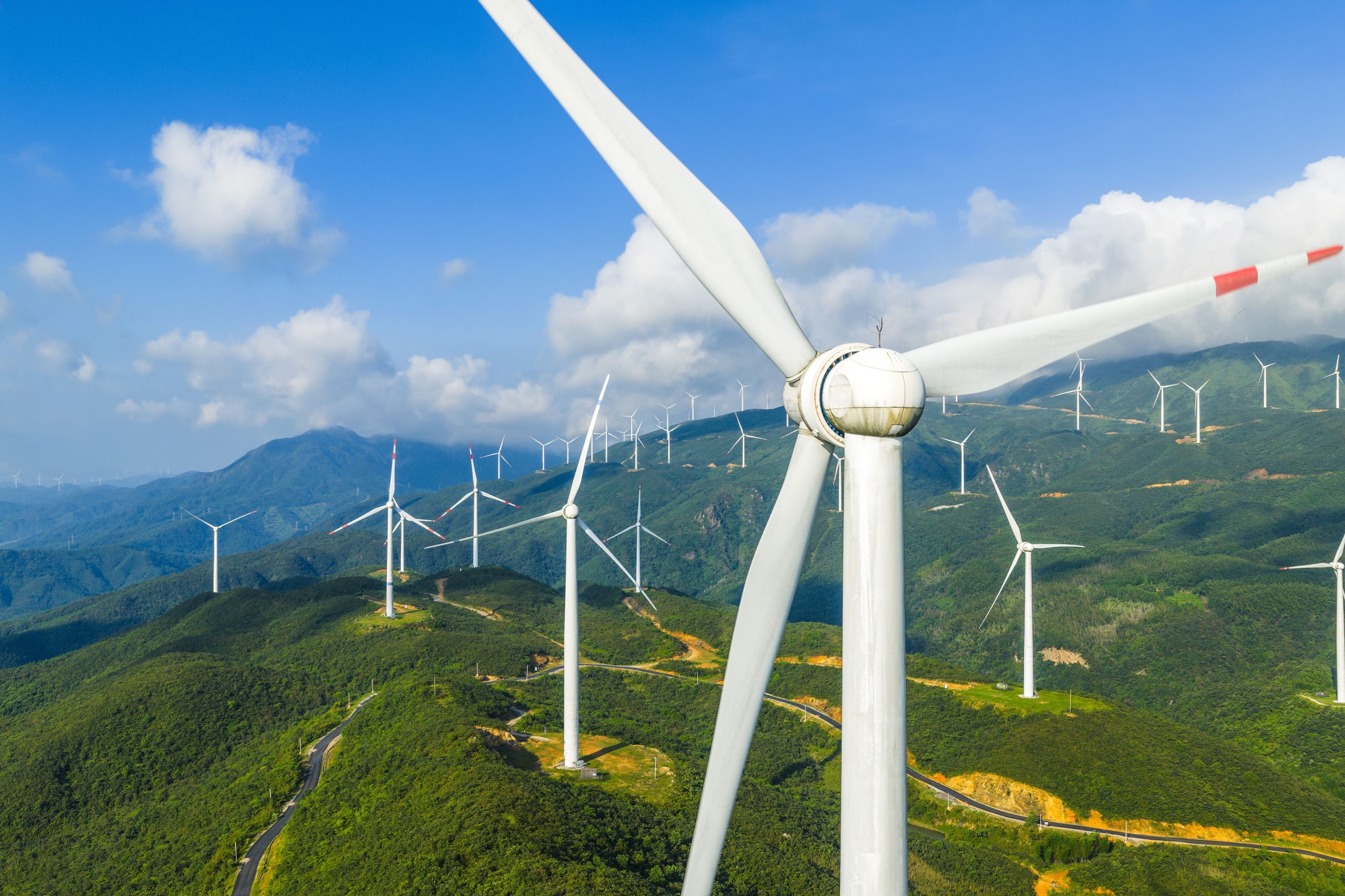
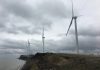
Onshore wind power and solar PV are expected to drive growth in Laos’ renewable power capacity, which is forecast to increase to 9.8 GW by 2035 at a compound annual growth rate (CAGR) of 17.1 percent during 2025-2035, according to GlobalData, an intelligence and productivity platform.
Onshore wind power and solar PV are expected to drive growth in Laos’ renewable power capacity. (Courtesy: GlobalData)
Laos is looking to move away from coal-based power generation, with a focus on renewables development, especially onshore wind and solar PV.The southern region of the country, encompassing the provinces of Sekong, Attapeu, and Champasak, boasts significant wind-energy potential. The solar potential is also estimated at 4.4 kWh per square meter per day, which translates to about 1,800 to 2,000 hours of sunlight annually.
GlobalData’s latest report, “Laos Power Market Trends and Analysis by Capacity, Generation, Transmission, Distribution, Regulations, Key Players and Forecast to 2035,” revealed that in 2025, onshore wind constituted for nearly 74.3 percent of Laos’ total renewable power capacity, followed by solar PV accounting for 12.8 percent share. Onshore wind is projected to increase from 1.5 GW in 2025 to 5.1 GW in 2035, whereas solar PV capacity is expected to increase from 0.3 GW in 2025 to 4 GW in 2035.
“Onshore wind will play a key role in the country’s renewable development,” said Attaurrahman Ojindaram Saibasan, Power Analyst at GlobalData. “Following the introduction of onshore wind into Laos’ capacity mix in 2025, with the launch of three wind power plants, the share of renewables increased from 2.6 percent in 2024 to 14.1 percent in 2025. However, hydropower is expected to continue to play an important role in the country’s electricity generation mix.”
Despite the potential for solar power development, the geography of Laos poses challenges for the implementation of large-scale, ground-mounted solar projects due to spatial constraints.However, developing floating solar installations on reservoirs used for hydropower generation provides an opportunity for solar power capacity expansion.
“Laos aims to achieve a 75 percent share of hydropower and an 11 percent share of variable renewables (specifically solar and wind) by 2030,” Saibasan said. “The country plans to increase its hydropower capacity by an additional 13 GW by 2030 and has set a conditional target of achieving 1 GW of total solar and wind capacity and 300 MW of biopower capacity by the same year. These targets are expected to bolster renewable growth.”
The North Sea Summit of the North Seas Energy Cooperation (NSEC) was in Germany at the end of January. Europe’s offshore wind potential is at the heart of its efforts to achieve climate neutrality, affordability, and energy independence amid turbulent geopolitical conditions. This is a significant development for an energy-intensive industry such as the European steel industry, both in terms of affordable green molecules and electrons, and with regard to the EU market for wind industry. Offshore wind energy needs green steel, and the steel industry needs energy costs that are as low and reliable as possible.
Building the North Seas’ power hub
As part of the North Sea Energy Cooperation, the NSEC energy ministers, the European Commission, and stakeholders met last year to set the agenda for the next 15 years of cooperation. Building on the Esbjerg and Ostend declarations, the energy ministers of Belgium, Denmark, France, Germany, Ireland, Luxembourg, the Netherlands, Norway, and the United Kingdom signed a joint declaration in Hamburg to set out their ambitions of 300 GW by 2050, tenders for European installation capacity of up to 15 GW per year in the period 2031-2040, 100 GW of cross-border cooperation projects for the North Sea, and the work of the NSEC.
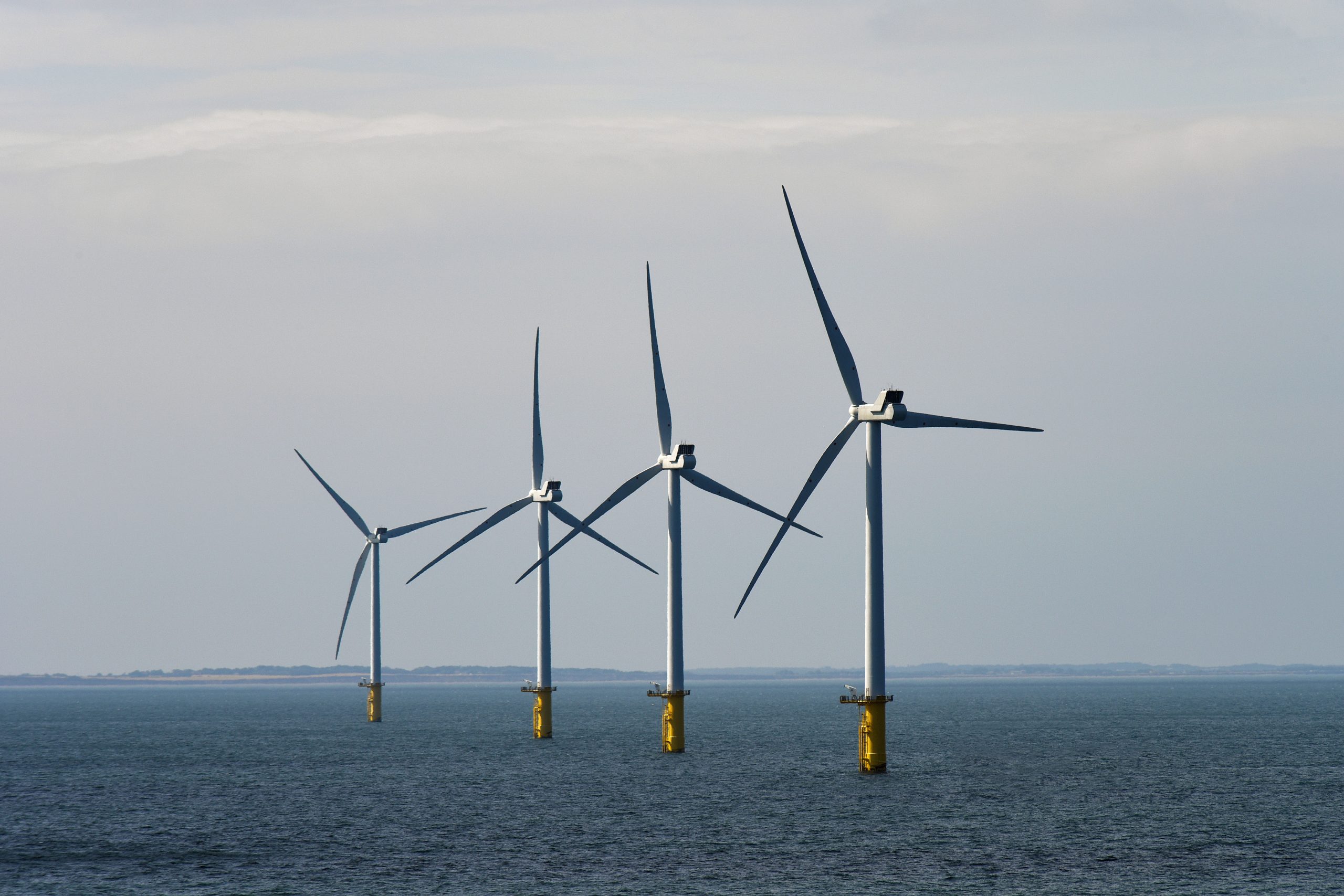
The Baltic Eagle offshore wind farm in the German Baltic Sea. (Courtesy: Iberdrola)
Eight Baltic TSOs, organized in the Baltic Offshore Grid Initiative: 50Hertz (Germany), AST (Latvia), Elering (Estonia), Energinet (Denmark), Fingrid (Finland), Litgrid (Lithuania), PSE (Poland), and Svenska kraftnät (Sweden) published an offshore system study ahead of the NSEC summit to promote coordinated maritime spatial planning, which could become an energy hub by 2040 with about 13 GW of new interconnectors and up to 50 GW of additional offshore wind compared to 2030.
The Clean Industrial Deal takes shape
Offshore wind energy is of great importance to Europe. It is cost-effective — cheaper than building a new fossil fuel power plant. It is efficient — a single offshore wind turbine supplies 16,000 households with electricity. And it is based in Europe — it employs 100,000 Europeans. Realizing the potential of offshore wind energy in the North Sea and Baltic Sea creates jobs, supplies energy and promotes industrialization in Europe. The North Sea Summit Investment Pact will mobilize 1 trillion euros in economic activity and create about 91,000 additional jobs for Europe by 2031, based on the potential of the North Sea alone. So far, so good. What’s more, offshore wind provides the energy with the power plant characteristics needed to transform energy-intensive industries and stabilize electricity grids.
Moving on to the steel industry, another brief intermediate step is necessary. This involves creating a solid investment framework for offshore wind energy through targeted mechanisms such as long-term power purchase agreements (PPAs), including cross-border PPAs. PPAs enable energy-intensive companies, such as steel producers, to avoid price fluctuations by fixing the price as electricity consumers. This requires an electricity market design geared toward renewable energies to be able to use PPAs in the proposed manner. This is transferable to green hydrogen. And that brings us quickly to the tender criteria and the Net Zero Industry Act. But first, let’s look at the steel industry using Salzgitter AG as an example.
Transformation of energy-intensive industry using steel as an example
Salzgitter AG, as one example of a steel company in Europe, entered into strategic partnerships with developers and operators of offshore wind energy at an early stage and secured PPAs with offshore wind farms in the North Sea and Baltic Sea.
Example 1: Salzgitter AG and Ørsted are working toward closed value chains in their business relationship. In addition to the supply of offshore wind energy and the use of renewable hydrogen, this also includes the production of low-carbon steel and its use in components for Ørsted’s offshore wind farms. There are also plans to recycle scrap from wind turbines that are being dismantled in the steel production process.
Example 2: Vattenfall and the steel group are pursuing their common goal of decarbonizing industrial production processes. A new PPA stipulates that fossil-free electricity from the Nordlicht 1 offshore wind farm will be available for steel production from 2028.
Example 3: Salzgitter Flachstahl GmbH and Iberdrola Deutschland have signed a long-term electricity supply contract for 2023. The electricity is to come from the Baltic Eagle offshore wind farm in the German Baltic Sea. With this PPA, Salzgitter Flachstahl GmbH has secured the supply of 114 MW of green electricity for 15 years.
There are other European steel producers that are undergoing sustainable transformation and require green electricity and green hydrogen for this purpose. A competitive European steel industry creates jobs in Europe and is necessary for the resilient transition to a sustainable energy supply.
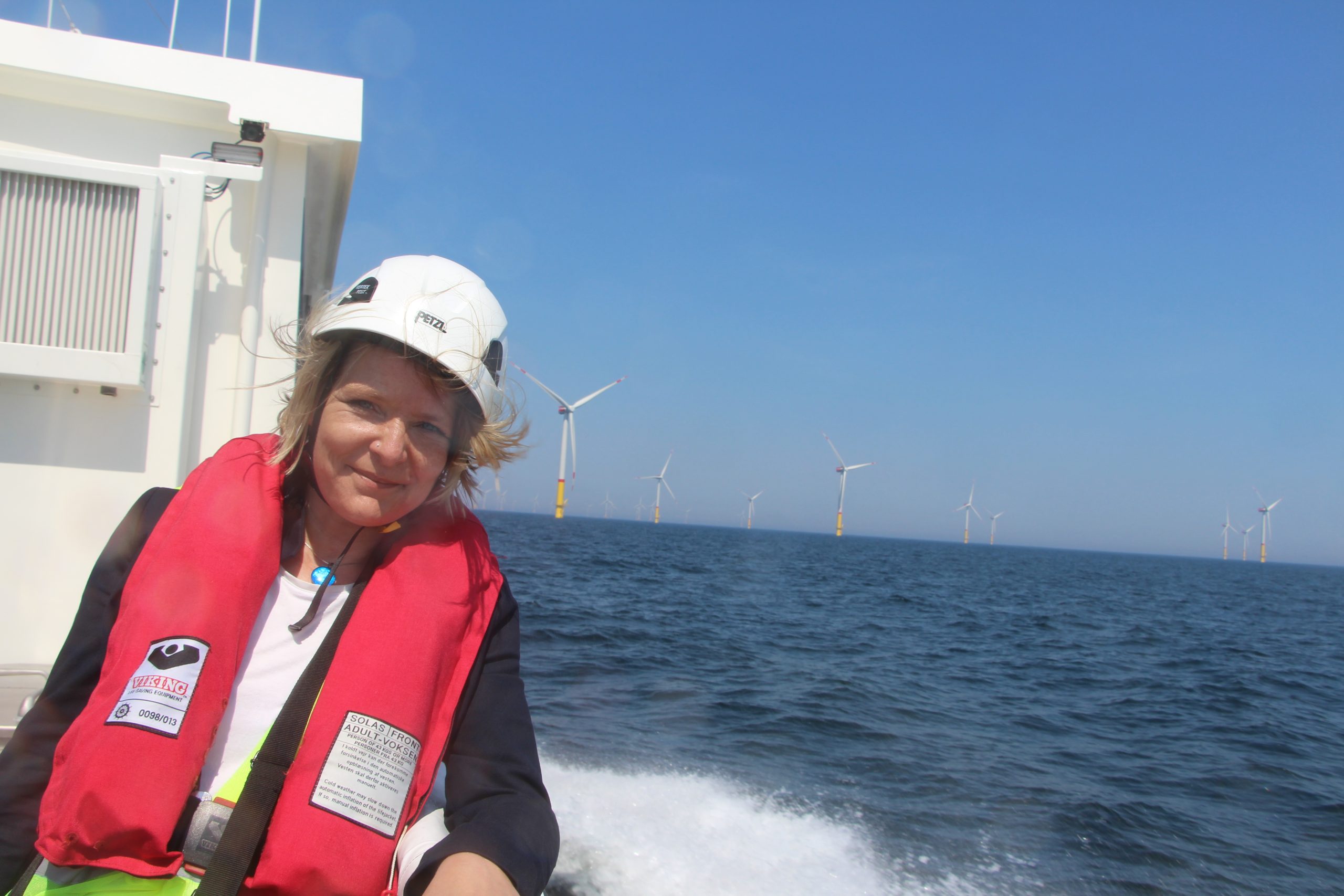
Heike Winkler on the Baltic Sea at an offshore wind power plant in the Baltic Sea. (Courtesy: Offshore Wind Kommunikation)
Not a one-way street
Ilsenburger Grobblech GmbH, a subsidiary of Salzgitter AG, and wind turbine manufacturer Siemens Gamesa signed a contract last year for the supply of about 25,000 metric tons of heavy plate for the construction of 36 wind towers. The “Siemens Gamesa GreenerTower” has CO2eq emissions of less than 700 kilograms per metric ton of steel per tower. RWE is testing these CO2-reduced steel towers in half of the offshore wind turbines in its Danish offshore wind farm Thor and reports a CO2 reduction of at least 63 percent in the steel plates of the tower compared to conventional steel. In this way, the European steel industry is reducing the carbon footprint of offshore wind farms in Europe.
More aspects of decarbonization
Green hydrogen from offshore wind energy is very important for the decarbonization of other industrial sectors that are difficult to electrify, in addition to the steel industry. They include the chemical industry, cement industry, maritime industry, transport, etc.
By the end of 2025, Amazon will have initiated more than 230 wind and solar projects in 13 European countries. Once all projects are operational, they are expected to provide 9 GW of clean energy capacity. That is enough to power more than 6.7 million households in the EU annually. The demand is high. This is particularly true for AI and data centres in Europe.
Salzgitter AG entered into strategic partnerships with developers and operators of offshore wind energy at an early stage. (Courtesy: Salzgitter AG)
Why the Clean Industrial Deal secures Europe
In order to enable a clean, secure, and competitive energy union, the overarching theme of the 20th edition of the European Sustainable Energy Week (EUSEW), there must be fair competition and European cross-industry lead markets as described must be able to grow.
The Carbon Border Adjustment Mechanism (CBAM) and NZIA are essential for this within the framework of the Clean Industrial Deal, with a focus on resilience and climate protection. In this way, industrial transformation for greater climate protection can simultaneously achieve energy independence, increased value creation potential, jobs, and thus, growing prosperity for Europe. All this requires a level playing field protected from price dumping, skilled workers, European technology development, production capacities, and accelerated infrastructure expansion.
The necessary regulations for green hydrogen and floating offshore wind energy will accelerate the development described earlier. In this way, the Clean Industrial Deal will lead to growing sustainable value creation for and, above all, within Europe.
This opinion editorial is produced in co-operation with the European Sustainable Energy Week (EUSEW) – the biggest annual event dedicated to renewables and efficient energy use in Europe. #EUSEW2026 marks the 20th edition and will once again bring together the community of people who care about building a secure and clean energy future for the next generations.
The HELUKABEL Group takes an important step in its strategic development: The specialists in electrical connection technology may now be found on the market under a new brand name — HELU, giving clear expression to the company’s transformation in recent years into a systems and solutions provider.
No longer HELUKABEL, just HELU — the idea behind this change is both deliberate and strategic, as the company has developed step-by-step from a manufacturer of only cables into an internationally leading systems supplier for electrical connection technology. In addition to cables and wires, its portfolio now includes assemblies and drag chains with which it creates integrated, custom, and installation-ready solutions for its customers’ wide range of applications. This evolution will also have an impact at a market level with a new brand name, new logo, and a new claim: “Always Stay Electrified.”
“The future of connection technology is no longer defined by the quality of individual components,” said Managing Director Marc Luksch. “Instead, it’s about combining them into intelligent, installation-ready systems and services. In the previous years, we’ve consistently expanded our competencies and our vision.”
Customers benefit from this solution-based approach through fewer and more clearly defined points of contact, time-saving implementation, and a consistently proven high level of quality.
As a sole supplier, HELU produces more than cables — it also produces drag chains and assemblies in its own factories. Unifying its entire range of products under the roof of the HELU brand is taking a step toward greater clarity and simplicity for customers.
“Our goal is to combine our competencies as a group to provide the users of our solutions with real added value,” Luksch said. “Regardless of how complex or unique the challenges may be.”
HELU USA is the wholly-owned U.S. subsidiary of HELUKABEL GmbH, a global cable system solutions provider specializing in the production of cables, wires, accessories, cable assemblies, robotic dress packs, and drag chains with 76 locations in 43 countries throughout the world. In its 200,000-square-foot, suburban-Chicago facility, HELU USA stocks more than 4,000 cable, wire, and accessory line items for a multitude of application areas including mechanical and plant engineering, industrial automation, oil and gas, building technology, infrastructure, mobility, and renewable energy. Direct access to a 1.8 million-square-foot, fully automated warehouse with 33,000 line items, enables HELU USA to provide extremely short delivery times.
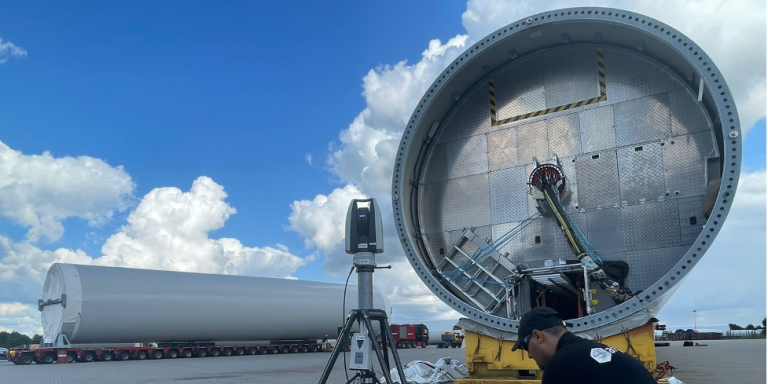
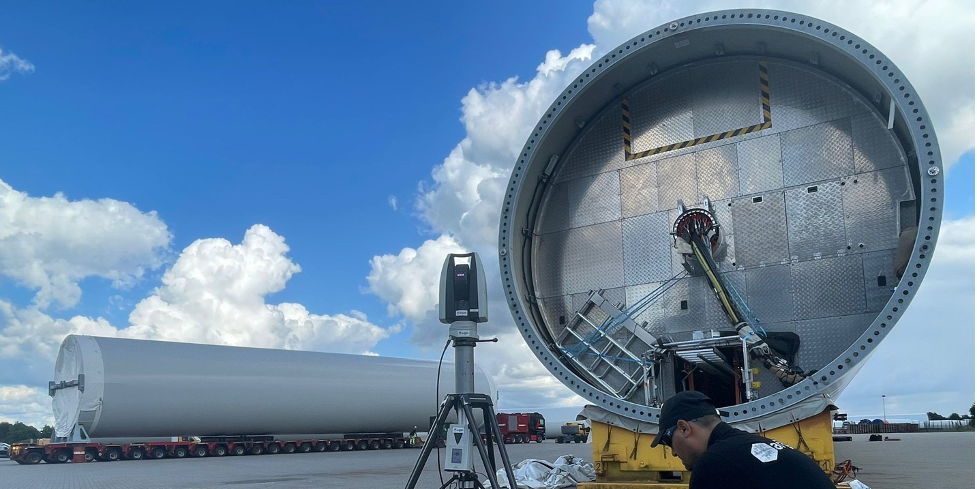
As offshore wind structures grow larger and tolerances tighter, precision on the shopfloor is becoming a decisive competitive factor. ARGON recentlyshowcased how its fully integrated Shopfloor Measurement Solutions (SMS) transform advanced 3D metrology into practical, operator-friendly, and operator-independent production tools at the offshore wind conference Belgian Offshore Days in March. By embedding automated, data-driven measurement into manufacturing workflows, ARGON enables faster execution, higher accuracy and shorter feedback loops — turning (sub)millimeter control into measurable economic value for offshore wind manufacturers.
At offshore wind conference Belgian Offshore Days, ARGON showcased its fully integrated Shopfloor Measurement Solutions (SMS). (Courtesy: ARGON )
Europe’s offshore wind sector is accelerating at a sustained pace. North Sea countries have set ambitious renewable energy targets, triggering a wave of investments. Meanwhile, turbines and foundations continue to grow in size and complexity. Larger components, tighter tolerances, and more demanding installation requirements significantly increase manufacturing challenges. As dimensions scale up, so do the risks and costs of even the smallest deviation. In offshore wind, more than ever, every 10th of a millimeter counts.
Within this landscape, ARGON plays a distinct role. Where traditional measurement methods reach their limits with extremely large and complex structures, ARGON bridges advanced 3D metrology technologies with the practical realities on the shopfloor.
Rather than supplying standalone devices, ARGON delivers fully integrated shopfloor measurement solutions (SMS), engineered, developed, assembled, and installed specifically for offshore wind manufacturers.
ARGON’s advanced systems are designed to be as intuitive as a coffee machine, while leveraging 3D measurement hardware and software.
Through its Stepstone Model, ARGON translates metrology challenges into practical solutions for industrial production environments. Each project follows a structured approach: from concept and proof of concept to a fully developed solution ready for immediate use, including full support after entry into service.
Dedicated ARGON SMS solutions for offshore wind applications include: BLADEscan, an inspection solution for wind turbine blades; FLANGEscan, for flanges of foundations and towers;WELDscan, for (semi) automated marking and inspection solution for large welded assemblies; and CRANEscan for telescopic crane pipes.
Aventus Energy, a specialist inspection, repair, and maintenance solutions provider for the marine energy industries, was recently awarded a major contract by Inch Cape Offshore for the delivery of foundation completion activities on its 1.1-GW offshore wind farm off the Angus coast.
The contract, which represents Aventus’ biggest individual contract to date with value running into the multiple millions, will be delivered at Edinburgh’s Port of Leith in collaboration with fellow Global group companies Global Port Services and Global Crane Services, and port owner Forth Ports.
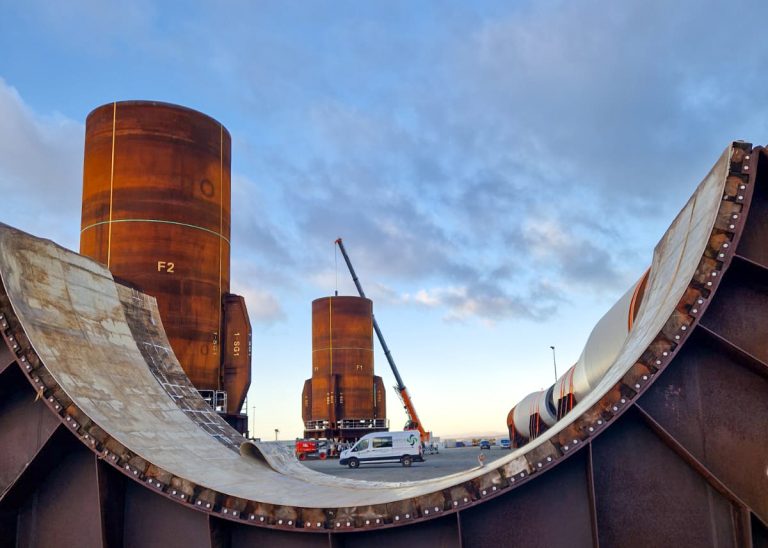
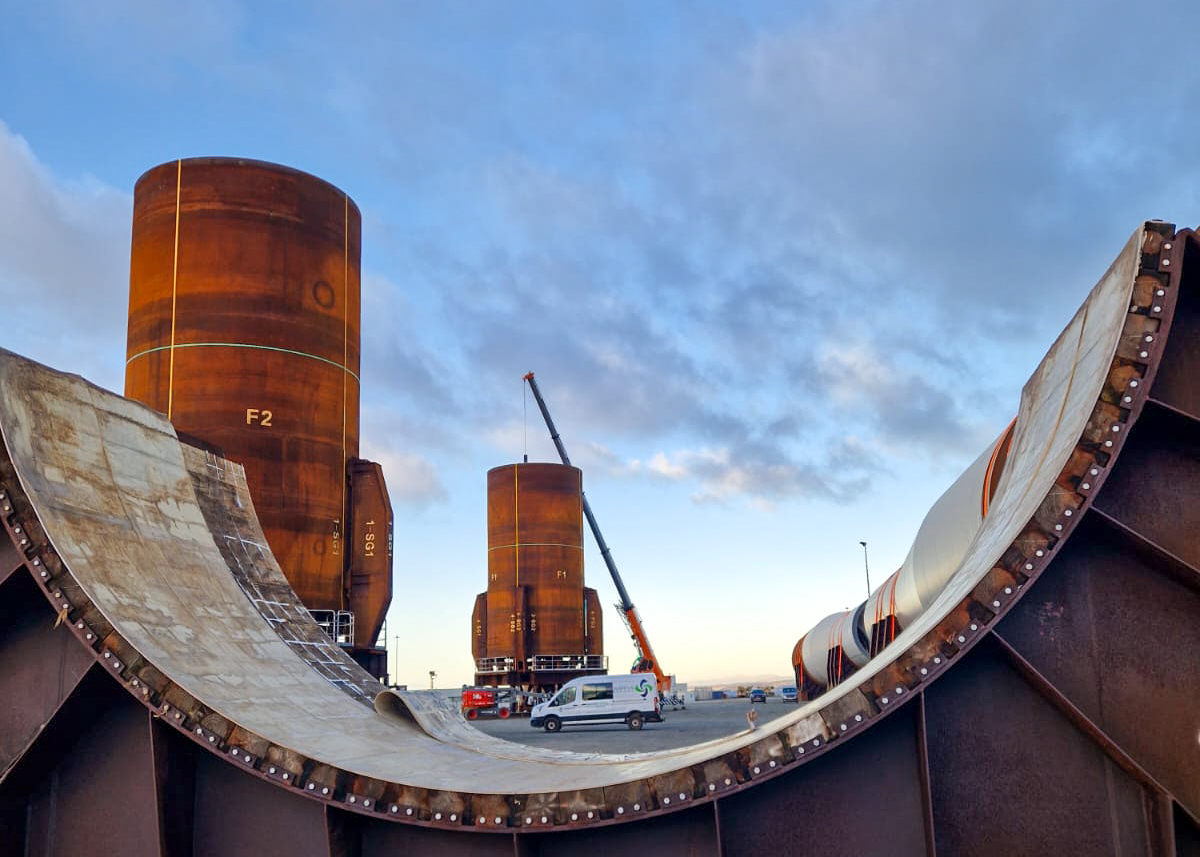
Inch Cape Offshore has awarded Aventus with a contract for the delivery of foundation completion activities on its 1.1-GW offshore wind farm. (Courtesy: Aventus Energy)
The year-long scope of works will see Aventus Energy inspect the Inch Cape wind-farm monopiles, transition pieces, and jacket foundations as they arrive into port before executing critical activities to ensure the components are ready for offshore installation and operational readiness.
The contract also involves project management including planning, documentation, survey, quality, and technical verification.
Aventus’ largest single project has involved the deployment of a combined team of more than 70 personnel, drawing on existing staff from its Highland headquarters while also employing individuals from within the project catchment area for the duration of the works, creating new skilled roles within the company.
“We’re delighted to be delivering this key renewable energy infrastructure project for Inch Cape at the Port of Leith,” said Ross Thomson, Aventus Energy managing director. “Working with group companies Global Port Services and Global Crane Services — and Forth Ports — our multi-disciplinary team is providing the client with a full-service package that will see us carry out surveys upon receipt of the assets, and execution of vital scopes required to ensure their offshore readiness before load out.”
Aventus also has recently delivered its specialist inspection, repair, and maintenance solutions on marine energy projects across Europe, Africa and South America.
Inch Cape Offshore Wind is one of Scotland’s largest offshore wind farms. It is now in construction with full operation due in 2027.
Vaisala, a leader in measurement instruments and intelligence for climate action, will launch Vaisala Care, a service offering that maximizes uptime, measurement quality, and asset lifetime for Vaisala weather systems and sensors. Vaisala Care combines the company’s in-house expertise, remote capabilities, and proactive lifecycle care into two tiers.
When challenges are managed on a one-off basis, recovery often takes more time. Vaisala Care ensures planned support that brings together prioritized access to Vaisala’s global technical support teams, remote services, defined response times, and extended warranty coverage.
Vaisala Care is designed for airports, meteorological institutes, energy companies, road authorities, and infrastructure operators who manage weather observation networks. (Courtesy: Vaisala)
Vaisala Care+ builds on this foundation with proactive lifecycle services including managed calibration programs performed by Vaisala experts, preventative maintenance, and performance enhancements to ensure long-term system reliability, stable performance, and trusted data quality across the network.
“Customers told us they wanted clearer choices and more predictable budgeting,” said Anne Jalkala, executive vice president, Weather, Energy and Environment at Vaisala. “Vaisala Care makes it straightforward to select the right level of support, whether that is responsive expert help when needed, or fully proactive lifecycle management where we handle scheduling and execution.” The program is designed for airports, meteorological institutes, energy companies, road authorities, and infrastructure operators who manage weather observation networks, where uptime and long-term accuracy are critical.
With two tiers, customers can choose the level of support that matches their operational criticality, while Vaisala takes long-term responsibility for keeping systems performing as intended. Both tiers are structured as annual contracts that bring fewer surprises, predictable costs, less effort, and confidence that critical observation infrastructure stays accurate, reliable, and available.
Vaisala manages service delivery through a combination of remote support, service centers, and onsite services provided by Vaisala or authorized partners. Customers select their preferred tier when purchasing new systems or sensors, or at contract renewal for existing installations, protecting the value of their measurement infrastructure throughout its lifecycle.
The framework addresses growing customer preference for planned maintenance approaches over reactive service calls, while providing cost predictability through annual pricing rather than variable charges for individual service events.
“Our technical capabilities and global service organization have evolved to better support our customers worldwide,” said David Rey, vice president, Project, CareTech and Service at Vaisala. “Vaisala Care brings that expertise together in a clear framework aligned with customers’ operational requirements, from essential support to comprehensive lifecycle management.”
Vaisala Care launches first for airport weather observation systems, with rollout planned for weather radars, wind lidars, and road weather systems throughout 2026.
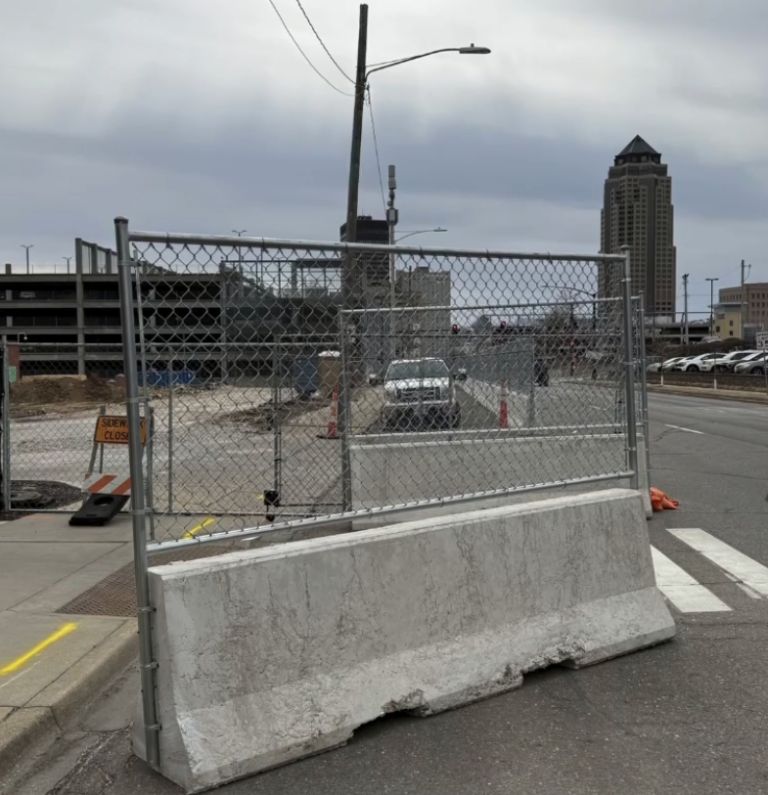
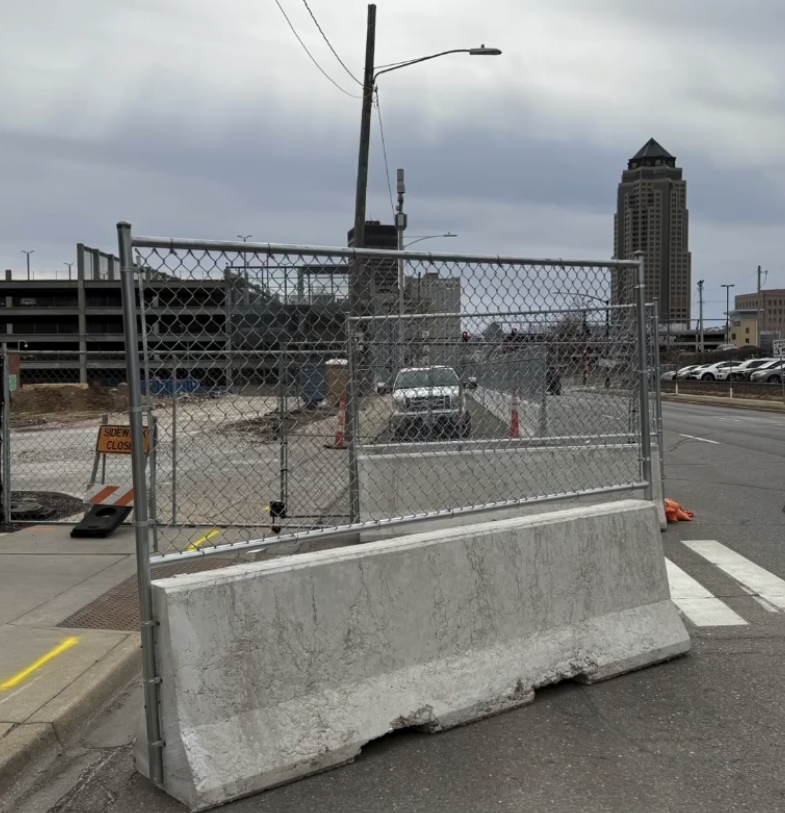
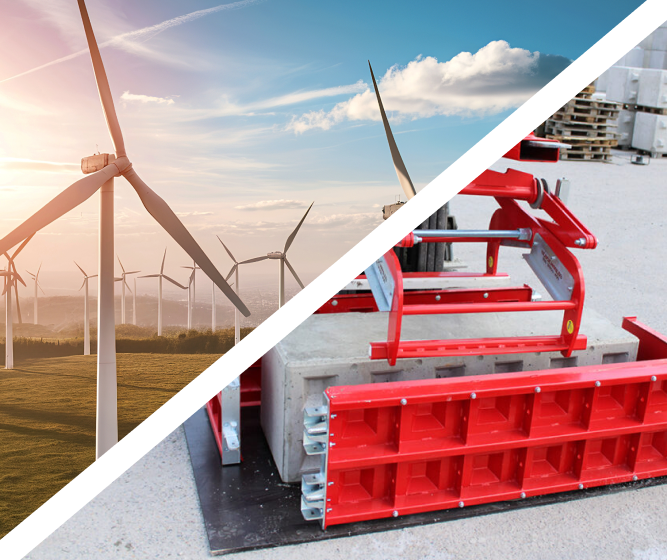
Graham Construction has secured its Des Moines worksite at Mercy College of Health Sciences with Renewablade commercial concrete barriers manufactured using recycled composite material from retired wind turbine blades.
Twenty-eight barriers were installed for the project, and across those 28 barriers, Renewablade incorporated recycled composite equal to one wind-turbine blade into the precast barrier systems.
Renewable barriers are made from recycled wind turbine blades. (Courtesy: Renewablade)
“Projects like this show that jobsite safety and sustainability can go hand-in-hand,” said Mike Berry, field operations leader. “These Renewablade barriers provide a safe working area for teams on site, next to a very active street on Mercy College’s downtown campus, while also helping repurpose a hard-to-recycle wind-turbine blade into durable infrastructure made for everyday use.”
Wind-turbine blades are massive and have historically been difficult to recycle. Renewablade’s commercial barriers and retaining-wall blocks are designed for jobsite performance while also supporting waste diversion by repurposing end-of-life wind turbine blade material that might otherwise be landfilled. The Mercy College installation marks the second major Renewablade project in the downtown Des Moines area. Premier Credit Union completed a retaining wall built with Renewablade hybrid concrete retaining-wall blocks, using material equal to three retired wind-turbine blades.
Together, these projects demonstrate how circular construction can move from concept to concrete, bringing renewable-energy materials back into the community as durable infrastructure.
INSPIRE Environmental, part of Venterra Group, has established a permanent operational base in Aberdeen, strengthening the U.K. and Europe’s access to regulator ready marine environmental evidence. The move positions INSPIRE at the center of Europe’s busiest offshore energy hub and supports rapid mobilization across Scotland, the wider U.K., and Europe. It also represents a long term commitment to local delivery, with plans to build a team of about 30 specialists by 2030.
INSPIRE Environmental has established a permanent operational base in Aberdeen, strengthening the U.K. and Europe’s access to regulator ready marine environmental evidence. (Courtesy: Venterra)
As Venterra’s environmental experts, INSPIRE supports offshore infrastructure across the full lifecycle, from early survey and consenting through to construction and long-term monitoring. Its integrated offering spans benthic and fisheries science, underwater acoustics, nature based design, and advanced data services.
A defining strength is the company’s ability to combine sediment profile imaging/plan viewwith conventional and non-extractive methods to generate proportionate datasets aligned with government expectations and evolving guidance. Although used in the U.S. for decades, SPI/PV is only now gaining wider recognition in the U.K. and Europe as regulators shift toward more fit for purpose benthic evidence. The method provides non extractive, high resolution seafloor data in near real time, enabling faster sampling, adaptive responses to unexpected conditions, and lower overall survey costs. Bringing this technology and expertise to more markets at scale gives developers a new option for accelerating consenting and reducing environmental uncertainty.
INSPIRE’s expansion comes at a pivotal moment for the U.K. market.
Policy is also tightening around underwater noise and marine mammal protection, with JNCC (Joint Nature Conservation Committee) mitigation guidance embedded in the consenting process. INSPIRE’s physics-based acoustic modelling and integrated survey approach help developers design and implement effective mitigation from the outset.
“We’re not just opening an office in Aberdeen, we’re investing in Scotland’s offshore wind future,” said Jeanine Boyle, INSPIRE managing director. “That means new jobs and bringing cutting-edge science that helps developers do more: cost-efficient surveys, stronger evidence for consenting, and clearer communication with the public. By combining advanced imaging, fisheries science, acoustics, and nature-based design, we’re helping projects work with nature from the start, and that’s what will define the next generation of offshore wind.”
Since 2009, INSPIRE has supported more than 27 GW of offshore wind. In the U.S., the company has worked on more than half of all offshore wind projects, delivering some of the most comprehensive monitoring programs in the industry.
The International Marine Contractors Association (IMCA) recently launched IMCA Skills, a digital learning hub, which will now be the go-to place for the marine industry’s competence and development needs. The first product on the new platform is the migration of the Dynamic Positioning CPD learning program, which is designed to be the first step in bringing all Dynamic’s CPD content together in the secure platform, which will offer improved learning and user experience.
It is designed to make professional development simpler, richer, and better value for users and is built to fit around learners’ needs, with improved function, and enhanced access.
The International Marine Contractors Association has launched a digital learning hub, IMCA Skills. (Courtesy: IMCA)
IMCA’s purpose is to bring all its CPD (Continuing Professional Development) and learning content together in one modern platform and ultimately make it easier for users to operate and navigate.
The organization, which for more than 50 years has played a key role in bringing the offshore industry together to improve safety, says the migration to IMCA Skills also will offer its users clearer progress tracking and better access across both online and offline devices.
“The change is entirely motivated by wanting to make our users’ experience as easy as possible; more convenient, flexible, and assisting them in acquiring the skills that are important to their work,” said Richard Purser, IMCA technical adviser-Marine. “We are always on hand to advise them through the process and welcome any feedback on the new platform. Our goal is to make our industry safer and better, and we are certain this will be another big step toward that.”
IMCA includes more than 230 guidance documents and 250 information notes that cover almost every aspect of offshore operations including diving, marine, ROV, and offshore survey.
The program will remain accredited by the Nautical Institute, which supports the revalidation of DPO certificates, ensuring alignment with industry standards and professional requirements.
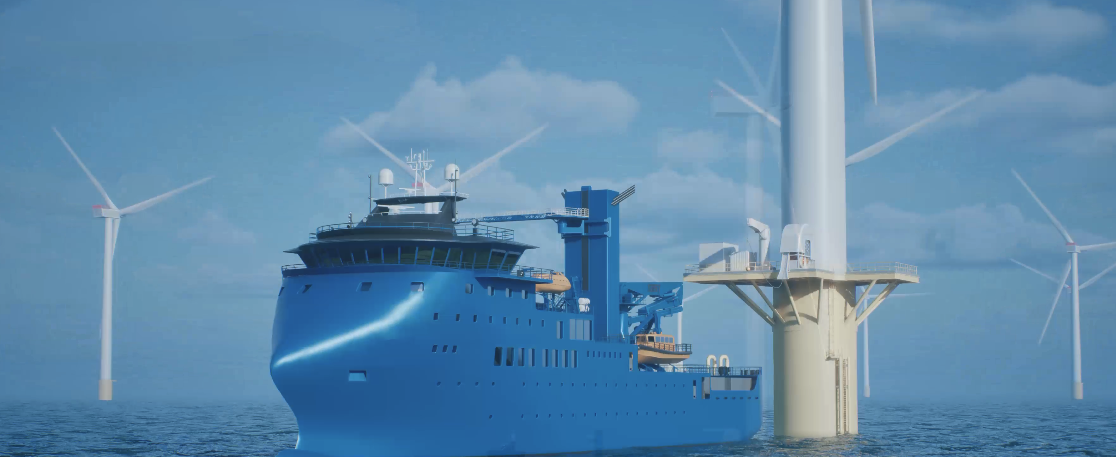
Energy solutions company OEG recently expanded its offshore wind vessel fleet with the delivery of Fulmar, its newest multi-purpose crew transfer vessel (CTV), following successful sea trials.
Fulmar will operate in U.K. waters with its first charter in Scotland supporting the offshore construction of Inch Cape Offshore Wind Farm, which was awarded to OEG earlier last year and supported by the company’s specialists based in Edinburgh.
OEG has expanded its offshore wind fleet with the delivery of its newest multi-purpose crew transfer vessel. (Courtesy: OEG)
Inch Cape is set to play a key role in delivering Scotland’s and the U.K.’s 2030 clean energy ambitions. Located 15 kilometers off the Angus coast in the North Sea, the 1.1 GW development spans a 150-square-kilometer site. When operational, it will comprise 72 wind turbines and an offshore substation, producing enough renewable electricity to power the equivalent of more than half of Scotland’s homes.
Fulmar can accommodate up to 24 personnel for high-speed transfers, with configuration options to allow for extended offshore trips. It boasts exceptional maneuverability and stability. While working at the Inch Cape development, the work boat will provide crew and cargo transfer services for transit to the offshore substation platform (OSP). It will also be used as part of the servicing campaign for the OEG-supplied welfare units installed on the OSP.
An Ambitious Class CTV designed by Chartwell Marine and built by U.K.-based shipyard Diverse Marine, Fulmar is the second work boat developed by the naval architects to join OEG’s fleet following the delivery of Furioso in 2024. Both are tailored to meet the specific requirements of offshore wind projects.
“As Scotland’s offshore wind industry continues to grow, OEG is committed to supporting the sector and the supply chain.” said Leif Cooper, marine service director at OEG. “We are focused on modernizing and streamlining our fleet, introducing newbuilds with lower emissions and higher performance capabilities, and Fulmar is the latest addition in partnership with Chartwell Marine, strengthening our existing capacity. We look forward to Fulmar’s first successful deployment on Inch Cape, one of Scotland’s largest offshore wind farms, and demonstrating our ongoing commitment to delivering safe, efficient, and sustainable support to Scotland’s offshore energy projects.” OEG owns and operates a modern fleet of 15 multi-purpose CTVs operating in the U.K., Europe, and Taiwan, providing support for the construction, operations, and maintenance phases of offshore wind projects.
Palfinger has secured a contract for the Formosa 4 offshore wind farm, marking the 11th project in Taiwan and the ninth wind farm to be equipped with its service platform cranes. With this order, Palfinger is expanding its presence in East Asia and strengthening its role as a reliable partner in the region’s growing offshore wind market.
Formosa 4 is one of the projects that drives forward Taiwan’s renewable energy transition: The wind farm is 18 to 20 kilometers off the coast of Miaoli County and covers 58 square kilometers. With an installed capacity of 495 MW, the project will contribute to strengthening the country’s clean energy supply. As part of the contract for Synera Renewables Taiwan (SRE), Palfinger will supply 35 units of PF 200 fully electric offshore cranes, each with a 7-meter outreach. They will be installed on jacket foundations equipped with 14 MW Siemens Energy turbines.
Palfinger has secured its 11th project in Taiwan. (Courtesy: Palfinger)
“A modular design, high corrosion resistance, and easy maintenance provide turnkey value for SRE by minimizing vessel time, reducing operational risk and accelerating project schedules,” said Alexander Lee, regional sales director APAC at Palfinger.
Deliveries will be between the second and third quarters of 2026, with installation and commissioning scheduled in Taiwan within the same year. Once delivered, this will bring the installed base in Taiwan to 271 offshore wind cranes.
“The constantly increasing footprint of our reliable fully electric lifting solutions for offshore wind is a great sign of the trust of our customers in our lifting solutions and their qualities. Our global experience and cooperative approach as a reliable equipment and service partner brings benefits to the local Taiwanese market,’” said Javor M. Markov, Global Key Account & Segment Manager Offshore Wind at Palfinger.
Steelwind Nordenham steel fabricators recently turned to Sherwin-Williams when working on He Dreiht, Germany’s largest wind farm and a showcase for modern, sustainable infrastructure.
Offshore wind is playing a vital role in delivering clean, reliable power at scale. And with the foundations of these mammoth structures being exposed to some of the harshest environments imaginable, protecting them from corrosion is tantamount to protecting energy security.
Steelwind Nordenham steel fabricators turned to Sherwin-Williams when working on He Dreiht, Germany’s largest wind farm. (Courtesy: Sherwin-Williams)
Given positive experiences on previous projects in collaboration with EnBW, The EnBW offshore wind farm He Dreiht comprises 64 turbines with a total capacity of 960 MW, and is one of the first wind farms in Germany to be built without government subsidies.
Covering an area of about 90 kilometers near the island of Borkum in the North Sea, He Dreiht is one of Europe’s largest energy-transition projects. By spring 2026, it will be able to supply 1.1 million households with renewable energy. It plays an integral part in the country’s future energy plans, making its protection from the elements a crucial consideration.
“Offshore wind monopiles are exposed to aggressive environmental conditions every day,” said Matthias Winkler at Sherwin-Williams. “Rising from the seabed, these steel structures encounter saltwater immersion, strong currents, wave impacts, and fluctuating splash zones, all of which leaves them highly vulnerable to corrosion. The monopiles are the backbone of the entire wind farm. If they fail, the turbines fail.” Protecting monopiles from corrosion is not just a technical necessity. It is a matter of safety, sustainability, and energy reliability.
Corrosion protection coatings act as a barrier between the metal and its environment, preventing corrosive elements such as water, oxygen, and salts from reaching the surface. Sherwin-Williams’ Dura-Plate SW-501 Series is a 100 percent solvent-free and benzyl alcohol-free high-build epoxy coating that forms a dense, impermeable layer over the steel surface. With outstanding structural integrity, these coatings offer long-term protection for turbine investment while delivering safety and reliability well beyond their expected service life.
Due to their extensive experience working with Sherwin-Williams on a range of projects, Steelwind Nordenham and EnBW were well aware of the coating system that best met their needs. “For Steelwind Nordenham, reliability and quality are non-negotiable,” said Dr. Andreas Liessem of Steelwind Nordenham. “Our reputation depends on delivering foundations that will stand the test of time. By choosing the Sherwin-Williams Dura-Plate SW-501 coating system, we’re not only ensuring 25 to 30 years of corrosion resistance in one of the toughest marine environments, but also helping safeguard Germany’s energy security and the end user’s investment.” Application of the 100 percent solvent-free coating system took place at Steelwind Nordenham’s advanced fabrication facility in northern Germany, where the massive steel monopiles, each measuring up to 71 meters in length and weighing about 1,350 tons, were produced.
Close collaboration between all three partner companies ensured the system met all regulatory and client requirements. As part of the He Dreiht offshore wind project, Steelwind Nordenham again relied on the proven protective coating Dura-Plate SW-501 this time on a foundation of exceptional size.
Dura-Plate SW-501 exceeded expectations in two key areas: handling during application and superior surface finish after curing. This confirmed the coating as a reliable solution for demanding offshore structures and highlighted its role in a long-term corrosion protection strategy.
CLEANPOWER 2026 will be in Houston, Texas, June 1-4. Wind Systems recently talked with Andrias White Murdaugh, ACP’s vice president of Conferences and Events, about new programs and what attendees can expect from this year’s show.
How will this year’s show differ from what attendees experienced last year in Phoenix?
Each year, CLEANPOWER evolves alongside the industry. In 2026, we’re building on last year’s momentum with expanded programming, more opportunities for connection with peers, and deeper engagement across the show floor.
We’re excited to launch expanded networking programming for women, veterans, emerging leaders, and CLEANPOWER in Color. Each day of the conference, attendees can join an EmpowHER, a PowerVets veteran, Emerging Leaders, or CLEANPOWER in Color activity. Through these programs, we’re hoping to help facilitate deeper, lasting relationships across the industry to help people — and businesses — grow.
If you aren’t already familiar with it, CLEANPOWER in Color is our co-located event for mid-level professionals of color in the industry to gain tailored tools, actionable strategies, and meaningful insights. That program takes place Monday and Tuesday during CLEANPOWER, and after, attendees can spend Wednesday and Thursday fully engaged with CLEANPOWER programming.
On the education front, expect an even stronger focus on the business of clean energy —how projects get built, financed, and scaled, and how our industry can continue to answer the call for more energy (and stable prices for consumers) as AI and data centers increase energy demand across the globe. We’re creating another dynamic, action-oriented experience that reflects where the industry is today and provides attendees with valuable takeaways and connections that improve their business outcomes immediately. Not to mention, the exhibit hall is back on one floor again this year.
If I were a first-time exhibitor, what should I expect from this year’s show?
We like to think of CLEANPOWER as the Goldilocks of energy shows. With an audience of about 9,000 and more than 500 exhibitors, the show floor is always bustling with decision-makers and leaders from every corner of the utility-scale solar, storage, wind, and transmission sectors. However, the show is small enough, with a high-level attendee base, that it’s easy for attendees to meet the right people.
The exhibit hall is designed to facilitate real conversations and business development, not just foot traffic. Exhibitors should expect strong visibility, opportunities to connect with both new and existing partners, and an environment where deals and partnerships are actively coming together. We frequently get feedback that exhibitors make a week’s worth of progress on deals over just three days at CLEANPOWER.
What issues should I expect presenters to address?
This year’s program focuses on the most pressing challenges shaping the industry, with an emphasis on market dynamics and real-world implementation.
The full list of session topics covers national-level insights like the clean-power market outlook, large loads and data centers, AI-driven deployment, and building clean energy in an era of federal policy uncertainty. Sessions will also address policy, finance, and markets, including tariff strategies, project financing, regulatory disparities, and state policy trends.
Across the show floor stages, attendees can also expect practical insights on siting and permitting, transmission development, energy storage, and community engagement, alongside emerging topics like cybersecurity, workforce retention, and agricultural economics.
What kind of networking opportunities will be available for attendees?
We know networking is the No. 1 reason people keep coming back to CLEANPOWER, so we’re continuing everything you know and love and adding new, more targeted opportunities to build connections. Attendees will have access to evening exhibit hall happy hours, the Welcome Reception and networking breakfasts, plus the annual Power Up 5K Run, the EmpowHER Luncheon and daily EmpowHER events, CLEANPOWER in Color sessions and activities each day, the PowerVets veterans meetup and daily activities, and a full Emerging Leaders program for young professionals — it’s a big list. We’re also launching a brand-new awards program for EmpowHER, CLEANPOWER in Color, PowerVets Veterans, and Emerging Leaders. Nominations for excellent colleagues in those groups are open through the month of April, please submit them.
This year’s CLEANPOWER is returning to Houston. What about this venue made it a positive to come back to?
Houston is one of the most important energy hubs in the world, making it a natural home for CLEANPOWER. The city brings together a deep concentration of energy expertise, infrastructure, and investment that reflects the scale and momentum of the clean-energy industry.
Clean energy is an essential part of the American energy mix now and into the future. Gathering for our largest conference in one of the biggest energy hubs in the world just makes sense.
From a practical standpoint, Houston also offers a highly accessible location and a venue that allows us to continue expanding the event experience. After a great conference there in 2019, it made sense to return to a region where the industry is actively growing and evolving. Plus, many of our members and conference attendees have large offices in the Houston area, so we’re excited to make travel easy for those groups and allow for a variety of potential offsite tours and meetings.
What are you personally looking forward to at this year’s CLEANPOWER?
This will be my first CLEANPOWER as an official member of the ACP team, so I’m excited to share that experience with other first timers and engage with our many stakeholders.
Beyond that, what makes CLEANPOWER unique is the energy and momentum that comes from bringing the entire industry together. I’m especially looking forward to seeing the connections that happen across sectors, where we see conversations turn into partnerships, projects, and real progress. It’s truly magic what happens when we’re all together.
With the continued growth of the event and the expansion of programs such as EmpowHER, PowerVets, CLEANPOWER in Color, and Emerging Leaders, this year will be an exciting opportunity to see how the industry is evolving — not just in scale, but in collaboration, community, and leadership.
The converter and control systems contained within every wind turbine are essentially the brain and the heart of the asset, converting variable-frequency electricity into grid-compatible power, all while maintaining the speed, blade pitch, and yaw to capture the maximum amount of energy while ensuring the safety of the turbine.
It’s a complicated bit of engineering, one that KK Group has been performing for the wind industry for decades.
“We deliver the converter and the controls to the big wind turbine OEMs,” said Kim Wichmann-Hansen, president of KK Group’s U.S. division. “We deliver to Siemens Gamesa, to Vestas, and to GE. In addition to the converter and the controls, we also deliver cooling solutions, as well as both structural condition monitoring and drive train condition monitoring, and the service business around that.”
Growing the Base
With a U.S. presence, Wichmann-Hansen emphasized that, from a U.S. perspective, the diversification in the U.S. for KK Group is hinged around growing the asset operator base.
“In the U.S., there are around 80,000 turbines,” he said. “We are probably in half of those turbines, if not more. We are delivering structural vibration monitoring to all GE turbines. We do the same for Siemens Gamesa and for Nordex turbines, as well as for Vestas. We are delivering all converter and control systems to the entire fleet, so you can see how we get into many individual turbines. That’s the business we run in the U.S., where we help both the OEMs, but also the asset operators, maintain those fleet of turbines with service offerings, condition monitoring offerings, and various retrofits. We also in turn now are in the UPS business, with battery driven back up power solutions that keep essential safety and communications systems online in the case of grid outages.”
KK Group is able to make older turbines grid compliant to modern grid requirements. (Courtesy: KK Group)
Even with the additional diversification of KK Group’s portfolio, the converter and control systems the company offers the sector are still the largest piece of its business, according to Wichmann-Hansen.
“The converter as a unit is the single biggest piece that we deliver,” he said. “What is relevant is, if you want to grow with the industry, you have to decide if you scale with units or whether you scale with megawatts. The industry has developed in a way where turbines get bigger and bigger, so for the same megawatts, you actually produce fewer units. An industry that scales only with units can be a little bit stagnant. One of the benefits of the converter is that it scales with megawatts.”
This means that, even though there may be fewer converters, the converter is still a big component in the turbines, according to Wichmann-Hansen.
“That’s one of the things we focus on, as well as taking over the complexity from our customers,” he said. “The converters and control systems in a modern turbine are much more integrated. It’s not only the reliability of the turbine and how cheap it is, it’s also how it can perform on the grid. One of the things we are excelling with in the U.S. is with older turbines. The converter determines how the grid sees the turbine. We are able to make older turbines grid compliant to modern grid requirements. That keeps your old fleet alive, because wind becomes more and more dominant on the grid.”
Repowering Older Converters
If an older turbine does not support the grid, it becomes an “Achilles’ Heel” for the industry, according to Wichmann-Hansen.
“We are able to repower older converters to make them grid code compliant and generally compliant to today’s industry,” he said. “We take old technology and improve it with today’s knowledge.”
KK Group definitely backs up its expertise with solid numbers. The company is a $1.2 billion global company with production facilities all over the world, including the U.S., according to Wichmann-Hansen.
“In the U.S., we have two locations — one in Houston, which is our headquarters, and in Kansas, where we have our warehouse and order management facilities,” he said. “We have sales areas also dotted around the country. Our monitoring and service business is the fastest growing part of our company, especially here in the U.S.”
Taking Care of Complexity
Through its history, KK Group has had to tackle the element of complexity as it delivers quality products and services to its customers, according to Wichmann-Hansen.
“It’s finding out that, as turbines became more and more competitive with the cost of energy, we had to also look at efficiency,” he said. “To avoid just competing on cost and price, we also compete on efficiency. That’s one of the reasons why we integrated cooling into our company, because cooling makes our electronics more efficient. If you look at the industry probably five or 10 years ago, there were many individual suppliers to the industry. To some extent in the U.S., there’s still a very fragmented supply chain landscape. One of the things KK does with its ownership from A.P. Moller Holding, parent company of among others, Maersk, is to take a longer perspective while trying to consolidate in the industry. Not consolidating from a perspective of just wanting to accumulate everything, but from a perspective of being more robust and being able to meet your customers in hindsight, so to speak.”
KK Group’s mission is to continue to innovate its converter and control systems in order to keep an aging wind fleet efficient and productive. (Courtesy: KK Group)
To that end, Wichmann-Hansen said he is acutely aware that KK Group is an important part of the wind industry.
“We want the wind industry to continue to grow, and as the industry grows and customers grow and turbines grow, that means complexity grows,” he said. “One of the key cornerstones in our approach is what we offer back to the customer is that we remove the complexity. We take that complexity over. That can be taking over supply chains. It can be taking over products that have interfaces that the customer does not need to deal with. We take that over and offer back more system solutions. We offer integrated service solutions, because what is produced in the wind industry must be able to operate in the field for the next 25 to 30 years.”
Staying Solvent
That crucial growth while dealing with the complexity of the industry helps ensure KK Group doesn’t have many individual small suppliers that have gone out of business with every down-cycle, according to Wichmann-Hansen.
“Wind, like any other industry, has up cycles and down cycles, so by making us so robust that we can keep serving an industry even in a down cycle period is one way we have grown within the industry, taking responsibility and diversifying the business,” he said. “We not only serve the wind OEMs with the team, but we also serve the asset operators and other industries. Within our cooling area, we also serve industrial customers. We don’t just focus on the OEMs. Our goal in the wind industry is to make our company more resilient and more robust, so we can actually serve them as the best supplier in the industry.”
To help achieve those goals, KK Group creates a unique relationship with its customers when the company is approached with a challenge, according to Wichmann-Hansen.
The converter as a unit is the single biggest piece that KK Group delivers. (Courtesy: KK Group)
“If it’s an OEM that wishes to have us build their technology, then there are ways the customer can approach us,” he said. “For example, they may already have a technology solution that they want us to build for them; it’s called built-to-print. They basically tell you, ‘Here’s the drawings; here’s the design. Could you please set up a supply chain, a production location, and an engineering source so we can produce that?’ Then we would engage with them and use our knowledge to move that from build-to-print, to build-to-spec, and introduce our own intellectual property gradually.
A part of the consolidation in the industry is that we can also offer better products for customers when they are being consolidated into KK Group. We very much look to serve the customer with value added offerings, not just the cheapest possible production. In the industry, we have to have a tight grip of cost, but we do that through value adding and a curve where you move it from build-to-print and build-to-spec into our own designs, so that we can potentially grow volume into it. Then we package it with a service offering — if the customer wants that.”
A Single Turbine Start
KK Group currently supports a large global swath of the wind-energy business, so it’s humbling and a little surprising to know the company began with a single turbine, according to Wichmann-Hansen. In 1978, a small, local carpenter owned a farm where he was tired of paying too much for the electricity he was using, so he constructed his own turbine. That one turbine eventually produced so much energy that it had to be connected to the grid. From this, KK Electronics was born, which would later become KK Group.
“When Siemens acquired Bonus Energy and became Siemens Wind Power, that’s when we really changed into being a wind-focused company,” he said. “One of the things that is a little bit special about our company is we have been brought up in an industry where there’s only a few customers, when you deliver to the OEMs. That makes you very focused on your customer. If you lose the customer, you cannot just replace them.”
In addition to converter and controls, KK Group also delivers cooling solutions. (Courtesy: KK Group)
An Eye on the Future
With a laser focus on wind energy and its future, Wichmann-Hansen said KK Group will continue to service wind and its importance to a global energy future.
“As wind continues to grow — whether it’s in the U.S. or outside the U.S. — it is still the fastest growing and cheapest source of energy,” he said. “That propels other related industries, like battery energy storage, because it’s not all 100 percent positive around wind, in the sense that wind is intermittent. You can only produce energy when the wind blows, and, therefore, you need to wrap some industries around wind to make it really robust.”
But with that diversification, KK Group will also keep innovating its converter and control systems in order to keep an aging wind fleet efficient and productive, according to Wichmann-Hansen.
“If we take the U.S. as an example — like I said earlier, it’s the largest installed base outside China with 80,000 turbines, and KK Group is in half of them,” he said. “For some of them, the age of that fleet is tripling. Turbines older than 15 years are now growing three times in numbers over the next couple of years, and that installed base is quite big in the U.S., and we keep adding to that install base. We keep adding to it, and that keeps it living longer and longer now. The average life of a turbine is maybe around 40 years in the latest industrial analysis. Being able to repower these turbines has quite an important element to it. That will definitely be part of KK Group’s next 10 years and beyond.”
Wind turbine technicians literally provide the foundation of the industry, playing a critical role in the global transition to renewable energy. As the wind sector expands, so does the need for skilled talent to install, maintain, and operate wind turbines safely and reliably.
The Role of the Wind Technician in 2026
Wind-turbine technicians (commonly called wind technicians, or wind-service technicians) are responsible for the installation, inspection, maintenance, and repair of wind turbines and related infrastructure. Working as a wind tech typically requires comfort at heights, mechanical and electrical aptitude, and strict adherence to safety procedures. Common duties include:
Climbing turbine towers for inspection and servicing.
Troubleshooting electrical, hydraulic, and mechanical systems.
Performing routine and predictive maintenance.
Reporting and documenting repair and performance data (see The Department of Energy’s Energy.gov).
Entry into the field typically requires a high school diploma or equivalent, plus specialized post-secondary training. Technical schools and community colleges increasingly offer wind energy or renewable energy technician programs — often coupled with hands-on experience. (The Department of Energy’s Energy.gov)
Working as a wind tech typically requires comfort at heights, mechanical and electrical aptitude, and strict adherence to safety procedures. (Courtesy: Shutterstock)
Tech Employment: U.S. and Global Demand
In the United States, wind-turbine technician jobs are among the fastest-growing occupations:
Employment growth for wind-turbine service technicians is projected to increaseapproximately 50 percent from 2024 to 2034 — much faster than average — adding roughly 6,800 new jobs by 2034. (Bureau of Labor Statistics)
The occupation is expected to have about 2,300 openings per year on average over that decade, largely driven by new turbine installations and the replacement of existing personnel. (Bureau of Labor Statistics)
These projections underline the sustained demand for technicians, particularly as older turbines age and require more maintenance work.
Wind-energy growth is stronger in most countries than that seen in the U.S. A number of factors are driving strong demand worldwide.
According to the Global Wind Workforce Outlook 2025-2030, the industry will need approximately 628,000 wind technicians by 2030 to support both onshore and offshore wind fleet deployment and operations. (Global Wind Organisation)
Earlier forecasts estimated that about 569,000 technicians will be required by 2026 to build and maintain the global wind fleet. (Windfair) This global demand highlights opportunities beyond the U.S., concentrated in major markets such as China, the United States, India, Brazil, Japan, Vietnam, and South Korea. (Global Wind Organisation)
For an overview of wind technician training programs in the U.S., visit BuildTurbines.com.
Wind Tech Compensation and Career Path
According to the Bureau of Labor Statistics, in May 2024, the median annual wage for wind-turbine technicians in the U.S. was about $62,580 in May 2024 (approximately $30.09/hr).
As with most skilled professions, pay varies by employer and region; experienced technicians and those with advanced certifications can earn much more. Employers may also offer benefits such as health insurance, 401(k) matching, and signing bonuses.
Internationally, salaries vary significantly by country, local labor markets, and employer — especially between developed and emerging wind markets.
Because the wind industry is growing quickly, available career advancement and growth opportunities are better than in many other fields. A typical career path might include:
Entry-level wind technician: Perform basic maintenance and inspections.
Senior technician/lead technician: Higher responsibility for complex troubleshooting and mentorship.
Operations & Maintenance (O&M) supervisor or manager: Oversee teams and maintenance strategies.
Specialty roles: Instrumentation, electrical systems, offshore wind technician, and technical training instructor.
Certifications like those from the Global Wind Organisation (GWO) are increasingly standard and help technicians demonstrate safety and technical competence.
And, many wind technicians find other opportunities, growing into sales or consulting roles, and others with entrepreneurial interests establish businesses of their own in the industry, often as a response to what they learn in a few years in the field.
Wind turbine technician roles require a blend of technical training and physical skills. (Courtesy: Shutterstock)
Skills and Training Requirements for Wind Techs
Wind turbine technician roles require a blend of technical training and physical skills:
Physical and safety skills: Comfort working at heights, use of fall protection equipment, confined-space procedures.
Certifications: GWO Basic Safety Training (BST), rescue and fall-protection standards, and employer-specific or manufacturer-specific credentials are common.
On-the-job training typically supplements formal education and is a key part of career development. Partnerships between training schools and employers enhance placement opportunities. (The Department of Energy’s Energy.gov)
For those looking for their first job as a wind technician, it’s important to note that on-the-job training should never replace formal job training.
Key Industry Trends Affecting Techs
Expansion of Offshore Wind: Offshore wind projects are expanding in Europe, the U.S., and Asia, creating specialized technician roles with higher travel and safety requirements. These roles often pay premiums due to the increased risk and logistical complexity.
Advanced maintenance technologies: Technicians with skills in digital tools and SCADA analytics are increasingly valuable. Predictive maintenance technologies, including data analytics, drones, and machine-learning-based condition monitoring, are reshaping the work scope and roles available to wind technicians. Service teams increasingly use sensors and analytics to predict failures and schedule maintenance more efficiently, which enhances uptime and reduces reactive repairs (arXiv) – and ultimately reduces serious safety risks.
Workforce development challenges: While demand is high, the industry faces training bottlenecks — particularly in the U.S. A skills gap exists between the number of trained technicians and the workforce needed to meet forecast installation and O&M demand, particularly in emerging wind markets. Investments in standardized training and apprenticeship programs are helping close these gaps. (Global Wind Organisation)
Hiring Practices and Opportunities
Entry-Level Positions: Many wind companies regularly hire entry-level technicians, especially those with GWO or equivalent certifications and technical training. Opportunities include onshore installation and maintenance work with employers such as Vestas, Siemens Gamesa, GE Vernova, NextEra Energy, and Ørsted. (Jobs are listed in industry job boards and sites like Indeed)
Some roles in the U.S. wind industry explicitly list zero-to-minimal prior wind experience as acceptable, emphasizing a willingness to train motivated candidates. (NextEra Energy Resources)
Because there are inherent safety risks in any job that requires working at heights, those new to the industry need to remember that on-the-job training should never replace formal training.
Regional Hiring Overview, 2025-2026
U.S.: Strong demand exists in wind-rich areas such as Texas, Iowa, and the Midwest.
Europe and U.K.: Offshore wind growth supports technician demand, especially in the North Sea and offshore clusters.
Asia: China and India continue to expand both onshore and offshore wind capacity, creating wide regional demand.
Online job boards show hundreds of local wind technician openings in regions such as Ohio, where employers routinely seek technicians for both onshore and travel roles. (Indeed)
Challenges and Considerations for Wind Technicians and Managers
Market shifts, including political maneuvering, as well as seasonal and weather impacts, are constantly affecting the industry.
While long-term demand is strong, some major developers have recently announced workforce restructuring, particularly as project pipelines shift and financial pressures mount in offshore sectors. For example, Ørsted — one of the world’s largest offshore wind developers — plans workforce reductions amid strategic refocusing. (Reuters) Some of the biggest impacts to the company’s business came about in 2025, almost entirely due to U.S. tariffs and energy policy changes.
To remain competitive, wind-operations managers need to plan for talent retention and strategic training investments and creating clear growth plans for employees.
While wind hiring can be seasonal — many sites see hiring slowdowns in winter months and resume when field conditions improve — larger companies maintain a full workforce year-round, sometimes shifting workers to other countries to maximize their workforce productivity.
Recognizing the Increasing Value of Wind Turbine Technicians
Technicians are essential to delivering reliable, high-uptime renewable energy. As installations grow and technologies evolve, technician demand is projected to remain robust through 2030 and beyond.
For entry-level candidates, strong technical training and safety certifications unlock opportunities across onshore and offshore wind. For wind managers, strategic workforce development and adoption of advanced maintenance tools are key to scaling operations effectively.
While continued technological advances have changed the role of wind technicians over the years, it is extremely unlikely that any technology will replace the people who truly keep the turbines turning. For the foreseeable future, wind-turbine technicians remain a foundation of the global wind industry’s growth, and career prospects are expected to remain strong.
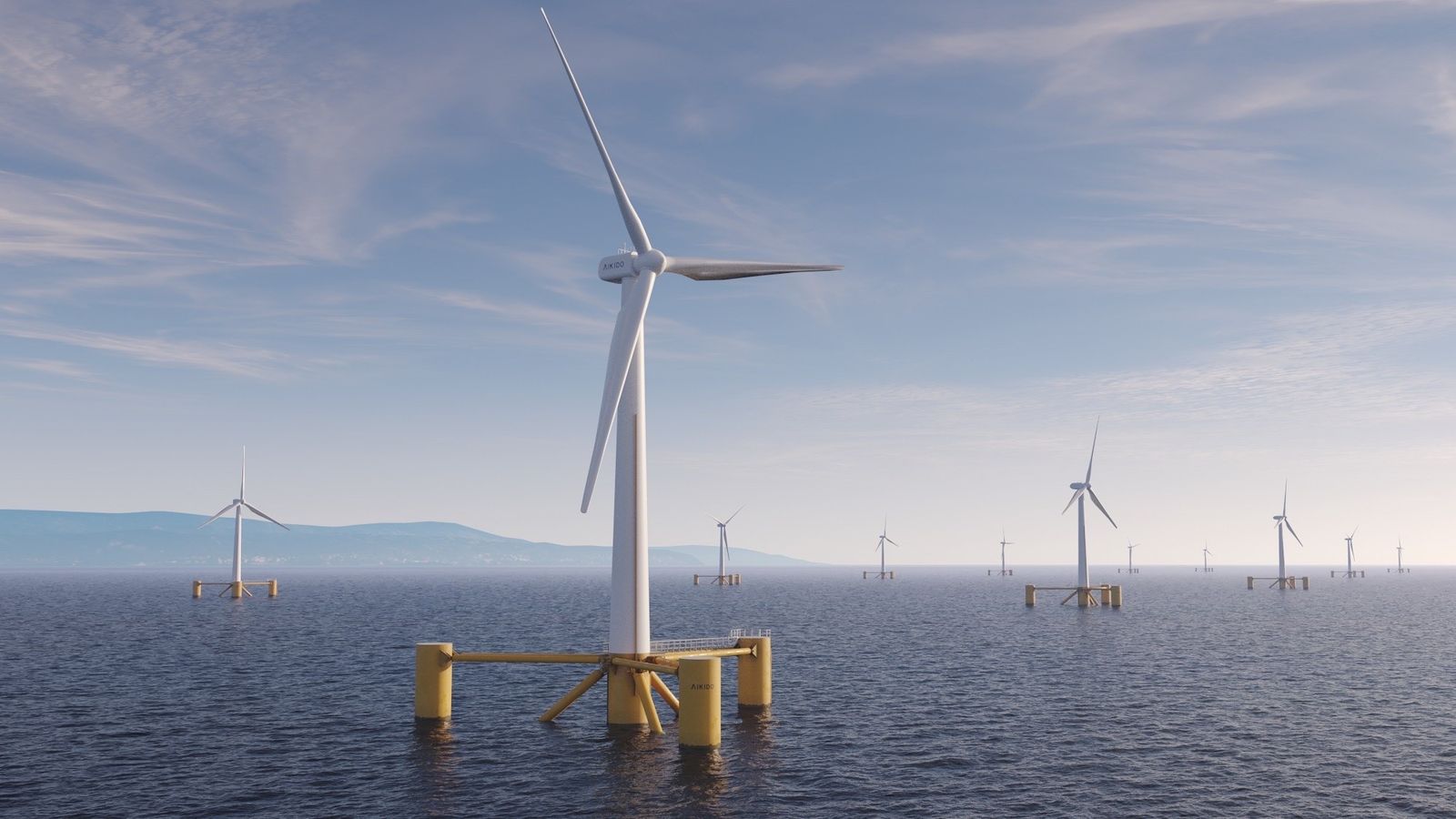
Offshore infrastructure provider Aikido Technologies recently unveiled AO60DC, a floating offshore wind platform designed to co-locate AI-grade computers with floating wind generation and integrated battery storage.
Designed for farms consisting of 30 MW to more than 1GW of IT load, the technology offers a pathway to sovereign, gigawatt-scale AI infrastructure built directly at the source of renewable energy, solving rapid growth in demand for high-density AI infrastructure.
Aikido Technologies unveiled a floating offshore wind platform designed to co-locate AI-grade compute with wind generation and battery storage. (Courtesy: Aikido Technologies)
“Before we go off-world, we should go offshore,” said Sam Kanner, CEO of Aikido Technologies. “First movers in the O&G industry exploited deep-water resources over 40 years ago and reaped massive benefits. Aikido is well positioned to integrate proven, offshore components with typical data hall construction techniques to build GW-scale AI factories faster, cleaner, cheaper and more efficiently than conventional techniques.”
Developers find it increasingly difficult to obtain energy, land, and water to build such mega-campuses, especially close to load centers. Offshore, however, energy, cooling, and space are abundant, and the ocean acts as an infinite heat sink. Around the world, areas pre-designated for floating wind deployments can instead be immediately used for data centers.
The onboard wind turbine and BESS are designed to power the compute load for the majority of operating hours, with a grid connection used primarily during summer months. Batteries can also be charged ahead of grid stress events, which can shorten effective grid connection timelines for new capacity. The units can be deployed within 200 miles (<10ms RTT) of major compute load centers in sovereign waters, allowing many energy-constrained countries to deploy AI infrastructure.
By combining Aikido’s proprietary wind-turbine substructure and the data center enclosure into a single steel unit, the design will reduce both capital and operating costs while simplifying integration. The data halls can be pre-fabricated in a factory and lifted into place during the final integration.
At the core of the concept is Aikido’s modular “flat-pack” semi-submersible floating platform, which can be assembled up to 10 times faster than conventional offshore structures. The approach is intended to support accelerated deployment timelines for AI and energy infrastructure. Semi-submersible offshore platforms are the most universal and proven offshore platform type, with O&G and floating wind operators deploying such platforms for 25-plus years. The units can be installed and serviced using vessels already active in offshore wind and deep-water O&G industries, enabling maintenance response times comparable to conventional data centers.
The platforms can be manned for days at a time to ensure individual servers have uptime that meet the typical standards in the datacenter industry. The integrated data halls are also engineered to provide the highest level of physical security.
A proof-of-concept unit is under development in Norway and is scheduled for deployment later this year. Aikido is a member of the NVIDIA Inception program, and the company has received early interest from AI inference customers.
The first commercial project is targeted for the U.K., with a planned operational date of 2028.
Neocycling US is a recycler of wind-turbine blades recently registered in Texas. The new company’s proprietary technology recycles used wind-turbine blades into profitable building and highway products and materials.
Neocycling’s mission is to be pioneers in sustainable engineering, recycling decommissioned wind-turbine blades previously considered impossible to repurpose. (Courtesy: Neocycling US)
Neocycling’s mission is to be pioneers in sustainable engineering, recycling decommissioned wind-turbine blades previously considered impossible to repurpose. The company’s proprietary science-based technology transforms complex composite materials into valuable resources for concrete products, providing environmentally responsible solutions to growing waste management challenges.
The new tech is based on patents developed in Germany. Texas, a state that mandates purchasing 50 percent recycled materials by 2030,has expressed interest in potentially buying highway and building products from Neocycling’s new technology (pavers, jersey highway barriers, asphalt substitute, highway aggregate).
The Offshore Achievement Awards (OAAs) recently recognized Stillstrom by Maersk at its achievement Awards event in Aberdeen, winning the Emerging Technology category for its pioneering offshore charging solutions.
The annual event, organized by the Society of Petroleum Engineers (SPE) and hosted at P&J Live, celebrates achievements in the energy industry. It rewards innovative technologies, company growth, and contributions of individuals in the industry.
The Offshore Achievement Awards awarded Stillstrom an emerging technology award. (Courtesy: Stillstrom)
The Emerging Technology category, which was sponsored by Evolve iMS, acknowledges early-stage products or services that have the potential for significant future value to the industry.
After being shortlisted earlier in the year, a panel of more than 30 industry experts selected Stillstrom as the winner for its breakthrough offshore charging technology that reduces greenhouse gas (GHG) emissions from idling and standby vessels.
“Our goal has always been straightforward: reduce GHG emissions from vessels by providing reliable, cost-efficient charging offshore, where it actually makes a difference,” said Kristian Borum Jørgensen, Stillstrom CEO. “This award confirms that the industry is ready to embrace solutions that deliver both climate impact and commercial value. Thank you to our partners and the offshore wind community for believing in this mission and helping push the industry toward a decarbonized future.”
Stillstrom, founded in 2019, is committed to reducing the maritime sector’s reliance on fossil fuels. Its suite of offshore charging solutions is designed to support the decarbonization of offshore vessel operations, lowering the environmental impact for offshore wind farms. The OAAs is the U.K.’s largest and longest-standing energy industry awards, recognizing collaboration in the North Sea.