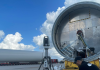
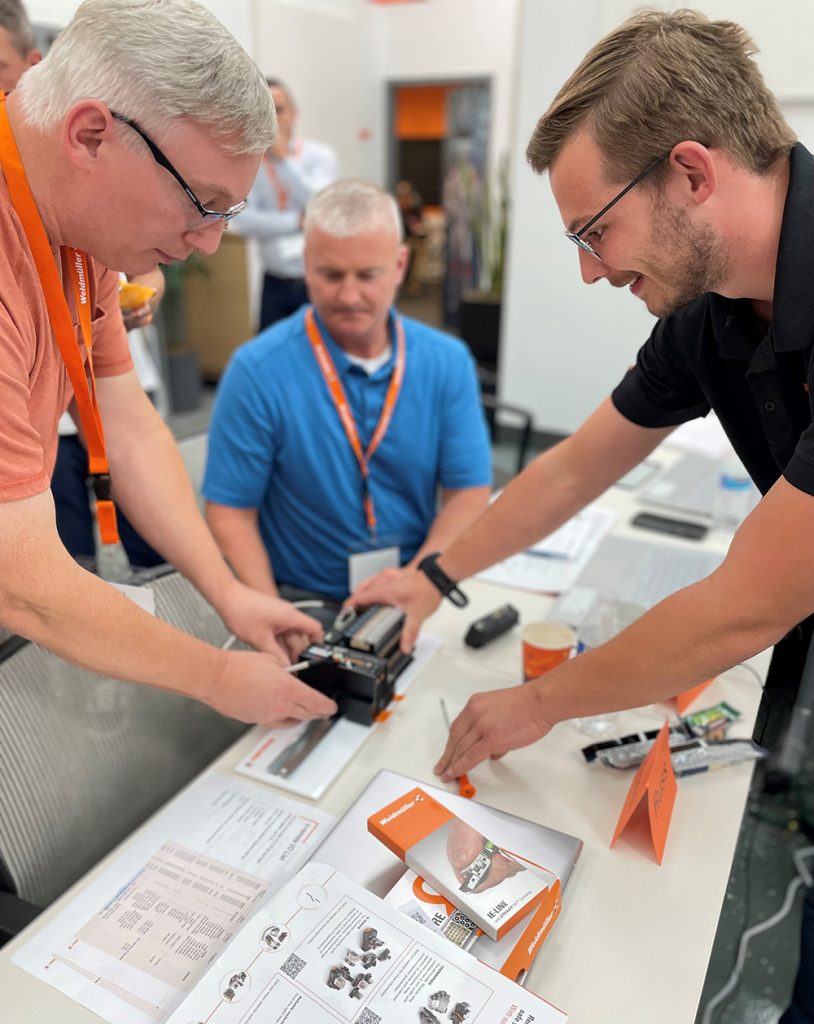
Lars Hohmeier (right), a Cabinet Products manager at Weidmuller USA, provides hands-on instruction about cabinet box products for attendees at a Distributor Connect training session. (Courtesy: Weidmuller USA)
Weidmuller USA has introduced Distributor Connect, a highly customized distributor training experience. This program is designed to elevate training for Weidmuller USA’s partner distributors to an unprecedented level of immersion into the company’s extensive lines of smart industrial connectivity products and solutions.
Distributor Connect sessions are held at The Weidmuller Application & Training Center at the company’s U.S. headquarters in Richmond, Va. The monthly, multi-day interactive training experience is structured to provide distributors with a deeper understanding of Weidmuller’s products, automation technology and solutions.
“The distributors meet and interact in-depth with our product managers and skilled trainers who present all the products and solutions their customers need,” said Caroline March-Long, Director of Marketing and Market Intelligence for Weidmuller USA. “Attendees participate in hands-on demonstrations of our automation and connectivity products. Also, this unique master class for distributors simulates real-world problem solving that will enhance their knowledge and professionalism.”
“The Distributor Connect training program adds tremendous value to the relationship that we have with our distributors in North America,” Tom Neff, Director of Distribution Sales. “We want them to experience for themselves that Richmond, Va., is the destination for a deep dive into the application-specific solutions and future-oriented products that have made Weidmuller a pioneer and global leader in smart industrial connectivity and automation technology.”
March-Long said that a new Advanced track will be launching in 2024 as part of the company’s investment in providing opportunities for product training. “The Advanced track is even more technical and will focus on automation and Industrial IIoT for automation engineers,” March-Long said.
The Weidmuller Application and Training Center is a smart connectivity and automation training program for employees, customers and other partners across North America.
Katrick’s wind panels can be fitted to existing structures, greenfield sites, and microgrids. (Courtesy: Katrick Technologies)
Glasgow-based greentech company Katrick Technologies has developed a new form of wind power technology that does not use rotary parts. Katrick Technologies’ Wind Panel instead uses the ducting effect and converts mechanical oscillations into clean energy. The principles of the ducting effect used to develop DWTs apply to the Wind Panel and have been instrumental in the development, patenting and validation of the technology.
The Wind Panel uses several channelling ducts containing aerofoils. These aerofoils convert the kinetic energy of wind to mechanical oscillations, which are then converted to energy.
The aerofoils operate independently from one another, in contrast to the rotary blades of a turbine. Energy is collected in smaller pockets, meaning that unlike traditional rotary technology, the Wind Panel can capture instantaneous changes in wind speed and direction. This makes the panels sensitive to gust winds and a higher range of speeds and frequencies than turbines.
Thanks to the unique design and ability to capture a wider variety of winds, the panels can be fitted to existing structures, greenfield sites, and microgrids. They can be installed at ground level to capture ground-effect winds and benefit from the increased flow rate found in previous research.
The Wind Panels provide a new solution for wind energy in locations where traditional turbines are not viable.
Windscope is developing tools to enable asset managers to pair their inventory data with predictive maintenance data. (Courtesy: Windscope)
More effective integration of predictive maintenance data and inventory data from component suppliers will be central to mitigating the impact of supply chain challenges on operational wind energy projects. This is according to Windscope – a hardware-free platform for maximizing wind turbine health and availability.
At present, the wind industry faces a multitude of pressures in the face of inflation and the after-effects of the COVID-19 pandemic, which has disrupted manufacturing and stretched supply chains.
“To further the goals of the industry in a challenging economic climate, we need to create a more transparent environment in which predictive analytics can be used to optimize maintenance of assets, taking into account lead times for components and supply shortages. Ability to understand component condition is the keystone around which an optimized supply chain can start to form,” said Joe Donnelly, Windscope CEO.
“The immediate benefits of such an approach are clear, but there is also huge potential for exciting innovations, such as live tracking of component prices for asset owners, enabling them to make well-informed procurement decisions and secure components at the most favorable pricing. In the future, we could even see automated ordering of components based on condition, further streamlining the procurement process, and reducing the administrative burden on stretched asset management and engineering teams.”
Windscope is developing tools to enable asset managers to pair their inventory data with predictive maintenance data.
“By creating stronger connections between operators and their supply chain, we can help overcome the challenges posed by aging fleets, increased lead times, and rising costs, ultimately ensuring the continued growth of renewable energy,” Donnelly said.
To address these challenges and promote efficient management of tight inventory schedules, Windscope has called for closer partnerships in the 3rd party and OEM supply chains, in particular between asset managers and their component suppliers, facilitated by predictive maintenance software platforms.
By gaining access to component health data from operational fleets, suppliers will be able to anticipate when these components require replacement, enabling more efficient inventory management and procurement planning. In turn, keeping asset owners updated on a live basis about component stocks and their availability can help to reduce unplanned downtime, and enable asset managers to better prioritize maintenance.
As part of the Biden-Harris administration’s goal of deploying 30 GW of offshore wind-energy capacity by 2030 and 15 GW of floating offshore wind by 2035, the Bureau of Ocean Energy Management (BOEM) recently identified a Draft Wind Energy Area (WEA) in the Gulf of Maine, opening a 30-day public review and comment period.
The Draft WEA covers about 3,519,067 acres offshore Maine, Massachusetts, and New Hampshire, ranging from around 23-120 miles off the coast. A map of the Draft WEA is on BOEM’s Gulf of Maine webpage.
“BOEM will continue to prioritize a robust and transparent planning process, including engagement with Tribal governments, federal and state agencies, the fishing community and other ocean users,” said BOEM Director Elizabeth Klein. “BOEM strives to minimize potential impacts and will continue working hard to finalize offshore areas that have strong resource potential and the fewest environmental and user conflicts.”
President Biden’s Investing in America agenda is growing the American economy from the middle out and bottom up — from rebuilding infrastructure, to driving more than $500 billion in private sector manufacturing and clean-energy investments in the United States, to creating jobs and building a clean-energy economy that will combat the climate crisis and make communities more resilient.
The Gulf of Maine has significant opportunities for offshore wind-energy development, which will create good-paying jobs and new economic activity. Due to the deep waters within the Gulf of Maine, these areas are also an opportunity to accelerate U.S. leadership in floating technologies.
Since the start of the Biden-Harris administration, BOEM has approved the nation’s first four commercial scale offshore wind projects, held four offshore wind lease auctions — including a record-breaking sale offshore New York and the first-ever sale offshore the Pacific and Gulf Coasts, initiated environmental review of 10 offshore wind projects, and advanced the process to explore additional wind energy areas in Oregon, Gulf of Maine, and Central Atlantic. The department has also taken steps to evolve its approach to offshore wind to drive toward union-built projects and a domestic based supply chain.
The Draft WEA has a capacity of more than 40 GW, which exceeds the current combined offshore wind-energy planning goals for the Gulf of Maine states: 10 GW for Massachusetts and 3 GW for Maine. Future adjustments to the Draft WEA will likely be made after incorporating feedback during the comment period, while striving to retain sufficient area to meet the Gulf of Maine states’ planning goals.
To identify the Draft WEA, BOEM worked collaboratively with the National Oceanic and Atmospheric Administration’s National Centers for Coastal Ocean Science to develop an ocean planning model that identifies and minimizes conflicts with coastal and marine resources and ocean users. BOEM also met with and incorporated feedback from Tribes, fishers, and the public to refine the model and inform the potential offshore locations that appear most suitable for floating offshore wind energy development.
The Draft WEA avoids Lobster Management Area 1 and all North Atlantic Right Whale Restricted Areas. The Draft WEA also avoids other important fishing areas and habitats, including important groundfish areas east of the Western Gulf of Maine Closure and within the 10-kilometer buffer from Georges Bank, Platts Bank, Parker Ridge, and Three Dory Ridge. In response to initial conversations with Tribal Nations within Maine, the Draft WEA strives to avoid a majority of the historic and present fishing grounds of those Tribes. BOEM will continue to consult with all Tribal Nations and other stakeholders who have an interest in the region to understand their concerns with potential offshore wind energy development and minimize conflicts.
BOEM also seeks comments on whether to add all or parts of three secondary areas identified for additional analysis but not part of the Draft WEA.
During the 30-day public comment period that began October 19, 2023, BOEM will hold a series of public meetings to outline data and information used to inform the Draft WEA and to discuss next steps.
To comment on the Draft WEA go to regulations.gov and search for docket number BOEM-2023-54. BOEM will accept comments through 11:59 p.m. ET, November 20, 2023.
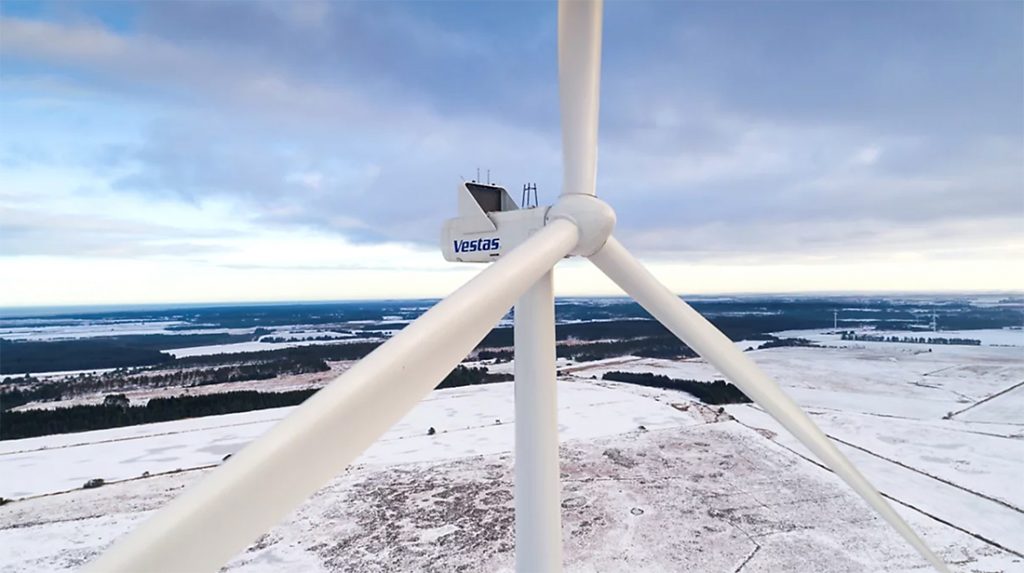
Vestas has repowered more than 1 GW of U.S. projects in the last five years. (Courtesy: Vestas)
Vestas has received a 90 MW order to repower an undisclosed wind project in the U.S. The order consists of 20 V150-4.5 MW wind turbines.
The order includes supply, delivery, and commissioning of the turbines, as well as a multi-year Active Output Management 5000 (AOM 5000) service agreement, designed to ensure optimized performance of the assets.
In the U.S., Vestas has repowered more than 1 GW of projects in the last five years across all major turbine brands.
Turbine delivery begins in the second quarter of 2024 with commissioning scheduled for the fourth quarter of 2024.
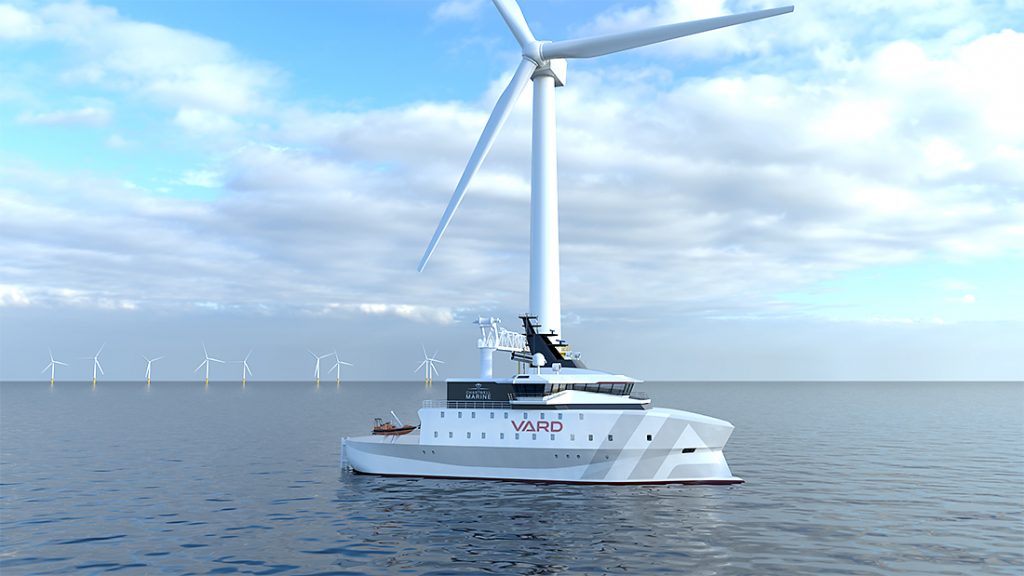
Chartwell Marine and VARD have announced a partnership to introduce the Midi-SOV, a 55-metre offshore wind. (Courtesy: VARD)
Chartwell Marine, UK pioneer of next-generation vessel design, announced a partnership with VARD, a designer and shipbuilder of specialized vessels, to introduce the Midi-SOV: a 55-meter offshore wind craft. Coming to both the U.S. and European markets in 2024, the vessel represents the combined expertise of the respective crew transfer vessel (CTV) and SOV design leaders, providing a solution to the challenge of expanding wind power across the globe.
As the offshore wind industry continues to grow, the demand for larger CTVs has surged, with larger teams of technicians operating on increasingly scaled-up turbines. However, owing to challenges in seakeeping and hospitality, merely increasing the dimensions of current CTV designs to create more capacity is not feasible.
“Never before has there been such a pressing need to develop offshore wind vessels that are reactive to evolving operational and financial conditions. Far from being a disaster, we see the failure of the UK’s Round 5 offshore wind CfD auctions as an opportunity for the maritime industry to respond to the fact that developer costs are skyrocketing,” said Andy Page, Chartwell Marine director.
“The Midi-SOV offers a cost-efficient alternative to full-sized SOVs, contributing to the industry’s overall sustainability. We’re putting a strong emphasis on having these vessels manufactured locally, with US-built vessels Americanized for the U.S. market and Europe-built vessels for European operations. Chartwell is leading the charge in CTVs; VARD are a pioneer in the SOV space — so the Midi-SOV is the best of both worlds,” said Page.
The Midi-SOV has been designed to prioritize stability and operability, and to be a cost-effective solution as the offshore wind industry tackles high inflation and increasing costs in its development pipeline. In taking the Midi-SOV design forward, Chartwell started from scratch, taking into consideration the insights of vessel owners, technical suppliers, and wind farm operators to meet the changing needs of the industry.
Proportioned for offshore wind, the vessel’s size hits the “sweet spot” for commercial and operational viability. It incorporates a low waterplane shape that broadens above waterline, minimizing and dampening roll motion. This allows the vessel to remain stable during operations, facilitating walk-to-work capabilities that were previously challenging for smaller scaled traditional SOV forms. Workability and comfort are bolstered by a superstructure that boasts a capacity of 36 single bunk cabins for SPS crew, 20 crew cabins, and extensive crew facilities, which include a gym, auditorium, meeting rooms, and day rooms.
With a strong focus on energy efficiency, this vessel can be equipped with methanol-diesel dual-fuel engines, electric propulsion, and a supporting energy storage system. Its design, balanced displacement, and advanced features position the Midi-SOV as a versatile and forward-thinking solution for offshore wind, marrying crew well-being and environmental responsibility with resolutely high performance.
To prove the Midi-SOV’s suitability, extensive simulation and model testing was conducted in collaboration with Seaspeed Marine Consulting. Throughout the development phase, Chartwell received support from marine firms, including Clarksons, North Star, Seaspeed and Voith. VARD, after conducting due diligence on the vessel design in summer 2023, recognized its potential and committed to developing the design to market.
“With the introduction of the Midi-SOV, Chartwell Marine and VARD are leading the way in opening up a new segment in the offshore wind industry enabling sustainable business at sea, bringing forth a vessel that combines innovation, efficiency, and sustainability. Our partnership signifies a commitment to providing operators with state-of-the-art solutions that slot into new and specialised roles that are emerging in markets across the globe,” said Runar Vågnes, VARD senior vice president, sales.
US Wind’s proposal for all three phases in the Maryland project includes installation of up to 121 turbines. (Courtesy: BOEM)
The Bureau of Ocean Energy Management (BOEM) has announced the availability of the draft Environmental Impact Statement (EIS) for the proposed Maryland Offshore Wind Project. If approved, the project could generate between 1,100 and 2,200 megawatts of clean, renewable energy to the Delmarva Peninsula, which could power up to 770,000 homes.
“Today’s announcement represents another milestone under this administration’s commitment to promoting clean energy production and fighting climate change, while ensuring our efforts are done in a transparent and inclusive manner,” said BOEM Director Elizabeth Klein. “We value the knowledge we receive from Tribal nations, other government agencies, environmental organizations, local communities, ocean users, and others. Working together, we can reduce conflicts and establish a strong foundation for offshore wind energy projects moving forward.”
An Oct. 6 notice will open a 45-day public comment period that ends at 11:59 p.m. ET on Nov. 20, 2023. The input received during the comment period will inform preparation of the final EIS.
BOEM will use the findings of the final EIS to inform its decision on whether to approve the project’s Construction and Operations Plan, and if so, what mitigation measures to require.
President Biden’s Investing in America agenda is growing the American economy from the middle out and bottom up – from rebuilding the nation’s infrastructure, to driving more than $500 billion in private sector manufacturing and clean energy investments in the United States, to creating good-paying jobs and building a clean energy economy that will combat the climate crisis and make communities more resilient.
US Wind, Inc. is seeking approval for the construction and operation of the Maryland Offshore Wind Project, which includes three planned phases. Two of those phases, MarWin and Momentum Wind, have offshore renewable energy certificates from the State of Maryland.
US Wind’s proposal for all three phases includes installation of up to 121 turbines, up to four offshore substation platforms, one meteorological tower, and up to four offshore export cable corridors with landfall occurring within Delaware Seashore State Park.
The lease area is about 8.7 nautical miles offshore Maryland and about 9 nm from Sussex County, Delaware.
If approved, the development and construction phases of the project could support up to an estimated 2,679 jobs annually over seven years.
The DOE’s funding opportunity supports development of offshore renewable energy by funding research to improve environmental compatibility of deployments in all regions of U.S. waters. (Courtesy: Department of Energy)
The U.S. Department of Energy’s Wind Energy Technologies Office and Water Power Technologies Office and the Department of the Interior’s Bureau of Ocean Energy Management and Bureau of Safety and Environmental Enforcement are providing $16.4 million in funding for installation noise reduction and reliable moorings for offshore wind and marine energy. Projects will also be managed in collaboration with the National Oceanic and Atmospheric Administration’s National Marine Fisheries Service.
This funding will support accelerated and responsible development of offshore renewable energy by improving the integrity and monitoring of mooring lines for floating offshore wind energy systems and marine energy converters, as well as by reducing or avoiding noise generation and propagation during the installation of fixed-bottom offshore wind foundations.
This FOA supports accelerated and responsible development of offshore renewable energy by funding research to reduce risk and improve environmental compatibility of deployments in all regions of U.S. waters including the Atlantic Ocean, Pacific Ocean, Great Lakes, and the Gulf of Mexico. This includes research into the integrity and monitoring of mooring lines for floating offshore wind energy systems and marine energy converters, as well as reducing or avoiding noise generation and propagation during the installation of fixed-bottom offshore wind foundations.
Projects awarded under this funding opportunity will support the Biden-Harris Administration’s goals of a carbon-free electricity sector by 2035 and a net-zero-emissions economy by 2050. This funding program also supports the Biden administration’s goals to deploy 30 gigawatts of offshore wind energy by 2030.
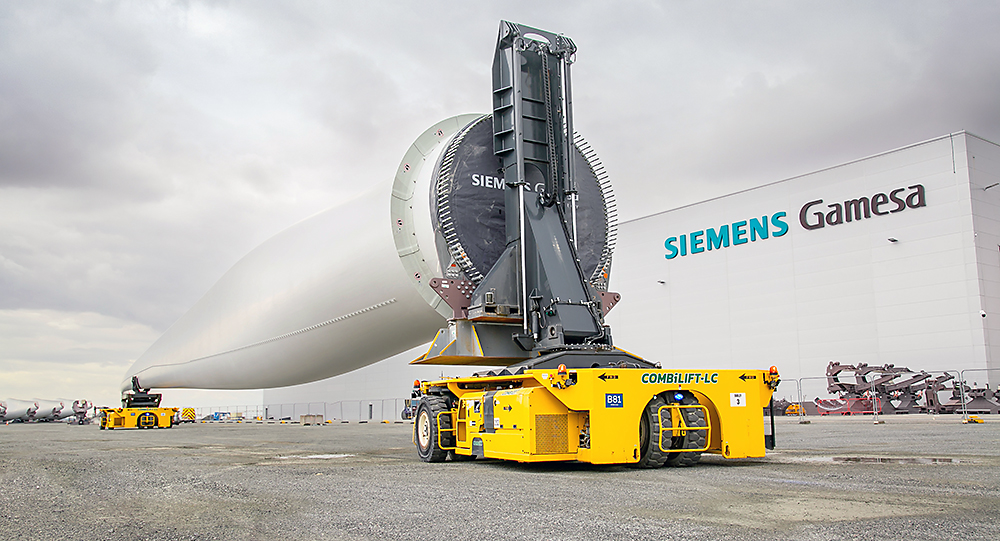
The Combi-LC, designed at Combilift’s HQ and manufacturing plant in Ireland, in collaboration with Siemens Gamesa, allows for the movement of wind turbine blades and towers. (Courtesy: CombiLift)
Combilift, the largest global manufacturer of multidirectional, articulated forklifts and straddle carriers, has announced its move into the offshore wind sector with the launch of a new product designed to meet the load handling demands of large scale offshore wind manufacturers.
As the green energy sector sees a surge in larger wind turbine components, including towers and blades, Combilift joined forces with industry leaders to engineer safe, stable, efficient lifting and storage solutions across its supply chain.
The Combi-LC, designed at Combilift’s HQ and manufacturing plant in Ireland, in collaboration with Siemens Gamesa, allows for the movement of wind turbine blades and towers, some as long as 115m and weighing in at around 70 tons, through production stages and on to storage locations, which can sometimes be as far as 5km apart.
The concept of bespoke Load Carriers (patent pending design) is based on two fully customizable remote-control units with low-level chassis beds that can work in tandem master and slave operation, with dimensions and wheel configurations that vary according to load type and weight.
Siemens Gamesa, one of the world’s largest offshore wind suppliers, has become the first company to leverage the new technology by signing a multi-million order for a number of the bespoke Load Carriers, and Combilift is in active discussions with other offshore wind companies with similar demands.
Combilift expects to generate more than €50m in revenue per year in this market segment by 2026.
“We are thrilled to have launched this new product, the Combi-LC, and we hope it will act as a gateway for us to further progress within our venture into the wind energy sector. The scale of offshore wind projects around the world leads to a very unique set of challenges, one of which being the ability to transport the very large components that make up a wind turbine. We recognized this and used our expertise in load handling to develop a solution to support those in the industry. The product is specifically made to order and therefore can be uniquely customized to fit specific applications,” said Josh Moffett, heavy equipment manager at Combilift.
“Over the past 25 years, Combilift has made a very important impact to the Irish economy. Combilift is a visionary company in every sense and I’m delighted that the Irish government, through Enterprise Ireland, has supported Combilift through its incredible 25-year journey,” said Heather Humphreys, minister for rural and community development.
Turbine delivery to repower the Downeast Wind project begins in the second quarter of 2024 with commissioning scheduled for the fourth quarter of 2024.
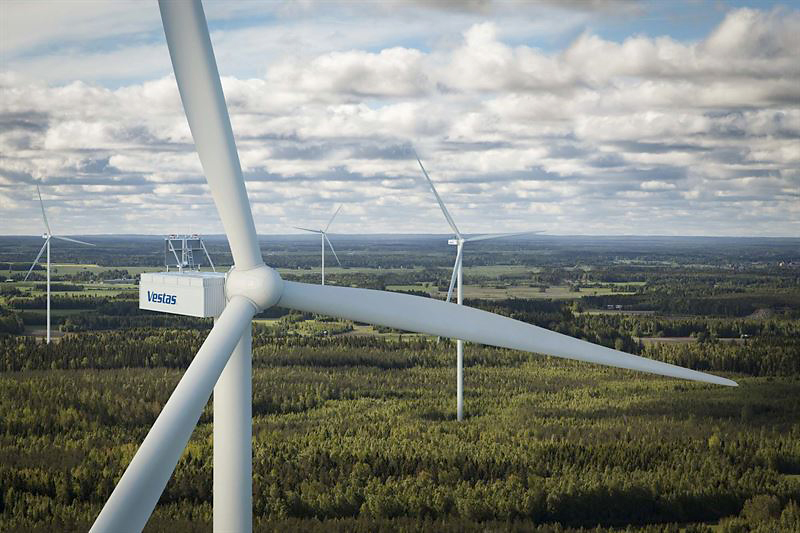
Vestas has received a 126-MW order to repower the Downeast Wind project owned by Apex Clean Energy in Maine. The order consists of 30 V150-4.2 MW wind turbines.
The order includes supply, delivery, and commissioning of the turbines, as well as a multi-year Active Output Management 5000 (AOM 5000) service agreement, designed to ensure optimal performance of the asset.
“Our strong partnership with Apex Clean Energy continues to bring wind energy to local communities across the U.S., and we look forward to the Downeast Wind project creating clean energy for the state of Maine,” said Laura Beane, president of Vestas North America. “With our industry-leading 4-MW platform, one of the most popular platforms sold globally, we’ll help bring Maine one step closer to achieving its goal of 80 percent of its energy coming from renewable sources by 2030 and 100 percent by 2050.”
“Our longstanding partnership with Vestas is pivotal to realizing our mission to accelerate the shift to clean energy across the country,” said Ken Young, CEO of Apex Clean Energy. “As our portfolio expands, we remain committed to building renewable energy projects that not only accelerate the transition, but also directly benefit the communities we work with.”
Turbine delivery begins in the second quarter of 2024 with commissioning scheduled for the fourth quarter of 2024.
Vestas Wind Systems has signed a conditional agreement to supply turbines for an onshore U.S. project. (Courtesy: Vestas Wind Systems)
Vestas Wind Systems has signed a conditional agreement for the supply of turbines for an onshore project in the U.S. with a capacity above Vestas’ current disclosure threshold of 1 GW.
If and when the agreement translates into a firm and unconditional order, Vestas will disclose that news in a company announcement, in accordance with the company’s disclosure policy.
CMaS Evolution is an integral part of Service 360. Plant operators have all turbine information constantly available and can optimize operation. (Courtesy: Winergy)
Winergy has introduced Service 360, a service concept for wind turbine drivetrains. Thanks to multi-brand service, digital services and the unique positioning as a system provider, it is the most comprehensive service concept in the market for wind drives. Winergy, the wind brand of the drive specialist Flender, offers turbine manufacturers and wind farm operators a one-stop solution for the entire drivetrain from gearbox to generator.
Today, wind is the cheapest energy form. Nevertheless, turbine OEMs and energy companies are trying to generate the maximum energy output at even lower costs. Efficient management of wind farms is essential to harness the available wind resources while minimizing downtimes.
With Service 360, Winergy offers a service concept for drivetrains that can be individually adapted to the respective customer need. It is unique in the wind market and the result of many years of cooperation with turbine manufacturers and wind farm operators. The service offering includes key innovations that cover the entire drivetrain, including the generator, and extends to servicing gearboxes from other manufacturers. Winergy is thus able to cover more than one hundred different turbine types and 130 gearbox models. Customers benefit from experience of the leading manufacturer of drive systems, regardless if it is a Winergy product or not.
Partners receive a complete package beyond the products. In terms of service, it is crucial to be close to the wind farms. Winergy covers all major wind markets in the world with its network of manufacturing and service locations. The integration of Moventas locations has expanded the presence further. Service 360 is thus available quickly and at any time. Service 360 also offers service for every point in the turbine’s life cycle, from installation, maintenance and repair to partial repowering, i.e. increasing the power of the wind turbine by upgrading individual components or the entire drivetrain.
“With this flexible multi-brand service, we focus on many gearbox and turbine brands and can thus serve drivetrains of entire wind farms. Service 360 can be applied to all turbine types with their various gearbox and generator types,” said Aarnout Kant, Winergy President.
Digital condition monitoring is an integral part of many wind farms. Operators use it to monitor and analyze their turbines. Winergy’s CMaS Evolution goes beyond this and offers customers a digital all-round service. It is part of Service 360 and for the first time fully compatible with already installed hardware. The end-to-end solution offers customers all important services, from the condition of the turbine to concrete recommendations for action to the delivery of spare parts at the right time and place.
CMaS Evolution is based on the further development of the successful Moventas CMaS Service and, thanks to Winergy’s unique position as a system provider, covers all components of the driveline from the main bearings to the transmission and generator. Existing systems can be connected without changing the infrastructure. Customers receive access to a digital portal in which all information about the turbines and services can be viewed transparently. The scope of the required services is based on the needs of the customers and can be individually adapted.
Cross-turbine algorithms also allow conclusions about the condition of the sub-systems and components outside the drivetrain. CMaS Evolution offers everything in one place: recommendations for operation, condition reports, instructions, required spare parts and their availability, as well as the planning of service calls.
“Service 360 combines everything our customers and partners need: service for all their turbines and drive types. For the entire drivetrain and not just for individual components such as the gearbox or the generator. Plus, it is available everywhere in the world. With CMaS Evolution, we are also leveraging the full potential of digital intelligence to further increase the efficiency of wind farms. In addition to wind gearboxes, generators, direct drive segments as well as wind couplings, Winergy has long been known for its extensive service portfolio,” said Antti Turunen, Wind Service vice president.
The Service 360 package also offers original spare parts, replacement of drivetrain components, workshop repairs at one of Winergy’s worldwide locations, on-site service, digital services, and training.
Winergy will present Service 360 at the Husum Wind trade show from September 12 to 15, 2023, in Hall 3, Stand C13.
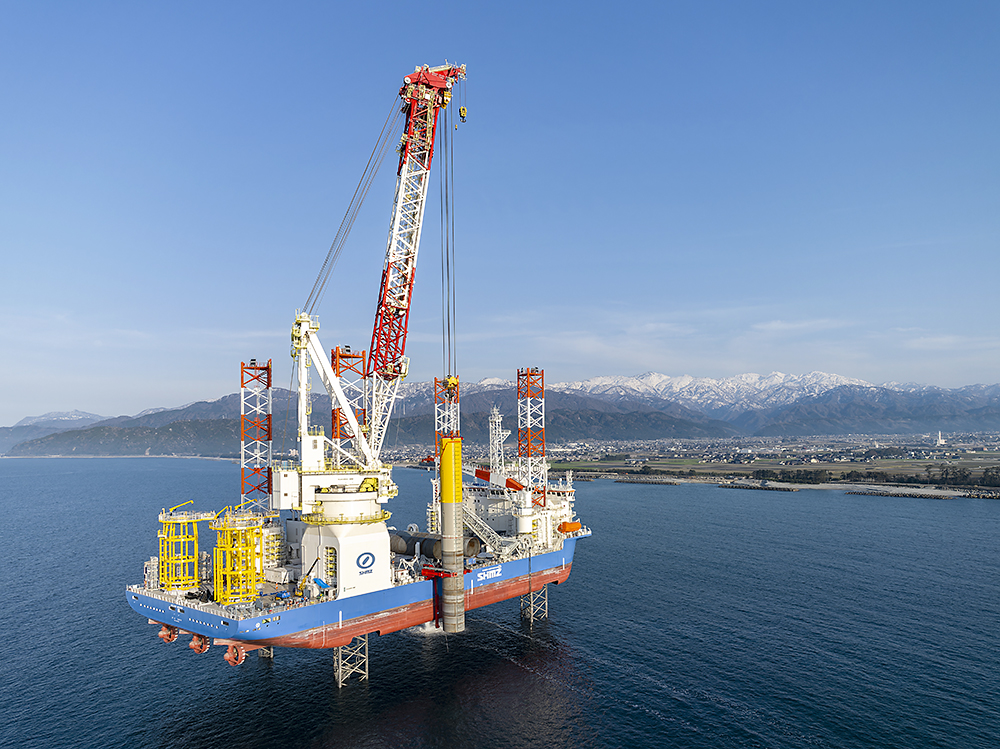
FOWIC will, in corporation with Shimizu, make use of the jack-up vessel Blue Wind for the project. (Courtesy: Fred. Olsen Windcarrier)
Fred. Olsen Windcarrier (FOWIC) has been awarded a contract working with Shimizu for the transportation and installation of monopile foundations for the 640 MW (8 MW / 80 wind turbines) Yunlin offshore windfarm off the west coast of central Taiwan.
FOWIC, which is in a cooperative relationship with Shimizu regarding offshore wind farm construction, will start operations in February 2024. The duration of the project is estimated to be 200 days.
FOWIC will in corporation with Shimizu make use of the jack-up vessel Blue Wind for the project. When fully operational, this project in Taiwan will have a capacity to create up to 640 MW green energy equivalent of more 600,000 Taiwan households and be another important step towards a fully green energy future in Taiwan.
“We are extremely proud to be awarded the transport and installation contract with Shimizu. This contract demonstrates our commitment to offshore wind development in APAC as a region and to our partnership with Shimizu. We look forward to executing this project together with Shimizu and all the local stakeholders and suppliers on the project,” said Alexandra Koefoed, CEO at Fred. Olsen Windcarrier.
Fred. Olsen Windcarrier established a partnership with Shimizu Corp. in 2021 to strengthen its position in the offshore wind industry in the APAC region. Both companies have a background in civil engineering and offshore & marine construction.
Together, FOWIC and Shimizu capitalize on a versatile jack-up vessel fleet, while making use of a larger pool of market knowledge and project execution experience.
“We’re happy for the chance to contribute with our joint capabilities to the Yunlin offshore windfarm project and to the APAC renewable energy overall,” said Koefoed.
The vessel is engaged in the Ishikari Bay New Port Offshore Wind Farm project, one of the largest commercial offshore wind farms in Japan with 8 MW / 14 wind turbines. The vessel will start preparation for the Yunlin offshore windfarm project in December 2023.
TDI-Brooks breaks ground and begins construction of a new expansion building that is located at TDI’s headquarters in College Station, Texas, 90 minutes north of Houston. (Courtesy: TDI-Brooks)
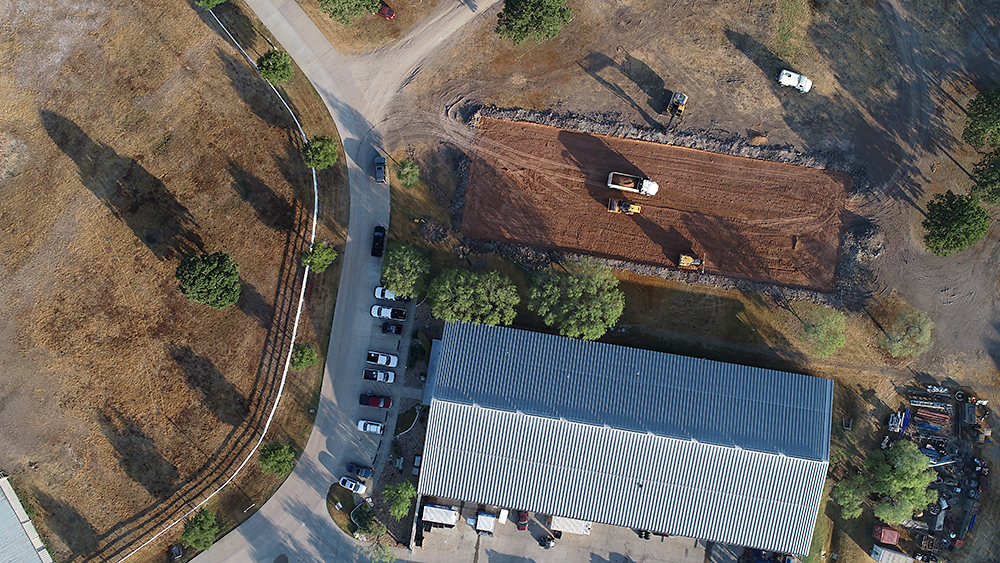
Following three years of rapid growth of both business and personnel, TDI-Brooks has broken ground and begins construction of a new 16,000 square foot “Technical Building #2.” The new expansion building is located at TDI’s headquarters in College Station, Texas just 90 minutes north of Houston.
The building is designed with 5,000 square feet of new office space along with technical work spaces, fabrication shops and storage areas. TDI-Brooks technical staff plans to move into the building by the end of the year.
“This new location will not only allow for the growth of staff we’ve employed to keep up with the growing demand for our technical services in offshore wind, it will allow further space for fabrication and storage of our geotechnical tools designed for seafloor surveys,” said Daniel Brooks, Director of Technical Systems and CPT Specialist.
TDI-Brooks is a 27-year-old research and service company specializing in geotechnical and offshore survey projects; multi-disciplinary oceanographic and environmental projects; surface geochemical exploration; and high-end environmental chemistry for IOC and offshore wind clients in addition to federal and state agencies. TDI-Brooks operates five research vessels, Brooks McCall, Miss Emma McCall, Gyre, Proteus and the Nautilus. These are multi-use vessels suited for a wide variety of oceanographic research duties for the offshore renewables and energy sectors.
TDI-Brooks was formed in mid-1996 by Drs. James Brooks and Bernie Bernard. Headquartered in College Station, TX with a remote domestic office located in Houston, TX and strategically placed offices around the globe. TDI-Brooks has a staff of more than 150 individuals including fourteen Ph.D. level oceanographers, geochemists, biologists and geologists, hydrographers, geophysicists, mariners, cartographers, engineers, GIS and CADD specialists who perform surveys and produce deliverables of the highest quality.
The company has international affiliates in Port Harcourt, Nigeria (TDI-Brooks Nigeria Ltd.) and Rio de Janeiro, Brazil (GSI-Brooks) with branch offices in Colombia (TDI-Brooks Succursal Colombia) and Mexico.
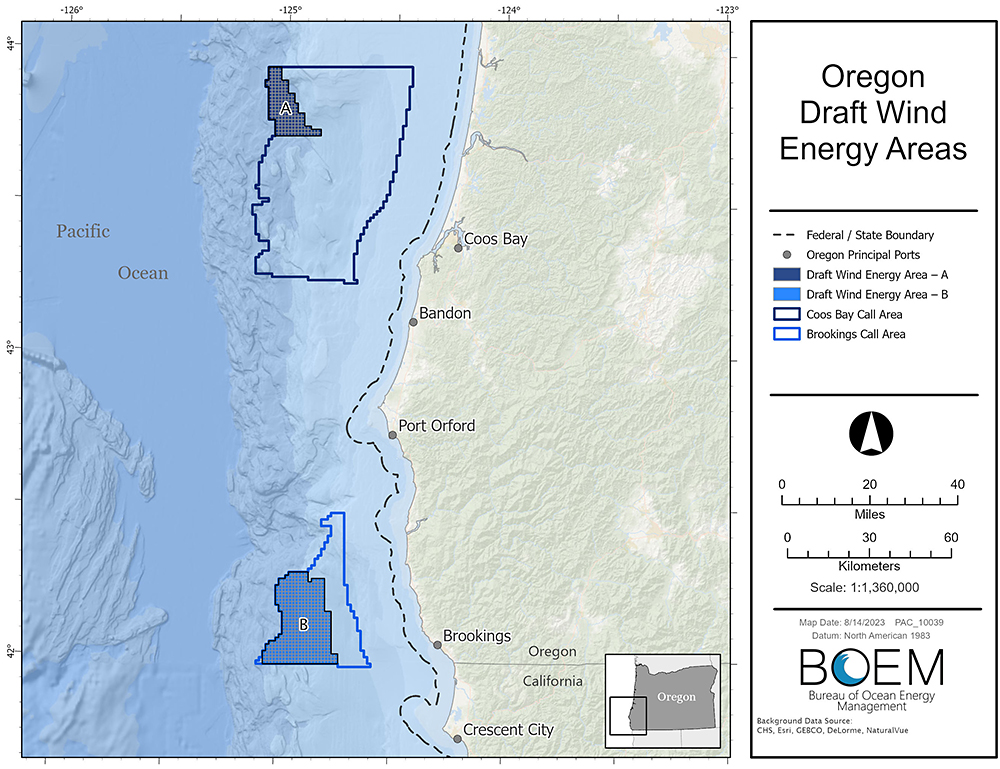
Caption: BOEM has launched a comment period for two offshore wind areas in Oregon. (Courtesy: Reuters)
The U.S. Bureau of Ocean Energy Management (BOEM) has launched a consultation for two offshore wind areas off the coast of Oregon that could host 2.6 GW of capacity.
Over a 60-day public comment period starting on August 15, BOEM will hold an intergovernmental task force meeting and several public meetings with the region’s fishing community.
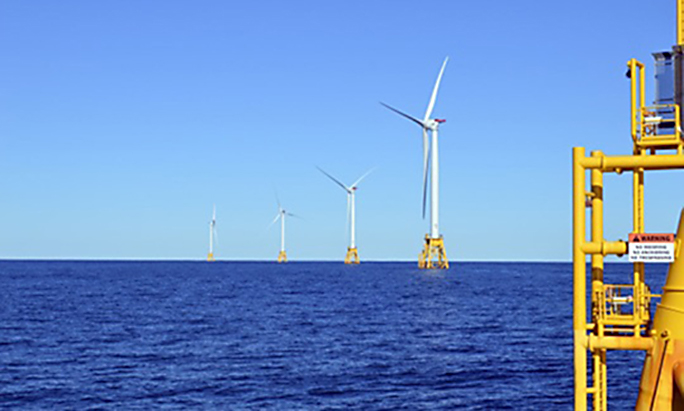
The WEAs have water depths of around 1,300 meters, requiring the deployment of floating offshore wind turbines that can be manufactured domestically, the Business Network for Offshore Wind noted.
“The introduction of these new WEAs will benefit not just Oregon, but California and Washington by attracting new investments in ports, vessels, and supply chain companies and delivering reliable power to the Western grid,” said Liz Burdock, founder and CEO of the Business Network for Offshore Wind.
Oregon plans to develop 3 GW of floating wind capacity by 2030 and is following progress made in California.
The U.S. Federal Energy Regulatory Commission (FERC) has agreed to streamline grid connection processes for wind and solar farms under new rules that prioritize projects that have secured permits and impose penalties for transmission operators that miss deadlines.
The final ruling aims to reduce delays in grid connections that are stunting renewable energy growth. Developers now take several years to secure grid connections as transmission operators work through a backlog of projects.
The announcement marks another step in fulfilling President Biden’s goal to deploy 30 GW of offshore wind energy capacity by 2030.
The Department of the Interior recently approved the Revolution Wind project. Located about 15 nautical miles southeast of Point Judith, Rhode Island, the project will have an estimated capacity of 704 MW of clean energy, capable of powering nearly 250,000 homes. The project is expected to create an estimated 1,200 local jobs during the construction phase.
The announcement marks another step in fulfilling President Biden’s goal to deploy 30 GW of offshore wind energy capacity by 2030. This is the department’s fourth approval of a commercial-scale, offshore wind energy project, joining the Vineyard Wind project offshore Massachusetts, the South Fork Wind project offshore Rhode Island and New York, and the Ocean Wind 1 project offshore New Jersey.
“President Biden has set an ambitious goal of achieving 30 GW of offshore wind by 2030 – and I am more confident than ever that we will meet it; together with industry, labor and partners from coast to coast, we are building an entirely new industry off the east and west and Gulf coasts,” said Secretary Deb Haaland. “The Interior Department is committed to the Biden-Harris administration’s all-of-government approach to the clean-energy future and delivering clean, reliable renewable energy to help respond to the climate crisis, lower energy costs, and create good-paying union jobs across the manufacturing, shipbuilding and construction sectors.”
“Today’s approval is not the end of our work on this project,” she said. “We will continue to maintain open communication and frequent collaboration with federal partners, Tribal Nations, states, industry, and ocean users to address potential challenges to and identify opportunities for the continued success of the U.S. offshore wind industry.”
“Under President Biden’s leadership, the American offshore wind industry is booming, creating new opportunities up and down the supply chain,” said Assistant to the President and National Climate Adviser Ali Zaidi. “Thanks to the Biden-Harris administration’s historic climate and clean-energy agenda, companies have quadrupled their U.S. offshore wind investments to over $20 billion, representing thousands of good-paying union jobs. (The) approval of a fourth major offshore wind project is our latest permitting milestone that will help strengthen America’s energy security, make our power grid more reliable, lower energy costs, and cut dangerous climate pollution. This is Bidenomics in action.”
President Biden’s economic agenda — Bidenomics — is fueling America’s clean-energy future, creating American-made products in American factories with American workers, and attracting more than $500 billion in private sector manufacturing and clean-energy investments, including in the offshore wind industry. Since the president took office, companies have announced 18 offshore wind shipbuilding projects as well as investments of nearly $3.5 billion across 12 manufacturing facilities and 13 ports to strengthen the American offshore wind supply chain, representing thousands of new jobs. The Department’s Bureau of Ocean Energy Management (BOEM) and federal partners are engaged in a thoughtful, all-of-government approach to collaborating on issues such as ocean co-use and efficient permitting to build a robust offshore wind industry that benefits communities and co-exists with other ocean users with minimal impacts.
“Revolution Wind represents another step forward in achieving the Biden-Harris administration’s goal of deploying 30 GW of offshore wind energy capacity by 2030,” said BOEM Director Elizabeth Klein. “The project’s approval underscores the administration’s commitment to promoting domestic energy production and fighting climate change, while promoting economic growth and fostering environmental stewardship within coastal communities. We are committed to working closely with Tribes, state and local leaders, industry, ocean users, and key stakeholders to responsibly develop this clean energy resource and ensure a sustainable future for generations to come.”
With this milestone, BOEM remains on track to complete reviews of at least 16 offshore wind project plans by 2025, representing more than 27 GW of clean energy.
After carefully considering the final Environmental Impact Statement (EIS) alternatives, including public comments received on the draft EIS, the department has approved Revolution Wind’s Construction and Operations Plan (COP) under its preferred Alternative G identified and analyzed in the EIS. This preferred alternative will meet energy needs by installing fewer wind turbines than originally proposed by the developer to reduce impacts to visual resources, benthic habitat, and ocean co-users. Alternative G includes up to 79 possible locations for the installation of 65 wind turbines and two offshore substations within the lease area.
The Record of Decision includes an extensive range of measures aimed at avoiding, minimizing, and mitigating the potential impacts that may result from the construction and operation of the project. Among them, Revolution Wind has committed to establishing fishery mitigation funds to compensate losses directly arising from the project incurred by recreational and commercial fisheries in Rhode Island and Massachusetts, and to creating a direct compensation program to reimburse lost revenues for fisheries from other states. Additionally, Revolution Wind has committed to measures such as vessel speed restrictions and construction clearance zones to reduce the potential for impacts to protected species, such as marine mammals, sea turtles, and Atlantic sturgeon.
BOEM worked with Tribes, federal, state and local government agencies, and reviewed more than 120 comments provided by industry, ocean users, and other key partners and stakeholders to develop these mitigation measures.
From 2021-2023, BOEM met with 44 consulting parties, including Tribal Nations, federal and state agencies, local governments, nongovernmental organizations, private property owners, and Revolution Wind, as part of the National Historic Preservation Act section 106 process to identify avoidance, minimization and mitigation measures for impacts to historic and cultural resources and properties.
BOEM considered the information obtained from these meetings and public comments when developing the final EIS, a critical step to ensure the project’s potential environmental impacts are fully analyzed and to identify any measures to mitigate those impacts for the Record of Decision.
President Joe Biden celebrated the advancement of the U.S. offshore wind supply chain during a steel-cutting ceremony for the Acadia, the first U.S.-built subsea rock installation vessel (SRI) for offshore wind. The vessel was ordered by Business Network member Great Lakes Dredge and Dock Corporation (GLDD) and is being constructed at the Philly Shipyard in Pennsylvania. During the ceremony, Biden celebrated the $16 billion of investments made during his administration in offshore wind manufacturing, shipbuilding, and ports, noting substantial growth in the supply chain that is now creating jobs in Indiana, Kansas, Louisiana, Pennsylvania, Texas, and New England.
GLDD’s investment into the $246 million vessel garnered the company a 2022 Ventus Award for Supply Chain Advancement for the vessel’s new efficiency standards and innovation with its large capacity, accurate placement technology, innovative battery, and alternative fuel system. Headquartered in Houston, GLDD has been in operation for more than 130 years. This vessel construction represents the company’s diversification into offshore wind and will fill a substantial need in the growing offshore wind industry.
“The Biden-Harris administration is helping make offshore wind a reality by bringing certainty to the permitting process, making investments in ports and transmission, and incentivizing domestic manufacturing,” said Business Network for Offshore Wind CEO Liz Burdock.
“Congratulations to Great Lakes Dredge and Dock Corporation for this achievement; we look forward to seeing the vessel finish construction and commence operation in 2025,” said Burdock.
Biden also announced the Final Sale Notice (FSN) for setting up an August 2023 auction. These will be the first federal lease areas auctioned in the Gulf of Mexico and, once developed, could support up to 3.7 GW of offshore wind generation. Despite having no active lease areas, the Gulf has been a leader in developing the U.S. offshore wind supply chain. The Network reports that 23 percent of contracts in the U.S. market are going to Gulf firms and about $1 billion in investments are flowing to Gulf shipyards or fabrication yards.
“Today’s release of the Final Sale Notice for the Gulf of Mexico Lease Areas marks an exciting new front for offshore wind in the United States,” said John Begala, the Network’s Vice President for Federal and State Policy. “With its long history of offshore construction, engineering expertise, and environmental monitoring and data collection, introducing the Gulf of Mexico and the region’s experienced professionals to the offshore wind market will drive new innovations and opportunities for the industry. BOEM’s inclusion of the supply chain, workforce, and fishery bidding credits demonstrates their continued commitment to seeing offshore wind develop in an equitable and inclusive manner.”
Vineyard Wind announced a pilot program to deploy and test a secondary bubble curtain during foundation installation (Courtesy: US Offshore Wind)
The U.S. offshore wind industry and supply chain reached major milestones in the second quarter of 2023 as installation began on the nation’s first two commercial-scale projects using components sourced from U.S. manufacturing facilities. These achievements are the result of a rapidly growing supply chain that has seen historic levels of investment in the last few years, including passage of the federal Inflation Reduction Act (IRA). These and other findings are detailed in the Business Network for Offshore Wind’s U.S. Offshore Wind Quarterly Market Report, which documents key investments announced over the past three months, growth in state demand for offshore wind, and notable policy advancements that drove the U.S. market forward between April and June 2023.
The network has also released a complementary Mid-Year Supply Chain Snapshot that highlights the accelerated growth experienced in just the past few years. While the U.S. market achieved a major milestone with the start of installation on the Vineyard Wind and South Fork Wind offshore projects, the Mid-Year Supply Chain Snapshot further profiles the development of the immense supply chain that is supporting the emerging industry. State demand has driven the market forward for years, but actions by the Biden-Harris administration to bring certainty to the permitting process and make historic investments in infrastructure and clean energy development have greatly accelerated supply chain growth.
The Snapshot details:
• A 272% increase in the number of U.S. market supplier contracts since 2021, according to the Network’s Market Dashboard, with 47% of that growth occurring since the IRA was signed in August 2022.
• 90% of contracts in the U.S. market going to companies that are either headquartered or have a presence in the U.S.
• A 169% increase in companies that have registered in the Network’s free offshore wind supply chain database since 2021, with a 54% increase since the IRA was signed.
• $16.6 billion in new market investments made since 2021 — more than quadruple the amount invested previously — with $7.7 billion of those investments made after the IRA was signed.
• A 100% increase in the number of vessels under construction or being retrofit in U.S. shipyards since 2021.
We are proud to say that we have steel in the water, steel in our factories, and steel in our shipyards today,” said Liz Burdock, founder and CEO of the Business Network for Offshore Wind. “Thanks to supportive federal and state policies, we are seeing unprecedented growth in the U.S. offshore wind supply chain across the nation. New contracts are signed daily with a vast majority going to small- and medium-sized American companies creating thousands of new jobs. With $7.7 billion in new U.S. offshore wind investments since the Inflation Reduction Act was signed into law, this is just the beginning. We will see many more factory openings, port revitalizations, and vessels under construction in the years to come.”
The historic commencement of the Vineyard Wind and South Fork Wind projects also yielded additional U.S. supply chain milestones. The two wind farms will feature the first U.S.-manufactured offshore substation, built in Texas, the first U.S.-manufactured export cables, from South Carolina, and the first run of critical steel foundation and tower components in Rhode Island. Unconnected to these projects, the U.S. supply chain also celebrated the first U.S.-assembled monopile foundation in Paulsboro, New Jersey.
The Network’s U.S. Offshore Wind Quarterly Market Report, which includes new data and analysis on market trends and advancements, provides additional context to the quickly developing market and its supply chain. The report details:
• The many recent firsts for the U.S. supply chain, including the first U.S.-built offshore wind substation and monopiles, along with the first cables manufactured for a U.S. commercial-scale project.
• New investments in steel manufacturing facilities in Ohio and Baltimore and a California port’s ambitious $4.7 billion plan for a major floating offshore wind facility.
• Economic headwinds that have forced projects in Massachusetts and New York to adjust their state financial agreements and led to new legislation passed in New Jersey aimed at supporting one of its projects.
• New offshore wind markets — adding to the existing 84 GW demand — in Delaware, Illinois, and Maine, which have all considered or advanced new procurement legislation, and Louisiana, which is negotiating with developers to advance projects in state waters.
ALLETE Clean Energy completed a refurbishment project at the Condon wind site in 2019. (Courtesy: ALLETE)
ALLETE Clean Energy has entered a new customer segment after signing a 5-year power purchase agreement (PPA) to sell wind power to Seattle City Light, the company’s first municipal customer.
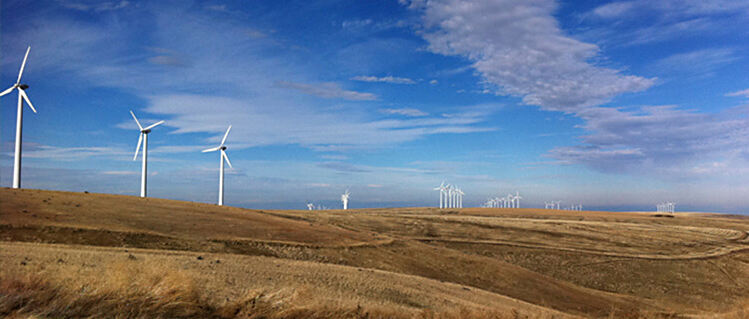
Seattle City Light, among the top-ten largest municipal utilities in the nation with more than 493,000 customers in Seattle, will purchase power from ALLETE Clean Energy’s 50-megawatt Condon wind site in northern Oregon. The PPA also includes an agreement to jointly explore adding solar energy and/or energy storage capacity at the Condon site.
“We’re excited to provide affordable, renewable wind energy to Seattle City Light from our Condon wind site and proud to help Seattle City Light meet their sustainability goals as we advance the clean-energy future,” said ALLETE Clean Energy President Nicole Johnson. “This agreement also furthers our strategy of leveraging our existing wind sites with potential for complementary renewable additions and gaining new contracts.”
ALLETE Clean Energy completed a refurbishment project at the Condon wind site in 2019 to extend its operating life and requalify the site for federal production tax credits. The project included equipment and system upgrades necessary to maintain its high operating availability and clean-energy production performance.
“Seattle City Light prioritizes creating our energy future on behalf of and in partnership with our customers and the communities we serve,” said Emeka Anyanwu, Energy Innovation & Resources Officer. “To meet reliability, affordability, and environmental responsiveness goals, we strive to leverage resources like the Condon project to expand our supply mix with renewable energy resources supporting our efforts to enable decarbonization through electrification of transportation, buildings, and industry. In doing so, we will help communities to shift further away from fossil fuels, meeting the climate crisis head-on.”
ALLETE Clean Energy also serves five Fortune 500 companies from its Diamond Spring and Caddo wind sites in Oklahoma and a number of large electric utilities from its other wind sites.
ALLETE Clean Energy owns, operates, and has delivered build-transfer projects totaling more than 1,500 megawatts of nameplate wind capacity across eight states. The company is well-positioned to drive additional clean-energy sector growth.
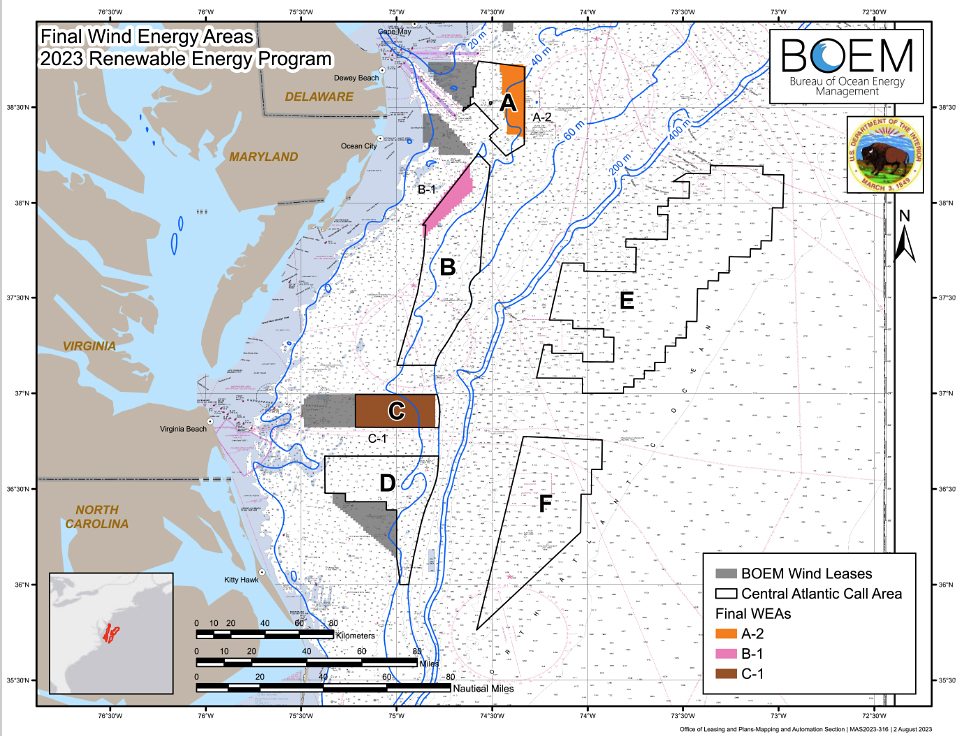
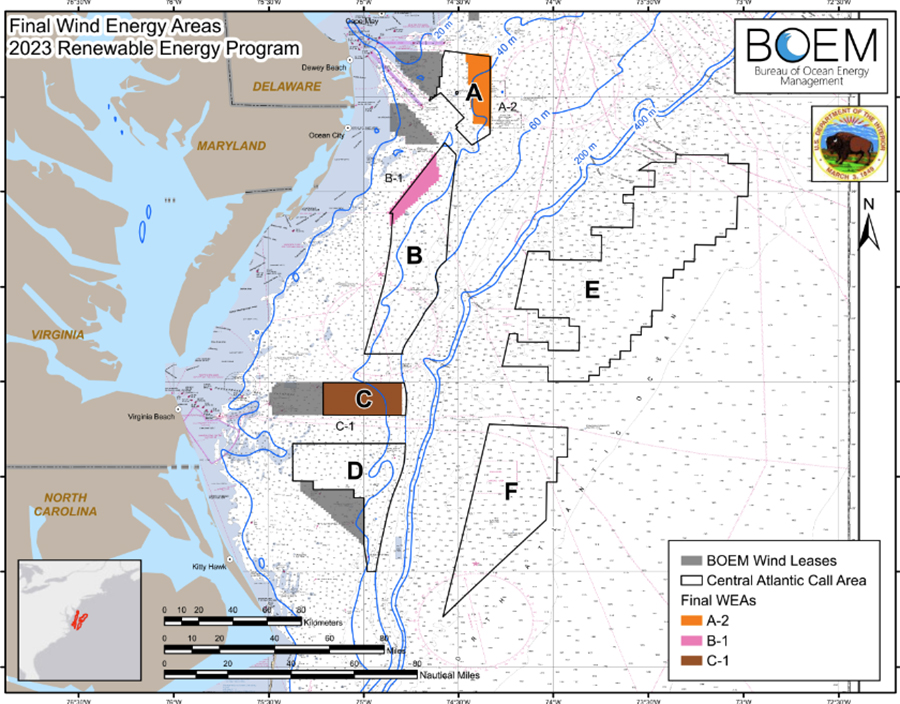
The three WEAs total about 356,550 acres. (Courtesy: BOEM)
As part of the Biden-Harris administration’s goal of deploying 30 gigawatts (GW) of offshore wind energy capacity by 2030, today the Bureau of Ocean Energy Management (BOEM) announced three final Wind Energy Areas (WEAs) offshore Delaware, Maryland, and Virginia, which were developed following extensive engagement and feedback from states, Tribes, local residents, ocean users, federal government partners, and other members of the public. If fully developed, the final WEAs could support between four and eight gigawatts of energy production.
The three WEAs total about 356,550 acres. The first WEA (A-2) is 101,767 acres and located 26 nautical miles (nm) from Delaware Bay. The second WEA (B-1) is 78,285 acres and about 23.5 nm offshore Ocean City, Md. The third WEA (C-1) is 176,506 acres and located about 35 nm from the mouth of the Chesapeake Bay, offshore Virginia. A map of the final WEAs can be found on BOEM’s website.
“BOEM values a robust and transparent offshore wind planning process, which requires early and frequent engagement with Tribal governments, the Department of Defense, NASA, other government agencies, and ocean users” said BOEM Director Liz Klein. “We will continue to work closely with them, and all interested stakeholders, as we move forward with our environmental review.”
BOEM partnered with the National Oceanic and Atmospheric Administration’s National Centers for Coastal Ocean Science (NCCOS) to develop a comprehensive, ecosystem-based ocean planning model that assisted in the selection of the final WEAs.
This model leveraged best available data on natural resources, ocean industries such as fisheries and energy production, and areas of national security activities to identify areas with high wind energy resource potential while reducing potential impacts to other ocean users and sensitive environmental resources. This comprehensive approach not only provided valuable insights about the seascape and uses of the ocean region, but also facilitated greater transparency and positive coordination with government partners and ocean stakeholders through direct engagement and incorporation of their feedback into the NCCOS model.
The final WEAs are in comparatively shallow water. BOEM may identify additional WEAs in deepwater areas offshore the U.S. Central Atlantic coast for future leasing once further study of those areas has been done.





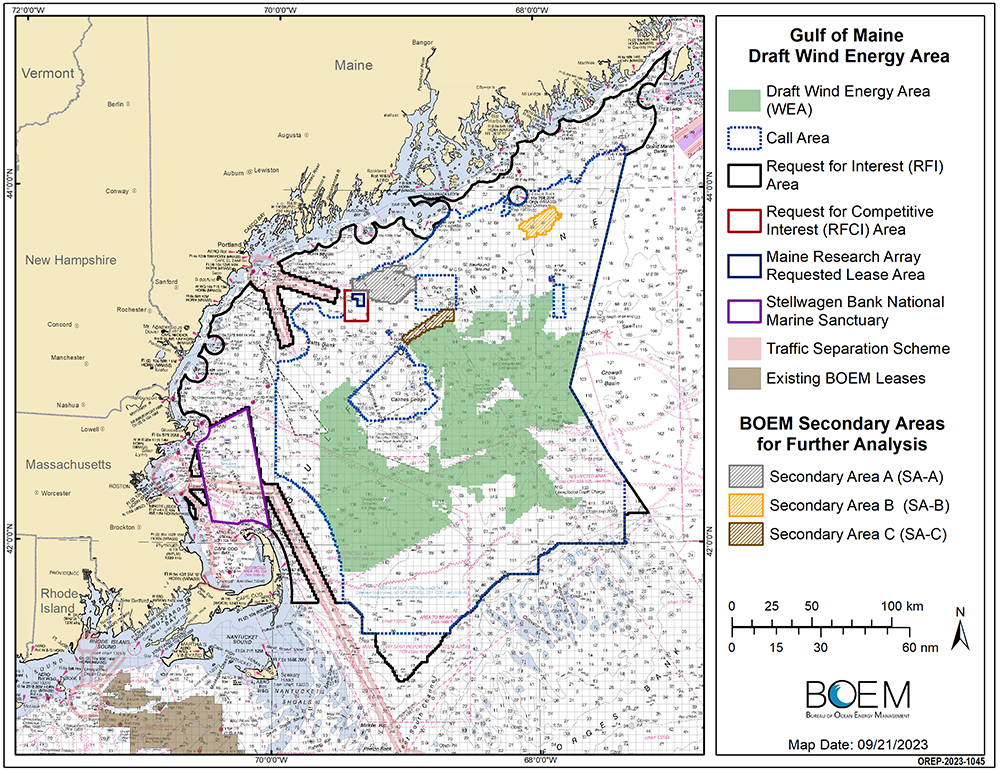 As part of the Biden-Harris administration’s goal of deploying 30 GW of offshore wind-energy capacity by 2030 and 15 GW of floating offshore wind by 2035, the Bureau of Ocean Energy Management (BOEM) recently identified a Draft Wind Energy Area (WEA) in the Gulf of Maine, opening a 30-day public review and comment period.