Hunter Armistead is set to be Pattern Energy’s new CEO. (Courtesy: Pattern Energy)
Pattern Energy has named Hunter Armistead as its new CEO, effective Jan. 1, 2023.
Armistead, Pattern Energy’s current chief development officer, will succeed Michael Garland in the role. Garland will retire after his successful tenure as CEO of Pattern and its predecessors since 2009.
“This is an extraordinary time for the renewable energy sector and the entire Pattern team is exceptionally well positioned to deliver on the opportunities ahead. Given his long history as a leader of this company, the strength of his commercial instincts, and his passion for Pattern’s vision, I believe Hunter is uniquely capable of leading this company in a way that provides consistency, continuity and leadership across the business both internally and externally,” said Garland.
“It has been a tremendous journey since we founded Pattern in 2009, and it is my honor and privilege to take on the CEO role. Pattern began with a modest pipeline, a few dedicated professionals, and a vision to accelerate the world’s energy transition. To see Pattern and our industry evolve into what we have become has been a beautiful ride and is one that has only just begun. I am 100% committed to driving the next chapter in our growth in a manner that is consistent with our mission, our culture and our values,” said Armistead.
“I have seen first-hand Mike Garland’s exceptional leadership of the company since 2009. During his long service he has led Pattern through many successful phases of development. We are most grateful for all he has done. We conducted a thorough search for his successor and concluded that Hunter Armistead was the ideal candidate. He cares deeply for the company’s culture and people and brings great experience and understanding of the company’s business to the role,” said Lord John Browne, chairman of the board.
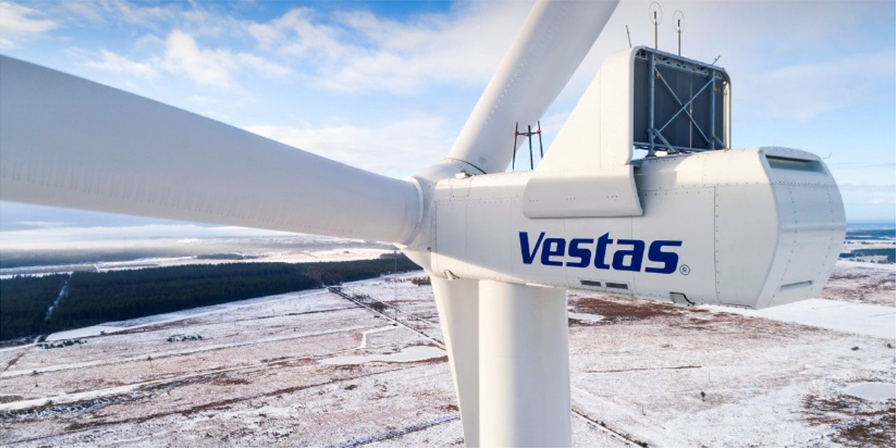
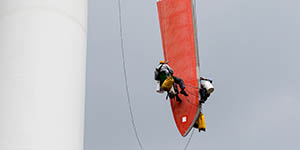
Vestas has signed a new agreement with blade supplier TPI Composites. (Courtesy: Vestas)
Vestas has signed a multi-year agreement with long-time partner TPI Composites Inc. (TPI), a supplier of wind turbine blades and services, to strengthen its scalable global supply chain network for current and future wind turbine blades.
“The continued and expanded partnership highlights how we are increasingly collaborating with partners, and how we continue to evolve and re-shape the industry together. We have been working together with TPI since 2014 and during that time, they have become one of our most trusted and strategic blade partners. With this agreement, we are happy to continue this journey, leveraging their global footprint and providing scalable, high-quality, and sustainable supply together”, said Tommy Rahbek Nielsen, Executive Vice President & Chief Operating Officer of Vestas.
TPI and Vestas work together on global manufacturing and supply chain operations, based on Vestas’ specifications and requirements, and TPI is supplying a range of blade variants to Vestas’ 2 and 4 MW platforms as well as the EnVentus platform. TPI will continue supply of blades from its existing global production footprint, while optimizing the production setup in current facilities, and evaluate new locations for possible future growth in strategic markets.
Vestas and TPI are equally investigating further collaboration possibilities for the V163-4.5 MW and V236-15.0 MW turbines and assessing the optimal manufacturing and production location setup for these new blades.
The new agreement is a continuation of the existing Vestas and TPI partnership agreement, and further builds on the expanding capabilities of TPI and core strengths of both companies. Sharing manufacturing operations across the renewables industry is more relevant than ever to ensure sites are not sitting idle and creates a flexible, scalable, and efficient supply chain that enables industrial scale to meet global net-zero ambitions
“We are proud of our long and successful partnership with Vestas and are pleased that Vestas has chosen to further expand its relationship with TPI. We look forward to continuing our collaboration with the supply of current and future blade models, blade design, and other services globally,” said Bill Siwek, CEO, TPI Composites Inc.
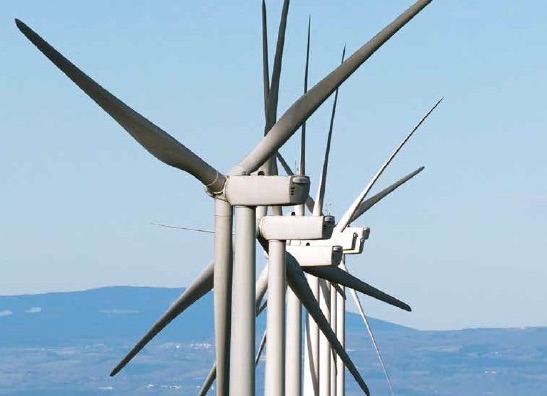
DNV, the independent expert in risk management and assurance, is moving ahead in collaboration with Reodor Studios to create a digital service that will make it easy to plan for sustainable decommissioning and recycling when a wind farm has reached the end of its life cycle.
In the 1970s, the wind-power industry boomed, and thousands of wind farms were built around the world. Now, 50 years later, the world faces a historic challenge: What do you do with a 300-ton wind turbine when it has reached the end of its life? ReWind, a brand-new digital service, aims to address this key issue for the wind industry.
Today, most decommissioned wind turbines are buried underground, for lack of a better solution. In 2020, Bloomberg highlighted the situation in Casper, Wyoming, where 870 wind-turbine blades are buried under a landfill. WindEurope estimates that 25,000 metric tons of wind-turbine blades will have to be recycled by 2025, and 52,000 metric tons by 2030.
DNV‘s specialist team analyzes and develops reports for wind-farm owners and operators, showing, among other things, which materials the wind turbines contain, how they can be disposed of in the best possible way, what can be recycled, and how. Now, in collaboration with Reodor Studios, a Norwegian corporate venture and innovation studio, DNV will shape this into a digital service.
“This service will enable wind-farm owners to quickly assess turbine recyclability percentage and options, end-of-life planning, and sustainable decommissioning,” said Matthew Geraghty, founder and ReWind venture lead at DNV.
The use of wind energy will grow, and with that, the need to replace older turbines and equipment to keep pace with developments. Indeed, DNV’s 2022 Energy Transition Outlook report forecasts that by 2050, wind will provide almost 50 percent of on-grid electricity in Europe, and 40 percent in North America and Latin America. New turbine types and bigger turbines, blades, and towers will raise capacity factors for onshore wind from 26 percent now to 34 percent, and from 38 percent to 43 percent for offshore wind by 2050.
“This is the first time in history that we have faced such a challenge,” said Lucy Craig, director of Growth, Innovation & Digitalization, Energy Systems at DNV. “A wind turbine has a life cycle of around 20 to 30 years, and now, many wind turbines are approaching the end of their life cycle. Today, the process of recycling and decommissioning these is extremely complicated and manual, and large quantities of wind turbines end up in landfills, for lack of better solutions. Introducing this digital service helps the owner plan for decommissioning, map costs, and assess recycling options.”
In order to create a digital service that meets all its customers’ needs, DNV has initiated a collaboration with Reodor Studios. By combining Reodor’s expertise in building digital products and services with DNV’s world-leading domain knowledge, the ReWind team can work faster, increase the chances of scaling successfully, and build a well-tested service that can make the process of decommissioning wind turbines smoother for wind-farm owners and operators.
“Capital Dynamics Clean Energy is committed to responsible investment and ESG implementation throughout the investment lifecycle,” said current customer of the service Gintare Briola, Head of Portfolio Management, CEI at Capital Dynamics. “ReWind’s recyclability study for our wind farms helped us gain a better understanding on the recyclability of the equipment, the existing and developing recycling methods, including for composite blade waste, and forecasted decommissioning costs. ReWind also provided recommendations for various stages of the project life cycle that we at Capital Dynamics hope to implement to minimize environmental impact and reduce lifetime emissions.”
“DNV, which already has a large customer base of wind-power operators and owners and sits on world-leading knowledge of wind power, has foreseen the need for this service, both through dialogue with the customers, but also through hard data,” said Kate Butchart, strategic adviser at Reodor Studios. “Add to that Reodor’s creativity and experience in building products and services, and I believe it’s a perfect match to create a solution that can potentially solve a huge industry — and global – need.”
The digitization project is now ongoing, with the team working on validating market needs, developing a service concept, business model, and a scalable growth strategy based on customer insights.
Including decommissioned turbines and wind parks, the U.S. has a total pool of more than 85,500 onshore and offshore wind turbines, and more than 151.7 GW worth of onshore and offshore wind power installed capacity which can be analyzed.
Using audited data from the Energy Information Administration (EIA), which is a part of the Department of Energy (DoE) in the United States of America, IntelStor has now completed the most detailed analysis of the efficiency of wind power ever in the country.
Including decommissioned turbines and wind parks, the U.S. has a total pool of more than 85,500 onshore and offshore wind turbines, and more than 151.7 GW worth of onshore and offshore wind power installed capacity which can be analyzed.
The analysis shows that the U.S. has a 34.84 percent combined lifetime average net capacity factor (NCF) for the entire installed base of more than 85,500 wind turbines.
The evolution of lifetime average net capacity factor over time shows a marked increase in average performance from 20-plus years ago. For assets installed around the year 2000, the U.S. had an average net capacity factor of just 26.45 percent. By 2003, that fleetwide average figure exceeded 30 percent for the first time. It took another 10 years from that point until 2014 before lifetime average fleetwide performance was above a 40 percent net capacity factor.
South Dakota, with an average of 42.78 percent across all wind parks, edges out Nebraska and Kansas to lead the U.S. in lifetime average net capacity factor of assets that are still operational, as well as those that have been decommissioned.
BlackRock (average 45.62 percent NCF), Ørsted (average 43.35 percent NCF,) and Xcel Energy (average 43.05 percent NCF) have the highest fleetwide capacity factors based on asset ownership, which is concentrated in Texas, North Dakota, South Dakota, New Mexico, Nebraska, Colorado, and Minnesota.
The three largest asset owners in the U.S., NextEra Energy Resources (average 36.78 percent NCF); Berkshire Hathaway Energy (BHE), including MidAmerican Energy Company and PacifiCorp (average 37.10 percent NCF); and Iberdrola’s Avangrid Renewables (average 31.23 percent NCF) have an older and more geographically diversified fleet, which has dragged their performance down relative to others.
Since lifetime average net capacity factor (NCF) is highly dependent on the specific site conditions of a wind park, variations in average wind speed from state-to-state or even site-to-site within a state, can create a bias to the benchmarking analysis that is solely based on NCF. Therefore, it is also important to look at asset performance benchmarking based on energy yield analysis as well.
In the U.S., more than 51.76 percent of all operational onshore wind-energy assets show they meet or exceed their P50 performance quotation. Approximately 34.25 percent of operational assets meet or exceed a P75, but not their P50, while 12.69 percent meet or exceed a P90, but not their P75 energy yield. Only 1.3 percent of the wind turbines installed in the U.S. fall below their P90 performance quote based upon their lifetime average AEP and capacity factor analysis.
Xcel Energy, with a total of 4.38 GW of operational capacity installed in the United States, has truly exceptional performance with 96 percent of their fleet operating at or above a P50 energy yield ranking.
Some of the largest asset owners in the U.S. have a performance ranking probably as expected, with NextEra Energy Resources seeing more than 66.7 percent of their operational capacity in the P50 range. Similarly, Berkshire Hathaway Energy (BHE) has just a fraction below 78 percent of their installed fleet operating at or above a P50 energy yield.
However, Iberdrola’s Avangrid Renewables, Energias de Portugal Renewables (EDPR) North America, and RWE as the next three in line for total installed capacity all show significantly lower performance amongst their fleet. Iberdrola’s dependence on legacy Gamesa turbines globally has certainly dragged down their performance in the U.S., along with their current lack of repowering prowess when compared to the other large asset owners.
Engie, American Electric Power (AEP), Southern Company, and Alliant Energy are the most noteworthy among the top 25 asset owners by installed capacity in the U.S. aside from Xcel Energy. This is due to respective fleets with no assets which perform below a P75 energy yield rank.
GE Renewable Energy has the largest installed base in the U.S. with 60.8 GW operational, but also the largest portion of their operational fleet performing at or above a P50 energy yield, a total of 61.59 percent. Vestas is in the No. 2 spot with a total of 61.1 percent of its 38.2 GW operating at or above a P50 energy yield, and Siemens Gamesa rounds out the top three with 23.3 GW installed, but only 36.75 percent operating at a P50 energy yield.
Age-related performance degradation of wind turbines can have profound impacts on asset profitability through the unrecovered loss of lifetime average performance in the later years of the asset life. In the U.S., dating back to the earliest installations in the 1980s, IntelStor can currently estimate a total of 114.4 TW/h of wind-energy production were lost due to curtailments and underperformance issues, underscoring the importance of proper fleet care and management.
The U.S. has a capacity weighted average asset performance drop-off of more than 10 percent in average annual AEP after approximately 11 years for the entire onshore wind installed base, including both operational and decommissioned capacity. The asset age since the commissioning date that shows the highest frequency of performance drop-off is 10 years, with a standard distribution curve around that time frame.
The major asset owners in the U.S., who tend to self-perform their maintenance, actually have a relatively longer period of asset operations prior to the age-related performance drop-off. However, it is also noteworthy that they still show a comparable frequency of performance drop-off vs. OEM maintenance or maintenance services from an independent service provider.
Now, with more than 47 GW of assets in the U.S. that are at least 10 years old or older, there is ample opportunity for all states, all project developers, all asset owners, and all investors to collectively take maximum advantage of the available wind resources in the U.S. and repower older wind parks with more efficient technology.
Perceptual Robotics engineers flew an M300 drone to autonomously inspect a G47 wind turbine. (Courtesy: Perceptual Robotics)
Perceptual Robotics has given the wind inspections and maintenance industry a preview of its unique capabilities by holding demonstrations with potential partners.
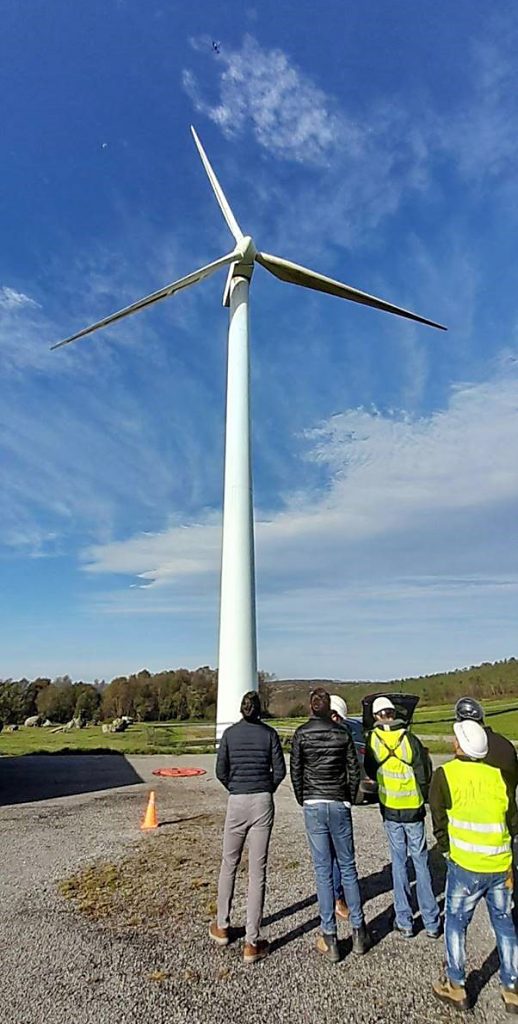
The company, which has offices in the UK and Europe, welcomed eight companies across Spain to take part in its demonstration day at Sotavento Experimental Wind Farm in Lugo, Spain. Perceptual Robotics engineers flew an M300 drone and used its unique Dhalion system to autonomously inspect a G47 wind turbine at the site.
Two demos were held, with attendees receiving a first-hand preview of the Dhalion system and an inspection as it happened. Perceptual Robotics engineers then showed post flight what data processing looked like and how inspection images and results were presented and analyzed in the system’s web portal.
“This was an excellent opportunity for different stakeholders in the industry to see up close how our system works in real operating conditions. We had people from all aspects of the industry attending, from asset and utility owners to drone companies and inspection organizations. By sharing our extensive experience of inspecting these massive structures, we can bring about the change the industry needs to make inspections more cost effective, timely and safer for all,” said Kostas Karachalios, CEO of Perceptual Robotics.
Perceptual Robotics’ Dhalion system is designed for autonomous in-depth turbine inspections, collecting and analyzing high-quality data from turbines in fewer than 20 minutes.
Earlier this year, the company announced that the advanced technology of robotic systems and artificial intelligence had proven to be almost 15% more accurate in detecting faults in wind turbines thanks to an Innovate UK Research and Development project, which had been ongoing in collaboration between Perceptual Robotics and the University of Bristol. The project showed the partners’ unique system had a 14% improvement in fault detection accuracy when compared with expert humans carrying out the same inspections.
ECOncrete can be added to regular concrete mix to create a chemically-balanced concrete. This enables healthy and diverse marine ecosystems to develop. (Courtesy: ECOncrete)
Deployment of Droplock Ecological Scour Protection has been completed 12 miles off the shore of Long Island, NY in coordination with the New York State Department of Environmental Conservation.
The project partners are ECOncrete Tech Ltd., provider for bio-enhancing concrete technology, and Holcim US, a cement producer. The concrete unit requires up to 30% less material, minimizes native habitat degradation, and supports ecological uplift in offshore wind projects.
“The unit’s ecological properties mimic natural marine habitats’ features while providing the armoring functionality required for scour protection,” said Dr. Ido Sella, ECOncrete Tech CEO and co-founder. “Offshore wind projects that integrate nature inclusive technologies are able to gain ecosystem services not achievable before. The ecological uplift and long term functionality of ecologically sensitive solutions can mitigate some of the associated impacts of offshore infrastructure. The ecological performance will be verified through comprehensive scientific monitoring comparing the bio-enhanced system to the standard rock based scour protection to set new industry standards for responsible construction.”
“This deployment of materials is exciting and timely. The Nature Conservancy believes there is great potential in intentionally designing and constructing materials used in offshore wind energy development in ways that are intended to create habitat for fish and other marine life,” said Carl LoBue, Nature Conservancy ocean program director.
“Renewable energy from wind is a critical part of building a more sustainable world and our Net Zero commitments. We also recognize wind generation needs to be built in a way that minimizes the ecological and environmental impacts,” said Michael LeMonds, VP, Environment, Land & Public Affairs at Holcim US. “Meeting our renewable energy goals together with ECOncrete Tech shows how an innovative approach using well-established building materials can protect natural habitats and help them flourish.”
This project provides the first and only structural solution that benefits both foundation resiliency and the local marine ecosystem. In a recent report, The Nature Conservancy (recommended ECOncrete’s nature-based design for cable protection and scour protection.
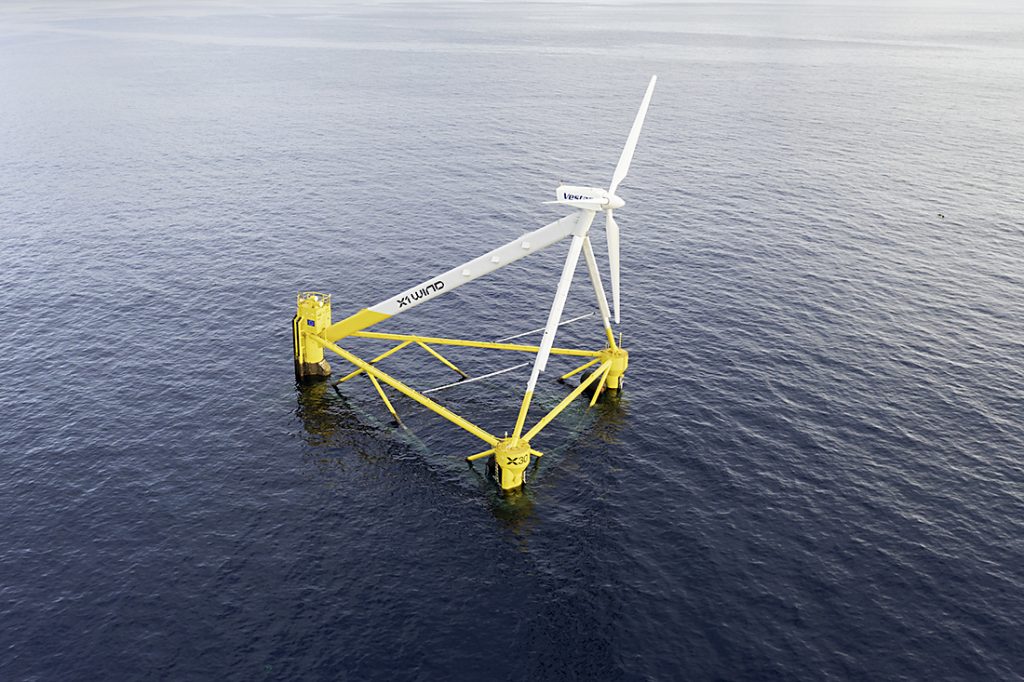
X1 Wind and the PivotBuoy Project installed a floating wind platform in the Canary Islands. (Courtesy: X1 Wind)
X1 Wind’s floating platform has been successfully installed at the PLOCAN test site in the Canary Islands.
As summer trade-winds abated, a suitable weather window allowed X1 Wind and partners from the EU-backed PivotBuoy Project to complete the installation process, connecting the fully-functional floating wind prototype to the mooring system and dynamic cable pre-installed last June.
X1 Wind Operations Manager Jorge Casanovas said operations will soon commence collecting valuable data to validate performance in open ocean conditions for the first time.
“As installation work comes to a close another exciting chapter begins for X1 Wind as we prepare for operations to deliver first power to the PLOCAN smartgrid,” he said. “This is the result of a massive team effort, and we would like to extend our appreciation to all project partners and local suppliers who have supported so diligently throughout the build and installation process. We are especially thankful to those partners and suppliers that have played an instrumental role in the final installation phase, developing a ground-breaking mooring, connection and installation solution for our X30 prototype. Now successfully installed, we will begin monitoring the platform in real-time with multiple sensors integrated within our in-house SCADA system.”
The X30 platform has been developed with key design features to streamline the installation process, including a light-weight and stable floater which can be wet towed by local vessels. The PivotBuoy Project focuses on demonstrating a mooring system configuration that combines the advantages of a SPM (single point mooring) with a small TLP (Tension-Leg Platform) mooring system, allowing the ability to reach deeper waters and minimizing the footprint and impact on the seabed.
Fitted with a Vestas V29 turbine, the 1:3 scale prototype has been stationed at a 50m water depth in a downwind configuration, creating a passive weather-vane effect that eliminates the need of an active yaw system. The scalability of X1 Wind’s technology will enable the firm to provide platforms for the 15MW scale turbines and beyond and to deploy them at very deep sites.
“This is a key milestone for our company and for the floating wind sector in general being able to install a floating wind platform using a TLP mooring system and requiring only small vessels. This reduces not only the costs but also the impact on the seabed. Data obtained from the X30 will contribute to de-risk the technology, improve the design, and obtain the certification of our commercial-scale platforms in preparation for upcoming tenders in Spain and other countries worldwide,” X1 Wind CEO and co-founder Alex Raventos said.
After completing the installation, the PivotBuoy project will be tested in fully operational conditions until March 2023, feeding the electricity produced to PLOCAN’s smartgrid, after it has been commissioned.
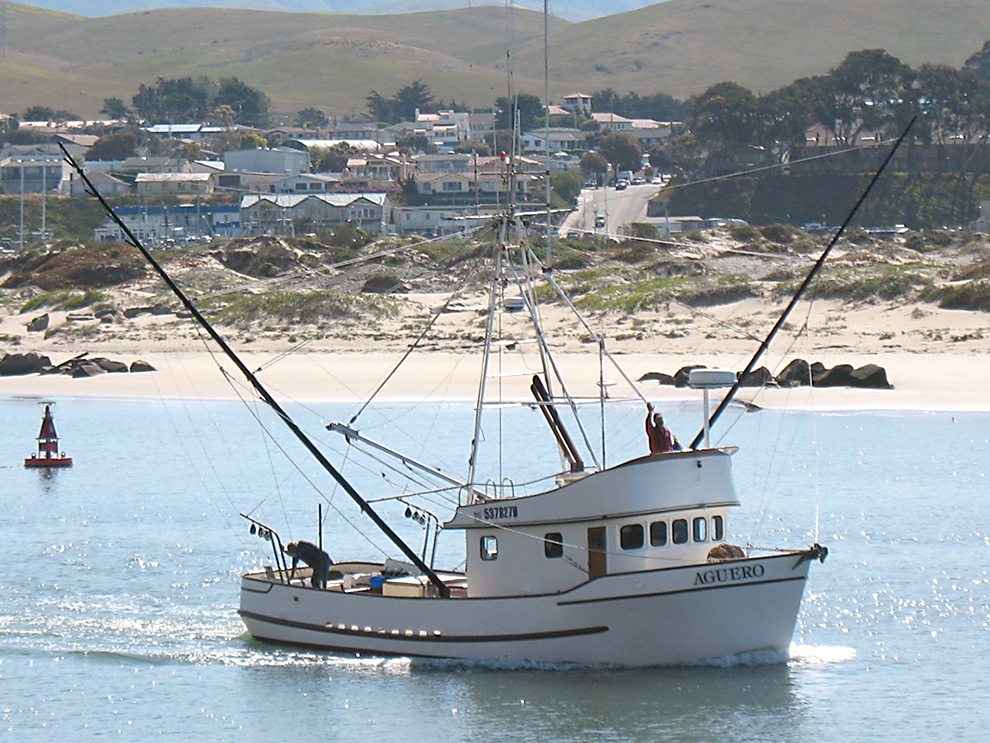
The MBCFO represents the working men and women of Morro Bay, California’s waterfront. (Courtesy: Morrow Bay Commercial Fishermen’s Organization)
The Morro Bay Commercial Fishermen’s Organization (MBCFO), the Port San Luis Commercial Fisherman’s Association (PSLCFA), and Castle Wind LLC (Castle Wind), a joint venture between Trident Winds Inc. and TotalEnergies Renewables USA are forming the Morro Bay Lease Areas Mutual Benefits Corporation (Morro Bay MBC).
The purpose of the Morro Bay MBC is to facilitate communication, coordination, and cooperation between the California Central Coast commercial fishing industry and offshore wind project developers, as well as to provide financial resources in furtherance of California Coastal Act policies.
Morro Bay MBC creates a pathway for the industry to demonstrate to the fishermen and fishing communities, to BOEM, and to the California Coastal Commission, the commitment of project developers to responsible offshore wind development that protects and supports a sustainable commercial fishing industry.
“We recognize the imperative behind developing our offshore wind resource for the benefit of all Californians and appreciate that developers like Castle Wind understand the importance of minimizing and compensating for the possible impacts of the offshore wind farms off Morro Bay on the fishing community,” said Tom Hafer, President of the MBCFO. “The newly formed Morro Bay MBC will help ensure that the Central Coast fishing industry is meaningfully included in the development of this new industry.”
“We, as a humanity, are facing a climate emergency and have to put all our efforts towards achieving a clean energy future,” said Alla Weinstein, CEO of Castle Wind LLC. “With any energy project of this magnitude, there are likely to be impacts. Our approach has been to acknowledge, as early as possible, that impacts may occur, which is why we have been working directly with the Central Coast fishermen since the inception of Castle Wind. By establishing the Morro Bay MBC at this early stage in the process, Castle Wind has created a platform for the developers to mitigate anticipated impacts of offshore wind to the commercial fishing industry without causing stakeholder fatigue.”
The Morro Bay MBC furthers the 2018 mutual benefits agreement signed by MBCFO, PSLCFA, and Castle Wind, which was exclusive to the three signatories. The Morro Bay MBC’s structure is open to all project developers who will secure site leases in the Morro Bay Wind Energy Area, and to fishermen that can prove they have been fishing in that area even if they are not members of MBCFO or PSLCFA.
The board of the newly-formed organization – which includes two representatives from each MBCFO and PSCFA, two representatives from Castle Wind, two seats for representatives from other project developers, and one Harbor Master – will be working together to encourage other project developers to join the Morro Bay MBC prior to the upcoming lease auction.
Vestas will provide its V236-15.0 MW™ offshore wind turbines, with installation expected in 2027. Once installed, the project will generate enough clean energy to power more than 700,000 U.S. homes.
After a thorough and competitive process, Atlantic Shores Offshore Wind (Atlantic Shores), a 50/50 partnership between Shell New Energies and EDF Renewables, recently announced its selection of Vestas as the preferred supplier for its 1.5 GW offshore wind project in New Jersey.
Vestas will provide its V236-15.0 MW™ offshore wind turbines, with installation expected in 2027. Once installed, the project will generate enough clean energy to power more than 700,000 U.S. homes.
This preferred supplier agreement (PSA) was signed shortly after New Jersey Gov. Phil Murphy issued an Executive Order increasing the state’s offshore wind target by 50 percent to achieve 11 GW by 2040.
“The Murphy administration has set bold offshore wind development and emissions reduction goals, and we’re backing up those commitments to a more sustainable Garden State through focused action and concrete investments that address climate change while creating good family sustaining jobs,” said Jane Cohen, executive director of the New Jersey Governor’s Office of Climate Action and the Green Economy. “Atlantic Shores’ selection of Vestas as the preferred supplier of its New Jersey offshore wind project marks another crucial step toward our state’s transition to a green economy and realizing our clean energy future.”
“(The) announcement by Atlantic Shores Offshore Wind and Vestas is an exciting step forward for one of New Jersey’s first offshore wind projects,” said New Jersey Board of Public Utilities President Joseph L. Fiordaliso. “This key development milestone helps keep the state on track for achieving Governor Murphy’s goal of 100 percent clean energy by 2050 and our nation leading goal of 11GW of offshore wind by 2040.”
With this project, New Jersey, Atlantic Shores, and Vestas are together taking a leading role in meeting the state’s clean energy goal,while also advancing the Biden administration’s goal to support the deployment of 30 GW of offshore wind in the United States by 2030.
“We are proud to partner with Atlantic Shores Offshore Wind as the preferred supplier for its project and deploy our flagship V236-15MW™ turbine to help New Jersey achieve its goal of rapidly developing offshore wind and creating new clean energy jobs,” said Laura Beane, president of Vestas North America. “Scaling offshore wind in the U.S.A. depends upon consistent policy and predictable, steady volume over a long period of time, and New Jersey’s newly stated 11-GW offshore target combined with stable federal policy signals this intent.”
Given the state’s significant investment in the New Jersey Wind Port and keeping in line with the Atlantic Shores’ commitments to New Jersey as part of its selected Project 1 proposal, Vestas intends to establish a nacelle assembly facility at the New Jersey Wind Port in Salem County where the assembly and testing of the hub, cooler top, and heli-hoist modules will take place. The facility will supply Atlantic Shores’ inaugural project in its portfolio.
In addition, Vestas will deliver a comprehensive wind turbine service solution as soon as the project commences operations. These services will be executed from a state-of-the-art operations and maintenance base established by Atlantic Shores in Atlantic City, that will also provide additional local employment opportunities over the life of the project.
“Since our award in June 2021, Atlantic Shores has conducted an extensive due diligence and procurement process to find the right turbine supply partner that will enable us to deliver the best value to the state of New Jersey, including local content commitments,” said Joris Veldhoven, CEO of Atlantic Shores Offshore Wind. “We are proud to have concluded that process with the selection of Vestas as our preferred supplier, and we look forward to moving forward together to successfully deliver our Project 1.”
“Congratulations to Atlantic Shores on a major milestone investment decision as part of its development of one of the largest offshore wind projects in the U.S., which is a sign of tremendous confidence in Governor Phil Murphy’s offshore wind economic development strategy that has positioned New Jersey to be the capital of American offshore wind,” said NJEconomic Development Authority CEO Tim Sullivan.
If the agreement with Atlantic Shores is converted to a firm order for Vestas, Vestas will disclose the order in a company announcement in accordance with the company’s disclosure policy.
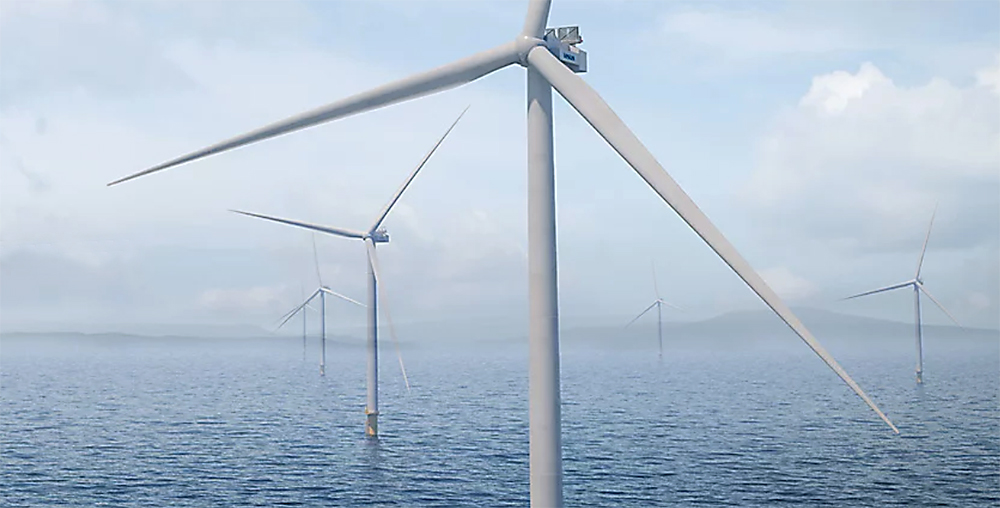
Perceptual Robotics has entered an innovative new inspections partnership with global renewable investments company EuroEnergy.
The company, which has bases in the U.K. and Europe, has been carrying out wind-turbine inspections at EuroEnergy’s site in Greece earlier this year successfully using its unique DOT drone and Dhalion system.
EuroEnergy, which is a subsidiary of Libra Group, has now bought a Perceptual Robotics’ Dhalion drone, allowing them to conduct their own drone inspections going forward while receiving all the benefits of inspections’ analysis and reports from the Bristol-based company.
The Dhalion system is designed to undertake autonomous in-depth turbine inspections, collecting high-quality data from turbines in less than 20 minutes, and quickly analyze the data collected.
EuroEnergy is a renewable energy investment company with operating assets in Greece and Romania with a track record of acquiring, developing, and operating more than 500 MW renewable energy assets across biogas, solar, and wind power. The Libra Group is focused on six sectors: aviation, renewable energy, maritime, hospitality, real estate, and diversified investments, with subsidiaries active across six continents.
Theofanis Mermigkousis, COO of EuroEnergy, said Perceptual Robotics had impressed them by offering a different type of inspection for its wind turbines.
“As one of the leading renewable energy companies with operating assets in Greece and Romania, ensuring we can keep our turbines at maximum output is essential to the success of EuroEnergy,” he said. “Perceptual Robotics’ Dhalion drone has the benefit of being fully automated while allowing us to track the progress of any damage on our turbines over multiple inspections. This means we can ensure we are maintaining our assets to the best of our ability, cutting costs and increasing safety. We are delighted to enter into this partnership with Perceptual Robotics.”
Perceptual Robotics initially carried out inspections at EuroEnergy’s Tripoli site in the summer, doing everything in house to demonstrate the technology.
Engineers at EuroEnergy have now undergone training with Perceptual Robotics to operate their own Dhalion drone, allowing the company to carry out their own inspections in house on wind turbines and explore together solar panels inspection. Perceptual Robotics will continue to produce the results of each inspection within 48 hours, with EuroEnergy able to access the data anywhere in the world.
Kostas Karachalios, CEO of Perceptual Robotics, said the two companies were exploring the possibility of using Dhalion to inspect EuroEnergy’s solar sites in the future.
“This is the beginning of a great partnership between EuroEnergy and Perceptual Robotics,” he said. “We are thrilled they have singled-out Dhalion as their inspection system of choice after experiencing the success of the system for themselves at inspections we carried out this summer. We look forward to strengthening this relationship over time with the possibility of inspecting EuroEnergy’s solar and other assets.”
The Business Network for Offshore Wind, the leading non-profit working to accelerate offshore wind development and build a dedicated manufacturing supply chain in the United States, welcomed U.S. Congressman Bobby Scott, Maritime Administrator Rear Admiral Ann Phillips (United States Navy, Retired), and more than 350 business leaders and maritime industry experts to discuss the challenges and opportunities facing the nation’s port and vessel infrastructure at the OSW Port & Vessel Summit in Norfolk, Virginia.
“Ports and vessels are the foundation of America’s offshore wind industry,” said Liz Burdock, president and CEO of the Business Network for Offshore Wind. “As the pipeline of offshore wind projects continues to grow up and down our coasts, it is critical that we work together to address challenges like upgrading our existing ports, tackling the shortage of specially designed transport vessels, and leveraging new investments from the Inflation Reduction Act. The 2022 Offshore Wind Port & Vessel Summit convened key maritime industry leaders, state and federal officials, private sector companies, worker representatives, and utilities to discuss and showcase the tremendous port and vessel business opportunities that are rapidly unfolding across the industry.”
“Virginia’s workforce, infrastructure, and geography make it well positioned for offshore wind,” Scott said. “In building offshore wind generation and an offshore wind supply chain, it is essential that we do it right: ensuring that we cut emissions while creating good-paying jobs, and also ensure that communities benefit from these investments. The Inflation Reduction Act goes a long way in ensuring that American workers will not only manufacture the components and build the turbines, but also will make enough to sustain their families.”
Speakers focused on a wide range of issues that will be critical to resolve over the next decade as more turbines are installed in East Coast waters, from financing port infrastructure improvements and autonomous vessel technology, to ensuring the availability and capacity of vessels, scaling the nation’s shipyards, and achieving a net-zero supply chain. Businesses also received critical information about how to best position themselves to take advantage of the recently-passed Inflation Reduction Act (IRA), which has numerous provisions that benefit the offshore wind industry, including the vessel manufacturing credit.
“Recently, I was able to designate vessels that service offshore wind-farm facilities as vessels of national interest — the first vessels so designated under this authority,” said Maritime Administrator Rear Admiral Ann Phillips (United States Navy, Retired). “This reflects the Administration’s commitment to supporting these vessels and construction of them to service offshore wind terminals. Within MARAD and the Department of Transportation, we will do whatever we can to support this effort, working closely with partners through government and industry and ensuring that we have the vessels, the capacity, and the mariners to build this new industry.”
The Board of Directors for Atlantic Shores Offshore Wind, LLC, (Atlantic Shores), a 50/50 partnership between Shell New Energies US LLC and EDF Renewables North America recently appointed Joris Veldhoven as the company’s first Chief Executive Officer.
“I am excited and humbled to lead the continued growth of Atlantic Shores, one of the nation’s leading offshore wind developers, as we continue to set the standard for offshore wind development in the United States,” Veldhoven said. “As a company, we are uniquely positioned to both mitigate climate change and generate positive impact on those who live in the local communities in which our projects will be built. I am grateful to work with a talented, diverse, and highly skilled team focused on building the future of clean, renewable offshore wind energy.”
Atlantic Shores has grown significantly since its inception in 2018, bringing together its parent companies’ decades of experience developing offshore and onshore projects across the globe. The joint venture is comprised of more than 100 experts dedicated to delivering its 5-plus-GW portfolio, and is strategically positioned to meet the growing demands of its markets in New York and New Jersey.
In June 2021, the New Jersey Board of Public Utilities awarded the organization an Offshore Renewable Energy Credit to deliver enough renewable energy to power 700,000 homes in the State of New Jersey. The lease areas will be developed in stages, with Project 1 slated to begin construction in 2024.
“It is a true pleasure to see Joris take the helm of Atlantic Shores Offshore Wind,” said Tristan Grimbert, president and CEO, EDF Renewables North America. “Joris’ strategic acumen coupled with business intellect has positioned him to smoothly transition into this important role. Joris is the right person at the right time to lead the venture into future success. I am grateful for the exceptional performance of the entire Atlantic Shores team and excited by the opportunity ahead to convert this hard work into carbon free electricity for the residents of New Jersey and New York.”
Veldhoven previously served as Atlantic Shores’ commercial and financial director where he focused on developing the domestic supply chain, building local partnerships, creating economic benefits for the community at large, and helping to lead the company’s overall growth. Veldhoven has also been the global wind supply chain manager for Shell New Energies Wind and, over the span of a decade, has held various commercial roles with Shell in The Netherlands, Norway, and the United Arab Emirates.
“Joris has been a key member of the Atlantic Shores team and has helped shape and grow the company since the start,” said Amanda Dasch, Shell Vice President Offshore Power Americas, RE&S. “As New Jersey and New York work toward reaching their offshore wind procurement targets, Joris will provide strategic direction to be the partner of choice in providing more, affordable renewable power generation for their communities.”
The International Wind Congress will be in Berlin, Germany, November 7-8. It focuses on wind energy, and it will provide its participants — developers, operators, EPC(I)s, Electricity TSOs — with a place to discuss their projects in a closed-door format.
The two-day business program features more than 45 case studies from wind-energy experts, including Energinet, Maple Power, The Scottish Government, Hexicon, and Equinor. The topics of discussions include:
Repowering and recycling of aged assets.
Digital optimization with big data, AI, and drones.
Wind-farm challenges.
Enlargement of turbines.
Factors in offshore wind-farm development.
Also, the framework of achieving 2030 goals by using new technologies and making new projects will be discussed. The closed-door format ensures only key representatives of companies and decision-makers will be in attendance; therefore, the exchange of views and consultations are expected to be mutually productive.
The list of confirmed participants already includes representatives from more than 20 wind farms, including Thor Offshore Wind Farm, Saint-Brieuc offshore wind farm, Nordsee One, ScotWind, and Albatros.
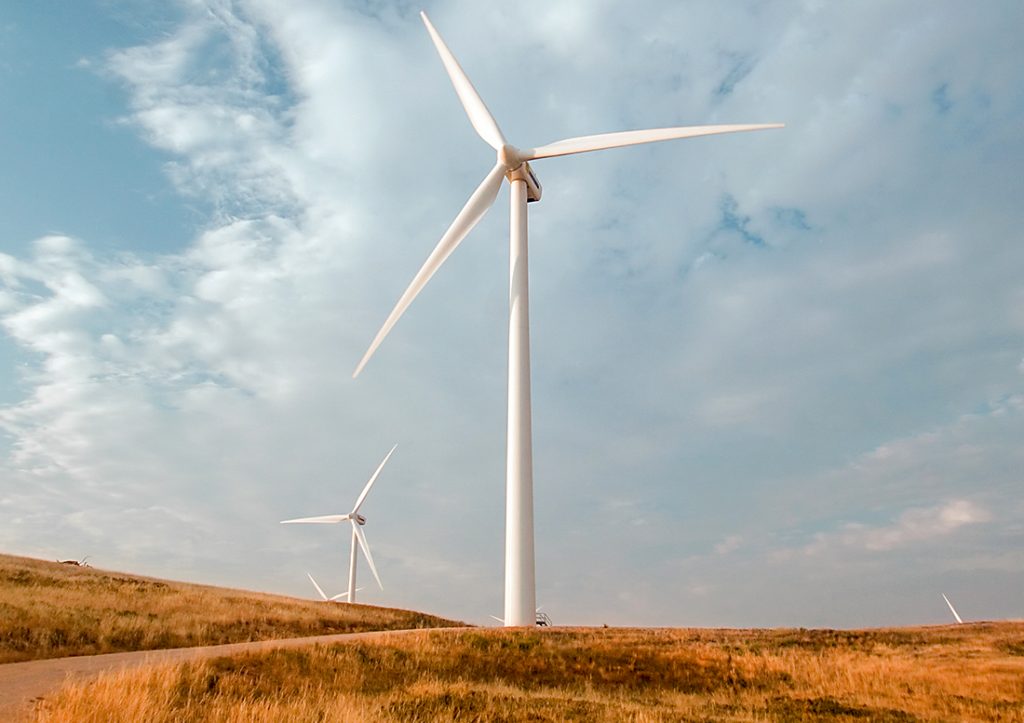
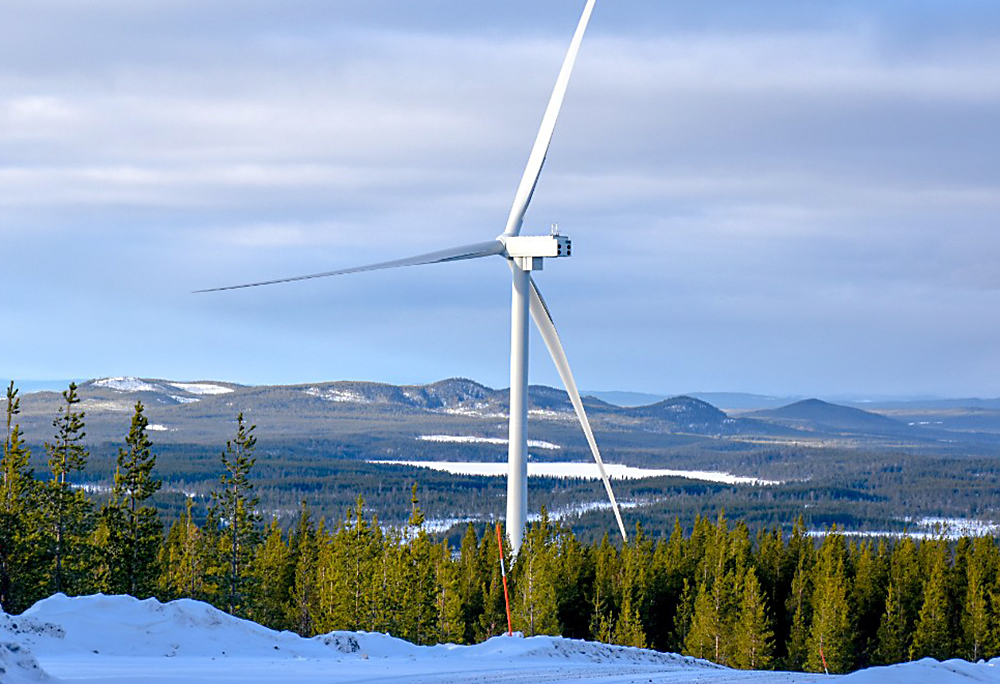
The boundaries of onshore wind continue to be pushed higher with the launch of a new product of the Siemens Gamesa 5.X platform with a rated power of 7 MW.
The new SG 7.0-170 turbine will offer one of the most competitive levelized cost of energy (LCOE) in the industry, enabling customers to provide more clean power. The variant has evolved from the original SG 6.6-170 turbine and is particularly aimed at medium- to high-wind sites globally.
The powerful Siemens Gamesa 5.X wind turbine has attracted strong interest from customers since its launch with sales of about 4.5 GW to date from Brazil to Finland.
“This is a natural evolution of the species,” said Siemens Gamesa’s CEO Jochen Eickholt. “The Siemens Gamesa 5.X has already offered our customers one of the most powerful machines providing green energy in the onshore landscape, and we can now boost its capacity even higher. This will provide real benefits for our partners, and we will work closely with them to guarantee we continue to deliver sustainable energy to the world with this benchmark turbine.”
The first Siemens Gamesa 5.X turbine was installed in Sweden at the 231-MW Skaftåsen project. Since that first project, customers have placed orders for the wind turbine in many other countries including Brazil, Finland, Germany, Romania, and Spain.
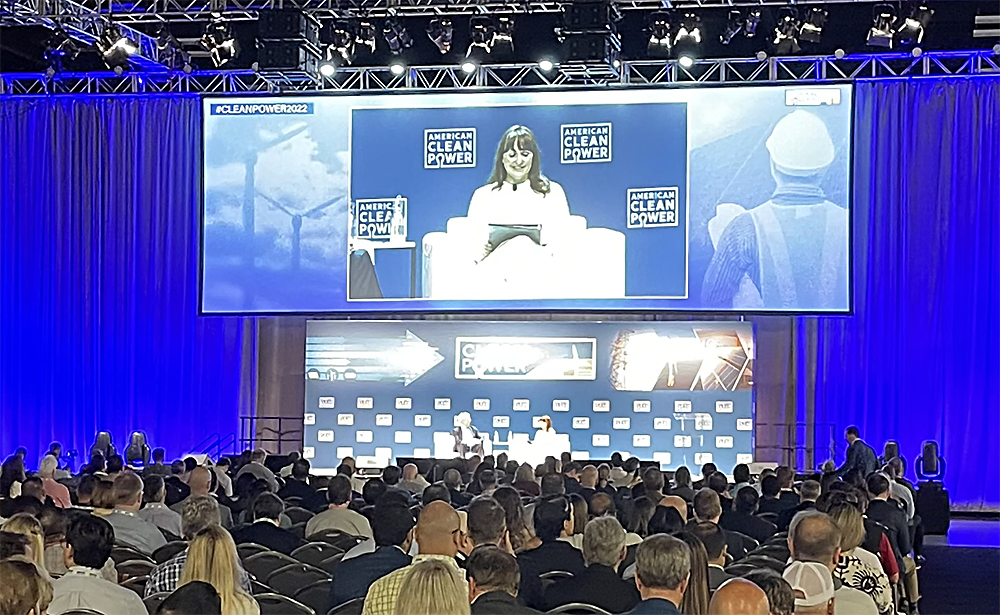
ACP CEO Heather Zichal speaks during a presentation at CLEANPOWER 2022. (Courtesy: Wind Systems)
Heather Zichal, CEO of the American Clean Power Association (ACP), recently announced she is moving on from the helm of the organization after two years to take on a new role as the new Global Head of Sustainability at JPMorgan Chase.
Craig Cornelius, the CEO of Clearway Energy and Chair of ACP’s Board of Directors and Leo Moreno, the President of AES Clean Energy and incoming Chair of the Board, will engage more directly with the senior team until a successor is selected.
“In her two years at the helm of ACP, Heather has positioned us as the single voice of the clean energy industry,” Cornelius said. “Thanks to her leadership, the organization is the strongest it’s ever been. While we are sorry to lose her and wish her continued success, we are confident that the next CEO will build on the momentum she and her team have created.”
In a short time, ACP has been instrumental in securing a series of major advocacy victories on behalf of its members, including the bipartisan infrastructure law and the historic passage of the Inflation Reduction Act (IRA), which has brought predictability and certainty to the clean-energy sector for the next 10 years. Under her leadership, membership has grown to more than 750 companies, and the organization has more than doubled revenue in just its first 18 months.
“Heather has built a large team of talented, experienced and purpose-driven professionals while completing a successful merger of two organizations,” Moreno said. “On behalf of the Board, Craig and I will work closely with the executive team as they lead the staff through the next few months until a permanent successor is named.”
As the search gets underway, the Board has appointed J.C. Sandberg, chief advocacy officer, as interim CEO. Sandberg will continue to lead the organization’s ambitious advocacy agenda building on the momentum of significant victories he and his team achieved with the passage of the IRA. In addition, Jason Clark, chief strategy officer, has been named interim president, responsible for the day-to-day execution of the association’s operations, while assuming management responsibility for the executive team. Rosanna Maietta, chief communications officer and senior counselor, will continue in this capacity supporting Sandberg, Cornelius, and Moreno, in addition to elevating the organization’s visibility in and outside Washington.
“Leaving ACP is the toughest professional decision I’ve ever had to make, especially after the historic progress we’ve made together,” Zichal said. “We’ve grown as a trade association, with nearly double the resources and an entire, diverse team of experts paving the way for a clean-energy future at the state, regional, and federal level. In my remaining time here, I am going to work tirelessly to set ACP up for a smooth transition and have tremendous faith in J.C., Jason, Rosanna, and the entire executive team who will be a steady hand on the wheel in the coming days and months ahead.”
The Board has appointed a nominating committee made up of select members and engaged Russell Reynolds to lead the process to select the next ACP CEO.
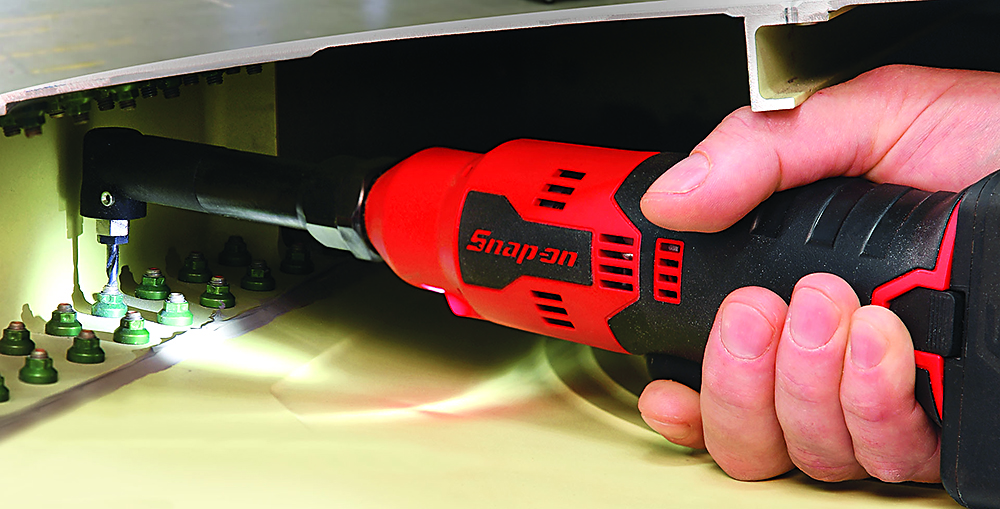
The 14.4 V MicroLithium Mini Drills are ideal for applications within public transportation manufacturing, fleet maintenance, repair and overhaul, and more. (Courtesy: Snap-on Industrial)
The new angled-head 14.4 V MicroLithium Mini Drills from Snap-on Industrial provide precise drilling without the need for tethering to an air source.
The 14.4 V MicroLithium Mini Drills are ideal for applications within public transportation manufacturing, fleet maintenance, repair and overhaul, public safety vehicles, electronic component manufacturing and installation, HVAC and others where small holes are needed, often in hard-to-reach locations. Using a cordless drill with small compact recessed heads gives technicians unhindered access, while also removing tripping hazards caused by air hoses in the shop or plant floor.
For added flexibility, the 14.4 V MicroLithium Mini Drills come in three different models: 45° angle head (CDRR200545DB), 90° angle head (CDRR2005DB), and 360° fully rotating head (CDRR2005360DB).
Features and benefits of the new 14.4 V MicroLithium Mini Drills include a compact head for great access, a variable speed trigger, low runout for precise drilling, quarter-inch threaded bits and accessories accepted, ability to run items such as reams and sealant removal cutters. More features include a double ball bearing-supported spindle shaft for durability, spiral beveled gears for durability and smooth operations, multiple configurations, LED light to illuminate the work area, soft grip handle for positive tool control, and a battery life gauge.
Clir Renewables, the market intelligence platform for wind and solar, has been retained as the data analysis and optimization service for the Okanagan Wind portfolio. (Courtesy: Okanagan Wind)
Clir Renewables, the market intelligence platform for wind and solar, has been retained as the data analysis and optimization service for the Okanagan Wind portfolio following Canadian Power’s purchase of the sites from Toronto-based InstarAGF Asset Management.
Comprised of Pennask Wind Farm and Shinish Creek Wind Farm, Okanagan Wind represents the only wind power facilities in the Okanagan region, with a combined capacity of 30 MW – enough to power roughly 9,000 Canadian homes.
Prior to the 2021 sale to Canadian Power, the sites became operational in 2017. Making up two of only seven grid-scale wind farms in the province, the farms were developed in partnership with a local indigenous group who continue to benefit today through community funding and access to jobs.
Clir Renewables developed its data management, software-as-a-service platform alongside the original owner as a foundational client. Work to date on the Okanagan Wind portfolio includes upgrade validations, met mast configuration and icing studies, accounting for challenging meteorological conditions attributable to the sites’ mountainous geography.
Following the sale in 2021, Clir was retained by the new owner, Canadian Power, to provide continued support with analytics, reporting, and upgrade validation. Clir software empowers owners and asset managers to analyze and optimize their assets using a suite of tools based on proprietary AI and machine learning algorithms.
These tools have been trained using the company’s extensive dataset from over 200 GW of assets from different OEMs, technologies, regions, and ages. This allows users to quickly detect site-specific issues and understand performance in relation to the wider industry.
“Collaborating with Canadian Power from the start of their tenure at Okanagan Wind has been brilliant. After inheriting our services in the sale, we worked to help them understand the power of our offering and its benefit to the business,” said Oscar Radevsky, Clir project engineer.
“It has been satisfying to see a client get increasing value from the tools we offer here at Clir. I am confident that this momentum will continue and we look forward to continuing this mutually beneficial relationship.”
“I have been consistently impressed by the value Clir Portfolio is able to add to our projects. It gives us a crystal-clear picture of all our data in one place, allows us to dig into performance issues, and makes it easy to do monthly and quarterly reporting. We look forward to working with Clir as Canadian Power continues to expand its presence in the renewable energy sector,” said Steven Gwatkin, Okanagan wind operations manager.
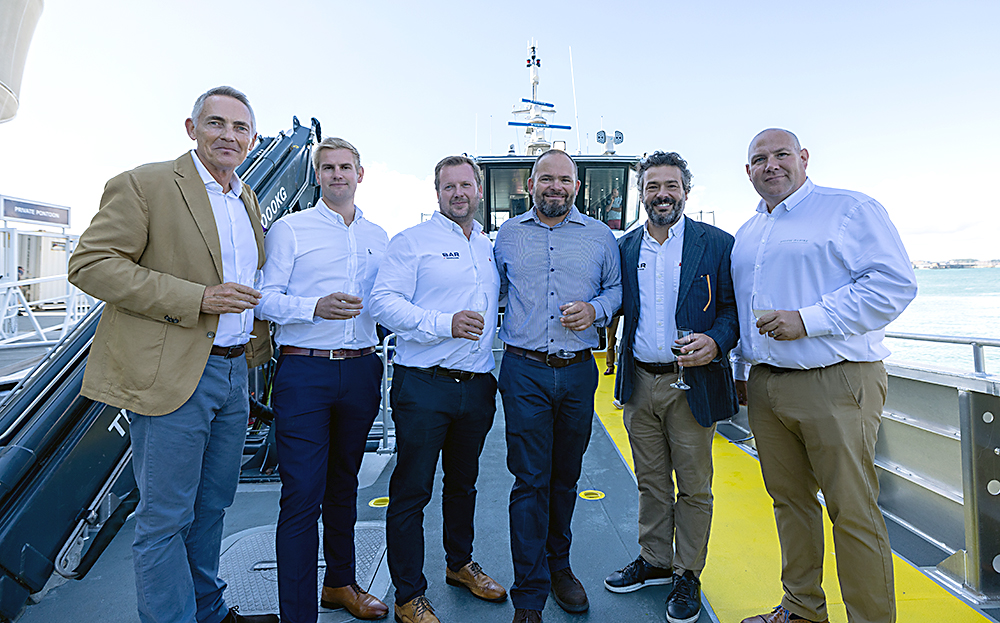
As part of the launch, the vessel was named Seacat Columbia by Ian Baylis, founder of Seacat Services, and Martin Whitmarsh. (Courtesy: BAR Technologies UK)
BAR Technologies, a simulation-driven marine engineering consultancy, held the official launch of its first BARTech 30-crew transfer vessel (CTV) from its premises on The Camber, Portsmouth. BAR Technologies Chair Martin Whitmarsh, also chair of the Offshore Wind Growth Partnership, led his BAR Technologies colleagues to hand over the first vessel of its type to class leading OESV operator, Seacat Services.
As part of the launch, the vessel was named Seacat Columbia by Ian Baylis, founder of Seacat Services, and Martin Whitmarsh. Guests attending the ceremony were given an in-depth tour of the vessel and shown some of the key features that provide the new craft’s efficiency and handling.
The BARTech 30 was designed to address the two most pressing challenges of the offshore wind industry: vessel efficiency, and therefore emissions reduction, and the comfort in transfer, and subsequent effectiveness, of offshore wind engineers.
In the first instance, many of the major offshore wind developers and owners are beginning to look in earnest at the rates of fossil fuel consumption in wind farm service vessels. Secondly, any offshore engineering personnel beset by sea-sickness in travel to a project must be returned to port, meaning that a vessel transporting up to 24 engineers must cease its transit to a project site, resulting in expensive downtime for the project owner.
With its 30m ProA design, and active foiling systems to correct for pitch and roll, the BARTech 30 is able to minimize vessel motion and fuel burn, leading to an average increase in stability across all sea states of up to 70% and a reduction in total emissions of 30% over a typical operational profile, making the vessel one of the first Low Emission Vehicles (LEVs) serving the UK’s growing fleet of offshore wind farms.
Additionally, with the vessel able to operate in more challenging conditions than the current catamaran designs, offshore wind turbines may be serviced over a greater number of sea states, ensuring wind farm owners have more opportunities to better and more cost effectively provide turbine maintenance.
“BAR Technologies was established to leverage the highest level of engineering expertise and understanding of hydrodynamics from the fields of Formula 1 racing and the Americas Cup respectively, to take on some of the biggest challenges in vessel efficiency and maritime decarbonization,” said Martin Whitmarsh, BAR Technologies chair.
“Alongside our pioneering wind propulsion technology for the shipping industry, our latest developments in crew transfer vessel design, demonstrated by the BARTech 30, are helping to significantly mitigate the ‘last mile’ of carbon emissions in offshore wind development and construction.”
“We know that the offshore wind industry has led several innovations in cost reduction since its inception. We’re now able to take this efficiency drive one step further with a vessel design not only able to operate in wider offshore parameters and presenting new savings in servicing and maintenance, but, also combined with a significant reduction in fuel consumption.”
“Following our preview of the vessel at the Seawork maritime event in June, we’re thrilled to officially launch the BARTech 30 here at our home in The Camber in Portsmouth,” said BAR Technologies CEO John Cooper.
“Having our first customer delivery is a key milestone in our development of the BARTech 30 program, and we look forward to seeing further customer orders for the vessel fulfilled in the near future.”
“In taking this pioneering design to market, we’ve been able to bring in elements of collaboration from other South Coast marine designers and consultancies, and the Isle of Wight based vessel manufacturer, helping to secure a domestic supply chain for a key part of the UK offshore wind industry,” Cooper said.
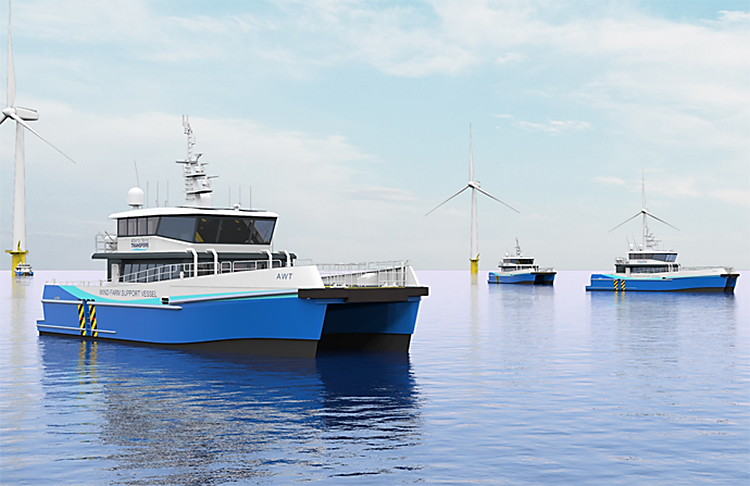
The first two vessels are expected to be delivered in summer 2023 and January 2024, respectively. (Courtesy: Atlantic Wind Transfers)
Atlantic Wind Transfers (AWT), the first US offshore wind farm support company, has ordered six Chartwell Ambitious-class Crew Transfer Vessels (CTV) designed by UK-based pioneers of vessel design, Chartwell Marine.
AWT’s order comprises six CTVs, and will be constructed by St. John’s Ship Building Inc. at its shipyard in Palatka, Florida. The first two vessels are expected to be delivered in Summer 2023 and January 2024 respectively, with four further builds in the pipeline. The vessels will be the first US-built CTVs to be compliant with the US Environmental Protection Agency’s Tier 4 regulations, which rank among the most stringent emissions rules for marine engines in the world.
Through its continued partnership with Chartwell Marine, AWT demonstrates its commitment to the growth of the US offshore wind market. Building US Jones-Act Compliant vessels certified under US Coast Guard Subchapter L, these CTVs will be able to operate on any wind farm in the United States up to 150 miles offshore, under the Safety and Inspection standards of the US Coast Guard. AWT operates the only two crew transfer vessels in the US under long-term contracts, servicing the Block Island Wind Farm and Coastal Virginia Offshore Wind Farm. AWT’s seven years of operating experience in US offshore wind brings an impeccable safety track record while logging over 6,600 TP connections and 25,000 personnel transfers.
“We’re pleased to strengthen our pioneering status in delivering another first for the US offshore wind sector with these new Tier IV vessel orders. Our goal is to build the most reliable, multi-purpose Jones-Act CTV fleet in the US, and provide our clients with cutting edge technology while lowering our carbon footprint and meeting all Jones Act and USCG Regulations. This investment will enable us to have crew transfer vessels available for charter to support the demand over the next several years,” said Charles A. Donadio Jr., founder of Atlantic Wind Transfers.
“Our experience has proven our vessel model works for both the shipyard construction phase with on-time deliveries, and in-service uptime reliability for installation support and long-term O&M. Chartwell is our go-to when it comes to CTV designs which are operating in multiple international markets. We see our partnership with both Chartwell and St. John’s Ship Building as a key cornerstone in our strategy to build the capability and capacity of AWT to support the future growth of the offshore wind industry.”
The Ambitious is Chartwell’s flagship CTV design; a 25.2m aluminum catamaran with capacity to transport 24 personnel to and from turbines with speed, safety, and stability.
“The US offshore wind market is expanding rapidly, and AWT’s pioneering vision to support this growth aligns well with our own ambition to bring versatile, high-performance crew transfer vessels to the markets that need them most. With its performance and versatility, the Ambitious delivers on the needs of the growing US market,” said Andy Page, director and navel architect at Chartwell.
“St. Johns Ship Building is excited to be working with Charlie Donadio and to be part of Atlantic Wind Transfers’ successful CTV operation and their extensive planned new vessel construction program. This effort further solidifies our position as a leading supplier of Jones Act compliant CTVs for the offshore wind industry and working with highly experienced European naval architects such as Chartwell Marine. We know that our skilled workers also appreciate the additional opportunity to showcase their high quality craftmanship and will allow continued growth and opportunity,” said Jeff Bukoski, president of the shipyard.
The new Lanfine Wind Project, located in Oyen’s Special Area 3 in Alberta, has now entered its final construction phase. (Courtesy: Pattern Energy)
The Lanfine Wind Project, located in Oyen’s Special Area 3 in Alberta, has entered its final construction phase, with the wind turbines being lifted and installed in their final locations, as well as the blades being attached to the rotors. This new facility is expected to be operational by the end of this year, after an investment of close to C$350 million.
Borea, the company in charge of the construction and installation of the 35 Vestas V150-4.2 MW wind turbines that will make up the wind farm, has required the collaboration of Sarens, a specialist in heavy lifting, engineered transport and crane rental, for the lifting of each of the structures, as well as the lifting of the blades for their installation.
For these tasks, Sarens has used a Liebherr LR1600 Crawler Crane, part of its fleet of cranes in Canada, thanks to its maximum lifting capacity of 660 US tons with a main boom maximum length of 420 feet, and its great capacity to move over uneven and soft terrain, always guaranteeing the safety and viability of the operation.
The new Lanfine Wind Project, which will be operated by Pattern Energy, is considered strategic for the Alberta region’s energy grid, to which it will be able to provide 150 MW, enough to supply renewable energy to more than 25,000 homes in the region. In addition, since the project began at the end of 2020, this wind farm has created 200 construction jobs, to which must be added those corresponding to maintenance and operation work that will be created once it is operational.
This new park will also provide a boost to the local economy in the region, as it will generate landowner revenue and provide tax revenue to the local community, which will directly contribute to education, community services, roads and first responders. As a part of this project, a community benefits program that will support local initiatives and community-based organizations, has also been created.
Sarens has a long history of developing wind projects in Canada. These include the Whitlaw Wind project, the Golden South Wind Project in Asinibola, and the Blue Hill Project in Saskatchewan, where Sarens contributed to the transport and erection of 50 wind turbines at their final destination. This facility will be responsible for generating up to 200MW of renewable energy, enough to power up to 100,000 homes, and will bring an economic impact of over $45M to its community.


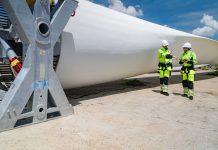





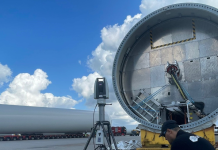



 DNV‘s specialist team analyzes and develops reports for wind-farm owners and operators, showing, among other things, which materials the wind turbines contain, how they can be disposed of in the best possible way, what can be recycled, and how. Now, in collaboration with Reodor Studios, a Norwegian corporate venture and innovation studio, DNV will shape this into a digital service.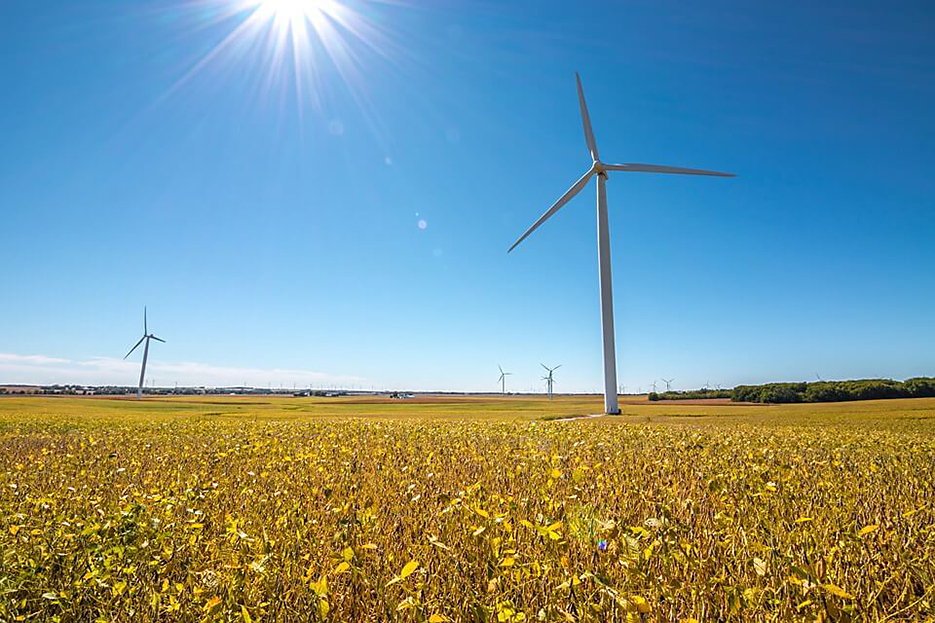

 Perceptual Robotics has entered an innovative new inspections partnership with global renewable investments company EuroEnergy.
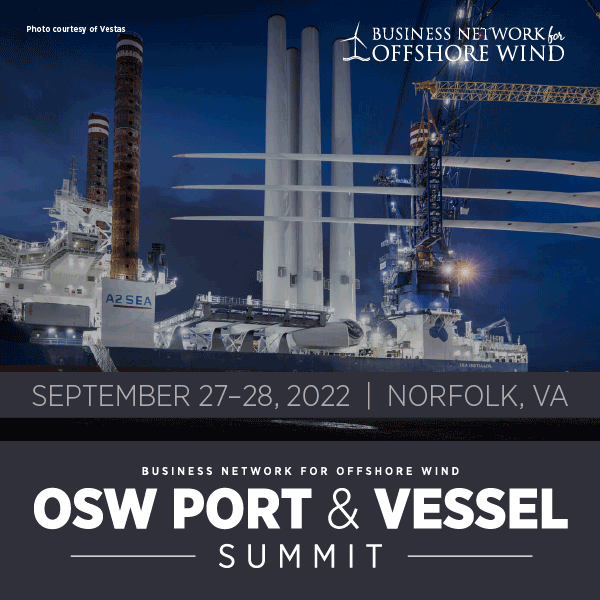 The Business Network for Offshore Wind, the leading non-profit working to accelerate offshore wind development and build a dedicated manufacturing supply chain in the United States, welcomed U.S. Congressman Bobby Scott, Maritime Administrator Rear Admiral Ann Phillips (United States Navy, Retired), and more than 350 business leaders and maritime industry experts to discuss the challenges and opportunities facing the nation’s port and vessel infrastructure at the
 The International Wind Congress will be in Berlin, Germany, November 7-8. It focuses on wind energy, and it will provide its participants — developers, operators, EPC(I)s, Electricity TSOs — with a place to discuss their projects in a closed-door format.
 The boundaries of onshore wind continue to be pushed higher with the launch of a new product of the Siemens Gamesa 5.X platform with a rated power of 7 MW.