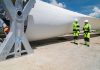





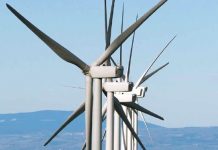

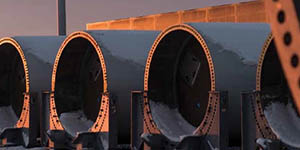
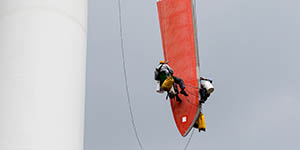
EDF EN Canada Inc., and Enbridge Inc., recently dedicated the 300 MW Blackspring Ridge Wind Project. Located in Vulcan County, Alberta, the project is the largest investment in wind energy in Western Canada.
EDF EN Canada and Enbridge officials joined Alberta Energy Minister Diana McQueen, Derrick Annable, Reeve of Vulcan County, Kym Nichols, Mayor of Carmangay, and more than 100 other invited guests to mark the occasion.
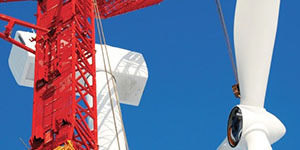
Construction of the 166 turbine project commenced in May 2013 and reached commercial operation twelve months later in May 2014. Mortenson Canada served as the construction contractor.
Home 2014
EDF EN Canada And Enbridge Dedicate Blackspring Ridge Wind Project
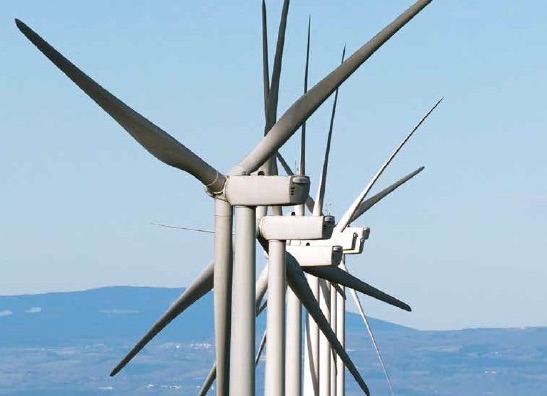
DOI Opens Mass. Wind Energy Area, Doubling Available U.S. Offshore Wind Acreage
As part of the Obama administration’s Climate Action Plan, Secretary of the Interior Sally Jewell and Bureau of Ocean Energy Management (BOEM) Acting Director Walter Cruickshank today joined Massachusetts Governor Deval Patrick to announce more than 742,000 acres offshore Massachusetts will be available for commercial wind energy leasing. The proposed area is the largest in federal waters and will nearly double the federal offshore acreage available for commercial-scale wind energy projects.
The Massachusetts Wind Energy Area is located approximately 12 miles offshore Massachusetts – from its northern boundary, the area extends 33 nautical miles southward and has an east/west extent of approximately 47 nautical miles. BOEM proposes to auction the Wind Energy Area as four leases.
“Massachusetts is leading the way toward building a clean and sustainable energy future that creates jobs, cuts carbon pollution and develops domestic clean energy resources,” Jewell said. “Thanks to Governor Patrick’s vision and leadership, the competitive lease sale in Massachusetts will reflect the extensive and productive input from a number of important stakeholders. This includes interests such as commercial fishing, shipping, cultural, historical, environmental, and local communities to minimize conflicts and bring clarity and certainty to potential wind energy developers."
“Today’s announcement is a momentous occasion and the culmination of years of cooperation and hard work between the Commonwealth and federal officials,” Patrick said. “Through our investments and proactive planning, Massachusetts is poised to lead the charge in offshore wind energy development, with the economic and environmental benefits that come with it.”
The announcement builds on Interior’s work to stand up a sustainable offshore wind program through its wind energy initiative for the Atlantic Coast. To date, BOEM has awarded five commercial wind energy leases off the Atlantic coast: two non-competitive leases (Cape Wind in Nantucket Sound off Massachusetts and an area off Delaware) and three competitive leases (two offshore Massachusetts-Rhode Island and another offshore Virginia). To date, competitive lease sales have generated about $5.4 million in high bids for about 277,550 acres in federal waters. BOEM is expected to hold additional competitive auctions for Wind Energy Areas offshore Maryland and New Jersey later this year.
“The Commonwealth of Massachusetts has been working hand in hand with BOEM to foster responsible commercial wind development in federal waters off Massachusetts,” said BOEM Acting Director Cruickshank. “Members of the Massachusetts Renewable Energy Task Force have been great partners in our planning process for the Wind Energy Area and the Proposed Sale Notice.”
To help inform BOEM’s decision-making, the Commonwealth established two working groups, a Fisheries Working Group on Offshore Renewable Energy to discuss issues and compatibility between commercial fishing activities and offshore commercial wind energy development, and a Habitat Working Group on Offshore Renewable Energy to discuss available ecosystem data and information within the area under consideration in order to identify any gaps.
The Commonwealth has additionally collected and presented spatial information and data for the Wind Energy Area regarding marine mammals, birds, ocean floor, geology, commercial ship traffic, and recreational boating to inform BOEM’s offshore wind planning process. In addition to BOEM’s stakeholder outreach, the Commonwealth has conducted dozens of public meetings and stakeholder sessions to discuss the Federal offshore wind leasing process.
Since taking office in 2007, Governor Patrick’s Administration has worked to position Massachusetts as a hub for the emerging U.S. offshore wind industry. These efforts also include the construction of the Marine Commerce Terminal in New Bedford, the first facility in the nation designed to support the construction, assembly, and deployment of offshore wind projects.
The Proposed Sale Notice announced today triggers a 60-day public comment period ending on August 18, 2014. Comments received or postmarked by that date will be made available to the public and considered before the publication of the Final Sale Notice, which will announce the time and date of the lease sale.
The end of the comment period also serves as the deadline for any participating companies to submit their qualification packages. To be eligible to participate in the lease sale, each bidder must have been notified by BOEM that it is legally, technically and financially qualified by the time the Final Sale Notice is published. For more information on qualification requirements, please see The Proposed Sale Notice. Companies planning to submit a qualification package are strongly encouraged to submit as early as possible during the comment period to ensure adequate time for processing.
BOEM will host a public seminar during the comment period to describe the auction format, explain the auction rules, and demonstrate the auction process through meaningful examples. The time and place of the seminar will be announced by BOEM and related information will be published on BOEM’s website.
In addition to the Proposed Sale Notice, BOEM is publishing in the Federal Register a Notice of the Availability (NOA) of a Revised Environmental Assessment and a Finding of No Significant Impact (FONSI). The FONSI states that BOEM has determined that no reasonably foreseeable significant impacts are expected to occur as a result of issuing wind energy leases and the approval of Site Assessment Plans in the Massachusetts Wind Energy Area. Before a decision regarding the construction of any proposed wind power facility, BOEM will conduct a comprehensive site-specific National Environmental Policy Act review, which will include additional opportunities for public comment.
DNV GL FORCE Approach Aims To Reduce Cost Of Offshore Wind
DNV GL’s project FORCE (For Reduced Cost of Energy) has identified potential savings of at least 10 percent of the cost of offshore wind energy, if an integrated approach to four market-ready technologies is adopted. The cost savings identified by the FORCE team could be exploited by industry right now if industry shifts to collaborative design, engineering and procurement processes.
Project FORCE was set up to explore how the idea of “integrated design” could reduce offshore wind costs when applied to the wind turbine and its supporting structure for a typical project. Twenty-five DNV GL expert engineers from disciplines including cost modeling, offshore load calculations, blade design, controller design and structural design were brought together to work on the problem. This multi-disciplinary project has revealed the magnitude of the potential savings that a “joined-up” approach to the design of large offshore wind turbines and their support structures could achieve. Through the combination of four technologies (integrated design, relaxation of frequency constraints, enhanced control systems and slender, faster blades) aggregate cost savings of over 1 billion euros ($1.35 billion) in NPV terms could be achieved over the next decade.
However, these benefits can only be unlocked if the industry’s approach to engineering, design and procurement changes. DNV GL advocates a shift towards collaborative practices in order to address the misalignment of design-risk and cost-saving reward, which is currently blocking the cost-cutting power of near-market innovation.
Executive Vice President for Renewables Advisory at DNV GL – Energy, Dr. RV Ahilan commented: “The cost savings identified by the FORCE team could be exploited by industry right now. The problem is the misalignment between the design-risk of the changes needed and the cost-reduction reward delivered by those changes. Whilst the former mostly lies with the wind turbine manufacturer, the latter benefits the complete offshore wind asset. The technology is there – we now need to smash down the commercial barriers to make it happen.”
In order to remove these barriers, DNV GL believes a rapid maturation of industry practice is needed via an integrated and collaborative approach to design, engineering and procurement. DNV GL invites expressions of interest in a potential Joint Industry Project (JIP) to accelerate such a transition.
It is DNV GL’s hope that if the collaborative approach to engineering, design and procurement championed in this report can be applied in a broader sense, there will be a change of mind-set toward building and operating offshore wind “power stations” rather than collections of individual wind turbines — offering cost reduction benefits well beyond the minimum 10 percent identified in the work of project FORCE.
Dr. Tim Camp, Head of Turbine Engineering at DNV GL – Energy comments: “Ultimately healthy levels of collaboration are as important as healthy levels of competition. Whilst we have made significant progress on improving supply chain competition over the last few years, it is now time that we start acting like a mature industry — embracing both collaboration and integration.”
Vestas Releases 1Q 2014 Financials
In the first quarter of 2014, Vestas generated revenue of EUR 1,283 million—an increase of 17 percent over the year-earlier period. EBIT before special items increased by EUR 148 million to EUR 40 million due to improved project margins, higher revenue, lower fixed capacity costs and lower depreciation. The EBIT margin before special items was 3.1 percent and the free cash flow increased by EUR 36 million to EUR (24) million compared to the first quarter of 2013. During the last 12 months, Vestas has generated a free cash flow of EUR 1,045 million.
The intake of firm and unconditional wind turbine orders was 1,188 MW in the first quarter of 2014. The value of the combined backlog of wind turbine orders and service agreements stood at EUR 13.8 billion—an improvement of EUR 1.4 billion compared to the year-earlier period.
Group president & CEO Anders Runevad said: ”As we expected, first quarter showed improvements in all major areas. This is a result of a lot of hard work from my colleagues and we remain focused on executing on our strategy—profitable growth for Vestas.”
Xcel Energy Achieves Wind Energy Milestone
Xcel Energy achieved a milestone recently, when wind power met 46 percent of customers’ electricity needs in the company’s Upper Midwest service territory.
At the time the company’s Upper Midwest record was set, wind resources provided 1,622 megawatts of the 3,512 megawatts Xcel Energy’s customers were using in Minnesota and neighboring states. The previous record was set in April 2013, when wind generation met 42 percent of customer demand.
Xcel Energy is currently adding 750 megawatts of wind resources in its Upper Midwest territory. Four wind projects have been approved by Minnesota regulators, representing a 42 percent increase in the company’s wind power capacity in the Upper Midwest. All four projects—two in Minnesota and two in North Dakota—are scheduled to be in service by the end of 2015.
Wind generation produces 12 percent of the energy used by Xcel Energy’s Upper Midwest customers.
CanWEA To Ontario PC Party: Reconsider Wind
The Canadian Wind Energy Association (CanWEA) recently urged the Ontario PC Party to reassess its energy policy platform, and to acknowledge that affordable energy for Ontario should include wind energy—a clean, renewable and cost-competitive source of electricity supply.
“Independent analyses by the energy consulting firm Power Advisory LLC show that wind energy was responsible for only 5 percent of the increase in electricity bills between 2009 and 2012. The bulk of rising electricity prices comes from expensive upgrades to decades-old power plants and transmission systems,” said CanWEA President Robert Hornung. “The PC Party is mistaken when claiming renewable sources like wind energy are the key driver of rising electricity bills.”
Hornung added that the PC Party is confusing facts and logic by declaring wind energy is subsidized. “Wind energy can provide electricity more cheaply than new nuclear power and is cost-competitive with new hydro developments,” he says. “Wind energy developers absorb almost all of the upfront costs in developing their projects, which means no front-end or long-term risks to taxpayers and ratepayers. New wind-driven electricity is being secured through long-term, pre-set contracts that contribute to price certainty and to keeping Ontario electricity rates stable and competitive across North America.”
Wind energy projects continue to see falling costs as new turbine technology boosts output, and economies of scale reduce production and supply costs. Requiring no fuel costs to maintain the flow of electricity, wind energy is not subject to variable market pricing for fuel supplies bought outside Ontario.
Wind energy companies have spent over $5 billion since 2009 to develop Ontario’s wind energy industry. Every megawatt of new wind energy represents an investment of approximately $2 million; a large portion of which is spent in the local community. Largely through these efforts, wind energy today has supported new manufacturing facilities and new jobs for graduates—and now meets over 3 percent of the province’s electricity demand, doubling over the past four years to 5.2 terawatt hours, about what 550,000 average homes use each year.
Any energy platform should be more in step with how modern electricity systems are evolving around the world, Mr. Hornung adds. “Progressive governments are seeing how wind energy reduces carbon emissions, improve grid reliability, and leads to more predictable and stable electricity prices.”
Nordex Targets Further Growth And Improvement In Earnings In 2014
On the basis of its audited consolidated financial statements, Nordex confirms the preliminary figures for 2013 which it had reported in February. Thus, consolidated sales rose by around 33 percent to EUR 1,429.3 million (previous year: EUR 1,075.3 million), with return on sales widening to 3.1 percent. Consolidated profit after interest and taxes amounted to EUR 10.3 million, compared with a loss of EUR 94.4 million in the previous year, which arose mainly as a result of exceptional expenses in connection with the strategic realignment of the Group.
The gross margin expanded from 21.4 percent to the planned level of 22.6 percent in 2013.
This substantial improvement reflects operating measures such as cuts in the cost of materials of an average of around EUR 100,000 per turbine, more profitable contracts with new products and more professional execution of projects.
This development was particularly encouraging as Nordex’s production and installation output simultaneously reached a new record. Thus, turbine assembly output rose by 48 percent to 1,342 MW, while installations of new wind turbines increased by 36 percent to 1,254 MW.
In this way, Nordex was able to outperform industry trends and double its market share to almost eleven percent in its core EMEA region. In addition, Nordex installed wind power systems in South Africa and Uruguay for the first time. Consequently, Nordex is once again amongst the world’s ten largest producers of onshore wind turbines.
Nordex Receives Research Loan From EIB
The European Investment Bank (EIB) will support the research and development activities of wind turbine manufacturer Nordex SE. The bank will provide the company with a loan of EUR 100 million for its multi-year R&D program.
Within the framework of the R&D program, which is due to run until 2017, Nordex will work together with suppliers and research institutes in the European Union. With this research, Nordex plans to step up the development of increasingly efficient technical solutions in order to improve its competitiveness. At the same time the company aims to achieve grid parity for wind energy in all standard locations.
Among the focus areas for funding activities of the EU bank are projects designed to protect the climate and the environment. In 2013, financing in this area accounted for a total share of EUR 19 billion with the expansion of renewable energies playing a key role. In 2013, the EIB provided loans amounting to EUR 6.4 billion for this purpose.
PRODUCT SHOWCASE: Kurt Hydraulics Introduces 6W Couplings With High-Pressure Hoses For The Wind Energy Industry
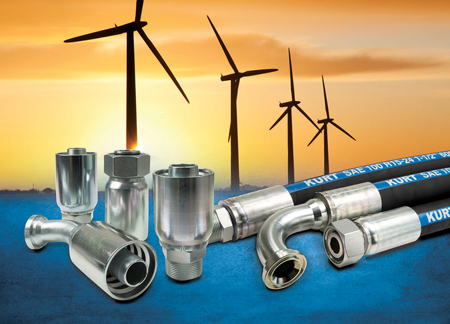
Kurt Hydraulicsâ line of 6W Couplings combined with high pressure braided hose are ideally suited for applications that require high pressure capabilities and temperature ranges from -40°F to 250°F for the wind industry. The couplings are a one-piece, bite-the-wire crimp coupling with non-skive design to eliminate cover skiving before assembly to the hose.
The Kurt 6W Couplings make assembly simple, quick and enhance the hydraulic hose assembly to maintain more integrity which is crucial in many applications. The couplings eliminate leaks and in-field failures caused by shock and vibration and are ideally suited in wind energy hydraulic systems.
Kurt 6W Couplings are available in 85 different types and popular sizes of 1¼â, 1½, 2â and are designed to work with SAE R13 and 4SH hydraulic hoseâalso available from Kurt. The 6W couplings can withstand ultra high pressure of up to 6000 psi, and are suited for operations ranging in temperatures from -40° F to 250°F.
All Kurt couplings meet or exceed SAE specifications and are quality manufactured in accordance with ISO 9002/QS 9000 quality processes and systems. They are finished with RoHS compliant trivalent Chromum-6 Free process, a highly durable finish which exceeds the industry SAE standard by 4X hours of salt spray.
For more information, visit www.kurthydraulics.com.
PRODUCT SHOWCASE: Flex Element Design Couplings Add Electrical Insulation To Mechanical Components

Motion system designers have a new option to arrest electrical current. In addition to their primary function, Zero-Max CD® couplings are designed with composite flex elements that are non-conductive.
The flex element designed into Zero-Max CD couplings provides electrical insulation while protecting mechanical components from system overloads. CD Couplings do not pass electrical current through the coupling.
In addition to protecting from stray electrical current, CD couplings protect generators in a system from transferring lower reaction loads to the generator bearings. The couplingâs composite discs withstand all types of environmental elements, including temperature extremes from -40 to +70°C, and also moisture and chemicals.
Additional operating features include: zero backlash; excellent for reversing loads; smooth operation at high speeds; and compact size with a clamping system that fits most applications. CD couplings have very long life cycles and require less replacement over time. They provide exceptional cost-effectiveness and reduced waste.
CD couplings are available in many models and sizes, including custom designs for unusually large and challenging applications such as wind turbines. Standard models and sizes include single and double flex models with clamp style hubs with or without keyways. The torque capacities range from 40Nm to 1436Nm and beyond with speed ratings from 4400 RPM to 17,000 RPM.
All CD couplings are environmentally friendly and are manufactured of RoHS compliant materials.
For more information on products and services call (800) 533-1731, or visit www.zero-max.com.
Greensmith On Track To Integrate Four New Battery Types In 2014
Greensmith, a leader in grid-scale energy storage technologies has announced it is on track to successfully integrate an additional four new battery types in 2014, bringing the company’s total since inception to 12 using its battery-agnostic technology platform, now in its fourth generation. With over 23 MW of energy storage capacity to be deployed in 2014, Greensmith continues its rapid growth by serving an expanding list of strategic customers and channel partners looking to take full advantage of the company’s proven technologies and application expertise, including frequency regulation, grid stability/deferral, renewable integration, and commercial/industrial functionality.
Refined over many years of development, innovation, and real-world deployment experience, Greensmith’s software platform enables the rapid economic integration of both current and future battery technologies, always selected and configured according to the objectives and requirements of the target application. Although the company continues to develop and deliver turn-key energy storage systems at scale, a number of customers and partners are choosing to license Greensmith’s software and integration technology a-la-carte.
“From the very start, Greensmith believed that the potential for energy storage lay beyond ‘batteries-in-a-box,’ and that robust layers of software, integration and optimization were critical to capturing its full value”, said John Jung, Greensmith CEO. “It was also clear that a variety of battery alternatives, suitable for different application needs, would be available over time and therefore need to be easily integrated into a single, resilient technology architecture. So we built and advanced our battery-agnostic technology through multiple cycles of product development and delivery. We’re quite pleased to be on pace to successfully integrate our 12th battery type by the end of 2014— and while it’s become fashionable to proclaim battery-agnosticism in the marketplace, it’s quite another thing to have actually executed and delivered the goods.”
NEC Acquires Grid Energy Storage And Commercial Systems Business Of A123 Systems From Wanxiang
NEC Corporation has announced the acquisition of the A123 Energy Solutions business unit of A123 Systems, LLC. This acquisition, for approximately $100 million, strengthens the energy storage capability of NEC’s smart energy business, a core segment of its Mid-term Management Plan’s commitment to social infrastructure. A123 Energy Solutions will be integrated into the NEC Group of companies and operated globally as a key element of its business. An agreement on the terms of the deal has been finalized and a new company “NEC Energy Solutions” is slated to begin operation in June under the direction of NEC. A123’s existing cell manufacturing and sales, research and development, and automotive operations will remain the core focus of A123 Systems, LLC.
With this acquisition, NEC will become the world’s leading supplier of lithium-ion grid energy storage systems. A123 Energy Solutions has deployed over 110MW of its Grid Storage Solutions (GSS™) worldwide with the vast majority of these systems already in revenue service. The company will continue to supply systems using A123 Systems’ Nanophosphate® lithium-ion cells and support all existing installations. NEC Energy Solutions, with access to NEC Corporation’s world-class information communications technology (ICT) and A123 Energy Solutions’ system integrations expertise, is now better prepared to address the increasing global need for energy storage. In addition, NEC’s high quality, cost-effective lithium-ion technology adds to the ever-growing portfolio of energy storage technologies available for future use in A123 Energy Solutions’ GSS platform. At the same time, NEC will leverage A123 Energy Solutions’ experience in commercial batteries in order to serve NEC’s telecommunication carrier, enterprise and government customer base, thereby helping to drive the global expansion of NEC’s smart energy business.
ACCIONA Debuts Medium-Wind Site Turbine In Las Vegas
ACCIONA Windpower has upgraded its AW125/3000 wind turbine, with a new version specially designed for medium-wind sites (IEC IIb). This new design was highlighted at the WINDPOWER 2014.
The upgraded design of the AW125/3000 allows for siting at locations with higher average wind conditions and lower turbulence intensity.
The AW125/3000 combines a 125-meter rotor with a three megawatt wind turbine generator and is available on multiple tower heights ranging from 87.5 meters to 140 meters. With the 87.5m tower, the AW125/3000 IEC IIb wind turbine—which has 61.2-meter blades—is uniquely positioned to deliver maximum Annual Energy Production while staying within a 150-meter tip-height threshold in sites with aviation permitting constraints.
The first Design Assessment for the AW125/3000 IEC IIb is expected by the end of 2014 and deliveries are available in early 2015.
GEâs Wind PowerUp Reaches 1,000 Installations
GE recently announced that its Wind PowerUp platform has secured more than 1,000 units under contract to date. PowerUp is a customized software-enabled platform that allows wind farm operators to increase annual energy production (AEP) on their turbines by up to 5 percent, taking into account environmental conditions. A 5 percent increase in energy output translates to up to a 20 percent increase in profit per turbine.
“The industry’s response to Wind PowerUp has been exciting to see over the past seven months,” said Anne McEntee, president and CEO of GE’s renewable energy business. “We have been working with our customers to develop customized solutions ideal for their fleet and working with them in new ways that helps them win.”
PowerUp adjust performance dials, including speed, torque, pitch, aerodynamics, and turbine controls with the goal of maximizing the power output of a wind farm.
Sage Oil Vac Receives 2014 Presidentâs âEâ Award
The U.S. Department of Commerce has awarded Sage Oil Vac, Inc. of Amarillo, Texas the 2014 President’s “E” Award in recognition for the company’s achievements in making significant contributions to the increase of U.S. exports.
Sage Oil Vac has demonstrated a sustained commitment to U.S. export expansion. The “E” Award Committee has recognized Sage’s innovation in the development of services for the wind turbine industry, as well as the company’s customization of products for export markets. Companies receiving this award have contributed to national export expansions efforts that support the U.S. economy and create American jobs.
The President’s “E” Award was created by President John F. Kennedy in 1961, and more than 2,500 firms have been recognized through the “E” Awards since the program’s inception. The “E” Award program is managed by the U.S. Commercial Service, which nominates the recipients. Through 108 domestic offices and locations in more than 70 countries, ITA offers programs and services focused on export promotion.
The primary criterion for the President’s “E” Award for Exports is four years of successive export growth, usually accompanied by a rising percentage of export sales within total sales. The application should demonstrate export expansion that is measurable, innovative, sustainable, and has broad impact.
Prairie Wind Completes Section Of Transmission Line
Kansans are a step closer to benefitting from a more robust electric transmission system with a portion of the Prairie Wind Transmission line now in service. About 78 miles of the 108-mile, double circuit 345 kV transmission line is complete and moving electricity between Wichita and Medicine Lodge. The line was energized Wednesday. The remainder of the Prairie Wind project, which will take the line from Medicine Lodge south to the Kansas/Oklahoma border, is scheduled to be complete by the end of 2014.
The Prairie Wind line is part of a broader project commonly referred to as the Y-Plan. The Y-Plan will alleviate congestion in the region’s transmission grid.
“Construction of the line has brought good paying jobs to the communities near the line, giving local economies a boost,” said Kelly Harrison, president of Prairie Wind Transmission and vice president, transmission of Westar Energy. “This line is like an electricity super highway Portion of Prairie Wind Transmission line energized that will strengthen the state’s transmission system for decades, providing Kansas communities with more reliable electricity, enabling development of wind energy and giving Kansans access to lower cost electricity.”
Under this plan, OG&E will continue the Prairie Wind line from the Kansas/Oklahoma border to Woodward, Okla. ITC Great Plains is constructing a line from Medicine Lodge to a Clark County, Kan. substation and then to Spearville, Kan. All of the transmission line projects under the Y-Plan are scheduled to be complete by the end of this year.
Through careful project planning and management, the estimated cost of the Prairie Wind line was lowered last fall to $170 million, about 25 percent less than original estimates of $225 million. Prairie Wind is a joint venture formed by Westar Energy and Electric Transmission America — a joint venture of an American Electric Power subsidiary and MidAmerican Transmission — to build and own new electric
Lucintel Forecasts Global Wind O&M Market To Reach $14 Billion By 2018
The global wind operation and maintenance market is set to expand with stable demand potential in the near future. The wind operation service market accounted for more than 20 percent and the wind maintenance service market accounted for more than 75 percent of the global wind operation and maintenance marketing 2012. The three main components of wind turbines, gearbox, generator, and wind blades account for more than 50 percent of repair and replacement servicing needs. According to market forecasts, the global wind operation and maintenance market is expected to reach $14,014 million by 2018.
Lucintel, a leading global management consulting and market research firm, has conducted a competitive analysis on this market and presents its findings in "Growth Opportunities in Global Wind Operation and Maintenance Market 2013-2018: Trend, Forecast, and Opportunity Analysis.” This study provides a concise overview of the global wind operation and maintenance market in terms of value and projected annual growth.
Lucintel discusses the various challenges and opportunities faced by the wind O&M market. Efficient and timely operation and maintenance servicing has a positive impact — both on reducing repair costs and improved performance output of large machines. In this market, it is very critical to have ready inventory of spare parts or a strong supply chain that can respond to the repair needs when they occur.
Lucintel's study encompasses the major drivers. Mostly, aging wind turbines cause unexpected failure of components, such as gearboxes, generators, and rotor blades, which is a major driver for wind operation and maintenance costs. So, improving turbine reliability is a priority for the manufacturers.
This report highlights different aspects of the wind operation and maintenance market. Due diligence has been given to the current market scenario. Europe is the leader in this market with the highest market share, followed by APAC.
The global wind operation and maintenance market is expected to grow significantly in near future. The top players need to formulate effective marketing strategies to take advantage of the opportunities, resulting in improved revenue and profitability.
Lawmakers Praised For Introducing Rural Wind Energy Development Act
Representatives Earl Blumenauer (OR-03) and Tom Cole (OK-04) introduced the Rural Wind Energy Development Act to provide an investment tax credit to ranchers, farmers, and small businesses to offset the up-front costs of owning a distributed wind turbine. This modest expansion of current law will keep small business energy jobs growing across the United States.
Distributed wind projects are present in all 50 states, providing clean, homegrown, affordable power and economic development across the United States. These systems are commonly, but not always, installed on residential, agricultural, commercial, industrial, and community sites and can range in size from a few-hundred-watt, off-grid turbine at a remote cabin or a 5-kW turbine at a home to a multi-MW turbine at a manufacturing facility.
“I applaud Representatives Blumenauer and Cole for their leadership at this critical time for our industry,” said Jennifer Jenkins, Executive Director of the Distributed Wind Energy Association. “This industry is bigger than just one job or one type of turbine. We have an entire supply chain here in the U.S. providing parts for a wide range of distributed wind systems, while employing Americans and providing American-produced electricity. This legislation will provide stability and certainty for the entire distributed wind market and allow this American success story to go on.”
The Congressmen issued the following statements earlier today:
“Community wind energy not only creates American-produced electricity, but American jobs as well,” said Blumenauer. “Approximately 90% of distributed wind turbines sold in the U.S. are made here, according to domestic manufacturing content, creating non-exportable, family wage jobs.”
“I am pleased to once again work with my friend and colleague in furthering the success of the same credit we worked to create in 2008,” said Cole. “Not only does the credit play an important role in encouraging and developing an all-of-the-above energy approach for our nation, but it also ensures that America continues to be a leader in innovation. By modestly increasing this credit, we can continue to encourage economic development, especially in our rural communities.”
The existing investment credits, which may be taken in lieu of the federal Production Tax Credit for large-scale wind projects, have worked very well, but are too limiting. This bill strikes the existing 100 kilowatt nameplate limitation for small wind systems, and expands the maximum wind turbine size to 20 megawatts, in line with the Federal Energy Regulatory Commission definition of distributed wind power.
This will provide stability and certainty for the distributed wind market and unlock the necessary investment to grow our global leadership role in distributed wind power, while helping Americans take advantage of clean, renewable, affordable power.
EPA Proposes Carbon Reduction Guidelines
The U.S. Environmental Protection Agency has released its Clean Power Plan proposal, which for the first time cuts carbon pollution from existing power plants, the single largest source of carbon pollution in the United States. The proposal will protect public health, move the United States toward a cleaner environment and fight climate change while supplying Americans with reliable and affordable power.
Power plants account for roughly one-third of all domestic greenhouse gas emissions in the United States. While there are limits in place for the level of arsenic, mercury, sulfur dioxide, nitrogen oxides, and particle pollution that power plants can emit, there are currently no national limits on carbon pollution levels.
With the Clean Power Plan, EPA is proposing guidelines that build on trends already underway in states and the power sector to cut carbon pollution from existing power plants, making them more efficient and less polluting.
By 2030, steps EPA is taking will:
· Cut carbon emission from the power sector by 30 percent nationwide below 2005 levels, which is equal to the emissions from powering more than half the homes in the United States for one year;
· Cut particle pollution, nitrogen oxides, and sulfur dioxide by more than 25 percent as a co-benefit;
· Avoid up to 6,600 premature deaths, up to 150,000 asthma attacks in children, and up to 490,000 missed work or school days—providing up to $93 billion in climate and public health benefits; and
· Shrink electricity bills roughly 8 percent by increasing energy efficiency and reducing demand in the electricity system.
The Clean Power Plan will be implemented through a state-federal partnership under which states identify a path forward using either current or new electricity production and pollution control policies to meet the goals of the proposed program. The proposal provides guidelines for states to develop plans to meet state-specific goals to reduce carbon pollution and gives them the flexibility to design a program that makes the most sense for their unique situation. States can choose the right mix of generation using diverse fuels, energy efficiency and demand-side management to meet the goals and their own needs. It allows them to work alone to develop individual plans or to work together with other states to develop multi-state plans.
Also included in the proposal is a flexible timeline for states to follow for submitting plans to the agency—with plans due in June 2016, with the option to use a two-step process for submitting final plans if more time is needed. States that have already invested in energy efficiency programs will be able to build on these programs during the compliance period to help make progress toward meeting their goal.
IEA: $48 Trillion Needed To Meet Global Energy Needs To 2035
Meeting the world's growing need for energy will require more than $48 trillion in investment over the period to 2035, according to a special report on investment released by the International Energy Agency (IEA) as part of the World Energy Outlook series. Current annual investment in energy supply of $1.6 trillion needs to rise steadily over the coming decades towards $2 trillion. Annual spending on energy efficiency, measured against a 2012 baseline, needs to rise from $130 billion today to more than $550 billion by 2035.
"The reliability and sustainability of our future energy system depends on investment," said IEA Executive Director Maria van der Hoeven. "But this won't materialize unless there are credible policy frameworks in place as well as stable access to long-term sources of finance. Neither of these conditions should be taken for granted. There is a real risk of shortfalls, with knock-on effects on regional or global energy security, as well as the risk that investments are misdirected because environmental impacts are not properly reflected in prices."
Newly compiled data show how annual investment in new fuel and electricity supply has more than doubled in real terms since 2000, with investment in renewable source of energy quadrupling over the same period, thanks to supportive government policies. Investment in renewables in the European Union has been higher than investment in natural gas production in the United States. Renewables, together with biofuels and nuclear power, now account for around 15 percent of annual investment flows, with a similar share also going to the power transmission and distribution network. But a large majority of today's investment spending, well over $1 trillion, is related to fossil fuels, whether extracting them, transporting them to consumers, refining crude oil into oil products, or building coal and gas-fired power plants.
Investment decisions are increasingly being shaped by government policy measures and incentives. While many governments have retained direct influence over energy sector investment, some stepped away from this role when opening energy markets to competition: many of these have now stepped back in, typically to promote the deployment of low-carbon sources of electricity. In the electricity sector, administrative signals or regulated rates of return have become, by far, the most important drivers for investment: the share of investment in competitive parts of electricity markets has fallen from about one-third of the global total ten years ago to around 10 percent today.
Of the cumulative global investment bill to 2035 of $48 trillion in the report's main scenario, around $40 trillion is in energy supply and the remainder in energy efficiency. Of the investment in energy supply, $23 trillion is in fossil fuel extraction, transport and oil refining; almost $10 trillion is in power generation, of which low-carbon technologies – renewables ($6 trillion) and nuclear ($1 trillion) – make up the lion's share; and a further $7 trillion in transmission and distribution. More than half of the energy-supply investment is needed just to keep production at today's levels, that is, to compensate for declining oil and gas fields and to replace power plants and other equipment that reach the end of their productive life. The $8 trillion of investment in energy efficiency is concentrated in the main consuming markets, the European Union, North America and China: 90 percent is spent in the transport and buildings sectors.