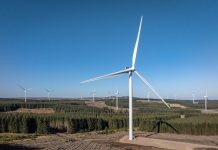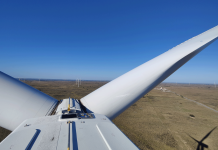



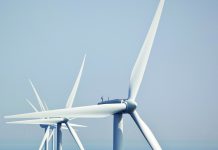



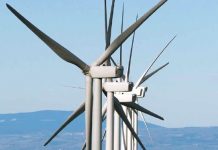
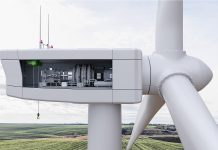
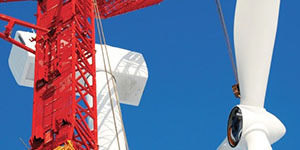

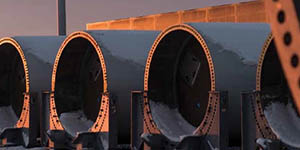
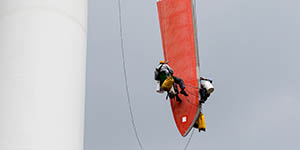
Let’s start with the obvious: Today’s wind turbines are enormous. Keeping them turning and creating power throughout their lifetime can sometimes be a bit more … complicated.
There are many checks and balances and necessary equipment needed to perform that complex task, but nothing may be more essential than the lubricants within the turbine itself.
To that end, Castrol has been creating lubricants for wind turbines since the early 1980s, according to David DiNunzio, Wind Key Account manager, North America.

Expanding its wind knowledge
In 2000, Castrol was acquired by BP as the company began to expand its presence in alternative energy, including wind. These investments focused on building and operating wind farms, especially in the United States, according to DiNunzio.
“That gave us some really unique insight into the wind business,” he said. “Today, it continues to give us a unique opportunity to look at what challenges the OEMs face when they’re building and constructing, and also the responsibilities of the site teams. It gives us valuable perspective that helps us bring the best solutions and develop products to meet new technology as it continues to evolve.”
One of the challenges facing lubricant providers, like Castrol, is the continued growth of the turbines themselves, according to DiNunzio.
“Unfortunately, everything doesn’t scale along with the power output,” he said. “In the past, turbines were small — around 200 to 400 kW — mounted on lattice towers. Today, we’re dealing with machines in the 4 to 6 MW range, which are massive pieces of equipment.”
One of the biggest engineering challenges that comes with this scale is weight.
According to DiNunzio, turbine manufacturers are very cautious about placing large or heavy components at the top of the tower, since doing so can introduce significant safety risks. He noted that the high power output required from modern turbines puts substantial additional stress on the gearboxes, main bearings, and the entire drivetrain.
“The power ratio these turbines have to put out puts a lot more stress on the gearboxes and main bearings — the whole drivetrain,” he said. “It just brings a lot of safety hazards with it.”

The power of lubrication, not just lubricants
To address the challenges, both large and small, Castrol works with customers to focus on the “total cost of ownership,” according to DiNunzio.
“What truly impacts a plant’s profitability isn’t the upfront price of the lubricant, but how it performs over time,” he said. “Castrol’s philosophy is centered on delivering the lowest total cost of ownership through performance, reliability, and advanced technology. In wind, where turbines operate under extreme conditions and service access is limited, our focus has always been on maximizing lubricant technology to extend component life, reduce failures, and simplify maintenance.”
Dealing with different environments
When it comes to total cost of ownership, operating environment matters because wind turbines face vastly different conditions that directly affect reliability and maintenance, according to DiNunzio. Understanding the distinct environments in which wind turbines are built is a critical part of the equation. Total cost of ownership is ultimately shaped by where the turbine operates, because the environment — whether offshore, coastal, or inland — directly affects lubricant performance, component life, and the overall value discussion.
“They’re not sitting in one, neat, sunny climate,” he said. “They’re all over the United States — and really, all over the world. That’s why we have to make products that are flexible to handle those different environments that turbines face.”
Offshore wind also has its own set of challenges, according to DiNunzio, which is why offshore turbines tend to be a little more robust.

“Offshore environments make serviceability even more challenging, so longer-lasting products that extend equipment life become essential,” he said. “Servicing a turbine 300 feet in the air is difficult on its own — adding a boat trip into open water makes it even tougher. That’s why we design products built for these conditions, with broad OEM approvals across multiple platforms.”
With that in mind, Castrol wants to ensure turbines get the best lubrication wherever they’re located, according to DiNunzio.
“We need our technology to perform everywhere — from the equator to the far north, offshore or onshore,” he said.
Finding the best solutions
Staying on top of the latest developments is just part of how Castrol develops the ideal solutions for its clients, according to DiNunzio.
“There’s a lot of competition in the industrial and wind space,” he said. “We’re all working to advance technology, understand emerging challenges, and anticipate where the industry will be in a few years. Developing, testing, and field validating new solutions takes time, so we have to project five to six years out and plan for the challenges ahead we’re going to face. That’s how we balance cost and technology to deliver the most value for our clients.”
As a global organization, Castrol has teams all over the world with expertise in dealing with a variety of different environments, according to DiNunzio.
“As you would expect, our teams in Europe have deeper experience with offshore turbines, while here in the United States the sheer number of onshore turbines gives us a strong base of knowledge, especially through our connection with the bp wind team,” he said. “We focus on asking customers the right questions and engaging the right people. It’s very important to get the opinion of the people in the field that see it firsthand. Input from field technicians, along with engineering and reliability teams, helps us understand the scale of an issue. From there, we can involve data scientists and specialists who monitor predictive technologies. Oil analysis is a core expertise for us, but we also rely on vibration analysis, temperature monitoring, and other diagnostic tools to pinpoint what’s going on. We draw on experience, ask targeted questions, and we’re not afraid to pull in other experts as needed. Troubleshooting is always better with more than one opinion.”

Developing wind-specific products
Castrol’s vast timeline of expertise mean the company has brought a lot of unique solutions to the industry, according to DiNunzio.
“We’ve developed products specific for the wind industry,” he said. “We were one of the first lubricant companies to do that. We’ve pioneered technology that allows gear oil to be reconditioned uptower, which extends oil life and, in turn, equipment life — reducing the amount of service required, which I’ve dedicated a lot of time to testing and proving out the main bearing greases we’ve launched over the past eight years. They’ve boosted reliability across many platforms, earning approvals from nearly every OEM — proof of our product advantages and the industry experience behind them.”
Future of wind
Despite the current political client when it comes to wind energy, DiNunzio said he isn’t worried about the future state of the industry.
“The industry naturally cycles up and down, and wind industry has operated this way for a long time,” he said. “With its dependence on the tax code, fluctuations are expected, but I am confident wind will keep growing quickly. Our energy needs are enormous, and any viable source will be highly sought after.”
It’s also important to remember that wind energy as a power source is still very young compared to others, according to DiNunzio.
“It’s remarkable to see how far the industry has come in the 40 years we’ve been involved,” he said. “Turbine designs have changed rapidly, and we’ve evolved our lubrication technology right alongside them. The materials we use today are completely different from what we used in the ’80s.”
Wind is still a young industry compared with traditional power sources, according to DiNunzio.
“It’s learning how to scale, improve reliability, and support larger machines,” he said. “That’s where we fit in — developing solutions that help operators grow and get more energy from the wind. I’m excited about where wind is headed, which is why I’ve dedicated the past 10 years to it and expect to see even more growth ahead.”
More info: www.castrol.comwind-u