




Most of the pomp and circumstance surrounding a wind farm starts with construction, then it moves on to maintaining those spinning turbines as they create needed power for decades.
But there’s another aspect in the life of a wind farm that doesn’t always get the recognition it deserves, considering what an ultimate performance it serves: wind-farm decommission.
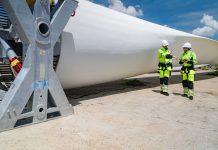
Since its inception in 2021, North Coast Enterprise has completed 61 unique major wind-turbine decommissioning projects across the United States and Canada, according to Tom Sheridan, one of the managing partners at North Coast Enterprise.
“We support utility scale owners of wind farms, the equipment manufacturers such as GE, Vestas, Nordex, Siemens Gamesa, and wind-specific EPC firms such as Mortenson, Blattner, White Construction, and Wanzek,” he said. “We handle the legacy components. When they are repowering or upgrading existing wind farms with new technologies, our job is to dispose of the legacy components. This could range from the proper disposal of gases and fluids to the metal recycling and fiberglass recycling of the wind-turbine blades.”

Decommissioning and repowering
Just the sheer increase of wind farms in the U.S. over the years has made Sheridan and his team’s expertise more needed, but he said it goes beyond that.
“Our wind infrastructure in the United States started becoming more popular about 20 years ago when some of the first utility scale units were installed,” he said. “Those units are nearing the end of useful life, but in many cases, the owners prefer to upgrade those units and extend their power purchase agreements and look to renew the useful life of that farm. That’s where repowering has become popular since about 2018. Rather than letting it go all the way to its end of life and taking it off the power grid, they’re finding ways to — whether that be through major component exchanges or full tear down of old components and building of new components — extend the life of that wind farm and interconnect to the power grid.”
The turbine replacement strategy could involve anything from one to two units to the entire farm, according to Sheridan, however, most projects of this scale involve the entire farm.
“Many times, if there are hundreds of units, they’re going to repower and upgrade the bulk of those units,” he said. “There are certainly times when they might have a maintenance issue and go in and upgrade a couple here or there, but largely our company is involved when they’re doing the major retrofits of the bulk, if not all of the wind farm.”
When North Coast Enterprise does deal with the decommissioning of only a few assets, it is typically a rare critical failure event, according to Sheridan.
“Where they’re going to take the entire infrastructure out of the old components and build a new, more efficient unit in its place, that’s a very widely used practice,” he said. “There are a lot of those projects that are happening today as we speak and continue to be explored for next year and beyond.”

ISO certification
North Coast Enterprise is a project management firm that focuses on safe and efficient services for North American utility scale wind, according to Sheridan.
“Every employee is committed to delivering on our promise with a focus on communication, safety, and the professionalism to facilitate the completion of every project on time, on budget, and with zero safety incidents,” he said. “We’re an ISO certified company specific to wind turbine decommissioning, so one of the core principles of ISO is continual improvement.”
North Coast Enterprise’s ISO certification is a particular source of pride for Sheridan and his team.
“Our ISO certification is something that was a very large undertaking,” he said. “It’s something we’re very proud that we went through. It has really helped our business in many aspects operationally, but it also helped us to be able to grow as a company and be able to project out allocation of resources and to grow as the industry has needed us to.”
Diverse client base
Sheridan also gave a nod to North Coast Enterprise’s diverse client base that continues to provide positive feedback in the company’s ongoing projects.

“We are the leader in this space, and we want to continue to be that leader and find innovative ways to continue to provide value for our customers,” he said. “That being said, probably one of the proudest achievements for our company happened at the most recent GE Vernova supplier award ceremony. Our company was named Supplier of the Year. We are very proud of that. GE has the largest market share in the United States, and it’s a very, very good client of ours. We are very proud of that, and we want to continue to strive and do that for other suppliers as well.”
This serious commitment has transformed North Coast Enterprise into a company that thrives on finding new solutions to challenges, according to Sheridan.
“We take new information and apply it to our processes and procedures so that we’re not having to learn the same mistake and not necessarily run into the same challenge,” he said. “We know that every project has its own nuances and things that we’re going to have to tackle. By building a knowledge base and sharing that knowledge base across our company, we’re able to find unique ways to tackle those problems.”
And tackling a customer’s problems is one of the most exciting things North Coast Enterprise does, according to Sheridan.
“There are constantly unique challenges on these project sites — ways that our company is able to help our customers find new solutions,” he said. “The goal is to make sure that things are happening safely on site, but efficiently. Then we take into account the project budget. If we’re able to find a unique solution to help the bottom line on a project, that’s important, because we’re always looking for ways to do that and to add value for our customers.”
Recycling
When decommissioning a wind farm, perhaps the first question asked is: Where do those decommissioned parts go? Sheridan said that recycling that material is a major priority.
“We provide a 100 percent recycled solution for the turbine, including the fiberglass, but it ultimately becomes a decision for the owner; however, many of them are going that direction,” he said. “But even with a landfill solution, there are much better ways as to how it was initially being performed with the disposal of these large components. We work very closely with landfills. They’re still active on these projects and finding ways to reduce the footprint and impact of those landfills is something that we also are very much at the forefront of.”
The current political landscape has been a challenge to some of what makes the wind industry flow, according to Sheridan, since many components that are imported are being subjected to higher tariffs than a year ago.
“So, manufacturers are looking for ways to do some component retention and use a legacy component and remanufacture it as a recertified manufactured part,” he said.

Optimistic path
With a footprint heavy in North America, Sheridan said the company has had opportunities to expand into Europe.
“We’re focused on North America — United States and Canada,” he said. “We have been approached about opportunities in Europe as they’re starting to look at repowering as a viable solution for their aging fleet, as well as some of the components that have reached end-of-life and what the next steps are for those projects. We certainly think that we could be a valuable resource that could bring our knowledge base and expertise. It’s something that we are at least discussing on a surface level and something we would be willing to explore.”
Being a leader in the space of wind-turbine decommissioning, Sheridan is optimistic about the path of wind.
“We’re very excited about the path of wind because energy demand continues to be driven by new data centers, industrial consumption, and increased residential use,” he said. “These demands keep growing. It’s our opinion that all available energy should be explored. Over the next 10 years, I think that’s just going to continue to become a topic: Wind does continue to evolve and to find ways to really meet that power curve and be a reliable energy source. We’re very excited about the strides that wind has made.”
There will, of course, be challenges dealing with regulatory agencies, as well as state, local, and federal government, that the industry will need to adapt to, according to Sheridan.
“We see wind as being a very strong supplier and growing energy source,” he said. “Our job at North Coast is going to continue to remain the leader in our space and find new ways to add value for these projects.”
More info northcoastenterprise.com