




Home 2021

Gastops ships first MetalSCAN turbine monitoring sensors

0
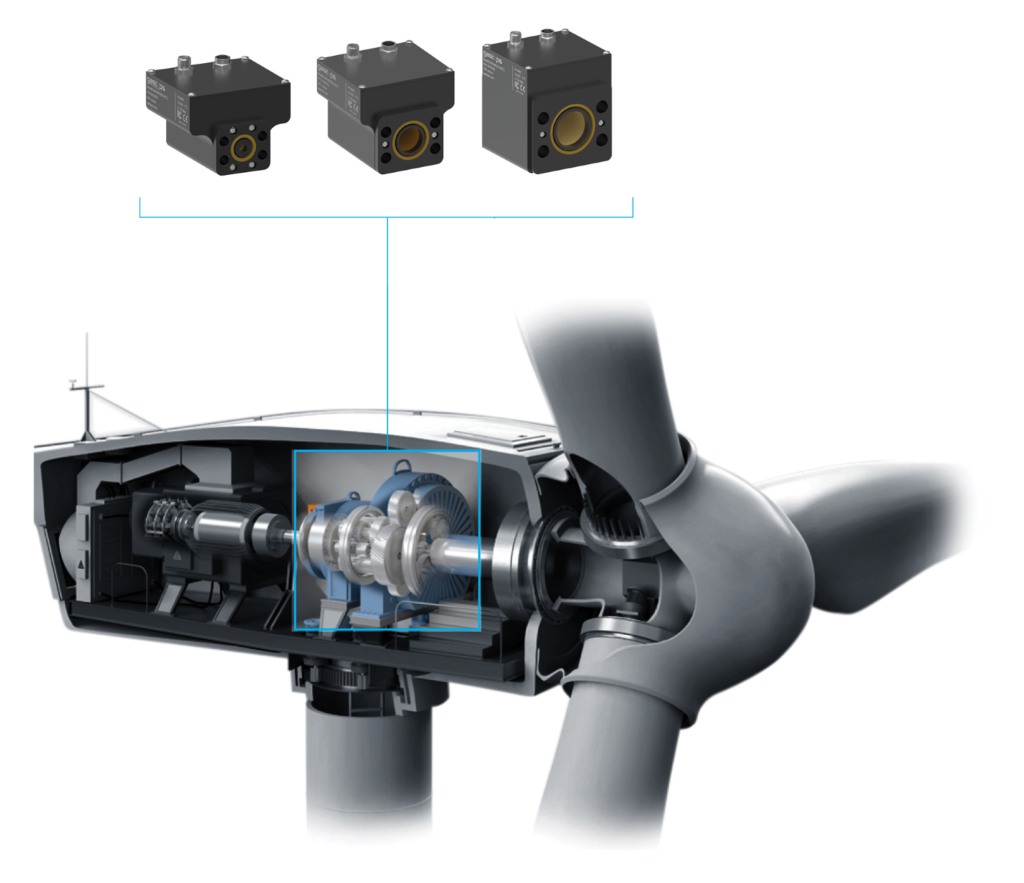
Designed specifically for wind turbine platforms, the MetalSCAN M3500 oil debris monitoring system provides continuous monitoring of the gearbox. (Courtesy: Gastops.)

Gastops, a leader in critical component condition intelligence, announced the first volume shipments of the MetalSCAN MS3500 online condition monitoring sensors to a major wind turbine manufacturer for their next generation platform, the fourth manufacturer to adopt MetalSCAN technology as standard equipment.

The MS3500 series provides the wind energy industry with online access to real-time condition monitoring data which enables the earliest reliable detection of component damage available on the market today.

“MetalSCAN MS3500 replaces the MS3000 series to further enhance the value proposition for the world’s leading wind turbine manufacturers by helping wind energy operators reduce costs and risk. With the MS3500 series, we have introduced key new functionality and connectivity capabilities to support Industrial Internet of Things (IIOT) implementations at a lower price point, all while maintaining the performance and reliability for which Gastops is recognized,” said Cedric Ouellet, director of energy and industrial at Gastops.

The MetalSCAN MS3500 series delivers real-time detection of 100% of ferrous and non-ferrous metal particles generated during component damage. The sensors generate continuous component condition data to provide advance warning of abnormal component wear or debris accumulation exceeding defined limits. This intelligence gives wind energy operators the power to plan maintenance in advance, predict the remaining useful life of critical equipment, and avoid secondary damage that leads to costly component replacements.

“Our MetalSCAN technology was developed to meet the demanding standards of the aviation and defense markets. As with our previous generation of sensors, the MS3500 series packages that advanced technology into a market leading solution that is now more valuable than ever to both wind turbine manufacturers and operators,”  said Shaun Horning, President and CEO of Gastops. “We are very excited to be bringing our latest innovations to the renewable energy industry,” Horning added.

Gastops provides intelligent condition monitoring solutions used in aerospace, defense, energy, and industrial applications to optimize the availability, performance, and safety of critical assets, offering online monitoring sensors, at-line analysis, complex modeling and simulation, laboratory testing, engineering, design, and MRO services that predict performance to enable proactive operating decisions. Gastops has been providing insights into the condition of critical equipment since 1979.

MORE INFO  https://www.gastops.com/products-services/metalscan/
Empire Offshore Wind names Vestas as preferred turbine supplier

0
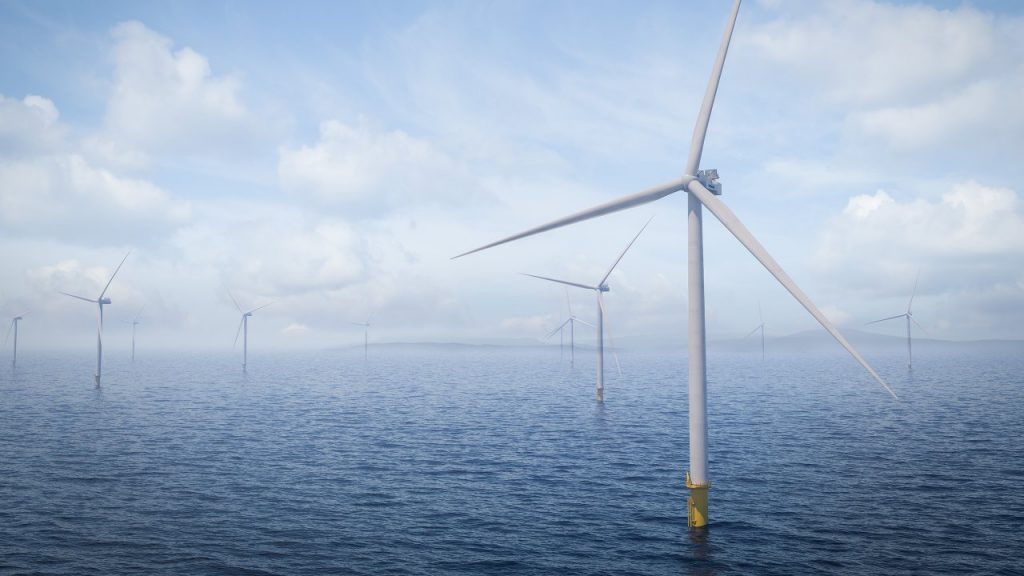
Vestas will provide 138 V236-15.0 MW turbines for Empire Wind 1 and 2 (Courtesy: Vestas Wind Systems A/S.)

Empire Offshore Wind, a joint venture between Equinor and BP, has named Vestas as the preferred turbine supplier for the 2.1 GW Empire Wind 1 and Empire Wind 2 offshore wind projects in New York.

Vestas will provide 138 V236-15.0 MW turbines for Empire Wind 1 and 2, located 15 to 30 miles off the coast of Long Island. With this project, New York, Equinor, BP, and Vestas are together taking a leading role in the U.S. offshore industry development and bringing the USA closer to achieving President Biden’s goal of 30 GW of offshore wind capacity installed by 2030 as well as New York state’s goal of installing 9 GW of offshore wind capacity by 2035.

“We are honored to partner with Equinor and BP as preferred supplier for the Empire wind projects and provide our V236-15.0 MW turbine to help New York achieve its ambitious offshore wind energy goals. To be part of a landmark project like Empire Wind 1 and 2 is a testament to the hard work of Vestas colleagues across the world dedicated to developing offshore technology capable of delivering reliable, resilient, and sustainable wind energy to communities around the world,” said Laura Beane, president of Vestas North America.

The tower sections for Empire Wind 1 and 2 are planned to be sourced from the Marmen/ Welcon plant, which is being developed in Port of Albany. For staging of turbine components, Vestas will use the South Brooklyn Marine Terminal’s upgraded port, developing a local New York-based, supply chain to provide services in the staging, pre-assembly and installation activities.

Vestas has established local partnerships and supply chains to serve regional markets, including more than 1,000 suppliers in USA that support onshore business. In addition, Vestas will deliver a comprehensive multi-year solution to service the wind farm when operational, with the goal to establish a New York-based service organization that provides local employment opportunities.

MORE INFO  vestas.com

New onshore wind crane takes step closer to reality

0
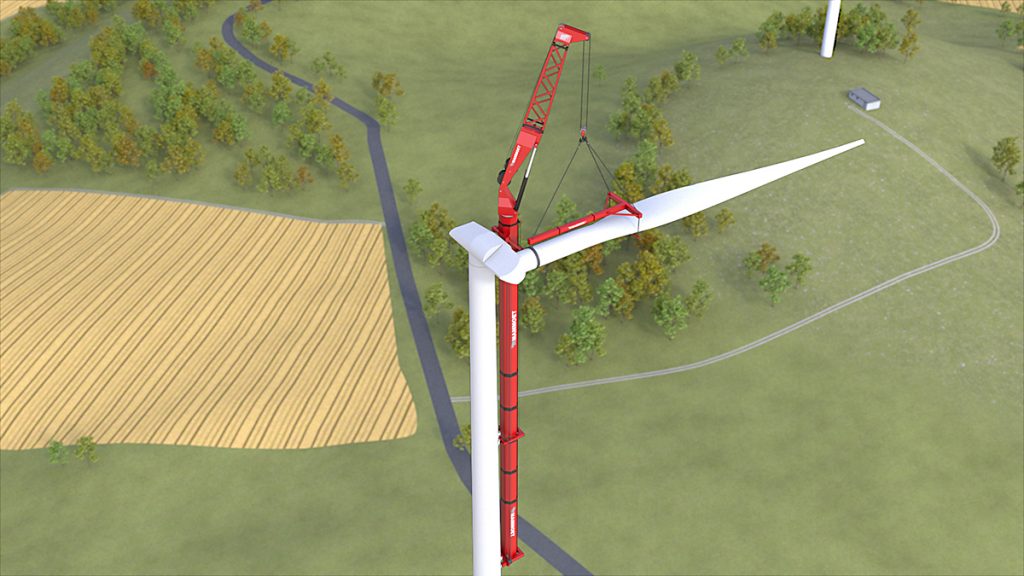
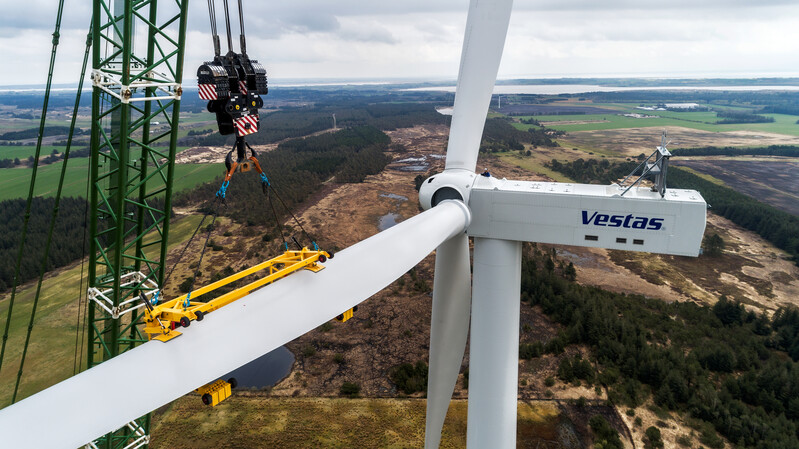
With the WTA, relocation time is reduced by approximately 50 percent. (Courtesy: Mammoet)

As developers chase stronger flows, onshore wind hub heights are growing beyond the reach of conventional crawler cranes. Mammoet’s new WTA lifting system allows theoretically infinite hub heights and paves the way towards emissions-free turbine erection.

The WTA assembles wind-turbine generators by attaching directly to the tower itself, using a series of clamps to self-assemble and then climb to each lift location. It assembles tower sections, hubs, and nacelles, and has a capacity of 150 tons.

Its innovative concept means the WTA can keep working when conventional crawler cranes can’t. It operates in wind speeds up to 20m/s, reducing downtime during construction and extending the build season.

As the WTA has a significantly reduced footprint and is much smaller and lighter than any type of crawler crane, it actively lowers the need for groundwork on site. Pads can be smaller, and ground pressure requirements are lessened — maxing out at the 15 tons/square meter typically needed for assist cranes.

The system’s small size means quicker and more cost-effective mobilization. While a conventional crawler crane can require up to 50 truck loads to reach site, the WTA gets there with just nine.

With no boom laydown requirement, much fewer components, and a lower total weight, the WTA is also faster from pad to pad. In fact, relocation time is reduced by approximately 50 percent, compared to using crawler cranes. It therefore shaves weeks off wind-farm construction schedules.

Powered entirely by electricity, it also opens the door for a 100-percent emissions-free journey from factory to first megawatt — with transport to site via electric or hydrogen-powered truck, on site maneuvers via ePPU-enhanced SPMT, and carbon-free WTA lifting.

The WTA system is now design-ready and can be ready to enter the market during the second quarter of 2023.

MORE INFO  mammoet.com/onshore-wind

Clir Renewables named one of Canada’s top growing companies

0
Launched in 2019, Canada’s Top Growing Companies aims to recognize and celebrate entrepreneurial achievement by identifying and amplifying the success of growth-minded, independent businesses.

Clir Renewables, a company dedicated to maximizing project returns from renewable energy assets, recently announced it was recognized as one of Canada’s top growing companies of 2021 by the Globe and Mail’s Report on Business.

Launched in 2019, Canada’s Top Growing Companies aims to recognize and celebrate entrepreneurial achievement by identifying and amplifying the success of growth-minded, independent businesses. The program ranks public and private companies based on three-year revenue growth. Clir achieved the 95th spot on the list. This year’s list of 448 companies is especially significant due to the unprecedented year caused by the ongoing pandemic. As renewable energy capacity worldwide sees significant growth, increasing 45 percent in 2020, Clir has experienced unprecedented demand for its analytics and reporting software.

“It’s an exciting time to be a technology start-up in Canada,” said Gareth Brown, CEO, Clir Renewables. “At Clir, we’re reducing humankind’s impact on the planet by turning renewable energy data into actionable insights. With the highest-fidelity wind and solar data models, our clients are able to maximize the performance and output of their assets. We’re proud of the impact that our technology has made, excited for our future growth, and delighted to be listed among these incredible Canadian companies.”

Founded in 2017, Clir combines intuitive software, advanced data science, and machine learning to analyze data and provide actionable insights to solar and wind-farm owners and operators. With more than 300 GW of renewable energy project experience, they’ve successfully optimized and maximized the financial returns of more than 10 GW of wind and solar projects.

“Any business leader seeking inspiration should look no further than the 448 businesses on this year’s Report on Business ranking of Canada’s Top Growing Companies,” said Phillip Crawley, publisher and CEO of The Globe and Mail. “Their growth helps to make Canada a better place, and we are proud to bring their stories to our readers.”

MORE INFO  www.clir.eco

Vestas wins 207 MW in the U.S., introduces two new 4-MW platform variants

0
To drive the global energy transition and expand the deployment of wind energy across the globe, Vestas continues to strengthen its product portfolio, and with this order, Vestas introduces the V150-4.5 MW and V136-4.5 MW — two new variants of the 4-MW platform.

Vestas has secured a 207-MW order from Duke Energy Sustainable Solutions to power the Ledyard Windpower project in Iowa, featuring 46 V150-4.5 MW wind turbines.

The order includes supply and commissioning of the turbines, as well as a 10-year Active Output Management 5000 (AOM 5000) service agreement, designed to ensure optimized performance of the asset. To drive the global energy transition and expand the deployment of wind energy across the globe, Vestas continues to strengthen its product portfolio, and with this order, Vestas introduces the V150-4.5 MW and V136-4.5 MW — two new variants of the 4-MW platform.

The new variants offer an increase in annual energy production of more than 3 percent compared with the existing variants of V136-4.2 MW and V150-4.2 MW and leverages the proven 4-MW technology with a combined global order intake of more than 21 GW. The increased power output is achieved while maintaining the same climate application space and noise level. This enables expanded applicability in some European, North American, and South East Asian markets.

“We have seen strong demand for the V150-4.2 MW turbine, particularly in the U.S., and the new V150-4.5 MW variant will continue to cement Vestas leadership in this segment,” said John Eggers, chief technology officer of Vestas North America. “Vestas will continue to develop a modular product approach to meet market demands ensuring that Vestas’ products fulfill the expectations of our customers.”

Turbine delivery for the Ledyard Windpower project begins in the second quarter of 2022 with commissioning scheduled for the fourth quarter of 2022.

MORE INFO  www.vestas.com

Collett & Sons Ltd delivers shunt reactors for offshore wind project

0
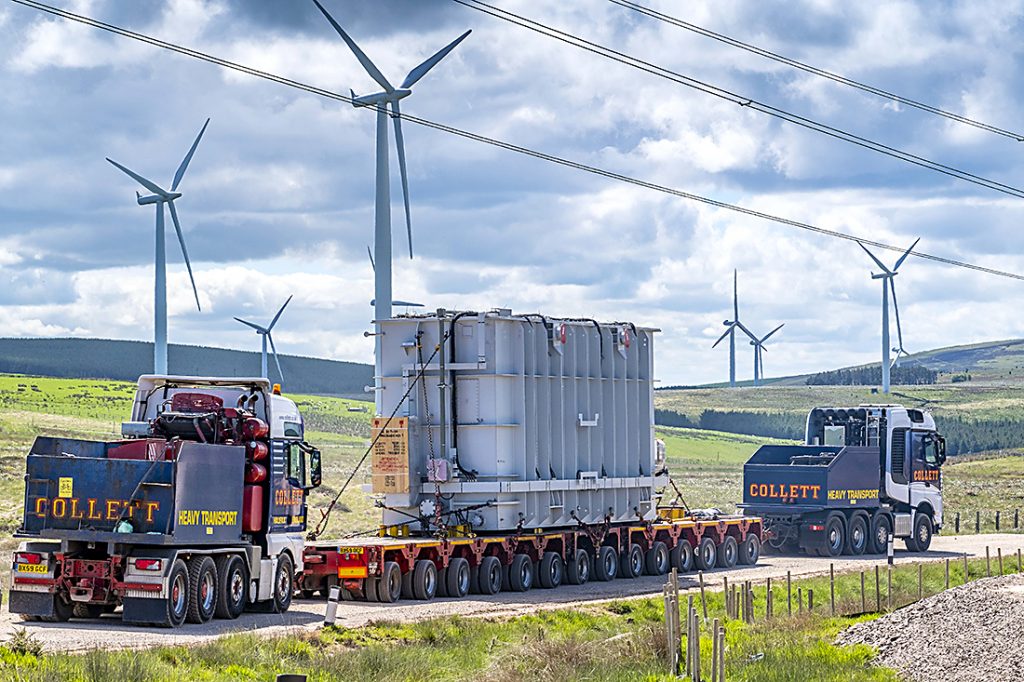
The shunt reactors were transported in three stages before arriving at the substation site. (Courtesy: Collett & Sons Ltd)

Collett & Sons has transported two 160Te shunt reactors more than 5,000 miles to the onshore substation site for the Neart na Gaoithe offshore wind-farm project, jointly owned by EDF Renewables and ESB.

Collett was contracted with the full scope of work providing a door-to-door service, including the project management, engineering, and the transport of the two 160Te shunt reactors.

A year before deliveries began, Collett’s Consulting Department was contracted to undertake multiple surveys to find the most feasible route. This included all route surveys, swept path analysis reports, topographical surveys, bridge height surveys, and wire cable height surveys. This resulted in Collett working with local authorities to temporarily remove street furniture and employing tree surgeons to remove obstructing foliage.

The shunt reactors were transported in three stages before arriving at the substation site. First, Collett worked in partnership with a trusted European partner to transport the shunt reactors ahead of their arrival in the U.K. The Collett Projects Department was then responsible for all port operations including the loading of the vessel, also chartered by Collett, for the 4,800 miles to the Port of Leith in Scotland.

Working closely with the port, Collett carefully planned the cargo’s discharge, including providing crane lifting plans and an agreed program of works for all loading and discharge operations.

Once at the port, using an 800Te crane, the shunt reactors were discharged onto a dedicated 14-axle line modular flat top trailer. Both shunt reactors were offloaded at the port onto stools for temporary storage. Collett also transported and stored multiple ancillary components at their port side depot in Grangemouth.

Using its 550Te capacity girder bridge with 20-axle lines, Collett transported the shunt reactors from Leith Docks to Innerwick. Due to narrow access along the remainder of the route, Collett shipped each of the two shunt reactors from the 20-axle girder bridge on to a 14-axle flat top modular trailer in a dedicated road closure area, complete with all traffic management, in order to complete delivery. All movements were facilitated under police escort, as well as Collett’s in-house fleet of pilot vehicles.

At the NnG onshore substation site in the Lammermuir Hills, Collett’s Heavy Lift Team offloaded and positioned the shunt reactors into their final position using a hydraulic jacking and skidding system.

Part two of the project is expected to take place in the coming weeks, when two 180Te supergrid transformers are due to be delivered to the wind-farm site.

MORE INFO  www.collett.co.uk

Alicat to build world’s first hybrid powered daughter craft fleet

0
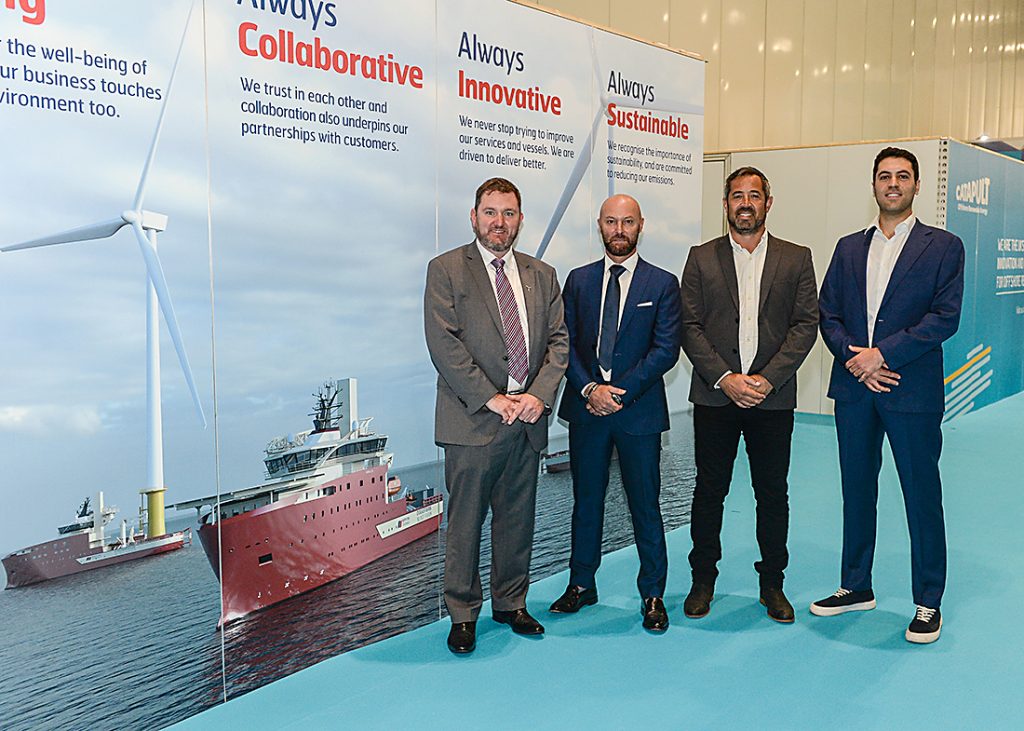
North Star Renewables’ Matthew Gordon, Equinor’s Luca Daniele, Simon Coote from Alicat and Guido De Mola from Chartwell Marine. (Courtesy: North Star Renewables)

Great Yarmouth based marine and engineering specialist Alicat has won a multi-million-pound contract with North Star Renewables, beating off stiff competition to secure the build work for its first hybrid powered daughter craft fleet.

Once completed, the vessels with low carbon emission potential are destined for the Dogger Bank Wind Farm, 130 kilometers off England’s North East coast.

Following a competitive tender involving multiple U.K. shipyards, Alicat has been awarded North Star’s initial contract to bring its first two daughter craft to the renewables market. They will use the game-changing combination of diesel and electric outboards, a world first for this form of workboat.

Designed by Southampton-based naval architects Chartwell Marine in collaboration with North Star, the daughter craft will be used to safely transfer technicians from their accommodation onboard North Star’s service offshore vessels (SOVs), to work on the offshore wind turbines at Dogger Bank A and B. Dogger Bank A and B are a joint venture between SSE Renewables (40%), Equinor (40%) and Eni (20%). Dogger Bank C is a joint venture between SSE Renewables (50%) and Equinor (50%). SSE renewables is leading on the construction of the wind farm, and Equinor will operate the wind farm for its lifetime of up to 35 years.

Once the third phase is completed and operational, it will become the biggest offshore wind farm ever built and able to generate about 5 percent of the U.K.’s electricity.

With bases in Aberdeen, Newcastle, and Lowestoft, North Star has the world’s largest daughter rescue fleet and has been servicing the North Sea’s oil and gas sector for more than 40 years. It has 63 daughter craft within the existing fleet, managed and maintained by the two Rescue Boat divisions in Aberdeen and Lowestoft. North Star group includes 1,400 employees servicing more than 60 locations and mobile installations in the U.K. Continental Shelf.

The new hybrid propulsion daughter crafts include stabilizer technology ensuring the vessels will not only deliver reduced carbon emissions, but provide class-leading comfort for the technicians on board while setting a new standard for safe operations. It has an increased sea state operability and safe transfer, tank tested at wave heights of up to 1.7m Hs – significantly higher than any alternative wind-farm daughter craft.

The first daughter craft is being delivered 12 months ahead of schedule, under the build supervision locally of North Star Group’s Boston Putford division in Lowestoft. This will allow time for performance analysis and improvements, crew training and additional development ahead of the first of three SOVs arriving from summer 2023.

“We are very excited to announce Alicat as the chosen shipbuilder for our first next generation and new breed of sustainable, reliable, comfortable daughter craft fleet, configured specifically for the renewables sector,” said North Star chief operating officer and Boston Putford MD Robert Catchpole. “Alicat is a leader in its field and demonstrated the comprehensive technical knowledge as well as great craftsmanship and the project management skills required to deliver the first of our new fleet. We also have great confidence in their capabilities after they satisfied all the financial, commercial and QHSE criteria set out in the contract.

“We are very fortunate to have talented companies like Alicat on our doorstep in East Anglia and working with them aligns to our strategy of utilizing U.K. businesses whenever possible to strengthen our services in our ambitions as the market leader in marine offshore wind infrastructure support in the U.K., and abroad.”

“This multi-million-pound contract is a significant win for our business as it further establishes us on the renewables map as the first company in the world to build hybrid powered daughter craft, which is also the first offshore wind-daughter craft to be built in the U.K.,” said Alicat director Simon Coote. “Our involvement in testing and knowledge of the new breed of outboard propulsion packages has a significant role to play in the build of these innovative vessels.”

North Star will start a recruitment program for new seafarers in the next six months. The firm is looking to hire about 130 onshore and offshore personnel from across the U.K. to support the Dogger Bank project.

MORE INFO  www.northstarrenewables.co.uk

NREL pinpoints method for moving larger turbine blades across U.S.

0
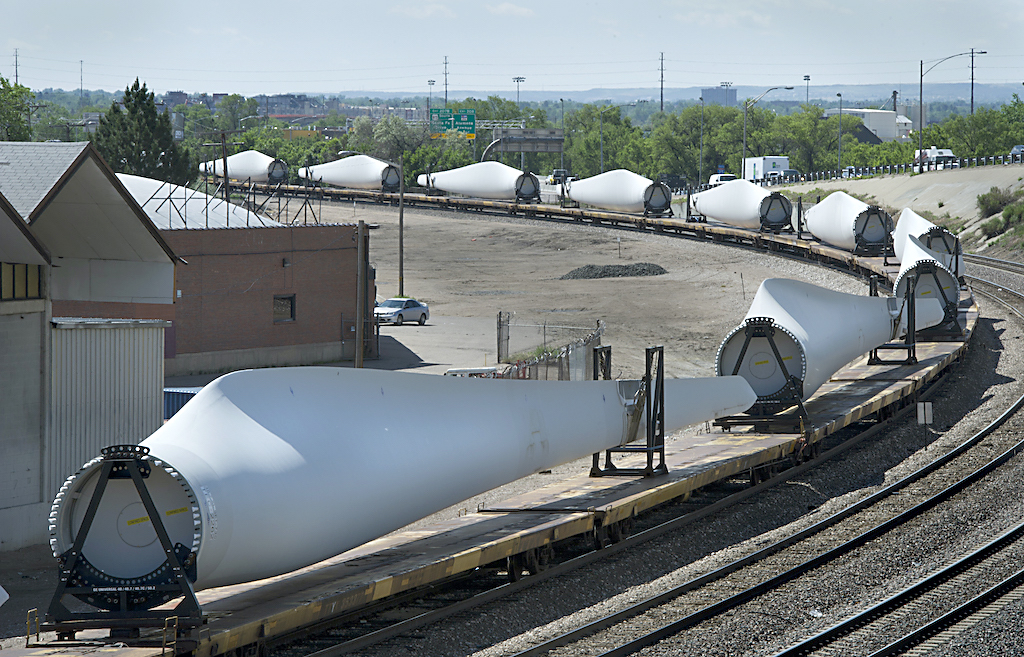
Wind turbine blades wind their way by train through Denver. (Courtesy NREL)

Researchers at the U.S. Department of Energy’s (DOE’s) National Renewable Energy Laboratory (NREL) have determined how to transport massive wind-turbine blades to parts of the country at a lower cost than segmented blades, but the solution will require some flexibility on the part of industry.

Manufacturing blades that can bend with “controlled flexing” will allow railroads to ship longer blades around the United States. Because of bends, twists, and turns in railroad lines, the upper limit for transporting single-piece land-based blades by rail is 75 meters. The conceptual design envisioned by researchers would stretch that limit to 100 meters or beyond for land-based turbines. Blades of this length are already being proposed for offshore wind turbines and can be transported via barge, but they have not been installed inland due to the transportation constraints.

For land-based turbines, the longer blades could be shipped attached across the length of four railcars.

Longer blades and taller wind turbines allow for the greater production of energy, even in areas where wind speeds are low. Seeking an economical solution to installing wind turbines has kept wind farms from regions where the resource could potentially be harvested, including the southeast United States. The flexible blade technology may enable more deployment in these areas in the future due to the lower cost. Lowering the cost of transportation and enabling rotors with a higher capacity factor could make these deployments more economically feasible.

“This research can aid in massive deployment of wind energy in different regions of the country — even parts of the country that typically haven’t seen as much deployment,” said Nick Johnson, a mechanical engineer at NREL’s National Wind Technology Center and co-lead of the U.S. Department of Energy’s Big Adaptive Rotor Project (BAR). He is also co-author of a new paper, “Land-based wind turbine with flexible rail-transportable blades,” which appears in the journal Wind Energy Science.

BAR emerged from a 2018 workshop on supersized land-based wind-turbine blades. In addition to NREL, other BAR partners are Sandia National Laboratories, Oak Ridge National Laboratory, and Lawrence Berkeley National Laboratory. Engineers at the international organization DNV GL, which has a working relationship with NREL, in 2019 proposed on a conceptual level the controlled flexing of the blades during rail transport. The new paper provides an in-depth investigation into the idea.

Co-authors on the paper are Pietro Bortolotti and Nikhar Abbas from NREL, and Evan Anderson, Ernesto Camarena, and Joshua Paquette from Sandia.

The paper considers a 5-MW wind turbine installed on a 140-meter-tall tower.

The scientists examined the potential for five designs that represent the next generation of land-based turbines. They modeled the designs using NREL’s Wind Plant Integrated System Design and Engineering Model (WISDEM) software to determine the best option. One idea, that of cutting a blade in two for transport, was among those considered as a baseline that considers existing technology. The analysis showed that, while this is a feasible solution, it does not have the same cost benefits as shipping the single-piece rail-transportable blade.

Blades already possess some flexibility. Traditional blades can have deflections of about 10 percent of the blade length from the root where they are attached to the turbine to the tip. For the blades envisioned by the BAR research, this increases to 20 percent to allow for the flexibility required for rail transportation.

Johnson said he sees industry adopting the flexible blades about five years out.

“We’re still in the process of fleshing out some of the details, some of the trade-offs associated with the technology,” he said. “We have an industry advisory panel and have had great input and feedback from the members. They’ve kind of steered us in this direction. They think it’s a promising idea, and certainly worthwhile as the impact could be significant.”

The paper points out areas for further research, including the potential for blades even longer than 100 meters.

The research was funded by DOE’s Wind Energy Technologies Office.

NREL is the U.S. Department of Energy’s primary national laboratory for renewable energy and energy efficiency research and development. NREL is operated for the Energy Department by the Alliance for Sustainable Energy, LLC.

MORE INFO  www.nrel.gov

Robotics vital to renewables growth needed to reach net zero

0
Accelerating and investing in the development of advanced RAS means robots will handle not only routine maintenance tasks, but also improve pre-emptive maintenance, which will extend the life of components and turbines at sea, supporting the industry’s waste reduction drive.

Accelerating the development of robotics and autonomous systems (RAS) will be a significant enabler to reaching net zero, according to new research from the Offshore Renewable Energy (ORE) Catapult.

ORE Catapult highlights that by 2050, the global robotics market in the energy sector will be worth £8.4 billion. With its high-growth forecasts, wind energy (onshore and offshore) is expected to open up a new robotics frontier that will be valued at £1.3 billion by 2030, increasing to £3.5 billion by 2050. Meanwhile, declining production will see the oil and gas market’s robotics market peak at £5 billion in 2030, before reducing to £3.3 billion by 2050.

The U.K. is targeting a seven-fold increase in offshore wind capacity by 2050, and with this growth comes the need for more operations and maintenance (O&M) activity. With wind farms set to be in deeper, more remote, often challenging waters, securing safe access for humans will be a significant industry challenge.

Accelerating and investing in the development of advanced RAS will mitigate this risk and means robots will handle not only routine maintenance tasks, but also improve pre-emptive maintenance, which will extend the life of components and turbines at sea, supporting the industry’s waste reduction drive.

ORE Catapult’s report highlights the global wind O&M market (both onshore and offshore) will grow from £51 billion in 2030 to £120 billion in 2050. While robotics will take a share of this prize, these technologies will also combine with data and digital solutions and other forms of O&M to increase that market share.

This is a huge opportunity for the U.K. to add value to the supply chain by leveraging its offshore oil and gas experience and global leadership in offshore wind. The expansion of offshore wind is set to offset many of the oil and gas jobs set to be lost over the next 30 years, with RAS set to create a 200,000-net-jobs boost across all U.K. sectors by 2038.

While the U.K. offshore wind O&M market for robotics is set to double in size, the export potential is even greater and set for staggering growth of 410 percent, increasing from £235 million in 2030 to £1.2 billion in 2050.

“The growth of the global energy market presents a remarkable opportunity for robotics and autonomous systems,” said Gavin Smart, Head of Analysis & Insights at ORE Catapult. “This is not only the case in offshore renewables, a sector which continues to grow at pace, but also in oil and gas in the short to medium term. What is unique about the robotics market is the potential for cross-application technologies. It is likely that the solutions that will maximize performance, increase efficiency, and improve safety will be adapted to work across multiple industries — inside and outside energy.

“As we continue to work towards achieving net zero, it is clear that robotics will play a key part,” he said. “The opportunity this presents for the U.K. is significant — across the supply chain we can create jobs, upskill our energy workforce, build export potential, and add value to our economy.”

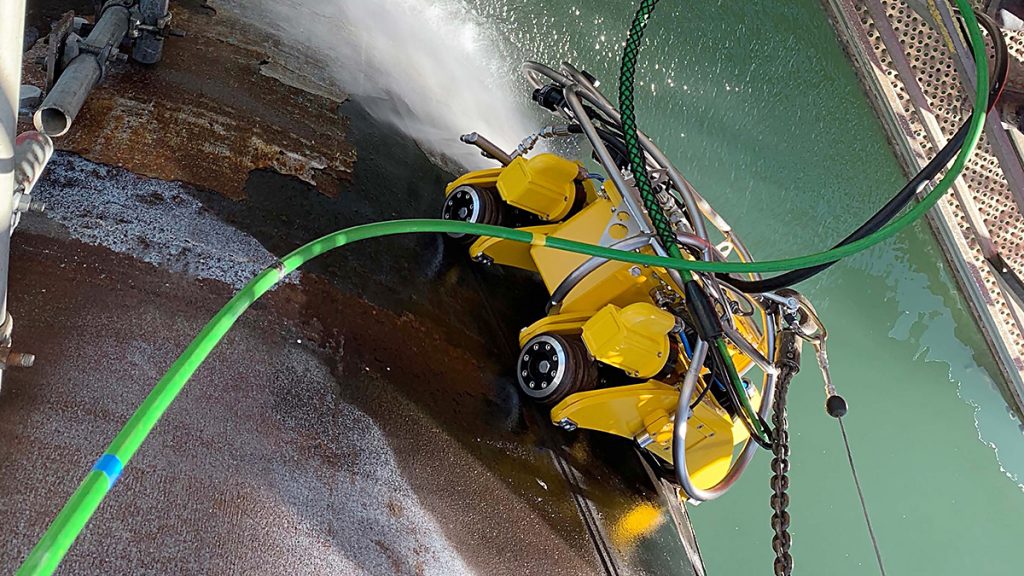
ORE Catapult supports many robotic technologies that have already shown promise for the offshore wind sector, including robots that can crawl turbine blades to conduct repair and maintenance, robots that can perform subsea cleaning and inspection tasks, and unmanned vessels that provide a power and communication hub for remotely operated and autonomous underwater vehicles.

“Cutting-edge research and development into robotic technologies for offshore wind is already taking place, right here in the U.K.,” Smart said. “We are building a position as a pioneer and expert in this field, which opens up a multi-billion pound domestic and export market over the coming decades. ORE Catapult is driving forward the pace of investment and R&D, and by defining the size of the prize on offer, we want to encourage the U.K. supply chain to capitalize on the opportunities. This is an incredibly exciting space to be in right now.”

Read ORE Catapult’s full research report and discover more about the technologies already in action.

https://ore.catapult.org.uk/wp-content/uploads/2021/09/ORE-Catapult-RAS-market-report-FINAL.pdf

Vestas secures 396MW order for Australia wind farm

0
Vestus is using its EnVentus platform for what will be New South Wales, Australia’s largest wind farm.

Vestas has secured a 396MW contract for the Rye Park Wind Farm in New South Wales, Australia. It will be the second project in Asia Pacific to feature Vestas’ EnVentus platform.

Vestas will supply and install 66 V162-6.2 MW wind turbines in 6.0MW operating mode.

Rye Park Wind Farm will be Vestas’ second-largest Australian project, and it will be the largest wind farm in New South Wales. In addition to providing clean energy for the equivalent of approximately 215,000 homes annually, Rye Park Wind Farm will create around 250 jobs during the peak of its construction and up to 10 ongoing regional jobs during its operational life.

The project is a partnership with Tilt Renewables, which is now part of the leading Australian renewable energy generator Powering Australian Renewables (PowAR),

“Vestas values our partnership with Tilt Renewables and PowAR as we build on our existing footprint of nearly 400 MW of wind energy in Australia,” said Peter Cowling, head of Vestas Australia and New Zealand.

Delivery of Vestas’ wind turbines is expected to occur in the third quarter of 2022, with commissioning to commence in the second quarter of 2023.

MORE INFO  www.vestas.com/en/products/enventus_platform#

H2Mare project aims to produce green hydrogen on industrial scale

0
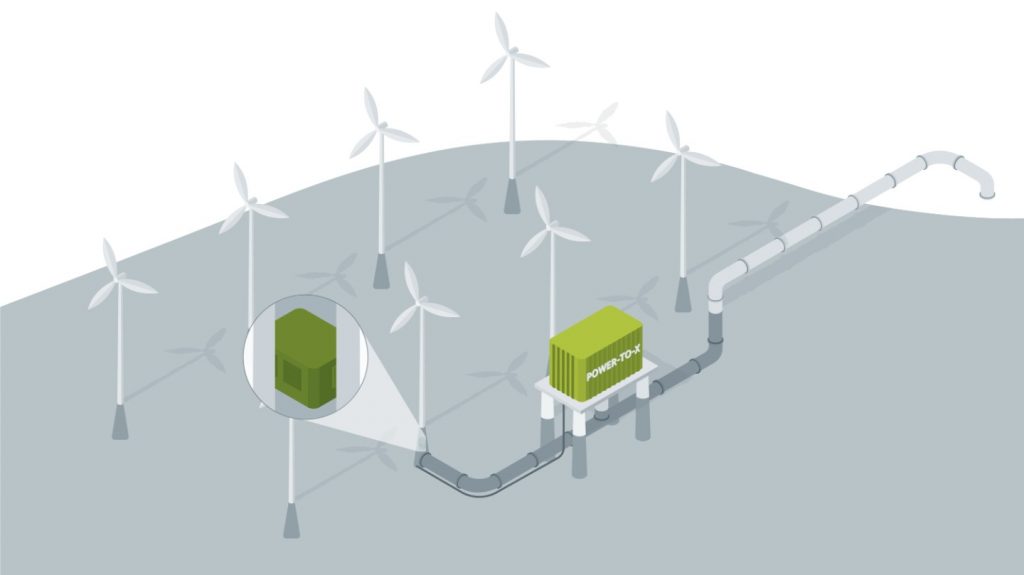
Schematic representation of the production of green hydrogen within the flagship project H2Mare.

The H2Mare project aims to establish a new type of offshore wind turbine, one that integrates an electrolyzer for direct conversion of electricity to produce green hydrogen on an industrial scale.

This way, the self-sufficient units can save costs of connection to the grid, and contribute to the reduction of greenhouse gas emissions. In a second phase, the green hydrogen can be converted into synthetic fuels and energy carriers.

The German Federal Ministry of Education and Research is funding the project. “We are bringing in our offshore wind and electrification capabilities as well as our expertise in electrolysis. H2Mare unites the strengths of research and industry – for sustainable decarbonization of the economy and to the benefit of the environment,” said Christian Bruch, Chief Executive Officer of Siemens Energy AG.

The project comprises four joint projects that are promoted independently of each other, with a total of 35 partners. Those projects are:

OffgridWind: A turbine concept that realizes electrolysis directly in the offshore wind turbine.

H2Wind: Aims to improve the maximum yield of wind energy, consisting of the development of a proton exchange membrane electrolysis system.

PtX-Wind: Focuses on converting to more easily transportable, synthetic energy carriers and fuels, such as methane, methanol, and ammonia. Direct saltwater electrolysis is also being tested.

TransferWind: Addresses transfer of knowledge to the public and exchange of expertise across multiple projects.

This will involve consideration of the entire value creation chain: from wind energy generation and hydrogen production to the conversion of hydrogen into methane, liquid hydrocarbons, methanol, or ammonia right up to use in industry or the energy sector. The goal is a significant cost advantage in the production of large volumes of hydrogen.

Siemens Energy is responsible for the coordination of H2Mare and is supported by institutes of the Fraunhofer Gesellschaft.

MORE INFO  www.iwes.fraunhofer.de/en/press—media/wind-turbines-with-integrated-electrolyzer-demonstrate-sustainab.html

Russelectric showcases Paralleling System for renewable energy installation

0
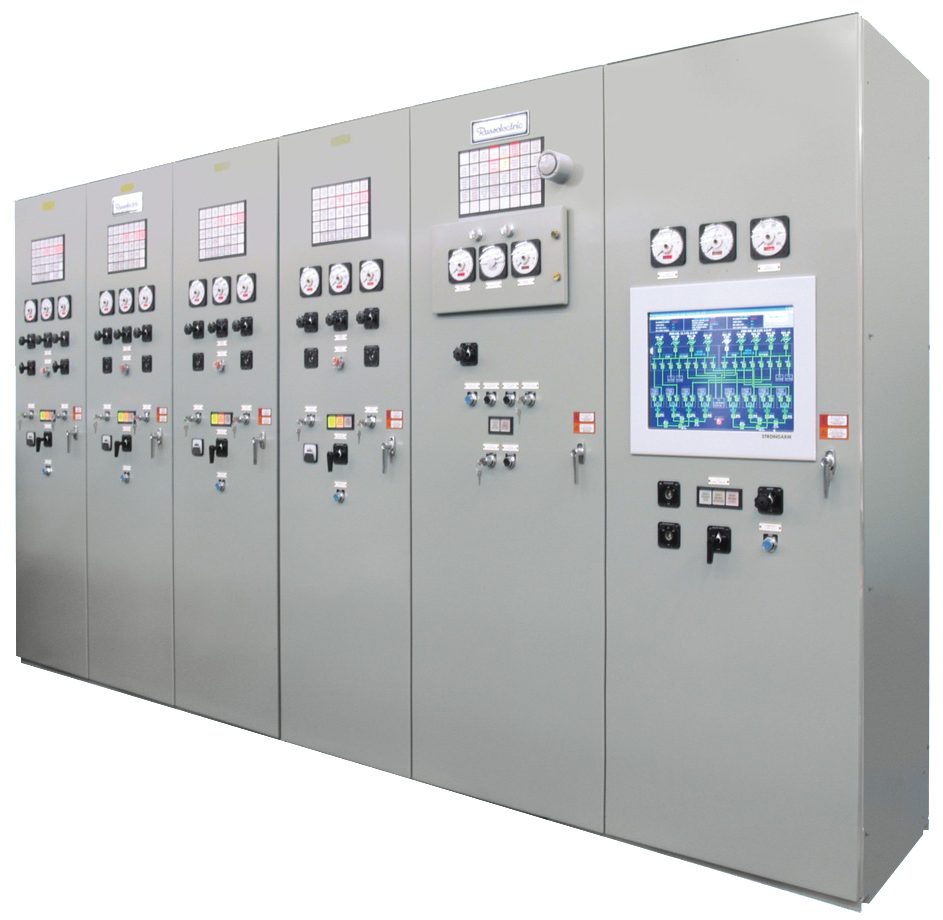
Paralleling System, ideal for ensuring that critical loads experience no interruption when transferring between all power source assets in renewable energy installations.

Russelectric, a manufacturer of automatic transfer switches and power control systems, has introduced Paralleling System, for ensuring no interruption of critical loads when transferring between power source assets.

The system can be configured for peak shaving and utility-sponsored load curtailment programs and offers high resiliency, power continuity and security for critical renewable energy installations.

Paralleling Systems incorporate dual, redundant, hot synchronized programmable logic controllers (PLCs) for system control. Discrete switches, meters, and control devices are standard to allow manual control capability in the event that both system PLCs fail. The system provides soft loading transfer and phase lock synchronizing when paralleling with the utility, which reduces transients and controls the loading to the engine generators.

Russelectric provides basic or custom SCADA for local or remote monitoring of all power system functions. Custom SCADA systems allow users to monitor system operation, acknowledge alarms and review PLC setpoints.

The Paralleling System offers a choice of either momentary paralleling with the utility or sustained paralleling for soft loading. Also available is paralleling of generator sets with the utility upon return of the utility source after power interruption. Selector switches are provided for open/closed transition, automatic/manual paralleling of generators and utility sources, and automatic/manual retransfer between both sources of power.

System operation begins with testing in closed-transition mode with no interruption of the load. Generators are then paralleled with the utility and the load is transferred to them. Upon completion of testing, the load is retransferred through closed-transition to the utility source without disturbance.

Utility Paralleling Systems can also be used in financial institutions, data centers, telecommunications, airports, healthcare facilities, and water and wastewater treatment plants.

MORE INFO  www.russelectric.com

Ampelmann signs 13 new contracts in European offshore wind 

0


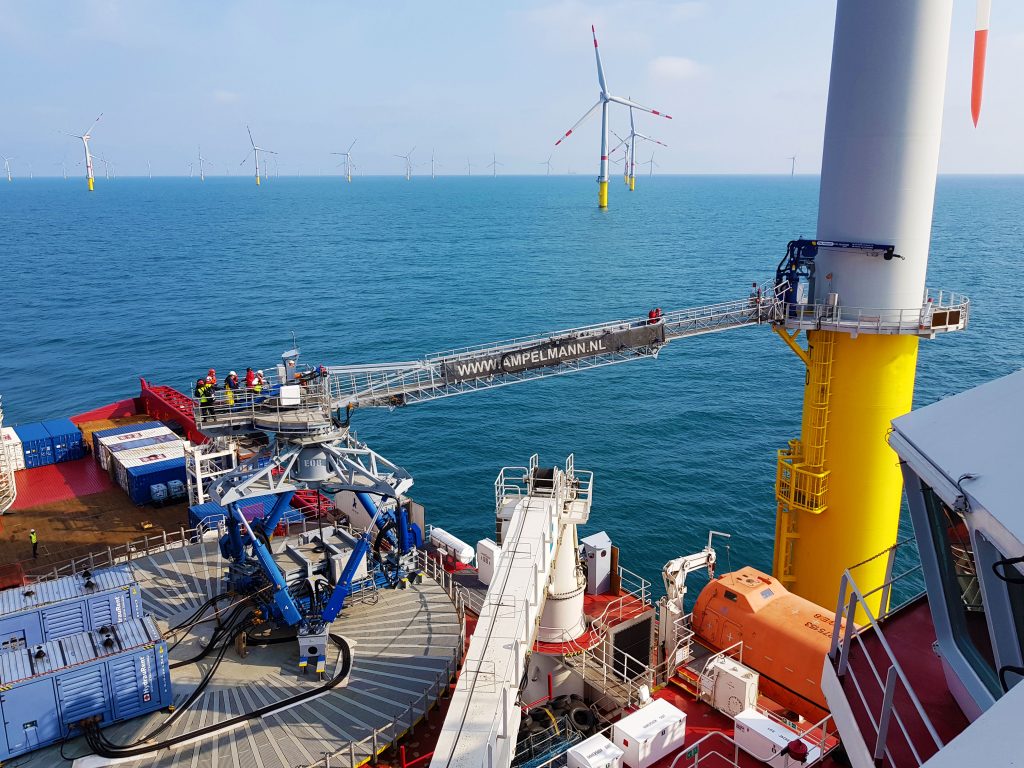
The E1000 system can switch from personnel to cargo transfer mode in less than a minute.

Dutch offshore wind access company Ampelmann signed 13 contracts in 2021 to provide motion-compensated gangway solutions for personnel and cargo transfer in Europe.

“Securing these projects has brought us new opportunities to deliver the highest level of safety to offshore operations,” said Bob Rollerman, business developer for Europe at Ampelmann.

Ampelmann will use its A-type and E1000 systems for all 13 campaigns. Two will use the company’s A-hoist, an innovation that allows the A-type to efficiently and safely lift and transfer up to 240kg of cargo.

For larger cargo operations, Ampelmann is using the E1000, which can transfer loads up to 1 ton, as well as compensate for vessels’ motions in the high seas.

“Safety and efficiency are at the core of what we do at Ampelmann and the E1000 delivers on both. It significantly improves the efficiency of our client’s operations, with its ability to switch between cargo and personnel transfer in less than a minute and with the push of a button,” Rollerman said.

One of the projects is the company’s first in France, supporting the installation of a wind farm’s foundation.  “Every commissioning operation in offshore wind is a step in the right direction and entering new geographical areas in that market is particularly exciting,” Rollerman said.

part from the installation and commissioning of wind farms, Ampelmann’s systems are also supporting multiple maintenance operations. Most of the contracts are with returning customers.

The company has introduced Insights, its data-driven platform that gives clients a detailed look into their day-to-day operations, including transfer numbers, performance, and workability forecasts based on sea and weather conditions.

According to some of the latest data, Ampelmann has enabled the safe transfer of more than 22,000 people and close to 1.5 million kg of cargo so far in the new projects.

MORE INFO  www.ampelmann.nl/news

Massachusetts Maritime Academy trains workers for jobs in clean energy

0
“The opportunity to work in the clean energy industry is great for our members,” said Dave Borrus, Pile Drivers and Divers Local 56 business manager.

The Massachusetts Maritime Academy (MMA) is training workers who will build the wind farms that will provide clean energy to the northeast U.S.

“It’s a fact that the clean energy industry is growing, and we are taking steps to be involved in this unique opportunity,” said Rear Admiral Francis X. McDonald, USMS, President of the Massachusetts Maritime Academy.

“One of the most important ways we can contribute is by training the men and women who will be on the front lines of this emerging industry,” McDonald said.

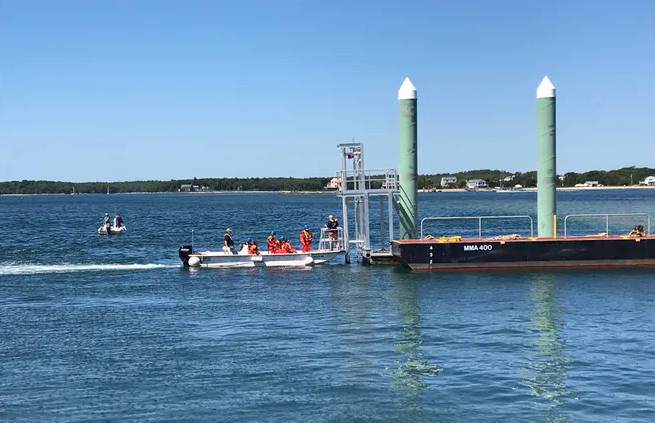
The Massachusetts Clean Energy Center provided funding in 2018 for MMA to build its Global Wind Organization training facility at the Maritime Center for Responsibility Energy. The center consists of a waterfront crew transfer training facility, a 25-foot crew transfer training vessel, and a facility for training in working at height. MMA began in 2019 offering GWO basic safety training, becoming the first in the U.S. to offer all five modules of GWO basic safety training for offshore wind.

The course includes modules about working at height, first aid, fire awareness, manual handlings, and sea survival. Instructors’ goals are to make workers familiar with wind industry work hazards and how to deal with them.

Three wind farms are in various stages of development in the Atlantic Ocean, about 20 miles south of Nantucket and Martha’s Vineyard. Those farms’ developers require the basic safety training course. “MMA has the experience to deliver this critical course, ensuring quality training to the people who will be out on open water building the wind turbines,” said Jenni Lewis, MD RelyOn Nutec Gulf of Mexico.

Members of Pile Drivers and Divers Local 56, the marine construction local of the North Atlantic States Carpenters Union, are taking advantage of the course. “This training is critical to our members,” said Dave Borrus, business manager of Pile Drivers & Divers Local 56. “The opportunity to work in the clean energy industry is great for our members but there are occupational risks, too. Safety must be at the forefront of each member’s mind,” said Borrus.

The Massachusetts Clean Energy Center is sponsoring Local 56 members’ participation with a $100,000 workforce development grant.

Training consists of both classroom and practical exercises. Participants acquire knowledge and confidence by learning the practical skills they need through practice. Students learn the proper use of personal protective equipment, emergency equipment, and procedures with the end result being able to appropriately respond in the event of an emergency.

Capt. Mike Burns, Executive Director of the Academy’s MCRE, praised the maritime academy’s training. “Every group that has gone through the training has been exceptional. The participants are highly skilled professionals who understand the importance of safety in this industry. It’s our honor to help them prepare for the next phase in their careers,” Burns said.

MORE INFO  www.maritime.edu/professional-training/offshore-wind-training

American Clean Power 2Q market report shows record installations

0


There are now more than 180,216 MW of clean-power capacity operating in the U.S, enough to power more than 50 million homes across the country and more than double the U.S. capacity just five years ago.

Clean Power Quarterly 2021 Q2 Market Report, recently released by the American Clean Power Association (ACP), shows that U.S. project developers commissioned 5,620 MW of clean power capacity in the second quarter of 2021, a 13 percent increase over 2020’s second quarter volume.

Additions for the first half of 2021 totaled 9,915 MW, the highest record for new clean-power installations, representing a 17 percent increase in the first six months of 2021 compared to the same period last year.

The industry installed 2,226 MW of solar capacity in the second quarter, a 73 percent increase compared to the first quarter, bringing total new annual operating solar capacity to 3,513 MW. The wind sector installed 2,824 MW of new capacity in the second quarter of 2021, a 10 percent increase compared to the same period last year. Battery energy storage experienced the most dramatic quarterly increase with new installations of 570 MW surging 439 percent, new energy storage capacity in 2021 now totals almost 665 MW, nearly the 2020-year-end total.

“This market report shows the record growth across the renewable energy sector. With a record pace of installations in the first half of 2021 our industry not only provides good-paying jobs but also is a key part of solving the climate crisis,” said Heather Zichal, ACP CEO. “This growth and expansion are expected to continue, but we need policymakers in Washington to make long term decisions to ensure we can continue to develop these critical projects.”

Project owners commissioned a total of 56 new projects across 27 states during the second quarter, this includes 16 new wind projects, 30 utility-scale solar projects, seven energy storage projects, and three solar-storage hybrid projects, enough to power nearly 1.3 million American homes. The top five states for second quarter additions include Texas (1,489 MW), California (585 MW), Michigan (424 MW), Florida (373 MW), and Kansas (301MW).

In total, there are now more than 180,216 MW of clean-power capacity operating in the U.S, enough to power more than 50 million homes across the country and more than double the U.S. capacity just five years ago. This growth will continue; at the end of the second quarter, there were 906 projects totaling more than 101,897 MW of clean-power capacity under construction (37,725 MW) or in advanced development (64,172 MW) across the U.S.

The sector also saw continued clean-power procurement activity with power purchasers and project developers reporting 4,218 MW of new power purchase (PPA) in the second quarter, bringing the first half-year totals up to 7,700 MW. The quarter saw a continued shift to solar PPAs with more than 20 solar projects securing PPAs.

MORE INFO  cleanpower.org

Next decade will see more demand for wind farms

0
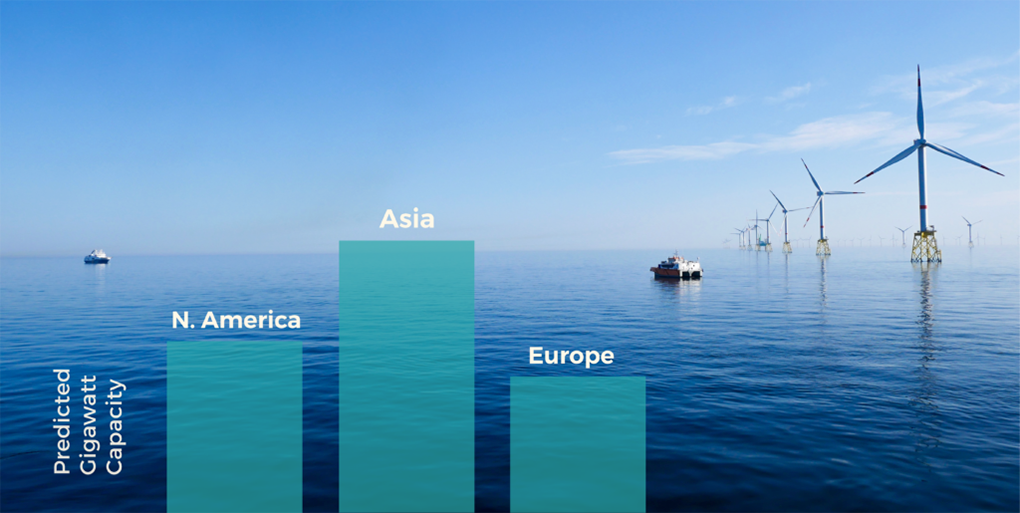
Asia is predicted to be the leader in gigawatt capacity in the next 10 years. (Courtesy: VesselsValue)

Demand for wind farms will increase over the next decade, according to offshore wind analyst Zac Ward.

In 2020, spending on offshore renewable projects was higher than that of offshore oil and gas spending, by an estimate of $12 billion, with $43 billion for oil and gas and $56 billion for renewable energy.

Newly built vehicles and repurposed or upgraded supply vessels will meet the demand for wind farm installation and maintenance vessels.

While the global capacity for offshore wind farms is now at 25GW, that number will rise to 235GW by 2030, estimates say.

VesselsValue’s Orderbook shows that out of the renewable energy still on order, about half are for Europe and half are for the Far East.

The United Kingdom has the most wind farms installed, followed by Germany, China, Denmark, Belgium, and the Netherlands. Asia, however, has the highest number of future plans for wind farms.

MORE INFO  https://blog.vesselsvalue.com/windfarm-vessels-in-increasing-demand/

Leosphere launches new tech for wind measurement

0
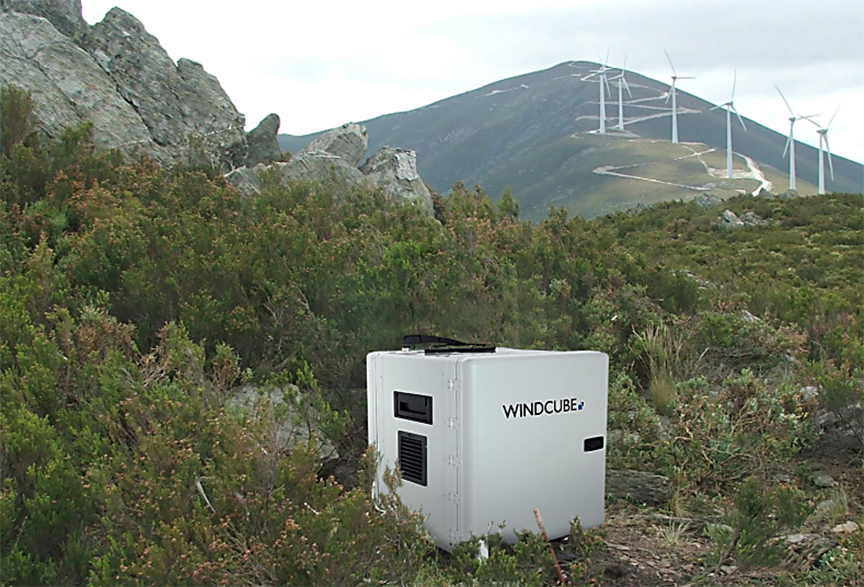
WindCube Complex Terrain Ready delivers wind measurement in terrains from moderate to complex. (Courtesy: Vaisala)

Leosphere has launched WindCube Complex Terrain Ready, to deliver wind measurement in terrains from moderate to the most complex.

The offering includes Leosphere’s patented Flow Complexity Recognition (FCR) software, and the Computational Fluid Dynamics correction method to deliver accurate and trusted measurement.

“With wind energy being one of the fastest-growing sources of sustainable energy production, the location of wind farm development and operations have expanded to new and challenging environments,” said David Pepy, Leosphere’s head of renewable energy.

“This expansion into hilly, mountainous and other areas with varying levels of terrain complexity, make it challenging to collect trusted and precise wind measurements that illustrate what the wind is doing in these increasingly complicated locations. That’s where our solutions come in to ensure project operators realize precise data in all types of complex terrain,” Pepy said.

With WindCube Complex Terrain Ready, companies have easy access to both FCR and CFD correction services, empowering wind farm developers with accurate, reliable, bankable, and widely accepted wind flow data. The integrated FCR solution is appropriate for moderately complex terrain while CFD post-processing, available as an option through partnerships with wind energy leaders and consultants, is leveraged for more complex terrain. In some cases, customers use both FCR and CFD data to ensure the highest possible wind measurement outcomes.

The company has partnered with proven CFD industry leaders, including Meteodyn and WindSim, and wind energy consultants such as ArcVera, Deutsche WindGuard, DNV, Fraunhofer IWES, and UL, to ensure WindCube customers have access to the right CFD solution and industry expert support to meet their specific needs.

MORE INFO  https://www.vaisala.com/en/lp/windcube-complex-terrain-ready

BOEM seeks input on California wind

0
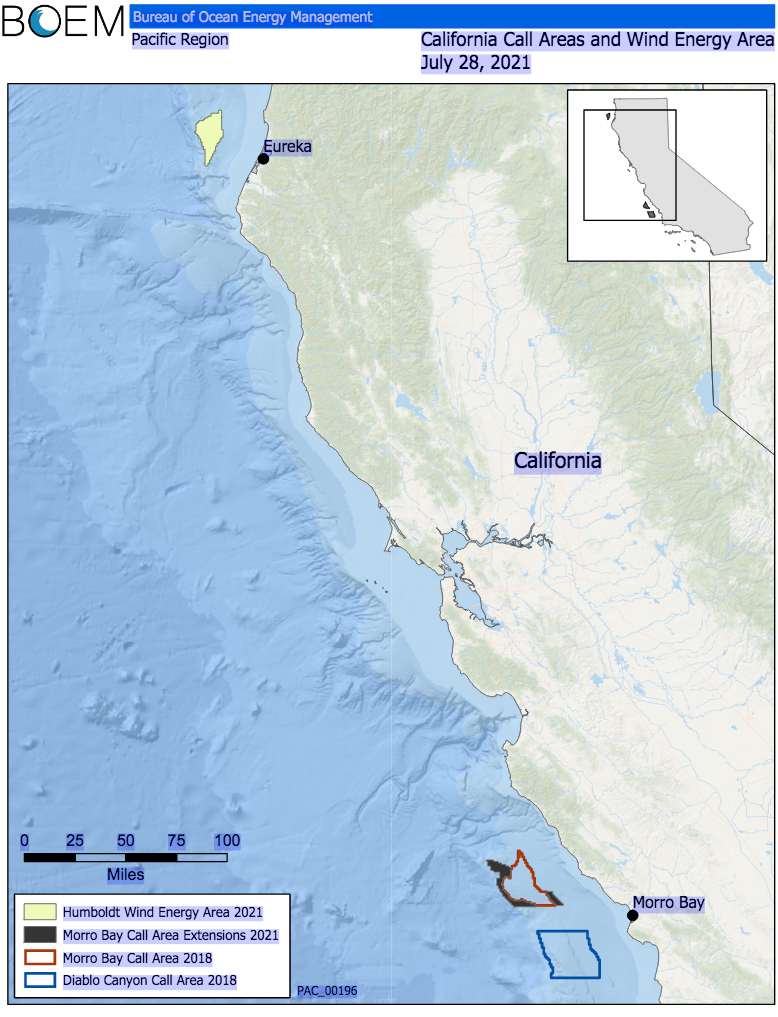
The Bureau of Ocean Energy Management seeks public input on offshore wind areas off of California’s north and central coasts. (Courtesy: BOEM)

The Department of the Interior’s Bureau of Ocean Energy Management (BOEM) has published a request for information from the public and to determine interest from industries in offshore wind energy development in central California.

The areas involved are within the Morro Bay Call Area East and West Extensions, a 399-square-mile area of central California.

BOEM has also formally designated the Humboldt Wind Energy Area in offshore northern California, and will proceed with an environmental review of that area.

“If approved for offshore wind energy development, these areas could bring us closer to reaching this administration’s goal of deploying 30 gigawatts of offshore wind by 2030,” said BOEM director Amanda Lefton.

“While we are still in the initial stages of BOEM’s leasing process, today’s announcement reflects years of working with ocean users, Tribal governments and local, state, and federal agencies to obtain the best available information to reduce potential conflicts,” said Thomas Liu, acting Pacific Region director of BOEM.

Offshore wind energy development can help California reach its goal of 100 percent carbon-free energy by 2045, as well as create good-paying union jobs, and foster investments in coastal communities. Offshore wind resources are typically stronger and more consistent than winds over land and are especially strong in the evening hours when solar energy production drops off, ensuring that offshore wind energy can make an important contribution to California’s electric grid.

The east and west extensions consist of about 141 square statute miles, or 90,025 acres.

BOEM published the call for information in the Federal Register on July 29, which started a 45-day public comment period.

The bureau also will use these comments as input for its consultation under section 106 of the National Historic Preservation Act. Additional information on how to comment can be found at https://www.boem.gov/renewable-energy/state-activities/humboldt-wind-energy-area.

MORE INFO  https://www.boem.gov/newsroom/press-releases/boem-advances-offshore-wind-leasing-process-california

X1 Wind expands team to ramp up commercial operations

0
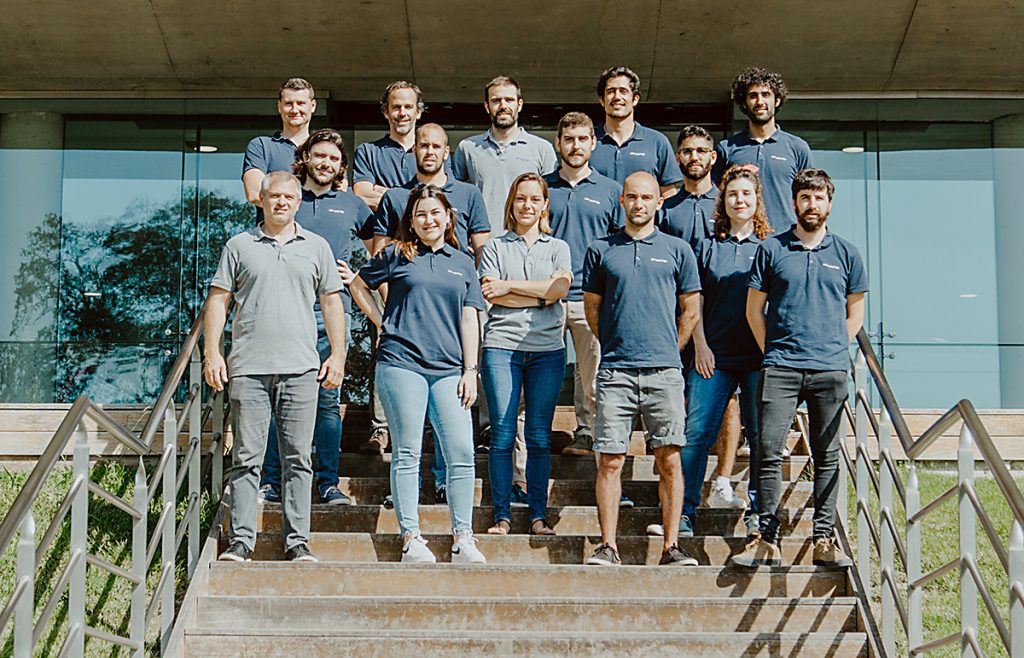
New additions to the X1 Wind team. (Courtesy: X1 Wind)

X1 Wind has made new appointments to help accelerate full-scale commercial operations.

New additions include Strategy and Business Development Director João Neves, Mechanical Engineer Javier G. Cervilla and Junior Structural Engineer Lucy Milde. The recruits come from a variety of backgrounds, including Boston Consulting Group, General Electric and Massachusetts Institute of Technology.

“Our new recruits will play an important role, helping to inform and accelerate our technical and commercial strategy,” said Alex Raventos, X1 Wind CEO and co-founder.

“Our overarching aim is to make a meaningful contribution to help combat climate change through large-scale decarbonization of the energy system. With this goal in mind, we have taken time to assemble a close-knit group of excellent engineers covering all core areas necessary to develop our innovative floating wind technology as well as experts on strategy and business development,” said Raventos.

X1 Wind’s technology is designed to reduce the current Levelized Cost Of Electricity (LCOE) of floating wind through reduced floater weight, a faster and cheaper installation process and a more reliable operation. The system is connected to a single point mooring system in a downwind configuration, which creates a “weather-vaning” solution that maximizes use of passive systems.

“I believe that we need to do everything we can to accelerate the energy transition, and floating wind has a massive potential to contribute to this goal. Nevertheless, it still requires innovation to become a competitive technology and that’s what we strive for at X1 Wind,” said Neves.

The team aims to be a world leader in floating wind, said Cervilla. “I couldn’t resist this rare opportunity to help redefine floating wind rules and indulge my passion for innovative solutions, which will underpin the future energy transition,” Cervilla said.

X1 Wind is a floating wind technology developer based in Barcelona, Spain. The company’s mission is to provide scalable solutions that deliver clean, affordable energy while reducing carbon emissions across the globe.

MORE INFO  www.x1wind.com

US Wind picks up speed in Maryland

0
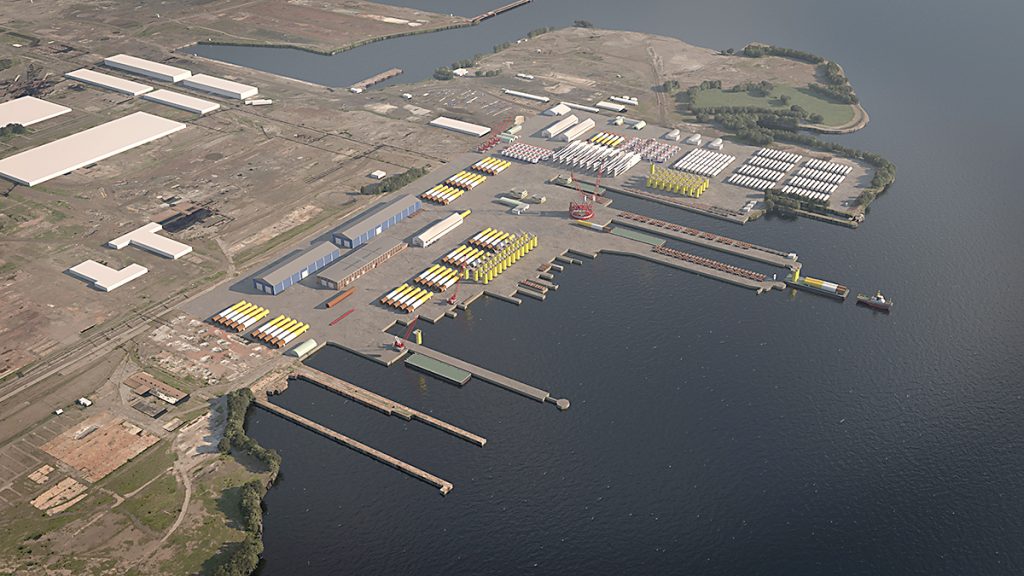
A rendering from a proposal for a new steel fabrication facility at Sparrows Point Steel. (Courtesy: US Wind)

US Wind, the only offshore wind company that focuses exclusively on developing clean energy for Maryland, announced progress for its offshore wind plans, including labor agreements and an agreement for a new port facility.

The labor agreements with the Baltimore-D.C. Building and Construction Trades and IBEW will support current and future projects, including the 22-turbine MarWin, the company’s first offshore wind project in Maryland.

MarWin is expected to begin generating clean power in 2025, and will support 1,300 direct construction jobs in the state. US Wind is committed to using union labor for many of those jobs.

The port facility agreement with Tradepoint Atlantic sets up development for 90 waterfront acres. US Wind will initially invest $77 million into an offshore wind development hub there.

US Wind also announced plans to develop up to 1,200 more MW of offshore wind energy in addition to Momentum Wind, a project that will consist of 82 turbines, with the first phase coming online in 2026, and subsequent phases online in 2028. About 3,500 direct construction jobs will be created.

In conjunction with Momentum Wind, the company announced a proposal to bring steel back to Baltimore, for a new steel fabrication facility in Baltimore County at Sparrows Point Steel.

MORE INFO  https://uswindinc.com/momentumwind/