Home 2014

NREL taking Applications for National Executive Energy Academy through January 31

0

The Energy Department’s National Renewable Energy Laboratory (NREL) is accepting applications for its 2014 Executive Energy Leadership Academy. NREL’s Executive Energy Leadership Academy, also known as Energy Execs, is a program for non-technical decision-makers throughout the country to learn about renewable energy and energy efficiency technologies, analytical tools and financing. Leaders in government, communities, non-profits and the private sector are eligible.

There are two Energy Execs learning opportunities — the Leadership Program and the Leadership Institute. Both programs are designed to provide executive decision-makers with information and tools to guide their organizations and communities in energy-related planning.

Apply online at www.nrel.gov/energyexecs/or via fax or mail. The application deadline is January 31, 2014.

Clean Energy Jobs Top One Million, Index Shows

0

Ecotech Institute’s Clean Jobs Index, a tool to compare states’ use and development of clean energy, found more than one million job postings in the clean energy sector from July 1, 2013, through September 30, 2013. This shows a 54 percent increase in needed clean energy employees, evidence that the sector is rapidly growing and in need of experts. 

Ecotech Institute launched the Clean Jobs Index in January 2013 to provide objective job information about the clean tech industry. The Clean Jobs Index defines a clean tech job as one where workers make their business more environmentally friendly, use fewer natural resources, or produce goods or provide services that benefit the environment.

To learn more about the Clean Jobs Index, please visit www.ecotechinstitute.com/cleanjobsindex. To learn more about Ecotech Institute, go to www.ecotechinstitute.com.

ENERCON Installs Prototype E-115 Turbine In Northern Germany

0

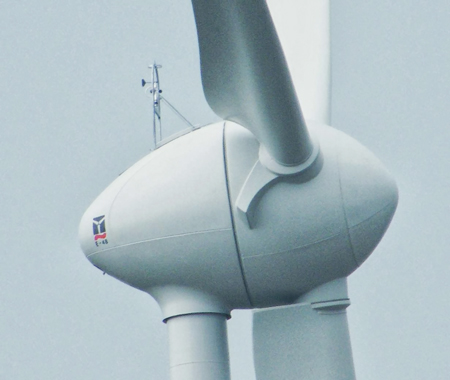
ENERCON recently installed a prototype of its IEC class IIa wind turbine in northern Germany and launched operations according to schedule.

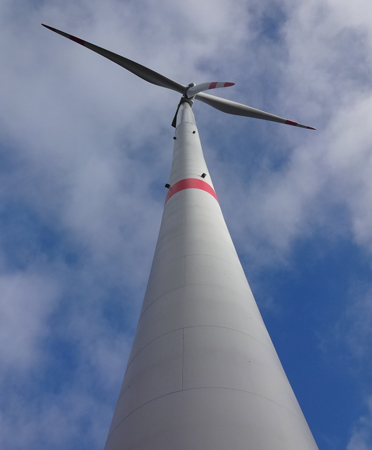
The prototype is perched on a precast concrete tower at a hub height of 135 meters, but is also available with towers ranging from 92 to 149 meters (hub height). Thanks to its performance-optimized blade design and a rotor diameter of 115 meters, the E-115 generates high yield even in the partial load range making the new series a profitable choice also for inland sites with slightly less wind.

This new turbine type aligns with ENERCON’s current MW-class models. Up until now, the top selling product was the E-101/3 MW machine with a rotor diameter of 101 meters.

“The demand for this category of wind turbine is high. And customers now have another turbine to choose from featuring technical innovations such as the divided rotor blade concept for optimized logistics,” said ENERCON Sales Director Stefan Lütkemeyer.

At a typical inland site with average wind speeds of 6.5 m/s at 149 meter hub height, the E-115 can generate an annual output of roughly 9.3 million kilowatt hours—an increase of 14 percent compared to the E-101. Expected availability for the E-115 is the middle of this year.

Ampair To Acquire Westwind

0

Ampair, the Dorset (UK)-based wind turbine manufacturer, is pleased to announce that it is in exclusive negotiations to acquire Westwind, the Belfast-based wind turbine manufacturer. Ampair, with over 40-years’ experience, is the UK’s oldest manufacturer of wind turbines.  Westwind relocated from Australia to the UK several years ago and now offers the widest range of MCS certified turbines of any manufacturer.

Ampair’s managing director David Sharman said “this acquisition immediately enables us to offer a wind turbine solution from 100W through to 20kW, which is a unique position and which will be to the benefit of our worldwide client base. Ampair’s smaller turbines and Westwind’s larger MCS-certified turbines neatly span the full range.”

RTS Signs On To Become UK Service Provider For Vensys

0

German turbine manufacturer Vensys and UK engineering services supplier RTS International have announced their UK framework agreement.

RTS has been chosen to become the UK Service Provider for Vensys. RTS will undertake the project management of the erection process as well as the on-going service requirements for Vensys turbines at onshore locations throughout the UK.

“We are delighted to be partnering with Vensys to deliver our installation and maintenance services across the UK,” Vensys managing director Chris Palmer said. “We installed the very first UK Vensys 1.5MW turbine in Kings Lynn at the start of October and this announcement today marks the start of what we expect to be a very successful and long-term partnership.”

GE’s 2.5-120 Turbine Now Operating Commercially at German site

0

Two months after the completion of installation, the first GE 2.5-120 wind turbine has been put into commercial operation in Schnaittenbach, a town in Bavaria, Germany. The 2.5-120 produces approximately 8,000-megawatt hours a year, which is equivalent to the required average energy needs of about 2,000 German households. The investor and operator of this project is Max Bögl Wiesner GmbH.

By choosing GE’s new 2.5-120 turbine, Max Bögl Wiesner GmbH made a decision for today’s most efficient inland wind turbine worldwide. GE’s goal was to facilitate the generation of wind energy in densely wooded regions with low wind intensity such as the Oberpfalz (Upper Palatinate area). The 2.5-120 meets these requirements and additionally contributes to the successful implementation of the “Energiewende” on a regional level.

The turbine’s advanced controls, paired with the 120-meter rotor and a specially engineered hybrid tower with a hub height of 139 meters, allow for a more efficient energy output. The 2.5-120 is GE’s first brilliant wind turbine to utilize the power of the Industrial Internet. The Industrial Internet uses data analysis to connect machines and equip them with intelligence, helping to position each one for enhanced performance. The 2.5-120 analyzes tens of thousands of data points every second to drive higher output and improve services productivity, ultimately helping to manage wind’s variability.

Siemens, DONG Energy Reach Deal on 582 MW German North Sea Offshore Projects

0

Siemens recently announced it will supply 97 wind turbines, each with a rating of six megawatts and a rotor diameter of 154 meters, to the Danish energy provider DONG Energy. The total capacity for the Gode Wind 1 and Gode Wind 2 projects is 582 MW, enough to supply around 600,000 German households with eco-friendly power.

The Gode Wind 1 (252 MW) and Gode Wind 2 (330 MW) wind power plants will be erected off the North Sea island of Juist, around 45 kilometers from the German coast in water depth of up to 34 meters. This will mark the first time that Siemens will be supplying its new 6 MW wind turbines for offshore in Germany. Siemens will also service the wind turbines for a period of five years. Construction is planned to begin in the first half of 2015, with commissioning scheduled for the second half of 2016.

“Offshore wind energy is a vital contributing factor to the success of the energy transition in Germany,” stated Markus Tacke, Siemens wind power division CEO. “Only at sea can wind projects of a performance category equivalent to major power plants be erected in Germany. Offshore wind energy will also act as a stabilization factor in the German energy mix. Offshore wind power plants produce electricity on more than 340 days per year, thanks to stable wind conditions at sea.”

Siemens is at the front of the market for offshore wind power plants, for grid connection and for offshore wind service. To date, the company has installed wind turbines with a total capacity of 3.9 gigawatts (GW) at sea worldwide. Siemens currently has orders for offshore projects with a capacity of around 5 GW in the books.

“Despite the fact that offshore wind energy is quite a new technology, we are making great advances. In the coming ten years we intend to reduce costs by up to 40 percent,” declared Mr. Tacke. “To accomplish this, it is essential that we have clearly defined and reliable framework conditions for the expansion of offshore wind power in Germany.”

Vestas and Enel Green Power Ink Deal for 350 MW, Plan for Order of Additional 636 MW

0

Vestas will supply 75 V100-2.0 MW turbines for the 150 MW Origin wind power plant in Oklahoma. Vestas and EGP-NA also have signed an agreement for up to an additional 836 MW worth of 2 MW turbines of which 200 MW is firm. Deliveries for Origin are expected to occur midyear, followed by commissioning by the end of December.

“We’re thankful to work again with a major global company like Enel which has a proven track record of building successful wind-energy projects in this country,” said Chris Brown, President of Vestas’ sales and service division in the United States and Canada.

Vestas’ factories in Colorado will be involved in manufacturing blades, nacelles and towers for the 350 MW order. To meet customer demand, Vestas is adding more workers at three of its Colorado factories—the blade factory in Windsor as well as the blade and nacelle factories in Brighton. Vestas is recruiting now and expects to add hundreds of production workers in the first half of 2014 in Windsor and Brighton, primarily at the two blade factories. Interested candidates can apply at ElwoodWindJobs.com.

The Origin project will include a three-year Active Output Management (AOM) 5000 service agreement. AOM 5000 is an energy-based availability guarantee that ensures the turbines are operational when the wind is blowing. This service option includes the VestasOnline surveillance system that remotely controls and monitors the turbines and predicts potential wear-and-tear issues. This allows Vestas to plan maintenance so the turbines operate with the minimum amount of lost production.

Vestas has previously supplied wind turbines to Enel for three U.S. projects, most recently the 200 MW Caney River wind power plant in Kansas that was commissioned in 2011.

EGP-NA, part of Enel Green Power, is a leading owner and operator of renewable energy plants in North America with projects operating or under development in 21 U.S. states and two Canadian provinces.

Gamesa to Supply Gestamp Wind 128 MW for Five Wind Projects in Brazil

0

Gamesa has signed a supply agreement under which it will supply 128 MW of its turbines to a Brazilian wind farm complex being developed by Gestamp Wind, the wind energy subsidiary of Gestamp Renewables, in Lagoa Nova in the state of Rio Grande do Norte. The development encompasses five wind farms: Santana I (20 MW), Santana II and III (30 MW each), Lanchinha (28 MW) and Pelado (20 MW).

The scope of the agreement includes the manufacture, supply, transport, installation and commissioning of 64 G97 wind turbines, each with unit capacity of 2.0 MW, as well as the complex’s  foundations civil works. The wind turbines are scheduled for delivery throughout the year, and the facility is expected to be commissioned at the end of this year.  Gamesa will also maintain the facility’s services for 10 years.

Gamesa has secured supply contract for over 1,000 MW in Brazil, in less than two years. As of last September, Gamesa had already installed 394 MW of capacity in Brazil, one of the company’s priority markets in the short and medium term.

Supply Agreement in Turkey
Gamesa and Gestamp Wind have also entered into another agreement under which the former will supply the latter 10 MW of wind turbines for a project in Turkey. The company will install and commission five G90-2.0 MW turbines at the Adares wind farm, which Gestamp is developing in a joint venture with Faik Celik in Selçuk, in the province of Izmir. Gamesa will maintain these turbines for 10 years. This facility is slated for completion during the second half of this year.

REpower Receives Turbine Orders Totaling 266 MW for 24 German Community Wind Farms

0

REpower Systems SE, a wholly owned subsidiary of the Suzlon Group, has signed contracts to deliver 103 wind turbines with a total capacity of over 266 MW for 24 community wind farm projects in the Schleswig-Holstein region of Germany. The contracts were concluded with different contractors who were previously represented by a purchasing association.

REpower signed a primary memorandum with the purchasing association, “Schleswig-Holstein GmbH Wind,” in December 2012. This memorandum assured the participants from 52 projects in Schleswig-Holstein binding conditions in a model contract. The participants could choose the appropriate offer from the final negotiated contracts of four different manufacturers for their own location. REpower has won 55 percent of all potential wind turbines for itself in this process.

The projects will employ various types of turbines from the MM82 with a 59 meter hub height, to the 3.2M114 with a hub height of 93 meters. Eleven wind turbines of the signed projects are already in the implementation phase and are to be commissioned quickly. The other projects will be completed by 2015.

 “With these contracts, we are significantly expanding our position in Northern Germany,” said Andreas Nauen, CEO of REpower Systems SE. “This is only possible because we have a suitable turbine for each individual site in our product portfolio, from Lübke-Koog in the far north, to near Fehmarn in the east of Schleswig-Holstein, and also because we have the ability to implement the interests of customers optimally with our staff on site.”

Acciona’s 3MW Platform Issued Seven GL DesignType Certificates

0

GL Renewables Certification, issued seven new certificates for different models of ACCIONA Windpower’s 3 MW AW 3000 turbine.

With these new certificates, Acciona Windpower now has 15 awarded for its 3 MW platform, a range of turbines for which the company has supplied or has orders for over 1,300 MW.

Specifically, GL Renewables Certification issued the Design Certificate for the AW 125/3000 IEC IIIa wind turbine, with a 125 meter rotor, 120 meter concrete tower and 61.2 meter blade, for grids of 50 and 60 Hz. This model is specially adapted for sites with low wind speeds. 

GL has also given the Type Certificate for another six models of the AW 116/3000 turbine with a 116 meter rotor. Apart from validating the design, this certificate indicates that AWP has a quality management system according to the ISO 9001 standard, that the manufacture of the main components of the turbine is done in line with the  highest quality standards, and that the turbine is capable of passing the prototype tests defined in current standards.

The Type Certificate has been awarded to the models of the AW 116/3000 for 120 meter (hub height) concrete tower and for 92 meter tubular steel tower. Acciona Windpower also holds Type Certificates for three other turbine models offered on its 3MW platform: the AW 100/3000 IEC Ia (100-meter rotor), the AW 109/3000 IEC IIa (109-meter rotor), and the  AW 116/3000 IEC IIa (116-meter rotor)— all mounted on 100-meter concrete towers.

Nordex Extends “Generation Delta” with the Addition of the N131/3000 for Light-Wind Sites

0

Nordex SE is extending the “Generation Delta” turbine platform launched in spring 2013 with the addition of a turbine for light-wind locations. With the N131/3000, customers will not only be able to choose from strong and moderate-wind turbines but now also from a highly efficient system specially designed for IEC-3 locations. The N131/3000 combines the proven advantages of the high efficiency and low sound power levels of the Generation Gamma’s N117/2400 turbine with the benefits of a high nominal output and the technical advances of the Delta platform.

A special feature of the N131/3000 is the substantially larger rotor. With rotor blades measuring 64.4 metres in length, the rotor diameter is 14 metres larger, thus producing a close to 26 percent increase in rotor sweep. This sweep plays a key role for energy yield. For this reason, the N131/3000 will achieve substantially improved project economics compared with existing turbines particularly at light-wind locations. The N131/3000 can derive up to 28.6 percent more yield from sites characterized by lighter winds. The reason for this is that Nordex also has raised the nominal output of this product for locations with wind speeds of less than 7.5 m/s by 25 percent to 3.0 MW.

 Nordex is offering the N131/3000 on tubular steel towers with a hub height of 99 and 114 metres for international markets. The target markets for the N131/3000 are Central Europe, Scandinavia and Turkey, as well as selected regions in Africa and the Americas.

One particular advantage of the turbine is the low operating sound power level. At nominal power, it achieves a sound power level of only 104.5 dB (A) — an advantage in densely populated regions or at noise-critical locations. A range of noise-optimised operating modes make it possible to run the turbine specifically meeting the requirements of those locations and so to reduce emissions even further.

The N131/3000 is based on the technical platform used in Generation Delta. All relevant certificates and documents required to apply for building permits have been available for the moderate-wind turbine N117/3000 and the strong-wind version N100/3300 since summer 2013. The first three Generation Delta turbines are in operation in Germany and Denmark. In Finland, two further cold-climate turbines were recently installed.

The first light-wind N131/3000 turbine is to be installed in the fourth quarter of 2014. Series production of the turbine is scheduled for 2015.

Goldwind Breaks into Romanian, Eastern European Markets

0

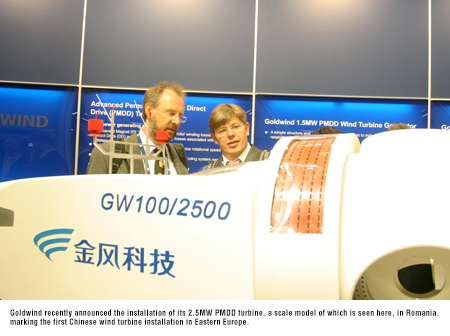
Goldwind recently announced the first successful installation of its 2.5 MW PMDD wind turbine, as part of a 50 MW turbine supply contract with the Romanian company Mireasa Energies S.R.L. The installation also marks the first Chinese wind turbine in Romania as well as Eastern European Market.

The Mireasa project is located in Constanta, Romania’s second largest harbor city. The city is on the west coast of the Black Sea—170 kilometers east of the capital city of Bucharest. The Constanta region is one of the country’s most prosperous areas.

Constanta has several benefits, including a temperate climate with an average annual temperature of about 10 degrees Celsius, annual rainfall of 600 to 800 millimeters, and the main attraction for electric generation is its abundant wind.

Goldwind customized its permanent-magnet direct-drive wind turbine to optimize its operating performance for local conditions in Constanta—a standard practice for the company’s installations. The objectives are to make the best use of the wind resources and to provide the most durable long-life performance for each installation, given the location’s environment.

Twenty Goldwind 2.5 MW wind turbines were expected to be shipped to Romania by the end of 2013. The turbine installations and connections to the local electric grid are to be completed in June. Monsson Alma, a local wind power developer in Romania, will operate the wind farm.

Vestas approves first fill agreement for Castrol synthetic gear oil

0

Castrol has signed a global three-year deal with Denmark-based Vestas Wind Systems to deliver first and service fills for all of its new builds and existing turbines.

It is projected that Castrol will deliver in excess of 1.5 million liters per year under this deal. The agreement follows the full product approval for global use, which came after a three-year trial.

“This agreement is the result of a close collaboration with Vestas using  our extensive expertise to deliver the best result for the company,” John Carey, vice president for  Castrol Lubricant’s business for aviation, industrial, marine, and energy said. “At Castrol, working alongside our customers is key to developing solutions that are able to meet their needs, and Castrol Optigear Synthetic CT gear oil has been formulated specifically for use in wind turbine gear box applications.”

New ASTM Standard Test Method certifies capabilities of Spectro’s FluidScan handheld infrared oil analyzer

0

ASTM International approved Test Method D7889, “Standard Test Method for Field Determination of In-Service Fluid properties using IR Spectroscopy,” in October. The approval represents official confirmation that the FluidScan handheld infrared oil analysis technology from Spectro Inc. meets ASTM guidelines for the analysis of in-service lubricants.

The FluidScan method provides direct, immediate measurement of multiple lubricant condition parameters via Spectro’s patented Direct Infrared Spectroscopy (DIR) technology. DIR operates without wet chemistry and requires no solvents; only one drop of oil is needed for analysis.

To gain certification of the FluidScan method as a worldwide fluid field analysis standard, Spectro worked with ASTM Committee D02.96 for In-Service Lubricant Testing and Condition Monitoring Services to develop the D7889 Standard Test Method.

Test Method D7889 specifically describes the way the FluidScan process measures soot, anti-wear additive, oxidation, nitration and sulfation. Performance levels published in D7889 for those in-service fluid properties (measured by repeatability tests) show that FluidScan analysis provides the measurements at levels comparable to established FTIR methods. In essence, the Test Method covers six existing FTIR In-Service Test Methods for lubricant analysis. Additionally, D7889 discusses the use of a FluidScan device to provide acid/base data, water content and other relevant parameters, and also establishes ASTM guidelines for creating infrared calibrations.

James Fisher Renewables Launches Offshore Oil Change System Using Sage Oil Vac Technology

0

U.K. marine services provider James Fisher Renewables has launched an oil change system utilizing technology patented by Sage Oil Vac. The Ship-to-Turbine system is designed to improve speed and efficiency in offshore wind turbine gearbox oil changes.

The oil exchange pumping technology includes an on-board filtration system that filters new oil to ISO-approved levels. Fresh oil is also heated for easier flow during the exchange. Time savings are realized by vacuuming new oil directly from a bulk tote or barrel. The systems also allows for flush and/or rinse capabilities. Sage Oil Vac equipment sold in Europe features CE tanks for compliance with European Union safety and environmental requirements.

James Fisher Renewables launched the STT system in November, building on the successful use of the technology in onshore applications. A range of product variants were created specifically for offshore use. These variants were based on application-specific oil volumes, oil types, umbilical lengths and ease of mobilization, and protection from the marine environment.

Availon Selected By Energiequelle To Maintain Portion of German Turbine Fleet

0

Availon recently announced that it won a full maintenance contract for seven Vestas wind turbines. The German multi-brand service provider is taking over the full maintenance of seven out of a total of 12 Vestas V80 turbines in the Hakenstedt wind farm. The wind farm is located 30 kilometers west of Magdeburg, Saxony-Anhalt, Germany.

 “The seven 2 MW turbines, were commissioned in 2003 and are to be maintained by Availon for five years as part of the ‘WindKeeper Complete Modular’ full-maintenance package. The contracts (began) in mid-December 2013, initially for two wind turbines and will then be extended to five further turbines at the start of March 2014,” commented Ulrich Schomakers and Markus Spitzer, Availon’s chief executives.

 The contract, with an availability guarantee of 97 percent, includes the maintenance of all wind turbines including the wear parts package occurring twice each year, full-time remote monitoring, oil change and unscheduled maintenance, amongst other things. Furthermore, the repair or replacement of individual wind turbine components, up to and including add-on parts for major components, is also included in the deal.

As part of the full maintenance agreement, Availon will be collaborating with Energiequelle GmbH, a German renewable energy project developer and operator based in Kallinchen, a suburb of Zossen near Berlin, who will be responsible for the technical management of the wind turbines. In the area of wind energy, Energiequelle now controls the technical management of more than 600 turbines, predominantly in Germany.

“We have had previous positive experiences with Availon over the past five years relating to another wind farm, with another type of turbines. That’s why we are looking forward to expanding the cooperation with Availon as part of further projects,” says Lars Schiller, head of technical management at Energiequelle GmbH.

Marshall Wind Energy, Mortenson Team Up On 74 MW Kansas Project

0

Marshall Wind Energy LLC, a wholly-owned subsidiary of RPM Access LLC, has commenced construction of its 74 MW wind farm in Marshall County near Beattie, Kansas.

Since project initialization in 2009, local landowner and community enthusiasm coupled with mutually beneficial arrangements established with Marshall County have underpinned the ongoing success of this development effort.

Marshall Wind Energy executed a high voltage transmission interconnection agreement with Westar Energy and Southwest Power Pool in mid-2011. Under the terms of this arrangement, the two companies are coordinating their efforts to pursue all design, engineering and construction activities related to the Westar 115kV Marshall County Wind Farm Switching Station and the Marshall Energy Rock Substation. Energization is scheduled for August with wind farm commercial operations expected by year’s end.

A contract has also been signed with Mortenson Construction to provide balance-of-plant design and construction management activities. Marshall Wind has established a local business office in Beattie. An on-site construction management office and equipment have been mobilized to support construction of access roads to wind turbine locations along with substation site grading and foundation work activities that are now underway.

Renewable energy generated by the project will be purchased by multiple entities via long-term contracts. In September, Marshall Wind signed a 20-year power purchase agreement (PPA) for 20 MW with the Missouri Joint Municipal Electric Utility Commission (MJMEUC). The project will qualify for current renewable production tax credits (PTCs). Located within the Southwest Power Pool market region, Marshall Wind in 2014 is positioned to offer for sale under long-term contract(s) the remaining available capacity.

The project is anticipated to create more than 150 jobs during the construction phase and approximately four permanent positions. The wind farm will also benefit the community by strengthening the local economy and providing a steady flow of revenue to Marshall County.

EDF Acquires 200 MW Texas Project, starts Construction

0

EDF Renewable Energy has announced it has acquired the 200 MW Hereford 1 Wind Project in the Texas Panhandle from Lincoln Renewable Energy and construction has commenced.

Encompassing approximately 15,000 acres in Deaf Smith County, southeast of the town of Hereford, the project will take advantage of the CREZ (Competitive Renewable Energy Zone) transmission lines connecting the wind generating capacity of the Texas Panhandle to high electricity demand areas in the state. EDF Renewable Energy has also secured a long-term, fixed-price hedge agreement for the expected energy production.

EDF Renewable Energy presently has 561 MW of wind capacity either in construction or ready-to-build in the State of Texas.

RMT begins construction on Greenbriar Capital’s 80 MW Blue Mountain Project

0

Greenbriar Capital Corp. announced in December that it has commenced formal construction at its 80 MW Blue Mountain, Utah wind energy site. Blue Mountain is a fully contracted 80 MW wind energy project holding a 20-year energy sales agreement with PacifiCorp, a subsidiary of Mid-American Energy Holdings Company (itself 89 percent owned by Berkshire Hathaway).

Construction has been awarded to RMT, Inc. of Madison, Wisconsin, a subsidiary of IEA Infrastructure and Energy Alternatives, LLC of Chicago. RMT is a world leader in renewable power engineering, procurement and construction services having built over 5,000 MW of renewable energy facilities.
Construction began December 9th and will qualify the project for Federal Investment Tax credits.