Home 2012

Web Conference on Countering Wind Energy NIMBYism

0

NIMBY is an acronym well-known in all development industries for “Not In My Back Yard.” As the wind energy industry matures, so does anti-wind energy sentiment. NIMBYism is becoming increasingly prevalent in the United Kingdom, and US wind farms are now encountering well-organized opposition and wind energy NIMBYism become more widespread. Arguments that are most prevalent and difficult for developers to answer surround the topics of noise, flicker, wildlife and habitat fragmentation, decommissioning, confidentiality, safety, efficiency & capacity, subsidies, and costs.


Through the lens of these popular arguments, this 90-minute webinar will educate all wind energy professionals seeking to responsibly represent their company and stave off complaints and concerns in working with county and local governments, landowners, and other important stakeholders. Those attending this seminar will learn how to:

• Disarm the opponent
• Dissect an argument into its structural components
• Spot commonplace fallacies
• Leverage counterarguments
• Assuage fears and concerns about “Wind Turbine Syndrome,” and Sidestep common mistakes made in landowner communications


The presenter is Tiff Thompson, principal at NIMBY Consulting, LLC, and the event will be held on Wednesday, February 15th, 2012, 1:00-2:30 PM Eastern. Please register by Midnight (Eastern), Tuesday, February 14, to receive webinar connection information in a timely manner. Go to www.cvent.com/d/OsxtCJV05keQI6CeFPirfQ/c7xt/P1/1Q?

AWEA Regional Wind Energy Summit—Midwest 2012

0

The Midwest wind power market is strong, and continues to be an anchor for the entire U.S. wind energy industry. Of the over 43,600 MWs of wind capacity installed in the U.S. through October 2011, over 14,600 MWs were installed in Midwestern states – that’s over 30% of total installed capacity.

Whether you are already involved in Midwest wind power activities, or want to learn more about entering into this growing marketplace, you won’t find a more relevant event. This new AWEA Regional Summit is a prime opportunity to engage in discussions with your peers, wind energy industry leaders, and subject matter experts on issues unique to the Midwest. And because this event is designed specifically for the region, the local business contacts and prospects you will develop will be invaluable. Learn about and discuss critical Midwest Wind Energy issues in these sessions:


  • • Keynote Session: Wind Industry Leaders Roundtable
    • • Midwest Wind Energy Market Assessment
    • • Transmission Opportunities and Issues in the Midwest
    • • Siting and Wildlife Issues
    • • Wind Power as a Manufacturing Growth Engine in the Midwest
    • • Community Relations and Local Acceptance in Sub-Regional Markets
    • • Key Wind Power Issues Facing Utilities in the Midwest
       
      The event will be held in Chicago at the downtown Fairmont Hotel, Millenium Park

March 6-7, 2012. Register here: www.awea.org/events/AWEA-Midwest-Wind-Energy-Markets-Seminar-2012.cfm.

Mexico Wind Power Finance & Investment 2012

0

Register now for the Mexico Wind Power Finance & Investment 2012 from March 26-28, 2012 in Mexico City, D.F. This program will explore the burgeoning Mexican wind market, giving you both an evaluation of the market and potential business models as well as an introduction to the government officials, financiers, and vendors you need to know to succeed. Register by Friday, March 2, 2012 to receive the Early Bird Special. Mexico Wind Power Finance & Investment 2012 will:
 
• Host the major government and industry players in the Mexican market as project development accelerates
• Assess wind resources and access to new areas where wind power will flourish
• Present case studies and lessons learned in public and self-supply deals
• Evaluate how the latest turbine and interconnection technologies will affect project performance
• Connect developers with leading domestic and international financiers to assure the profitability of the wind industry
 
March 26-28, 2012 · Mexico City, D.F.
www.informationforecastnet.com/mxwind12
Registration Code MX1E12

Early Bird Ends Friday, March 2, 2012

Maxwell Technologies Rings NASDAQ Closing Bell

0

Maxwell Technologies, Inc., CEO David Schramm (above center) rang the market closing bell on Wednesday, October 26, 2011 at NASDAQ’s MarketSite in New York City’s Times Square. Maxwell was honored in the closing ceremony for its 28 years of participation on the stock exchange and its profile of innovation and leadership that exemplifies a NASDAQ company. Sales of Maxwell’s ultracapacitor products have grown from $5 million in 2004 to a run rate on pace to reach $100 million by the end of 2011.

Maxwell is a leading developer and manufacturer of innovative, cost-effective energy storage and power delivery solutions. Maxwell’s ultracapacitor products provide safe and reliable power solutions for applications in consumer and industrial electronics, transportation, and telecommunications. Its high-voltage grading and coupling capacitors help to ensure the safety and reliability of electric utility infrastructure and other applications involving transport, distribution, and measurement of high-voltage electrical energy. Its radiation-mitigated microelectronic products include power modules, memory modules, and single board computers that incorporate powerful commercial silicon for superior performance and high reliability in aerospace applications. For more information please visit www.maxwell.com.

Castrol Industrial Secures Agreement with Siemens

0

Castrol Industrial has signed a purchase agreement with Siemens Wind Power to use the company’s flagship gear oil, Castrol Optigear Synthetic X 320. The award of the new contract has been the impetus for Castrol Industrial starting up the production of Castrol Optigear Synthetic X 320 at its U.S. manufacturing plant in Warminster, Pennsylvania, to help the company better serve Siemens operations in Hutchinson, Kansas, and supply locally-produced lubricants to other customers in the U.S. and surrounding markets.

“The deal is the latest in a long-standing working relationship with Siemens, a company that recognizes the importance of working with global partners to ensure consistency and quality in all markets served,” according to Sven Thiesen, key account manager wind energy, Castrol Industrial. “We are pleased to be working with such a forwardthinking, innovative and growing business and are incredibly proud to be supporting Siemens’ global expansion plans.”

Today, Castrol Industrial provides 100 percent fulfillment of all Siemens’ wind turbine gear box lubrication needs with its Castrol Optigear Synthetic X 320 product, and supply of complementary products, including hydraulic fluids and greases to the company’s wind energy business. Over the past five years Castrol Industrial has supplied Siemens Wind Power with gear box lubricants of consistent high quality and standardized packaging globally for first fill and ongoing maintenance applications. Siemens Wind Power is one of the world’s leading suppliers of wind power solutions for onshore, offshore and coastal sites.

While Castrol Industrial ships Optigear Synthetic X 320 from Europe to serve the Chinese market, the company continues to evaluate the option of manufacturing at its Taichang plant in China to meet the growing demand in this region, which represents significant future potential. Learn more at www.castrol.com.

Travelers Forms Dedicated Clean Energy & Technology Practice

0

The Travelers Companies, Inc., which has been offering insurance products and risk management services for clean energy and technology businesses for more than two decades, announces the formation of its Clean Energy & Technology Practice. This new practice creates a streamlined source of clean energy and technology-focused insurance products, and risk and claim management resources.

“With Travelers’ long experience working closely with clean energy and technology businesses, and as these businesses continue to grow and expand, the Clean Energy & Technology Practice makes it easier for independent agents and brokers to access the breadth and depth of Travelers’ products and services,” says Joe Tracy, president, Travelers Inland Marine. “The Clean Energy & Technology Practice offers rounded total account solutions. Through a single touch point, customers experience a streamlined process that provides access to a broad spectrum of insurance products and risk management services.”

The practice brings together all of Travelers’ existing clean energy and technology practice areas, providing customers, including wind and solar manufacturers, contractors, power producers, owners and developers, smart grid, fuel cell development, alternative, and other energy efficient solutions with industry-specific insurance protection. The Travelers Clean Energy & Technology Practice has extensive capabilities and interest in supporting U.S. entities and their international exposures that focus on technologies that are energy efficient or environmentally friendly.

Interest and demand for clean energy and technology is increasing dramatically in the United States and across the globe. As a result, these demands have fueled the growth of businesses in the renewable energy industry focusing on technologies that are energy efficient or environmentally friendly. “Clean energy and technology companies are expanding across the globe, each with a unique risk profile that our underwriters are trained to understand and address,” says Kathy Swendsen, president, Travelers Global Technology. “By combining our expertise under one practice, in conjunction with our independent agent and broker network, we help our customers avoid the growing pains of inadequate coverage as their businesses evolve.”

The Clean Energy & Technology Practice will be spearheaded by Travelers veterans Tracy and Swendsen and co-managed by Kirstin Simonson, underwriting director for Global Technology, and Lauren Cutro Berry, underwriting vice president for Inland Marine. For more information visit www.travelers.com/cleanenergy.

New Vice President/GM at NAES Power Contractors

0

NAES Corporation announces the addition of William “Will” Day as vice president and general manager of the NAES Power Contractors office in Hillsboro, Oregon. He is responsible for all activities for NAES Power Contractors emanating from the Hillsboro office.

Day has over 30 years’ experience in the generation industry. Before joining NAES he served as vice president of development engineering and construction at Calera Corporation, a Silicon Valley startup technology venture. Prior to that he spent 20 years in various leadership roles at NRG Energy and Cajun Electric Power Cooperative. During his career Day has held director level roles in transmission, operations, construction, business development, and mergers/acquisitions. He has also represented companies on industry and partnership boards both domestically and internationally.

Headquartered in Issaquah, Washington, NAES is the world’s leading provider of comprehensive services to industries that generate or consume power. For over 30 years, it has specialized in providing services centered on safe, reliable, and cost-effective performance including operations and maintenance; retrofit and maintenance services; on-site turbine inspection/overhaul services; staffing solutions; and customized services designed to improve plant and personnel effectiveness. NAES is owned by ITOCHU International, Inc., the U.S. affiliate of ITOCHU Corporation. With operations in over 80 countries covering a broad range of industries, ITOCHU is among the world’s largest corporations. Go online to www.naes.com.

Mortenson and enXco Partnership to Build 19th Wind Project

0

Mortenson Construction, a leading North American renewable energy contractor, was recently selected by San Diego-based developer enXco—an EDF Energies Nouvelles Company—for the construction of the Pacific Wind Project. Located on the south slope of the Tehachapi Mountains in Kern County California, the 8,500-acre project will generate 140 megawatts of wind power, which is enough energy to power approximately 39,000 homes.

Mortenson is responsible for the design and construction of access roads, foundations, erection, overhead and underground electrical collection system, and a 14,400 square-foot O&M facility that will support the Pacific Wind Project as well as other enXco projects slated for development in the area. Construction began in December, 2011, and is expected to be completed in August, 2012.

The Pacific Wind Project is the 19th wind power facility that Mortenson has constructed in partnership with enXco. Together the partnership has provided nearly 2GW of energy throughout the United States. In early October Mortenson completed construction of enXco’s 205.5 megawatt Lakefield Wind Project in southern Minnesota. In Minnesota alone the enXco/Mortenson partnership has developed and constructed approximately 36 percent of the state’s wind energy capacity.

“Our long-established relationship with enXco represents a cohesive partnership that reinforces our commitment to renewable energy though out the United States,” says Tim Maag, a vice president and general manager of Mortenson’s Renewable Energy Groups.

Since entering the renewable energy market in 1995 Mortenson Construction has become a leading builder of wind power facilities in North America, constructing more than 100 wind projects generating more than 11,000MW of renewable power across the United States and Canada. With 100 percent of Mortenson’s business in the power sector coming from renewable energy, Engineering News-Record ranked Mortenson the 11th largest power contractor in the U.S. for 2010. Go online to www.mortenson.com/wind.

Innovative Gearbox Concept Analysis from Romax

0

Romax Technology is pleased to announce the availability of release R14.0 of the precision bearing, gearbox, and driveline simulation and analysis software, RomaxDesigner, and wind turbine drivetrain specific variant, RomaxWind. The release includes many productivity and feature enhancements and introduces the innovative new Concept Modeller module option.

The Concept Modeller module revolutionizes the speed with which complex gearbox models can be created, functionally analyzed and exported to CAD for packaging analysis. The point and click user interface incorporates drag and drop editing and sizing features, resulting in over 10x speed improvement and reduced data entry errors when creating fully compatible RomaxDesigner models.

Designers can create gearboxes using conventional “stick diagrams” that are as easy as using pen and paper. Possible gearbox layouts include complex ravigneaux and plus-planet planetary arrangements and the latest dual-clutch arrangements. The Concept Modeller module takes the stick-diagram input and generates 2D and 3D representations that can be easily analyzed visually by selecting cut planes through the design. The module allows high-speed analysis of the basic properties required to evaluate many design concepts and select those that merit more detailed study. The properties include:

• Powerflow path analysis for each transmission ratio, speed and torque;
• Gear sizing analysis to aid in the determination of packaging requirements;
• Calculation of tooth passing frequencies to provide early indications of likely NVH performance.

No data re-entry is required on concept designs that are taken forward into RomaxDesigner for precision analysis. “We are seeing higher levels of innovation in our customer’s transmission designs and design processes as they rise to the challenges lower emission vehicle designs with rapidly evolving powertrains”, said Younsu Park, director of simulation technology. “A recent gearbox project involved the analysis of 58 conceptual layouts, of which six were selected for detailed analysis. RomaxDesigner release R14.0, with our new Concept Modeller option is making significant productivity improvements in this type of workflow.”

Based on extensive feedback from users, 20 productivity enhancements have been included in release R14.0. Commonly used functions have been assigned quick-click buttons, tabs during data entry have been re-ordered to match the most common workflows, and new visualizations have been added to more easily confirm correct data entry. Learn more at www.romaxtech.com.

Wind Energy Services Expands Services and Workforce

0

One segment of the wind energy business that is not stagnating is onsite service and maintenance of wind generation equipment, according to Wind Energy Services Company (WES), a specialist in composite components such as blades, nacelles, and nose cones. The company announces that it has expanded service offerings to meet the evolving needs of wind farm operators, and as a result anticipate doubling their workforce in the coming year. The expanded services that the company is adding include dynamic rotor balancing, comprehensive rotor service maintenance programs, and replacement composite parts for older-model equipment.

One reason behind the increasing demand for turbine repair and maintenance is the maturing of the installed base of wind turbines, some of which is aging out of warranty. As fleets age, instances of breakdown become more frequent and overall productivity declines, especially impacting profitability when the equipment is no longer covered by manufacturer warranty.

WES has created a range of planned maintenance programs tailored to a variety of operator needs. These comprehensive programs include inspection, corrective repairs and restoration, and preventative measures like leading-edge protection. The programs are scheduled during low-wind seasons to minimize loss of production revenue. For instance, in the Midwestern U.S. the summer months offer optimum working and curing conditions, as well as efficiencies in mobilization to the site, translating to bottom-line cost savings.

North American operators have historically been slow to implement pro-active maintenance practices, electing instead to manage breakdowns as they occur.  Recent studies by independent researchers have shown that over the lifecycle of a turbine, repair costs are substantially less with scheduled maintenance programs than on an emergency call basis.  As the industry pursues ways to improve their efficiencies and profitability, preventative maintenance is gaining acceptance as a necessary best practice.

Another new offering from WES is spare parts for older turbines.  Through the Molded Fiber Glass Companies (MFG), WES’s parent company and one of the largest manufacturers of composite components in the U.S., WES is now supplying custom orders of replacement blades, nacelles, spinners, hatches, and other FRP components that are no longer stocked by the OEM. MFG’s process for creating tooling from a customer’s existing part is quick and non-destructive to the part itself.

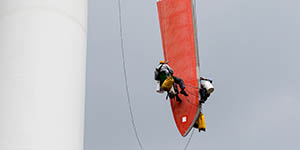
With the business expansion, WES anticipates a doubling of their workforce in the coming year, and is actively recruiting top talent for their Gainesville, Texas, headquarters as well as satellite service centers in California and South Dakota. “We want to attract and bolster the top blade repair force in the industry, especially with experienced technicians with management aptitude and ambition,” says Gary Kanaby, director of sales for WES. “It’s a job like none other—a blend of extreme sport, technical know-how, and business sense, and we’re looking for the very best of the breed to join our premier team.”

The company is currently seeking candidates to fill position openings for onsite team leaders, project manager, and composite repair technicians, and it anticipates bringing on 25 or more new teammates in the next six months. More information is available at www.windenergyservicesusa.com.

GE Software Powers Research on Efficient Wind Energy Production

0

GE announces that it is working with Illinois Institute of Technology (IIT) to investigate ways to improve wind farm productivity and efficiency. The results of the study will directly contribute to future product and service designs. The project is part of a larger Department of Energy (DOE) investment of $9 million to an IIT-led consortium to enhance the leadership role of the U.S. in testing and producing the most advanced and efficient wind turbines in the world. The two-year project will focus on helping wind farms to reduce maintenance costs and improve availability through predictions of impending problems. The project’s research will be conducted near Marseilles, Illinois, on a GE 1.5 MW series wind turbine operated and maintained by Invenergy, the nation’s largest independent wind power generation company.

“With skyrocketing costs, wind farms need to know ahead of time what needs to be fixed—and what doesn’t,” says Stacey Kacek, GE Intelligent Platforms’ general manager, Asset Intelligence. “If they have credible early warning of impending equipment problems, the farms can prioritize tower inspections, optimize crane usage, and leverage resources in remote locations. Being able to avoid surprises and take control of maintenance in a proactive way translates to significant cost savings for the industry.”

IIT students will be conducting research using GE’s Proficy SmartSignal software on the GE wind turbine to learn how to detect faults even earlier and more accurately than currently possible. The project includes adding more sensors than the industry standard to improve condition-monitoring precision, and enhancing the SmartSignal models to include measurements of vibration, lube oil, and blade pitch motors. The IIT team will monitor the turbine remotely from the IIT campus and analyze the energy output and overall equipment performance.

“Proficy SmartSignal software essentially acts as a supporting experienced operator and technician, leveraging past experience and working 24/7,” says Dave Parta, project manager, GE Intelligent Platforms. “In the wind industry, the solution is used to monitor the sensors on remote turbines and provide exception-based notifications when a turbine is not acting as it should based on its history. This is particularly challenging, given constantly changing wind speed, direction, shear, and turbulence. The SmartSignal solution collects and analyzes tens of thousands of data points daily on wind farms across the country and provides early warning of impending turbine and instrumentation failures.”

“The goal of this project is to illustrate how advanced and automated predictive diagnostics can improve the availability, reliability, and cost performance of wind power generation,” says Mohammad Shahidehpour, IIT Bodine professor and director of the Robert W. Galvin Center for Electricity Innovation, who is serving as the principal investigator for the consortium. “As a result of this research, we hope to improve the sensoring and modelling of wind farms. We’ll also be developing wind energy courses to address the technical, operational, social, and environmental aspects of wind energy. This will ensure that we have not only the technology, but also the talent necessary to compete and further innovate in the global marketplace.” For more information go to www.ge-ip.com/smartsignal.

Capital Safety Ownership Changes

0

Capital Safety announces its acquisition by KKR, a leading global investment firm, from Arle Capital Partners, which had owned the company since 2007. KKR has signed an agreement to pay $1.12 billion for the company, with transfer occurring in January 2012, subject to mandatory regulatory approvals.

Under its previous owner Capital Safety doubled its revenues through a commitment to aggressive research and development, which led to the launch of innovative first-in-the-industry products such as ExoFit NEX™ and i-Safe™ RFID equipment management system, enhanced its global supply chain and expanded into emerging markets for fall protection equipment. It also successfully executed five strategic acquisitions in Australia, Columbia, France, and the U.K. to broaden its offerings for customers worldwide.

“Strong interest in our company is confirmation of our strategic direction and testament to the most experienced team of fall protection experts in the world,” says Anders Pettersson, Capital Safety Group CEO, adding that KKR’s intent is to continue to strategically invest in Capital Safety’s position as the world leader in supplying fall protection solutions and expects continued expansion for the company, both in terms of products and markets served. “Without them we could not have countered the global economic stresses and served a record number of customers with a record number of products.”

Capital Safety, the world’s leading designer and manufacturer of height safety and fall protection equipment with 20 operating sites worldwide, is home of the DBI-SALA, UNILINE, and PROTECTA brands. All of Capital Safety’s fall protection and rescue systems are backed by extensive training, knowledgeable technical assistance, and professional customer service. To learn more call (800) 328-6146, (651) 388-8282, or visit www.capitalsafety.com.

Barrick Inaugurates Punta Colorada Wind Farm in Chile

0

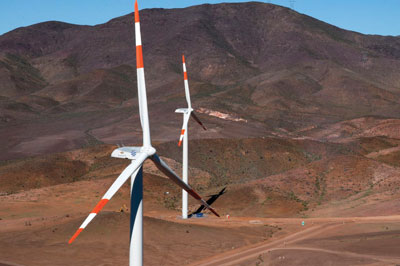
At an inauguration ceremony held in northern Chile in November Barrick Gold Corporation marked the official opening of the Punta Colorado Wind Farm, the largest wind farm ever built by a mining company in the country. The event was attended by the President of the Republic of Chile, Sebastián Piñera, the ministers of Mining and Energy, Hernán de Solminihac and Rodrigo Álvarez, and authorities from Chile’s Atacama and Coquimbo regions. This large-scale $50 million project, located in the town of La Higuera in the Coquimbo Region of Chile, consists of 10 wind turbines that generate 20 megawatts of power, enough to supply the energy needs of 10,000 families. The wind farm has the capacity to expand to 18 turbines and generate 36 megawatts, which would raise the total investment in the project to $70 million. The power generated by the wind farm feeds into Chile’s Central Interconnected Systems power grid.

“The inauguration of this wind farm is a milestone for Barrick, reflecting our belief that renewable energy and energy conservation benefit both the environment and our company,” says Igor Gonzales, President of Barrick South America. “We are also very pleased to contribute to the diversification of Chile’s national energy grid and to support policies for the development of renewable energy. We will continue to explore innovative technologies to make our company more energy efficient and to reduce our carbon footprint.”

The wind farm is one of a number of renewable energy projects and conservation initiatives that support Barrick’s broader climate change strategy. In Nevada, the company has a one-megawatt solar farm. In Argentina Barrick invested $8.5 million in a wind turbine that now provides up to 20 percent of the electricity needs for its Veladero mine. At 4,110 meters above sea level in the Andes Mountains, the wind turbine is recognized by Guinness World Records as the world’s highest-altitude wind generator.

In 2010, 15 percent of Barrick’s purchased and self-generated electricity came from renewable sources. The company completed more than 25 projects to reduce its energy and greenhouse gas footprint last year. These programs reduced the company’s GHG emissions by 206,200 tonnes over business as usual in 2010. Learn more at www.barrick.com.

AWEA Wind Environmental Health & Safety Seminar 2012

0

The AWEA Wind Environmental Health & Safety Seminar will be held January 9-10, 2012, in San Diego, California. As the wind industry evolves, so have the responsibilities of the environmental, health and safety (EHS) professional. From reducing incidents and preventing accidents to ensuring environmental compliance, EHS managers are facing new demands and challenges in an uncertain regulatory and standards environment.

Join us for the AWEA Wind Environmental Health & Safety Seminar to deepen your understanding of the issues facing occupational environmental, health and safety professionals in the wind industry and how others are solving issues to some of the industry’s most important challenges. Attend and learn directly from industry experts, interact with other EHS professionals and suppliers, and develop valuable new relationships to help support current and future projects. Come share your experiences and lessons learned with your peers as you discuss current EHS trends in the wind industry; building and improving safety behavior and culture on your work site; emerging issues and safety best practices; and wind energy and the human factor — work smarter not harder.

You are probably familiar with the saying “What gets measured, gets managed.” As EHS professionals are asked to collect, analyze, and report data on everything from material safety data sheets (MSDS), to audit results and incident tracking, you need a way to capture and view all these metrics.

Learn what an EMIS is, how it can help you manage and analyze your data to make decisions, and how to start your search for a software provider. Then sign up for user-led software demonstrations. Learn more at www.awea.org.

Vestas Urges Extension of U.S. Production Tax Credit

0

Martha Wyrsch, president of Vestas-American Wind Technology, Inc., gave testimony to the U.S. Senate Finance Subcommittee on Energy, Natural Resources and Infrastructure to urge an immediate extension of the Production Tax Credit (PTC), which is set to expire Dec. 31, 2012.

“An extension of the PTC is necessary for the continued employment of the 80,000 people working in the U.S. wind industry,” said Wyrsch, who leads the North American arm of Vestas Wind Systems, the world’s leading provider of wind turbines. “Wind energy has grown dramatically in the past several years, creating a manufacturing renaissance in the U.S., and the PTC has been a significant driver in that growth. The jobs at stake, which include 20,000 people in the U.S. wind industry’s manufacturing sector and technical jobs throughout rural America, are skilled-labor positions with competitive wages and medical and retirement benefits.”

Wyrsch said if the PTC is not extended, hundreds of U.S. wind-industry suppliers employing thousands of people also would be affected. Wyrsch addressed the bipartisan Senate subcommittee comprised of 13 senators, chaired by Sen. Jeff Bingaman (D-New Mexico).

The PTC, a credit of 2.1 cents per kilowatt-hour, is given to an owner of a wind-energy project once a wind turbine begins to produce electricity. Since 1999, the PTC has received short-term extensions seven times, and has lapsed three times. With the PTC in place, the U.S. wind energy industry has achieved impressive economic numbers, according to the American Wind Energy Association:

• More than 400 facilities across 43 states manufacture for the wind-power industry
• 60 percent of a wind turbine’s value is now produced here in America, compared to 25 percent prior to 2005
• A 90 percent drop in the price of wind power since 1980, benefiting utilities and consumers
• More than $60 billion invested since 2005
 
In the past, the wind industry has experienced a boom-and-bust development cycle, with significant drops in installations in years following PTC expiration. Each of these drops has had an impact on employment and capital investment. “The development cycle for wind power begins more than a year in advance of operation,” Wyrsch said. “Many of our customers have already announced they will not place orders for any new turbines until the PTC is extended. The industry needs predictable, long-term tax and energy policies to ensure continued investment.”

Navigant Consulting, a respected non-partisan consulting firm, reported on Dec. 12, 2011, that 37,000 American jobs could be lost if the PTC is not extended.

Vestas is the world leader in supplying high-tech wind power systems and a preferred provider of wind turbines, services and solutions in North America. Since 1979, Vestas has an industry-leading installed base of more than 44,000 wind turbines in 67 countries.

Vestas, which employs more than 3,000 people in the United States, sold its first wind turbine in North America in 1981 and since has supplied more than 12,000 in this market. Vestas’ North American manufacturing operations are located in Colorado while its technology research centers are in Texas, Massachusetts and Colorado. Vestas’ North American headquarters is in Portland, Ore., while its global headquarters is in Aarhus, Denmark. Go online to www.vestas.com.

Alstom Launches ECO 122 Turbine for Low Wind Sites

0

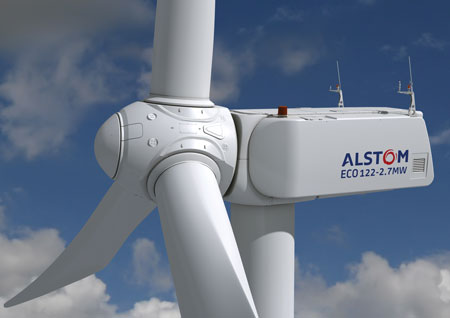
Alstom announces the launch of the ECO 122, a 2.7MW onshore wind turbine that combines high power and high capacity factor to boost energy yield in low wind regions worldwide. The ECO 122’s leading efficiency and high yield set a new benchmark for low wind sites. At a wind speed of 7.5 m/s the turbine delivers a net wind farm capacity factor of up to 42 percent, equivalent to 3,600 full-load hours each year. Its 122-metre rotor diameter and swept area of 11,700 m2—the largest in the 2-3MW turbine segment—maximize the harvest of energy and the return on investment to create new business opportunities for customers from low wind sites.

Alfonso Faubel, senior vice president of Alstom’s wind business, says “Research and innovation are at the heart of our business. With the ECO 122 and other turbines in our ECO 100 platform, we’re leading the development of the new generation of high power, high-efficiency turbines to increase value for our customers. Longer blades capture more power more effectively, and with its swept area much larger than current generation machines, the ECO 122 has set a new standard for low wind sites around the globe.”

The ECO 122 produces about 25 percent increased wind farm yield on a given piece of land compared with today’s 1.5-2MW turbines, and fewer turbines need to be installed. As an example, on a typical low wind site, six current generation 1.5 – 2 MW turbines will produce around 40 GWh/year, compared with more than 50 GWh/year with only five ECO 122 turbines. This yield advantage also means significant capital expenditure savings. An ECO 122 powered wind farm can reduce balance of plant costs by 10-15 percent, compared with a farm using typical 1.5-2MW machines, due to fewer foundations, platforms, roads, and less cabling.

The ECO 122 is the latest evolution of Alstom’s proven ECO 100 turbine platform, and the result of more than 30 years of experience in wind turbine design. The ECO 100 platform now has more than 350MW installed or under construction worldwide and over 200,000 cumulative operating hours since 2008. All Alstom wind turbines are based upon the unique and proven ALSTOM PURE TORQUE® rotor support concept that protects the drive train from deflection loads, ensuring higher reliability and lower maintenance costs. The first ECO 122 will be installed in mid 2012, with first commercial deliveries expected in early 2013. Learn more at www.alstom.com/wind.

NRG Systems Invests in Lattice Tower Manufacturer

0

NRG Systems, manufacturer of measurement systems for the renewable energy industry has agreed to invest in Oenko, a manufacturer and installer of lattice towers for wind resource assessment and wind farm monitoring. This investment pairs NRG Systems’ nearly 30 years in the wind energy industry and its complete system approach with Oenko’s cutting-edge lattice tower technology. “This line of lattice towers complements our existing tower offerings,” says Barton Merle-Smith. “Our investment enables us to offer customers greater choice in towers, booms, and mounting hardware, meeting the full range of customer needs anywhere in the world.”

Based in Thetford Mines, Quebec, Oenko designs and manufactures lattice towers from 30 to 120 meters for all types of project sizes and locations, specializing in extreme arctic conditions. NRG Systems, based in Vermont, pioneered complete measurement systems with tubular tilt-up towers in the 1980s. “I am pleased that Oenko has attracted the investment of NRG Systems,” says Guy Fortin, president of Oenko. “This will enable us to expand globally while continuing to grow jobs in Thetford Mines.”

As a result of the investment, NRG Systems will hold a majority interest in Oenko. Manufacturing will remain in its current location with Oenko’s existing workforce, while Fortin will continue on as president and key sales person for the company. For more information visit www.oenko.com.

NRG Systems is an independently owned company that has served the global renewable energy industry since 1982. Its wind measurement equipment can be found on every continent in more than 145 countries, serving electric utilities, wind farm developers, research institutes, and government agencies. The company has been nationally recognized for its LEED gold-certified manufacturing facility and its employee best practices. To learn more go to www.nrgsystems.com.

Wind Energy Manufacturing Lab at Iowa State

0

A laser in Iowa State University’s Wind Energy Manufacturing Laboratory scanned layer after layer of the flexible fiberglass fabric used to make wind turbine blades. A computer took the laser readings and calculated how dozens of the layers would fit and flow over the curves of a mold used to manufacture a blade. And if there was a wrinkle or wave in the fabric, any defect at all, the technology was designed to find it. That’s because the last thing you want is a defect in a 40-meter wind turbine blade when it’s spinning in the wind.

“Waves in the fabric are bad because they can’t take the load,” says Vinay Dayal, an Iowa State associate professor of aerospace engineering. “And if a blade can’t take the load, bad things happen to the turbine,” according to John Jackman, associate professor of industrial and manufacturing systems engineering.

The two are working with Frank Peters and Matt Frank, associate professors of industrial and manufacturing systems engineering, to operate and develop Iowa State’s Wind Energy Manufacturing Lab. The lab has been open for about a year and was built as part of a three-year, $6.3 million research project. The study is a joint effort of researchers from TPI Composites, a Scottsdale, Arizona-based company that operates a turbine blade factory in Newton, and the U.S. Department of Energy’s Sandia National Laboratories in Albuquerque, New Mexico. The researchers’ goal is to develop new, low-cost manufacturing systems that could improve the productivity of turbine blade factories by as much as 35 percent.

The lab in Iowa State’s Sweeney Hall provides researchers the facilities and equipment they need to study how lasers can analyze the fiberglass fabric that’s used to manufacture turbine blades; develop technology for the nondestructive evaluation of turbine blades; analyze and improve wind blade edges; make precise 3-D laser measurements of 40-meter wind turbine blades; and develop new fabric manipulation techniques for automated blade construction.

Researchers say the lab has already advanced their understanding of turbine blade manufacturing and is helping to develop automation technologies that could one day be used in manufacturing plants. “In the early stages of the research there were a lot of investigations to understand all the problems we’re addressing,” Frank said. “But now we’re at that phase where real intellectual property is coming out of the lab.” Learn more at www.iastate.edu.

Mortenson Builds Fifth Wind Facility In Illinois

0

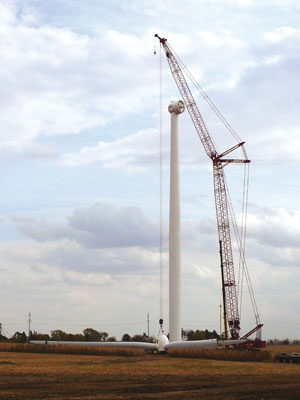
Mortenson Construction has started construction of the Shady Oaks Wind Farm near Compton, Illinois, adding 109.5MW to the state’s wind energy capacity. The wind power facility will consist of 71 Goldwind turbines. Mortenson is responsible for the design and construction of access roads, collection system, foundations, and the erection of the turbines. The Shady Oaks project will be the fifth utility-scale wind facility that Mortenson has constructed in Illinois, bringing the total number of turbines erected in the state to 541 upon its completion. Construction started in late August and is expected to be complete in early 2012.

According to the Illinois Wind Energy Association, an average 100MW wind farm in Illinois creates 125 to 150 temporary construction jobs and 10 permanent maintenance jobs, which is consistent with the number of jobs that will be created with the Shady Oak Project. “The Shady Oaks project is the first partnership of Mortenson and Goldwind and the first major wind project in the U.S. to utilize the advanced Permanent Magnet Direct Drive Technology (PMDD),” according to Tim Maag, a vice president and general manager of Mortenson’s Renewable Energy Groups.

“We selected Mortenson as our construction partner for the Shady Oaks project because of their outstanding track record of success with wind farm construction and because of the commitment to on-site safety,” said Tim Rosenzweig, CEO of Goldwind USA.  “We are pleased to be working with Mortenson on this important project.”

The Goldwind portfolio of 1.5 and 2.5MW permanent magnet direct-drive wind turbines are designed for high power generating efficiency, superior power quality and grid code compliance, and significantly reduced maintenance and total operating expenditures. The simplistic permanent magnet direct-drive design reduces the number of high-speed rotational parts and avoids the sources of expensive faults that require crane mobilization.

Founded in 1954, Mortenson Construction is a U.S.-based, family-owned company that has constructed more than 100 wind projects generating more than 11,000MW of renewable power throughout the United States and Canada. Visit www.mortenson.com/wind. With offices and facilities throughout Asia, Europe, and the Americas, Xinjiang Goldwind Science & Technology Co, is ranked among the leading wind turbine manufacturers in the world. Learn more at www.goldwindamerica.com.

Second Wind System in Turbine Wake Effect Study

0

A Colorado-based research team recently completed a major wind study using Second Wind’s Triton® Sonic Wind Profiler to learn more about one of wind power’s biggest unknowns, the wake effect, and its impact on turbine productivity. Triton is one of several remote sensing technologies that TWICS (the Turbine Wake and Inflow Characterization Study) has used to create a detailed 3D model of the turbulence caused when wind passes over rotating turbine blades. Turbulence can damage turbines downstream and undermine productivity. The project’s goal is to understand how to enhance wind farms’ productivity. Turbine inflow and wake observations will be integrated into a wind energy forecasting model. Understanding how gusts and rapid changes in wind direction affect turbine operations will enable turbine manufacturers to improve design standards and increase efficiency, which will ultimately reduce the cost of energy.

The study is aimed at capturing turbulence and other wake effects in a broad wedge of air up to 7km (4.3 miles) long and 1km (3,280 feet) high in front of and behind a multi-MW wind turbine. Triton, along with tower-mounted sensors and other remote sensing systems, profiles the winds in front of and behind a 130-meter high wind turbine located at the National Renewable Energy Laboratory’s (NREL’s) National Wind Technology center near Boulder, Colorado. NREL, the University of Colorado at Boulder, the Cooperative Institute for Research in Environmental Sciences (CIRES), and the National Oceanic and Atmospheric Administration (NOAA) have teamed up to conduct the study.

“The NREL site is prone to complicated wind patterns, so we needed several remote sensing instruments. The site is flat, but it’s located just five kilometers from El Dorado Canyon on Colorado’s Front Range and the canyon funnels air into the site,” says Julie Lundquist, assistant professor of atmospheric and oceanic sciences at the University of Colorado at Boulder. “The Triton is a good instrument for this study. It will provide us with anchor points in the study by profiling selected slices of a larger wedge of the atmosphere over a long period of time.”

Triton is an advanced remote sensing system that uses sodar (sound detection and ranging) technology to measure wind in the areas that most affect a wind turbine’s performance. By measuring wind speeds at the turbine rotor’s hub height and beyond, Triton reduces uncertainty in annual energy production (AEP) forecasts. Easy to install and capable of autonomous operation, Tritons are being used throughout the wind industry, alone or in conjunction with met towers, to streamline the wind farm development process and to improve wind farm operations.

“Turbine wake effects are a huge unknown in the wind industry. To fully realize the potential of wind energy, with large-scale wind farms, we need to know how turbulence from one turbine affects those around it,” says Second Wind CEO Larry Letteney. “We’re confident that Triton will make a significant contribution to understanding wind farm conditions, which will lead to a more productive and efficient wind power industry.”

Second Wind provides the wind energy industry with the intelligence required to plan, finance and operate highly efficient, profitable wind generation facilities. Learn more at www.secondwind.com.