



Home 2013

E.ON Climate & Renewables to Install GE’s PowerUp Platform

0

GE has announced E.ON Climate & Renewables’ (EC&R) contract for GE’s PowerUp turbine platform. PowerUp is a customized software-enabled platform that increases a wind farm’s output by up to 5 percent. EC&R will enhance 469 of its GE 1.5-77 wind turbines with the PowerUp platform.

The PowerUp offering agreement between EC&R and GE is an outcomes-based approach. EC&R will pay GE only on the actual benefit of the PowerUp platform.

“The outcomes-based approach aligns well with our goals of providing cleaner, better energy at a more affordable price,” said Steve Trenholm, chairman, E.ON North America. “Investment in wind energy has led to technological advancements like PowerUp that continue to make renewables more and more competitive with traditional forms of energy.”

GE and EC&R have agreed to a set point of additional annual energy production per wind turbine, which could bring the equivalent power of as many as 19 new 1.5-77 wind turbines for the EC&R fleet.

“We see PowerUp as a new path to development for our customers. Without any development risk, or installation expense, EC&R will see the equivalent of 19 new turbines in the ground today,” said Andy Holt, general manager of GE’s renewable energy projects and services organization. “With this model, we are on the same side of the field as our customers. We succeed when they succeed.”

GE will work with EC&R to perform a complete before-and-after wind farm power-performance analysis to validate the performance improvement.

For more information, visit www.ge-energy.com or www.eon.com/renewables.

MidAmerican Energy Begins Iowa’s Largest Wind Expansion

0

MidAmerican Energy Company announced additional details about the largest wind expansion in Iowa’s history. Earlier this year, the company announced plans to develop up to 1,050MW of additional wind generation in Iowa by the end of 2015. Construction activity is now underway at each of the five project sites, and MidAmerican Energy has released information about the developers, turbine supplier, contractors, and project size by location.

MidAmerican Energy recently reached an agreement with Highland Wind Energy, LLC, an Invenergy Wind LLC company, for the acquisition of the approximate 500MW Highland wind project site in O’Brien County. Agreements also were reached with EDF Renewable Energy for the acquisition of the approximately 250MW Lundgren wind project site in Webster County, and with two RPM Access, LLC companies for the acquisitions of the approximately 138.6MW Wellsburg wind project site in Grundy County and the approximately 117MW Macksburg wind project site in Madison County. In addition, MidAmerican Energy’s existing Vienna wind farm, constructed in 2012, is being expanded by 44.6MW in Marshall County (Vienna II wind project).

MidAmerican Energy has selected Siemens Energy as the turbine supplier for all project sites. All of the blades for the expansion will be manufactured at Siemens’ Fort Madison, Iowa, facility. Nacelles will be manufactured at Siemens’ Hutchinson, Kansas facility. Siemens will provide turbines utilizing technology from its 2.3MW G2 platform for all five projects. The contract also includes a service, maintenance, and warranty agreement.

The Highland, Macksburg and Wellsburg wind projects will be constructed by Mortenson Construction, which is based in Minnesota, while the Lundgren and Vienna II wind projects will be constructed by North Dakota-based Wanzek Construction, Inc..

Upon completion, the projects will encompass 448 wind turbines, and will generate enough electricity to power the equivalent of approximately 317,000 average Iowa households.

“We look forward to continuing positive relationships with state and county officials as well as landowners and other local residents during the construction and operation of the new wind farms,” said Bill Fehrman, president and CEO of MidAmerican Energy. “Not only will the projects bring jobs and other economic development to the state, they will enhance MidAmerican Energy’s renewable energy portfolio—making additional affordable, environmentally responsible energy to benefit our customers.”

The wind expansion will provide more than $3 million in landowner payments each year and more than $360 million in additional property tax revenues over the next 30 years. The expansion will be constructed at no net cost to the company’s customers and will help stabilize electric rates over the long term. Approximately 1,000 construction jobs will be added to Iowa’s economy during the two-year construction period, and approximately 40 new permanent jobs will be added when the expansion is complete.

For more information, visit www.midamericanenergy.com.

BayWa Taps Signal Energy for 20mw Wind Farm Project in New Mexico

0

Signal Energy Constructors, a major design/build general contractor providing engineering, procurement and construction services to the North American renewable energy industry, was recently awarded a full design/build contract from BayWa r.e. Wind LLC for the Brahms 20MW wind farm. The project is currently under construction and is scheduled for completion before the end of the year. Brahms is located in Grady, New Mexico, 25 miles outside of Clovis.

“Signal Energy’s commitment to building in-house expertise in the most critical areas of utility scale wind construction enables us to take projects, like Brahms, from design to completion with great efficiency and superior quality,” said Ben Fischer, CEO of Signal Energy.

A critical area of utility-scale wind construction in which Signal Energy provides in-house expertise is preconstruction value engineering. Early-stage performance of this value engineering analysis insures projects are designed in a way that maximizes long-term energy production and short-term capital costs for construction without compromising quality. Signal Energy’s ability to optimize Brahms’ wind project components cut several months off the design/build timeline.

“We have reached agreement with Signal Energy in two and half weeks with construction already underway and the goal is set to deliver energy before year-end. Signal built a number of our projects including last year’s Mozart project in Texas. We value the quality of their work and engineering expertise,” said Florian Zerhusen, CEO, BayWa r.e. Wind, LLC,  adding that BayWa continuously is looking for projects.

Signal Energy’s scope of work for the Brahms project includes full design and engineering of all project civil infrastructure, underground and overhead collection systems, wind turbine foundations, project substations and the project interconnection facilities. In addition, Signal Energy will self-perform the wind turbine erection.

The design/build contract was signed in September and construction began in October.

For more information, visit www.signalenergy.com or www.baywa-re.us.

EDF to Acquire Longhorn Wind Project from RES Americas

0

EDF Renewable Energy announced it has reached an agreement with Renewable Energy Systems Americas Inc. (RES Americas) to acquire the 200MW Longhorn Wind Project in Texas. Construction is expected to commence later this year in order to qualify the project for the Production Tax Credit (PTC).

The project encompasses approximately 14,000 acres in Floyd and Briscoe Counties, 60 miles northeast of Lubbock, Texas, and will take advantage of the CREZ (Competitive Renewable Energy Zone) transmission lines connecting the wind generating capacity of the Texas Panhandle to high electricity demand areas in the state.

“Longhorn represents our third wind project acquisition in the Texas Panhandle this year, and brings EDF Renewable Energy’s near-term capacity under either late-stage development or construction in the area to 561MW, including the previously announced Hereford and Spinning Spur II transactions,” said Ryan Pfaff, executive vice president of EDF Renewable Energy.

“We are pleased to be working with EDF Renewable Energy to bring additional wind energy to the Texas grid,” said Tom Hiester, senior vice president of development with RES Americas. “Longhorn is another example of significant investment occurring because of the Production Tax Credit for wind energy, and it speaks to the criticality of maintaining this important tax incentive.”

EDF Renewable Energy has also secured a long-term, fixed-price hedge agreement for the expected energy production of the project. RES Americas will construct the project under a balance-of-plant construction contract.

For more information, visit www.edf-re.com and www.res-americas.com.

Clemson Dedicates Drivetrain Testing and Grid Simulator Facility

0

The Energy Systems Innovation Center—the world’s largest wind turbine drivetrain testing facility and the first-of-its-kind smart grid simulator—opened in November.

The 82,264-square-foot, $98 million facility, which includes $53M of private and state contributions, stretches across 6.3 acres strategically located at the Clemson University Restoration Institute’s (CURI) campus at the former U.S. Naval Base in North Charleston, South Carolina. The location offers a working port facility on the East Coast and worldwide access to wind turbine innovators through road, rail or ship.

The global leaders in wind turbine manufacturing serve on the Industrial Advisory Board with key industry players already requesting time in the facility for testing of their next generation turbines. Modeled after the success of the Clemson University International Center for Automotive Research, the facility will forge public/private partnerships in a unique industrial, port environment.

The center houses both 7.5MW and 15MW capacity test rigs—weighing a combined 550 tons. Each rig features an off-axis and bending moment static load applicator capable of reproducing forces seen in real-world conditions. Additionally, the center features a 15MW Hardware-In-the-Loop (HIL) Grid Simulator, leveraging the electrical infrastructure of the Wind Turbine Drivetrain Testing Facility and allowing turbine generator manufacturers to test both mechanical and electrical characteristics of their machines in a well controlled and calibrated environment. The simulator will allow for testing of the wind turbine generators compatibility to 50 or 60 Hz electrical transmission grids. This is important to ensure the wind turbines have minimal impact to the existing grid as well as grid disturbances having minimal impact on the machines.

In November of 2009, the U.S. Department of Energy awarded Clemson University a $45 million grant to build and operate a facility capable of full-scale, highly accelerated testing of next-generation wind turbine technology. The U.S. DOE EERE’s objective for this project is to accelerate the development and deployment of next-generation wind turbine technology to reduce the cost of energy delivered. The mission of the facility will forge public-private partnerships in a unique industrial coastal environment and support the nation’s emerging offshore wind industry and educate the workforce of the future. The project has received additional investments from GE Energy, Shell, SCE&G, Duke Energy among others.

The Clemson University Restoration Institute hosted the dedication, alongside the Charleston Regional Development Alliance.

For more information, visit www.clemsonenergy.com.

REpower Systems Rebranding as Senvion Beginning in 2014

0

REpower Systems SE, a wholly owned subsidiary of the Suzlon Group—the world’s fifth-largest manufacturer of wind turbines—will change its name in 2014; thereafter the company will be called
Senvion.

REpower has been using its name under license since 2001. The rights belong to a Swiss company that is now using this name itself. Therefore the external corporate design will be gradually changed.

The Hamburg-based wind turbine manufacturer will thereafter identify itself using the new brand image worldwide.

Andreas Nauen, CEO of REpower Systems SE, said: “This is an important development for us. In addition to having unique products and services, we will also be the only company with this name. Senvion may be associated with ‘innovation,’ ‘energy,’ and ‘wind,’ and this underlines our focus on renewable energies. As Senvion we will continue along our path as a strong brand and remain an innovative company in the wind energy industry.”

The transition to the new corporate design will take place in the 2014. The company will present its future brand image after entry in the commercial register. Only then will the changeover become official. The announcement of the new name was agreed for 2013 with the licensor.

For more information, visit www.repower.de or www.suzlon.com.

EPA Expands Lists of U.S. Organizations Using Most Green Power

0

The U.S. Environmental Protection Agency (EPA) has released updated lists of the top Green Power Partnership (GPP) organizations choosing to use clean, renewable electricity.

For the first time, the national list expanded from the Top 50 to the Top 100 Partners using green power. In another move, several of the sector-specific lists expanded from Top 20 to Top 30. The expanded lists help further recognize leading organizations committed to using green power and reflect recent growth within the Partnership—the GPP now includes more than 1,500 organizations that are collectively using more than 28 billion kWh of green power each year. Through the use of green power, these top organizations avoid carbon pollution equal to that created by the electricity use of more than 2.5 million average American homes each year.

The top 10 partners appearing on the Top 100 list include:

1. Intel Corporation
2. Microsoft Corporation
3. Kohl’s Department Stores
4. Whole Foods Market
5. Wal-Mart Stores, Inc.
6. U.S. Department of Energy
7. Staples
8. City of Houston, TX
9. Starbucks Company-Owned Stores
10. Apple Inc.
 
In addition, the Green Power Partnership kicked off the 2013-2014 College & University Green Power Challenge today by updating the rankings of the 32 competing conferences. Throughout the 2013-2014 academic year, the GPP will track the collegiate athletic conferences with the highest combined green power usage in the nation. The Big Ten conference, Big 12 conference and the Ivy League lead the current standings.

For more on the Top Rankings visit www.epa.gov/greenpower/toplists/index.htm.

Nordex on Track to Achieve 2013 Financial Goals

0

In the first three quarters of this year, the Nordex Group posted a 47 percent increase in sales to approximately $1.4 billion. This growth was underpinned by business in the core EMEA market (Europe plus South Africa), where Nordex generated 91 percent of its sales. Business in the Americas and Asia accounted for six and three percent, respectively, of sales.

This strong operating performance was based on the substantially increased production and installation output. Thus, production rose by 64 percent to 1,002MW, with the volume of new installations climbing by 61 percent to 924MW. With a disproportionately low increase in staff costs, this testifies to the substantial efficiency gains which Nordex has achieved thanks to its reorientation. Together with the execution of more profitable projects, this resulted in a significant improvement in operating profit. The gross profit climbed by some 39 percent to approximately $325 million as of the end of September, accompanied by an increase in earnings before interest and taxes to $41.7 million. Net profit amounted to $7.1 million.

As of September 30, the equity ratio rose slightly to 27.7 percent. Cash and cash equivalents amounted to $186.6 million, with net debt at a still low $72.7 million. Moreover, Nordex achieved a working capital ratio of 11.2 percent, thus remaining within the target range.

New business also remained promising. Firmly financed order intake rose by 85 percent to $1.59 billion. At 79 percent, most of these came from the EMEA region, with the proportion of non-European business widening slightly. Orders from the Americas accounted for 12 percent and those from Asia for 9 percent. All told, the backlog of firm orders amounted to $1.74 billion as of September 30.

“We are very satisfied with our business performance in 2013 and are reaffirming the guidance that we had previously increased in the summer for the current year. As we are even more confident about our order intake, we are now looking for a higher figure of ($1.88 billion — 2.02 billion). At the same time, we confirm our expectation of being able to achieve our medium-term goal in 2015,” says Dr. Jürgen Zeschky, CEO of Nordex SE.

For more information, visit www.nordex-online.com.

Consumers Energy Breaks Ground on Cross Winds Energy Park

0

Consumers Energy, its contractors, Tuscola County-area landowners and local government officials held a groundbreaking event in November to officially start construction of the company’s second wind park, the Cross Winds Energy Park.

“Renewable energy will continue to be a vital part of our Balanced Energy Initiative, providing Michigan residents with the energy they need, whenever they need it,” said Jack Hanson, Consumers Energy’s senior vice president of energy resources. “We are drawing on our state’s natural resources to power our state’s future.”

Cross Winds is expected to open in late 2014, fulfilling the state of Michigan’s requirement that energy providers generate 10 percent of their power from renewable sources. The facility will include 62 wind turbines, with a total capacity of 105MW.

Consumers Energy also opened the 100MW Lake Winds Energy Park in Mason County last year.

About 150 construction jobs will be created during Cross Winds construction into 2014.

“As part of our $1 billion commitment to the Pure Michigan Business Connect initiative, we’re pleased to report more than $100 million of the $255 million Cross Winds Energy Park will come from services and goods supplied by companies in our state,” Hanson said.

GE is supplying the 1.7 MW turbine units for Cross Winds, with 43 turbines scheduled for
Akron Township and 19 turbines scheduled for Columbia Township.

Initial construction will focus on building access drives and turbine foundations and will continue in coming months, weather permitting. Turbine construction is scheduled to begin next summer.

For more information, visit www.consumersenergy.com.

National Wind Technology Center Debuts a Dynamic 5MW Dynamometer

0

As wind turbine capacity continues to grow, so does the need to test the electrical and mechanical power-producing components of those turbines. Currently, only a few test facilities worldwide have the capability to test wind turbine drivetrains with capacity ratings up to 5MW— and the National Wind Technology Center (NWTC) at the National Renewable Energy Laboratory is now one of them.

The NWTC’s new dynamometer test facility, which opened in November, simulates operating field conditions to assess the reliability and performance of wind turbine prototypes and commercial machines, thereby reducing deployment time, failures, and maintenance or replacement costs. Funded with American Recovery and Reinvestment Act funds, the 5MW dynamometer will provide the ability to test wind turbine drivetrains and connect those drivetrains directly to the electricity grid or through a controllable grid interface (CGI). The CGI tests the low-voltage ride-through capability of a drivetrain as well as its response to faults and other abnormal grid conditions.

With the new dynamometer, turbine manufacturers and industry professionals can have their wind turbine drivetrains tested in a controlled environment—saving time, money, and risk. Jim Green, project manager, said, “The new dynamometer more than doubles the capacity (rated power) of wind turbine drivetrains that can be tested at the NWTC, which is sufficient to test the largest drivetrains envisioned for land-based markets. It will have the capability to simulate wind loads in six degrees-of-freedom, providing the most complete simulation of wind turbine operating conditions available in North America.”

The dynamometer’s first test article, a GE Energy 2.75-MW wind turbine weighing more than 96 tons, was delivered to the NWTC in August and used for the commissioning in September.

For more information, visit www.nrel.gov/wind.

Nate Issues Third Edition of Fall Protection Training Standard

0

The National Association of Tower Erectors (NATE) has announced that the third edition of the NATE Tower Climber Fall Protection Training Standard (NATE CTS) is now available. The NATE CTS was last revised in 2008 and the new edition includes updated references to the ANSI Z359 Fall Protection Code and Z490.1 Criteria for Accepted Practices in Safety, Health and Environmental Training standard. The updated NATE CTS also includes additional terminology in the definitions section of the document.

“NATE is proud to offer this updated edition of the CTS to better facilitate training and improve safety in the industry,” said Chairwoman Pat Cipov of Cipov Enterprises, Inc. in Sumter, South Carolina. “The Climber Training Standard is the Association’s signature safety resource and provides one more tool in the toolbox to ensure that climber training is consistent regardless of who is conducting the training,” Cipov added.

The NATE CTS was originally developed in 2005 to establish the minimum requirements to which all tower climbers should be trained. The third edition of the Fall Protection Training Standard is available online as a free resource for member companies in the member login section of the NATE website. Members and non-members can also purchase printed copies of the standards at http://natehome.com/safety-education.

GE Stimulates Wind Energy Growth in the UK

0

As wind energy continues to be deployed throughout the United Kingdom, GE announced it is providing two new wind farms in central England with more than 40MW of installed capacity. GE has supplied the Chelveston Wind Farm with nine GE 2.85MW wind turbines and will also deliver nine GE 1.6MW wind turbines to the Burton Wold wind farm extension in Kettering.

As a member of the European Union, the U.K. is required to meet the EU 20/20 target of having 20 percent renewable energy generation by the year 2020. The Chelveston Wind Farm and the Burton Wold wind farm extension are located within 15 miles of each other. Combined the 40-plus MW would be equivalent to the required energy needs of approximately 30,000 homes in the region. To date, GE has supplied or is under contract to supply more than 163.10MW of wind turbines to the U.K.

The Chelveston Wind Farm will provide 25.65MW of power to the grid. GE has already supplied the nine 2.85MW turbines to Wykes Engineering Ltd., one of the leading design, engineering and manufacturing companies. The wind farm was commissioned in September 2013 and entered full operation in October 2013. The Chelveston Wind Farm is part of the Chelveston Renewable Energy Park, which was formerly a Ministry of Defense bomber base throughout World War II and the Cold War and later a radio-mast transmitter site until 2005. The renewable energy park also consists of biomass plants, biofuel generators and solar photovoltaic arrays, which are currently being installed.

According to Wykes Engineering, GE’s efficient wind turbines were selected for the Chelveston site based on increased efficiency. In total, the Chelveston facility will have the ability to generate an estimated 109,000MWh of renewable electricity annually—enough energy to supply for 27,500 households.

The Burton Wold wind farm extension will provide 14.4MW of power—equivalent to the required energy needs of more than 11,000 homes in the region. John Laing is the owner of the project, and the plans were developed by First Renewable Ltd. John Laing will build, own and operate the wind farm.

“GE’s 1.6-100 wind turbines are the right machines for the Burton Wold wind farm extension due to their ability to enhance energy efficiency. This latest project is an exciting addition to the John Laing portfolio of investments in the onshore wind sector and is part of our commitment to deliver cleaner, renewable electricity to communities across the United Kingdom,” said Ross McArthur, managing director of renewable energy-John Laing.

GE also will support the Chelveston Wind Farm and the Burton Wold wind farm extension’s long-term availability through service and maintenance agreements, which include remote monitoring and local support. GE’s wind service solutions increase turbine reliability and availability, reducing down turbine time and improving lifetime performance.

For more information, visit www.ge-energy.com.

Siemens: Offshore Wind on its Way to Cost Reduction

0

Greater output, less weight, improved production and installation processes. Siemens intends to apply these approaches to reduce the costs of offshore wind power in the coming years. The company is presented its new 4MW and 6MW wind turbines at the EWEA Offshore Trade fair in Frankfurt/Main, Germany in November. At the conference accompanying the trade fair, high-ranking representatives from Siemens presented the strategies the company plans to apply to achieve these cost reductions in the coming years.

“We want to reduce the levelized cost of energy (LCOE) for offshore wind power by up to 40 percent before the end of the decade”, said Siemens Wind Power CTO Henrik Stiesdal. “This means that starting as early as 2020, we will offer our customers technologies that allows offshore wind power to be produced for less than 10 euro cents per kilowatt hour.” Siemens’ technical innovations demonstrate significant steps toward efficiency enhancement. The nacelle and rotor of the new SWT-6.0-154 6MW wind turbine are around one-third lighter than that of similar systems. The direct-drive technology used in the 6MW turbine, which eliminates the need for a gearbox, plays a major role in reducing the cost of energy. The weight advantages gained through this enhance economic viability across all project phases, from fabrication to transport, foundations and installation all the way up to operation.

Similar benefits are also offered by the improved offshore geared units with a capacity of 4MW. These units—the SWT-4.0-120 and SWT-4.0-130 —combine the technology used in the more than 900 units of the most widely built offshore wind turbine with an increase in performance from the upgraded generator. In addition, the 130 m rotor has innovative, 63-meter-long “aeroelastic” rotor blades. These blades are designed to be flexible under high wind loads and can be produced with up to 20 percent reduced mass compared to conventional blades.

Stiesdal said a wide range of social perspectives must also be taken into account in the offshore wind power cost debate. “Environmental benefits, energy supply stability and positive impacts on domestic jobw markets are frequently underestimated in the discussion on renewable energy sources,” Stiesdal said. “These aspects, which influence the true ‘society’s cost of energy’, should also be incorporated into the ongoing cost debate.” Only in this manner would a fair assessment of offshore wind energy as compared to conventional or other renewable energy sources be possible.

For more information, visit www.siemens.com.

Popular Science Recognizes GE with ‘Best of What’s New’ Honor

0

Popular Science magazine has recognized GE’s 2.5-120 brilliant wind turbine with its 2013 “Best of What’s New” award in the “Green” category. Announced in January, the 2.5-120 is GE’s first brilliant turbine, which harnesses the power of the Industrial Internet to analyze tens of thousands of data points every second, providing short-term predictable power and communicating seamlessly with neighboring turbines, service technicians and operators.

“For more than a quarter century, Popular Science has devoted its December issue to the year’s most remarkable innovations,” said Cliff Ransom, executive editor, Popular Science. “The ‘Best of What’s New’ Awards is our magazine’s top honor, and the 100 awardees are selected from a pool of thousands. Each winner is handpicked and revolutionary in its own way. Whether they’re poised to change the world or simply your living room, the ‘Best of What’s New’ awardees challenge us to the see the future in a new light.”

Popular Science featured GE’s integrated wind energy storage technology in part four of its series on America’s Road to Energy Independence.

The 2.5-120 is the first wind turbine to incorporate short-term energy storage as part of the complete turbine package. Integrating the battery into the wind turbine allows wind farm operators to reap the benefits of energy storage without the high costs of farm-level battery storage installation. This revolutionary configuration integrates GE’s advanced Durathon Battery technology with three software applications. The resulting intelligent system enables power producers and the wind turbines themselves to make data-informed decisions and provide short-term predictable power.

“We are thrilled with this recognition from Popular Science,” said Keith Longtin, general manager of GE’s renewable energy business. “Combining energy storage and advanced software at the turbine level helps tackle wind’s most inherent challenge: its variability. With short-term energy storage and GE’s advanced forecasting algorithms we can help improve wind power’s predictability efficiently and more cost-effectively.”

GE engineers created three battery-enabled software applications that integrate seamlessly with the wind turbine to provide enhanced wind power availability. Wind developers and operators can select the application or combination of applications that best suits individual site needs.

Ramp Control: Today, when wind speed increases quickly, the grid cannot always absorb the extra wind power produced. GE’s Ramp Control App allows the brilliant turbine to capture “wasted” wind power and store it in the battery meaning operators can capture revenue previously left on the table.

Predictable Power: Power producers must be able to provide consistent and predictable power to the grid but the variability of wind can make smooth grid integration challenging. The Predictable Power App allows the brilliant turbine to smooth out the short-term peaks and valleys in wind power and make it predictable over periods of 15-60 minutes.

Frequency Regulation: Power demand changes throughout the day and grid operators must keep up with its constant fluctuation. Grid operators look to power producers to respond rapidly to keep the grid balanced. The Frequency Regulation App allows wind farms to store energy in the battery and respond to load changes with precision.

For more information, visit www.ge-energy.com.

EWEA CEO: Binding 2030 Target would Boost Economy

0

Offshore wind energy is a “no-regrets” option for green growth, job creation and de-carbonization, ministers and delegates heard at the opening session of EWEA OFFSHORE 2013 in Frankfurt.

But the energy projects coming online today will run for 30 years, so to ensure the right choices are made, a binding renewables target for 2030 needs to be put in place today, CEO of DONG Energy and conference chair Henrik Poulsen said.

“It has been the binding targets and not the malfunctioning ETS that has been the key driver for renewable investments in the 2020 package,” he stated.

EWEA CEO Thomas Becker, who opened the conference, warned that changes to market and regulatory frameworks in a range of EU countries were putting investment in the sector at risk.

“Even in forward-thinking Germany, there is now a question mark raised over the support for offshore wind,” Becker said. “Likewise, a lack of political commitment and discussions on electricity market reform in another major market, the UK, are blurring long-term visibility. This is hampering investment decisions. There is an urgent need for policy stability, for political certainty and market clarity, for the direction and drive a 2030 binding target for renewables set at EU level would give.”

In November, CEOs of eight companies representing 176,000 jobs and over EUR250 billion ($336 billion) annual turnover sent out a statement calling for a “stand-alone, stable and predictable 2030 framework with an ambitious binding renewables target alongside an ambitious binding greenhouse gas reduction target and a robust CO2 price”. They said this would reduce costs, help Europe’s competitiveness, bring down energy and electricity bills, and “help remove the need for renewable energy support in future.”
Speakers in the panel at EWEA OFFSHORE 2013 were the secretaries of state for energy from Sweden and Belgium, the European Commission Director-General for Climate Action, the CEO of the Vestas-MHI Offshore Joint Venture, and the Senior Vice President of Alstom Wind.

Financiers Able to Invest EUR123 Billion ($165 Billion) in Offshore Wind

0

The offshore wind energy sector needs up to EUR123 billion ($165 billion) in investment between now and 2020 if it is to meet its target of 40GW of installed capacity, and the financial community is able to invest this amount, new research shows.

What’s blocking the investment is the uncertainty caused by changing regulatory frameworks, not least in the two largest markets, the UK and Germany, the independent survey of the financial community shows.

“By undermining investment stability, governments are putting green growth, jobs and a world-leading European industry at risk,” said CEO of the European Wind Energy Association (EWEA), Thomas Becker, at the report launch in Frankfurt at EWEA OFFSHORE 2013 on November 20.

“Stable national frameworks and a binding EU renewable energy target for 2030 will be a green light to investors and ensure the industry continues to flourish,” he added.

The report, ‘Where’s the money coming from? Financing offshore wind farms’ comes from EWEA with research from Ernst and Young.

The full report is available on www.ewea.org

PRODUCT SHOWCASE: Windrush Introduces the Shipman Anchor Bolt Cleaning Tools

0

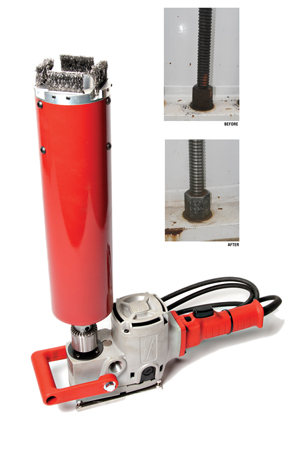
Cleaning the anchor bolts on a wind turbine tower for the purpose of re-tensioning and/or coating with a non-corrosive coating can be accomplished a number of ways. One of the most efficient and effective  methods used to clean rust from the anchor bolts is by using the Shipman Anchor Bolt cleaning tools.

Towers often vary  in the size of the bolt, nut and the distance of the bolt and nut from the side of the tower.  These dimensions are critical in the sizing of the tools in order to achieve maximum cleaning.  If grease is present on the bolts, Windrush and Shipman suggest that the bolts be power washed prior to cleaning with the brushes in order not to smear the grease and to keep the brushes from fouling with grease. 

The set consists of three tools: one to clean the bolt; one to clean the nut; and one to clean the top and base of the nut, washer, and tower base. This is accomplished by using a slow-speed one-half-inch electric drill with the Shipman tools. Estimated time to clean one bolt is approximately three minutes or less, depending on the condition of the fastener and the amount of rust present. The approximate amount of time to clean the typical tower with 160 bolts at three minutes per bolt would be approximately eight hours.  This time can be cut substantially by using a two or three man crew and working in succession. 

For more information about Windrush and the Shipman tools visit www.windrushllc.net or email us at sales@windrushllc.com.

PRODUCT SHOWCASE: Larson Electronics Introduces LED Work Light

0

For more than 40 years, Larson Electronics has supplied the industrial and commercial sectors with the latest in high-grade lighting technology and offers a host of lighting solutions ideal for wind farm projects. As professionals in the wind industry ramp up their efforts and increase productivity, they are finding illumination to play a larger and growing role in the safe and successful completion of projects. High-quality illumination is pivotal to maintaining a safe and efficient work site, and project managers can realize improved performance through the introduction of newer lighting technologies such as LEDs.

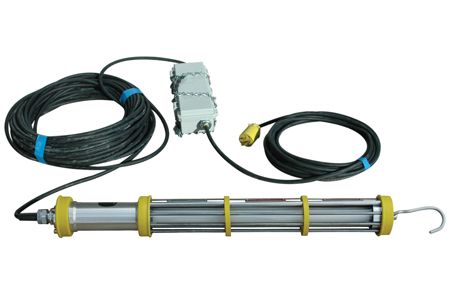
The Larson Electronics EPL-FL1524-LED-X24-100 Low Voltage LED work light provides an excellent choice for operators who need a rugged low voltage lighting solution capable of providing the quality illumination needed for detail oriented electrical and inspection related tasks associated with tower installation. This LED work light is designed similarly to fluorescent tube drop lights, but features a high output LED lamp assembly that virtually eliminates the potential for lamp failures due to rough handling without compromising light output or quality. Unlike incandescent hand lamps which produce yellowish light and a prodigious amount of heat, this LED work light produces clean white light that is ideal for close work such as joint inspection and wiring installation, and runs cool so workers can forget about accidental burns.

The EPL-FL1524-LED-X24-100 LED work light produces 1,450 lumens of light output without shadowing or beam irregularities and runs from 12 VDC current provided by an included waterproof step down transformer. The casing is formed from aluminum for durability and light weight, and an annealed glass tube cover with rubber bumper isolators provides rugged protection against abusive work conditions. 100 feet of abrasion resistant cord provides ample working length, and an integral aluminum hanging hook offers easy overhead mounting. This LED work light represents the next step in work lighting technology and provides the enhanced performance and durability needed for demanding construction environments.

Larson Electronics offers a wide variety of lighting solutions geared towards the industrial construction sectors and as a manufacturer can tailor equipment according the customers needs and requirements.

For more information about the EPL-FL1524-LED-X24-100,  or to view all of Larson Electronics’ lighting solutions, visit www.larsonElectronics.com, or call 800-369-6671 (domestic) or 1-903-498-3363 (international).

PRODUCT SHOWCASE: New Shaft Grounding Assembly Protects Again Premature Bearing Failure

0

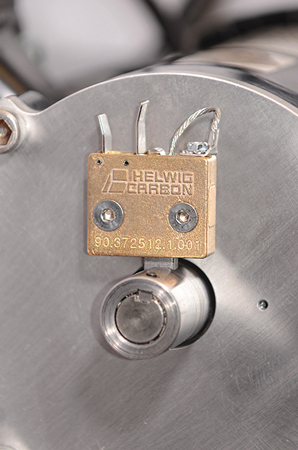
Helwig Carbon has announced the launch of a new line of shaft grounding systems to protect motors from bearing failure, a major cause of motor downtime. The stock kits fit most motors and various shaft sizes. They are easy to install, maintain, and work effectively in contaminated environments. Helwig’s grounding assemblies divert static and induced electrical currents in the motor shafts away from the bearings, protecting them from pitting and potential damage.

Several methods are available to reduce or eliminate the path the induced electrical currents can travel.  Among these Helwig’s Bearing Protector is a wise choice. The Helwig Bearing Protector is designed for a multi-year lifespan  while maintaining low shaft potential, minimizing your chance of having stray currents pass through the bearings.  The Bearing Protector is a cost effective way to keep shaft voltage to a minimum.

Helwig Carbon has over 85 years experience manufacturing precision machined carbon brushes, vanes, bearings, bushings, and seals. Helwig is one of the last American-owned carbon companies. They are known for fast, reliable service, high quality workmanship, and on-time deliveries.

For more information, or to download a .pdf file about the product, visit www.helwigcarbon.com/literature.html or call 414-362-6241.

PRODUCT SHOWCASE: Cleco Debuts Lighter, More Powerful, and More Durable Grinders

0

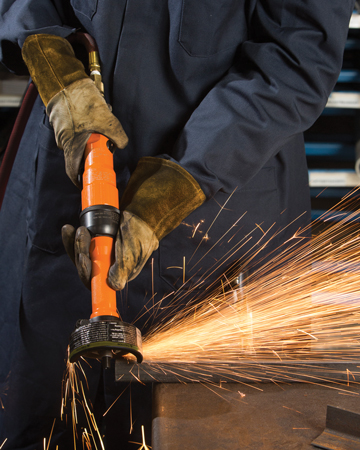
Cleco Tools, a business unit of Apex Tool Group, LLC, has  announced the new Heritage Series of material removal products. The new 216, 236, and 25 Series Grinders utilize the latest in advanced alloy materials and improved motor technologies to deliver industrial grinders that offer increased durability and power, yet are lighter and more capable than ever before.

The Cleco 216, 236, and 25 Series is engineered for heavy-use, industrial applications and built to deliver unmatched productivity and maximum material removal with minimum operator effort. Each series was precisely engineered to provide the power and durability required for the user’s application: Series 216, 0.7 HP; Series 236, 0.9 HP; Series 25, 1.4 HP. Now available in high visibility Cleco orange, the Heritage Series Grinders come in over 60 configurations. Compatible with industry standard abrasives, the Heritage Series Grinders offer configurations up to 1.4 HP and up to 25,000 rpm.

Key features include:

• Advanced lightweight alloy housing for durability and weight savings
• Motor technology delivers up to 27% more power without increasing tool size
• Power-to-weight ratio improved by as much as 114%
• High-visibility Cleco Orange product color
• Parts interchangeability with the Cleco Series 116, 136, and 15
• Designed, engineered and made in the USA

For more information on Heritage Series Grinders, visit www.clecotools.com,  or call  800-845-5629.